

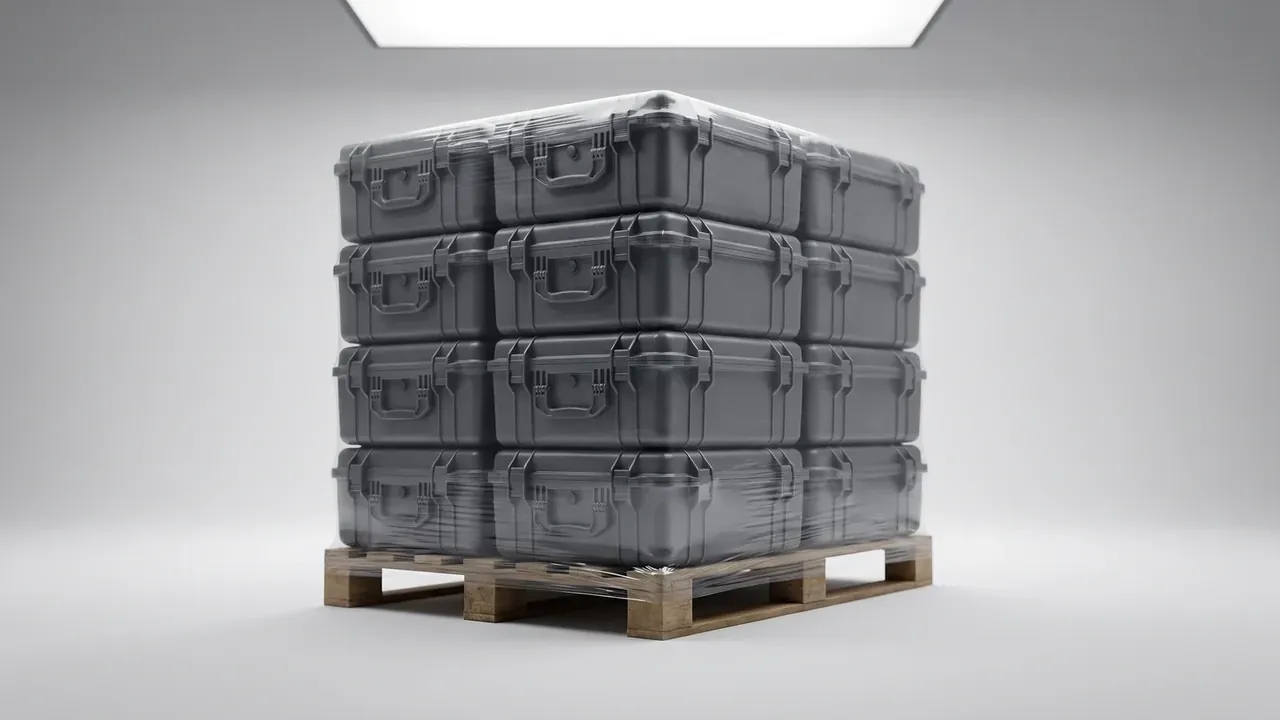
Quick answer: A Military Rotomolded Case is weighed against welded steel, aluminium frame with riveted panels, and one-way timber crates. The differences sit in empty weight, dent recovery, trip count and pallet fit. Fix the mission profile first, then compare those four items.
Table of contents
- Set the mission profile before comparing
- Against steel cases: weight and corrosion path
- Against aluminium frame cases: dents and field repair
- Against timber crates: cycles and pallets
- Four options on one whole-life sheet
- FAQ
1. Set the mission profile before comparing
Most comparison arguments fail because each side prices a different life. One team quotes a case that flies once and is handled four times; the other buys a body that sees five hundred cycles a year. Those numbers fix wall thickness and hardware.
Four numbers belong in the enquiry: payload per case, dominant transport mode, annual handling cycles, and storage range. Once fixed, wall thickness and hardware grade are largely locked.
| Profile item | Typical value | What it constrains |
|---|---|---|
| Payload per case | 18 to 35 kg | Handle rating, base ribs |
| Transport mode | Air plus road | Empty weight, stack height |
| Annual handling | 300 to 500 cycles | Latch and hinge life |
| Storage range | -40 to +60 C | Toughness, gasket hardness |
2. Against steel cases: weight and corrosion path
At 120 litres, a Military Rotomolded Case weighs 13.8 kg empty against 24.5 kg for cold-rolled steel. That 10.7 kg gap becomes 85 kg when a six-person team carries eight cases at once.
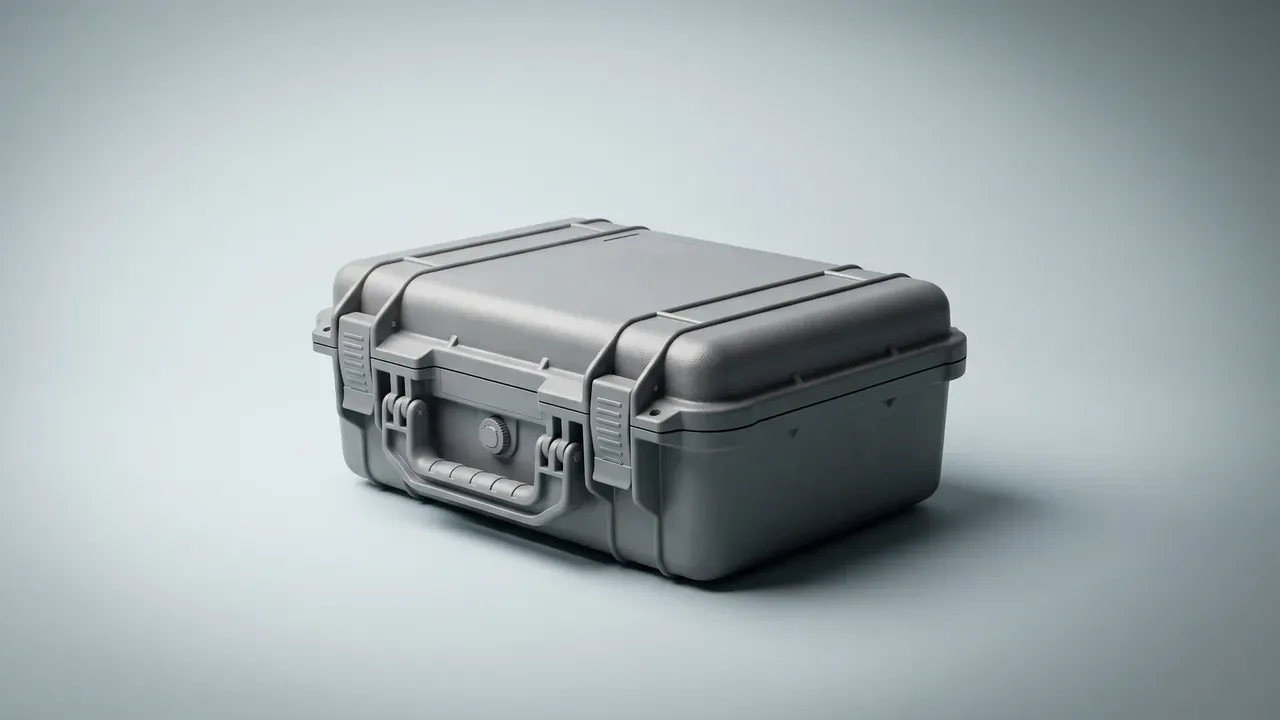
On steel, corrosion starts at folded edges and weld spots: after 168 hours of neutral salt spray, hinge pins and the inner fold show rust points. Repair means grinding to bare metal, then primer and topcoat; colour matching is never exact. Polyethylene has no metal substrate, so a scratch cannot start galvanic corrosion; the only ageing path is wall thinning.
| Item | Military Rotomolded Case | Steel case, 120 L |
|---|---|---|
| Empty weight | 13.8 kg | 24.5 kg |
| 168 h salt spray | No metal substrate | Rust at fold and hinge pin |
| Deep scratch | Check wall, weld if needed | Grind and repaint |
| End of life | Ground, 70 percent reusable | Sold as scrap |
3. Against aluminium frame cases: dents and field repair
An aluminium frame case uses 30 mm extrusion with 2.5 mm panels riveted on, so it is lighter, flatter. The weakness is local denting: a panel pressed by a case corner stops at about 3 mm and stays. In the field the only fix is a panel swap.
A 5.5 mm polyethylene wall behaves differently. Most blunt-edge dents spring back to within 1 mm in half an hour. Field repair is hot-air welding: a matching rod fuses into the groove at 220 C, a 60 mm split takes about 20 minutes, then a vacuum check. Swapping an aluminium panel means drilling out 40 rivets.
4. Against timber crates: cycles and pallets
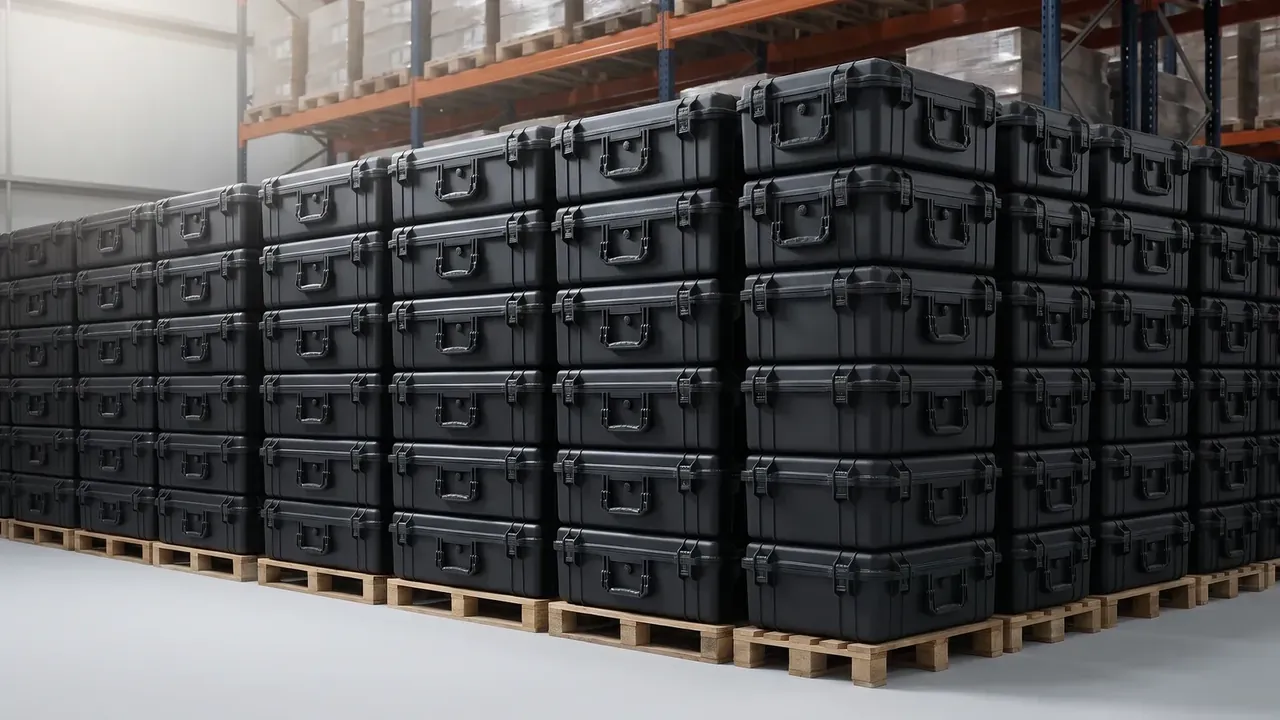
A Military Rotomolded Case is costed per trip, and 350 cycles is a normal life before the body is ground for reuse. The pallet interface is overlooked: a 100 mm forklift opening lets four cases cover a 1200 by 1000 mm pallet exactly, six high.
A timber crate wins on one point: cheap, no tooling. That price ignores fumigation, since solid wood needs 24 hours and a marked certificate. The 8.6 kg of board is scrap once the crate is opened.
5. Four options on one whole-life sheet
Unit price belongs last. Take 300 cases a year over five years and place price, tooling and trip count side by side.
| Option | Unit price | Tooling | Trips | Cost per trip |
|---|---|---|---|---|
| Military Rotomolded Case | 620 | 96,000 steel mould | 350 | about 1.9 |
| Steel case | 480 | 8,000 jigs | 80 | about 6.0 |
| Aluminium frame case | 1,580 | 15,000 jigs | 200 | about 7.9 |
| One-way timber crate | 95 | none | 1 | 95 |
The 96,000 steel mould must be absorbed in three years, so rotomolded bodies lose to steel below roughly 300 units a year. The aluminium case costs more but returns 200 trips, and on a high-cycle route panel swaps eat that advantage.
Conclusion
No single option covers every profile. Steel wins on entry price, aluminium on weight, timber on one-off cost, and the Military Rotomolded Case on 350 trips, dent recovery and a corrosion path with no metal substrate.
This article discusses only the container (case body) side of specifications and design intent, and does not cover any handling, loading or use of the contents.
Related Reading
- How a Military Rotomolded Case is built: five key points
- Rotomolded versus injection moulded cases
- Configurations for field and sea freight
- Material comparison for military packing boxes
Related Products
- 8 Series — Gun Cases; Military Equipment Cases; Camera Equipment Cases; Drone Cases; Watch Cases; Knife Cases; First Aid Cases; Electronics Equipment Cases
- WL8-2812 PP Gun Case — model WL8-2812
- All protective cases and toolboxes: 7 series, 158 models