

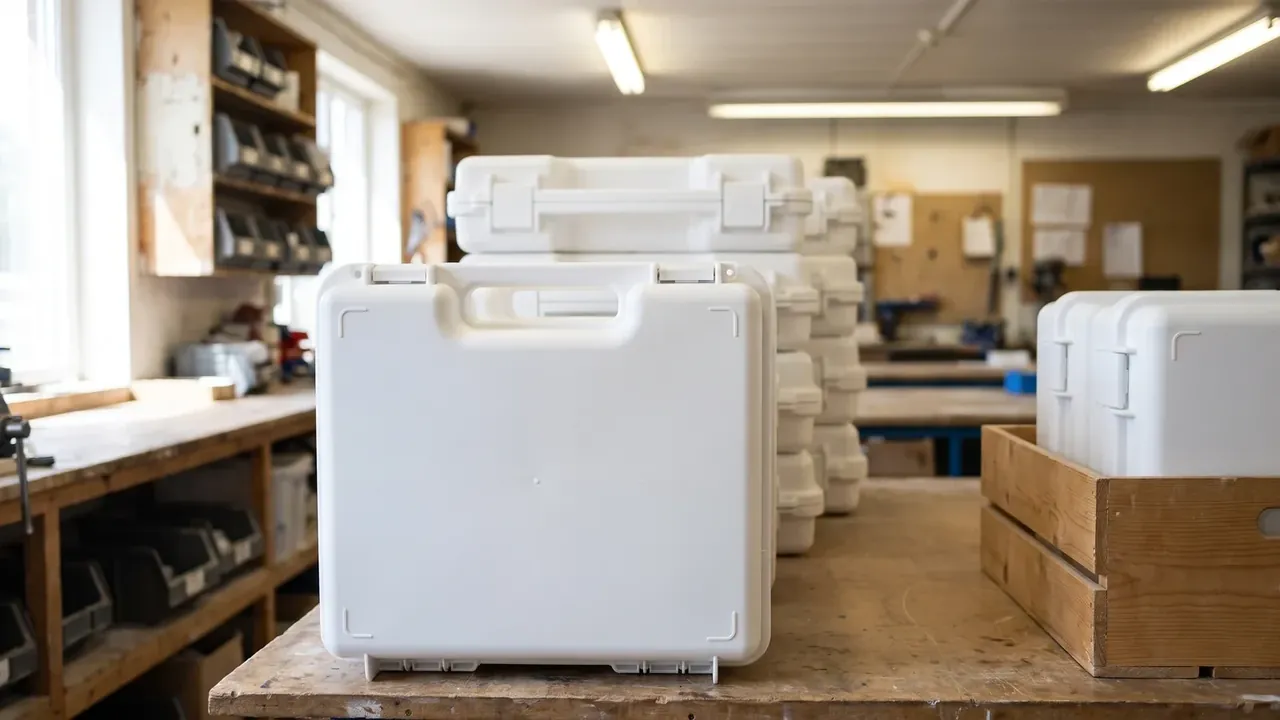
Quick answer: Choosing a military rotomolded case starts with five criteria rather than a catalogue: whether the cavity fits the load, whether sealing survives a pressure hold, whether weight and stacking both work, whether the temperature range covers the site, and whether sample validation runs in the right order.
Table of contents
- Start With the Internal Cavity
- Criterion Two: Sealing and Pressure Hold
- Criterion Three: Weight, Stacking and Handling
- Criterion Four: Temperature Range and Resin Grade
- Criterion Five: The Order of Sample Validation
- FAQ
1. Start With the Internal Cavity
Measure the cavity before arguing outside dimensions. A military rotomolded case runs 5 to 9 mm of wall, so the outside is often 60 to 80 mm larger, and a case picked by outside size may hold nothing.
| Criterion | Question to ask | Reference |
|---|---|---|
| Cavity size | Item plus cushioning | 780 x 480 x 380 mm |
| Usable volume | Space left clear | 118 litres nominal |
| Access direction | Top, side or drawer | Matches shelf height |
A 780 x 480 x 380 mm cavity is rated 118 litres; dividers and padding leave about 105 usable, and above 80 percent fill loading turns stiff. Access matters as much: on a 1.2 m shelf a side-opening case opens in place, at the cost of loaded hinges and a longer sealing path.
2. Criterion Two: Sealing and Pressure Hold
Sealing on a military rotomolded case is not decided by gasket thickness. Pressurise to 20 kPa, hold 30 seconds, and accept a drop of 0.5 kPa or less; that single test exposes low compression, an out-of-flat rim and uneven clamping.
| Test | Method | Reference line |
|---|---|---|
| Pressure hold | 20 kPa, 30 seconds | Drop of 0.5 kPa or less |
| Rain spray | 30 minutes on a turntable | No water inside |
| Immersion | 300 mm down, 10 minutes | No seepage |
Use 60 Shore A silicone at 25 to 30 percent compression, since past 35 percent the cord takes a permanent set. A case with a balance valve cannot be sold as airtight, so weigh the two by transport mode.
3. Criterion Three: Weight, Stacking and Handling
Weight and stacking pull against each other. A 118-litre case weighs 16.5 kg with a 45 kg rating, so three-high stacking puts 240 kg on the bottom unit; moving from 6 mm to 8 mm walls adds 2.4 kg of margin and lifting effort alike.
Forklift openings of 45 mm high by 200 mm wide are common, and below 40 mm a thin tine will not enter. Lifting points at the four corners keep a suspended case level, where two side points let it tilt. Two latches at 350 N suit this size; larger bodies need a third, or a gap opens mid rim.
4. Criterion Four: Temperature Range and Resin Grade
On a military rotomolded case the grade sets the range: resin holding impact at minus 40 °C costs more than a general grade that stops at minus 20 °C, and sustained 65 °C accelerates ageing, fading colour before impact strength.
A 1.2 m six-face drop without cracking is the room-temperature baseline, yet some grades chip at minus 30 °C. Hinge life of 5,000 cycles drops in cold, so cold sites justify stainless bushes and an 8,000-cycle check.
5. Criterion Five: The Order of Sample Validation
A military rotomolded case sample should not be judged by its finish first. Measure, then seal, then drop, and look at appearance last, because drop testing exposes weak points anyway.
| Step | What to check | If it fails |
|---|---|---|
| Dimension | Cavity, outside size, flatness | Over 1.5 mm, return it |
| Sealing | Pressure hold, rain spray | Check the rim first |
| Drop | Six faces and edges | Chipping means a grade change |
| Appearance | Shade, flow lines, sink marks | Reject only if assembly suffers |
Allow two rounds: structure and resin first, batch consistency second, with no mould change between them or the first round is void.
Conclusion
Selection compresses into one order for a military rotomolded case: measure cavity and access, test pressure hold, check weight against stacking, match temperature range to grade, then validate dimensions, sealing, drop and appearance. The first two decide whether it works; the last three decide how long. Written as a checklist, those five criteria beat browsing a catalogue, and they pick a military rotomolded case that fits the job.
This article discusses only the container (case body) side of specifications and design intent, and does not cover any handling, loading or use of the contents.
Related Reading
- Military rotomolded case versus alternatives
- Inspection items and replacement lines
- Basics of choosing a rotomolded case
- Pricing, minimum order and lead time
Related Products
- 8 Series — Gun Cases; Military Equipment Cases; Camera Equipment Cases; Drone Cases; Watch Cases; Knife Cases; First Aid Cases; Electronics Equipment Cases
- WL8-2812 PP Gun Case — model WL8-2812
- All protective cases and toolboxes: 7 series, 158 models