

Quick answer: Upkeep on one Military Supply Case runs about 41 CNY a year: inspection, cleaning, consumables and seal amortization, roughly 3.5 percent of purchase price. The real money sits in missed checks. Run a wall below 3.2 mm or a seal with 30 percent compression set and one water ingress starts at 110 CNY.
Table of contents
- Costing a Year of Military Supply Case Upkeep
- Inspection Cycles and Five Judgement Lines
- Cleaning and Touch-Up: What the Material Allows
- Repair or Replace: Where the Line Sits
- FAQ
1. Costing a Year of Military Supply Case Upkeep
Upkeep is not a lump sum. It splits into labour, consumables, wear-part amortization and marking refresh, and once those four are annual, a repair decision stops being a matter of opinion.
Take a store of 200 cases with labour at 30 CNY an hour. A 10-minute visual inspection four times a year costs 20 CNY; seal-face cleaning twice at 10 minutes adds 10 CNY; grease and paint take 4 CNY; a seal at 18 CNY amortized over three years gives 6 CNY; labels cost 1 CNY. The total is 41 CNY per case per year.
| Item | Frequency | Time per event | Annual cost |
|---|---|---|---|
| Visual inspection | 4 times | 10 minutes | 20 CNY |
| Seal-face cleaning | 2 times | 10 minutes | 10 CNY |
| Grease and paint | on demand | not timed | 4 CNY |
| Seal amortization | 1 per 3 years | 18 CNY over 3 years | 6 CNY |
| Labels and plates | 1 per year | not timed | 1 CNY |
| Total | — | — | 41 CNY |
Against a 1,180 CNY purchase price that is a 3.5 percent annual rate, roughly 205 CNY across a five-year life.
Rates drift on frequency, not unit price. Twelve inspections instead of four push labour from 20 to 60 CNY and more than double the annual figure.
2. Inspection Cycles and Five Judgement Lines
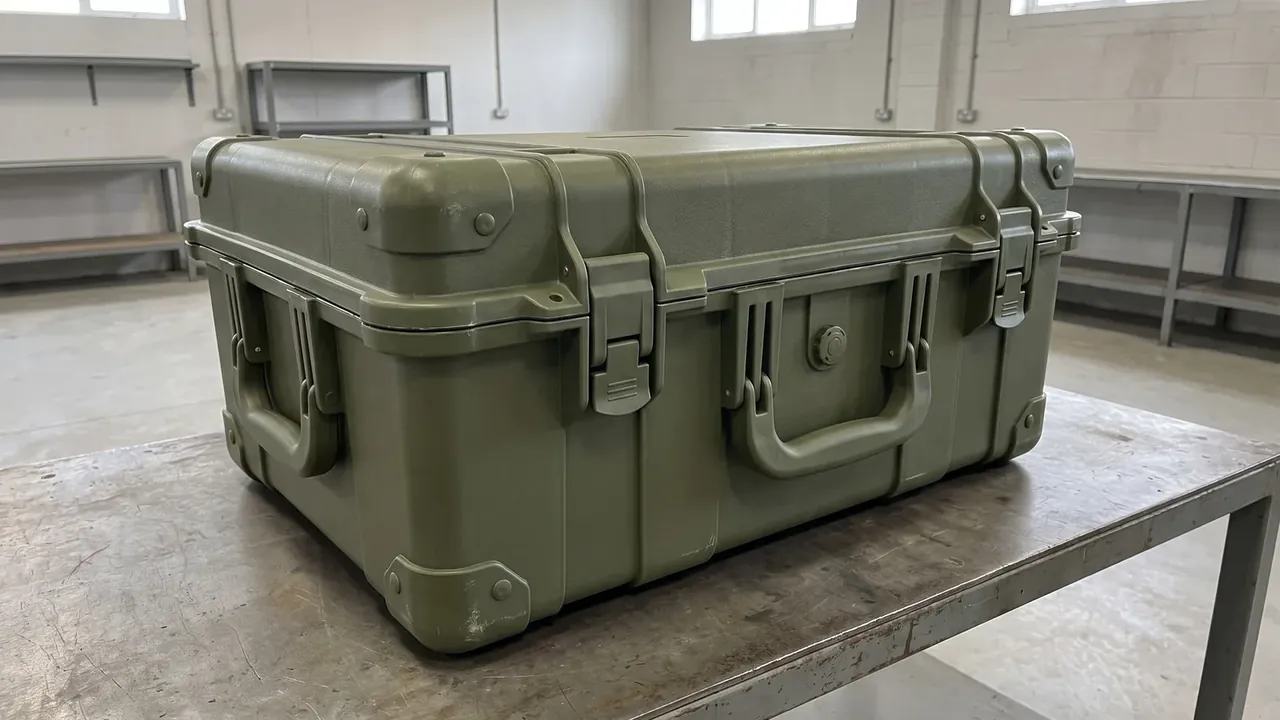
A Military Supply Case is inspected in three layers, each with its own interval and targets. Merge them and the usual result is a hundred looks at the shell and no wall reading at all.
Daily checks happen as cases are drawn: new cracks, latches that no longer close in one motion, whitened handles, grit in the seal groove. Nothing is opened; the case is released or held.
Quarterly checks reach the hardware: latch preload on a hand dynamometer, hinge-pin play by feel and feeler gauge, a seal taking over 3 seconds to spring back flagged as suspect. Only the annual check brings out an ultrasonic gauge, six points at long-edge midpoints, four corners and the base centre.
| Check | Pass line | Action when exceeded |
|---|---|---|
| Wall thickness, lowest of six points | 3.2 mm or more | stop use, downgrade the load rating |
| Seal compression set | 30 percent or less | replace the seal |
| Latch preload | 90 N or more | adjust or swap the latch |
| Hinge-pin play | 1.2 mm or less | replace the pin, not the case |
| Crack length | 15 mm or less, not through-wall | stop-drill; scrap if beyond |
Two of the five are hard lines, wall thickness and through-wall cracks, and they ground the case on the spot. The rest wait for planned service, which is what lets a storeman decide without escalating.
3. Cleaning and Touch-Up: What the Material Allows
Cleaning a Military Supply Case means removing grit and salt, not making it look new. Overdo it and the seal lip deforms first, after which water resistance is finished.
Four actions are allowed:
- Neutral detergent with a soft brush, water below 40 °C, rinsed clean afterwards
- Isopropyl alcohol on the seal groove and latch pivots, grease reapplied within 10 minutes
- Low-pressure wash on the outside, under 30 bar, kept off the seal groove face
- 240-grit sanding before touch-up, one patch no larger than 30 square centimetres
Four actions are not:
- Solvent cleaners such as acetone or xylene, which whiten HDPE and speed cracking
- Pressure washing the groove directly, where 80 bar flips the lip over
- Wire brushes and grinding wheels, whose deep scratches become crack starters
- Long passes with a heat gun, since a 4.5 mm wall softens above 120 °C
Touch-up is sealing, not cosmetics. Any scratch deeper than 0.5 mm gets paint, or salt spray creeps along it and blisters first in a 240-hour test.
4. Repair or Replace: Where the Line Sits
One criterion governs Military Supply Case upkeep: does the repair cost more than 40 percent of a new case? Forty percent of 1,180 CNY is 472 CNY, and most jobs land far under it.
The best value in life extension is the seal: 18 CNY buys two more years, pushing a five-year case toward seven. Corner caps follow at 25 CNY a set, delaying the forklift cracks that end a shell.
Three signals say replace: wall below 3.2 mm, a crack through the wall, or 3,000 hours of UV exposure that has chalked the surface. The first two are strength, the third is ageing, and neither paint nor sanding brings any of them back.
One cost never makes the ledger: downtime. A case held out for a week costs more in substitute transport and waiting than a new case does, so judgement lines should be written to be used.
Conclusion
Upkeep on a Military Supply Case is a curve set by two numbers: frequency from the duty cycle, judgement lines from the material. Write both down and the annual figure settles near 41 CNY; leave them to experience and the money migrates into rework after missed checks. Post the intervals and the five lines on the store wall, and a Military Supply Case moves from craft to process.
This article discusses only the container (case body) side of specifications and design intent, and does not cover any handling, loading or use of the contents.
Related Reading
- Inspection items and acceptance criteria for Military Supply Cases
- Maintenance intervals for war reserve cases
- Selection guide for military supply transport cases
Related Products
- 8 Series — Gun Cases; Military Equipment Cases; Camera Equipment Cases; Drone Cases; Watch Cases; Knife Cases; First Aid Cases; Electronics Equipment Cases
- WL8-2812 PP Gun Case — model WL8-2812
- All protective cases and toolboxes: 7 series, 158 models