

Quick answer: Most fit questions about a military supply case can be settled at the receiving dock with a tape measure, a caliper and a hanging scale: four internal dimensions, three wall readings, one loaded hang test.
Table of contents
- Four Internal Dimensions Come First
- Wall Thickness Is the Only Strength Number You Can Read on Site
- Latch Count and Handle Position Decide How It Is Carried
- Rule Out Three Types Before You Score Anything
- FAQ
1. Four Internal Dimensions Come First
Buyers compare the outside of a military supply case with a pallet or a truck bed, then find at loading that the divider set will not go in. Rotomoulded bodies carry ribs, corner caps and a moulding seam, so a 36 mm gap between outer and inner length is normal.
Measure against the inside of the base, four positions, and keep the smallest reading.
| What to measure | How | Difference people miss |
|---|---|---|
| Internal length | Wall to wall, clear of radii | 36 mm longer outside |
| Internal width | Centre and both ends, take the minimum | Ribs narrow ends by 4 mm |
| Internal height | Base floor to lid ceiling | A recessed lid costs 12 mm |
| Usable height | Subtract foam and divider thickness | 20 mm of foam eats one divider slot |
When internal length and width divide into the 600 mm by 400 mm logistics module, two cases sit side by side on a standard pallet without overhang.
Wrong dimensions make every later argument pointless.
2. Wall Thickness Is the Only Strength Number You Can Read on Site
A caliper is the cheapest argument in the room. On a rotomoulded military supply case, 3 mm of sidewall is the floor; below that the body bulges at mid-height once stacked while loaded.
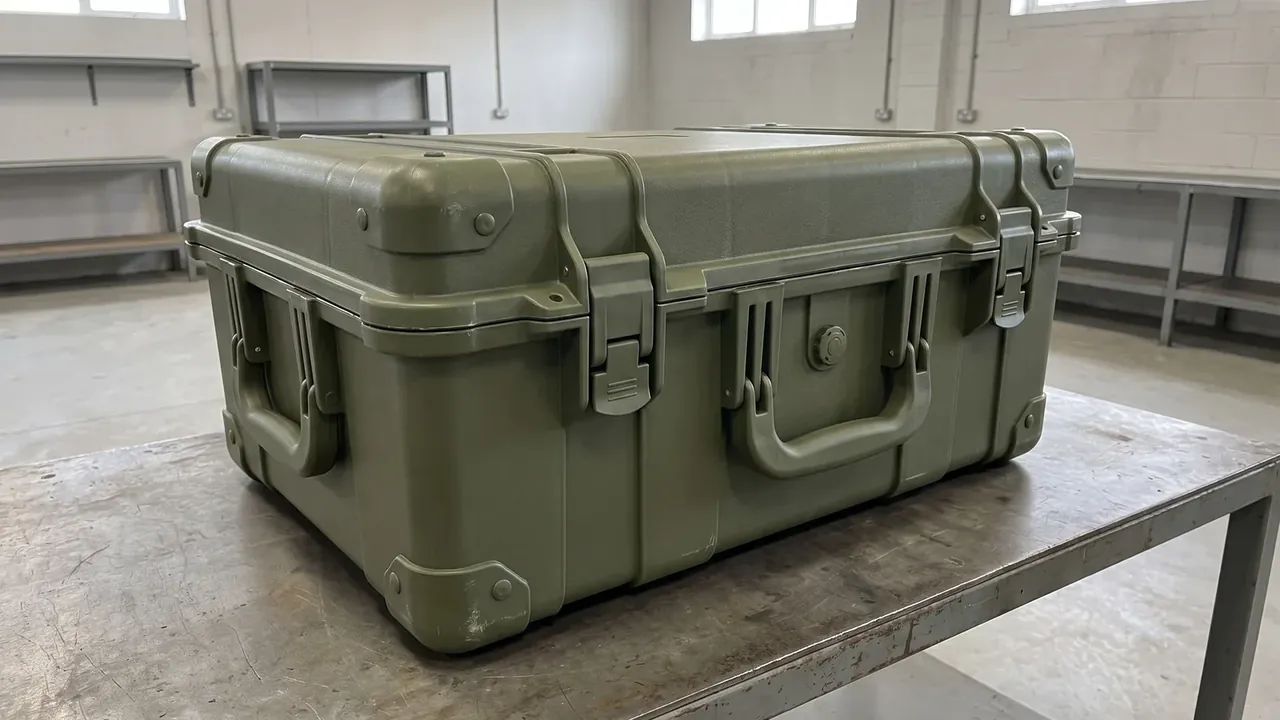
Take three readings: mid-sidewall, the transition beside a corner cap, and the centre of the base panel. A spread above 0.4 mm points to an uneven mould temperature field or uneven powder flow, and that weak spot cannot be predicted from a drawing. Readings between 3.0 and 3.6 mm with a 0.2 mm spread indicate a controlled process.
Weighing backs up the caliper: two units of the same outer size that differ by 1.5 kg in tare differ in wall or rib structure, not pigment.
Thickness you can read. Load rating you have to test.
3. Latch Count and Handle Position Decide How It Is Carried
A 40 kg loaded military supply case is lifted by two people on the side handles, dragged by one person on base wheels, and picked by a forklift at the base slots. Those three actions fight each other: handles pull load into the walls, wheels need holes in the same floor panel, and slots cut stiffness out of it. Turning the case over at a trade show settles the question faster than ten minutes of talking. Once the handling method is fixed, handle height, latch count and base structure have little freedom left.
Try three actions instead of reading three pages of data.
| Where | Action | Pass line |
|---|---|---|
| Latches | Close three times with one hand | The third close still needs pressure; a 0.5 mm feeler will not enter the lid seam |
| Handles | Hang 40 kg for 10 minutes | No whitening at the handle root, no wall deformation |
| Hinge | Open to 90 degrees and release | Lid droop no more than 5 mm |
More latches is not better. Four latches split between the ends of the long side spread sealing pressure evenly; six bunched at mid-length let both ends lift.
4. Rule Out Three Types Before You Score Anything
Site time is short, so treat the comparison as elimination, not scoring.
- Not enough internal height: if usable height after foam sits 15 mm below the tallest item, walk away. A taller body is cheaper than a rebuilt insert.
- Wall readings that jump: a 0.4 mm spread, or any point under 3 mm, means the process is uncontrolled. Skip the trial batch.
- Mixed sources: a bought-in latch with a moulded-in handle differs by an order of magnitude in failure load, and the weaker part fails first.
Fit comes next: largest single item, tie-down spacing on the vehicle, shelf clear height. Those three set the final specification, not the stock list.
Three tiers is the default stack height, and the top case must carry 180 kg. Two loaded cases stacked for 30 minutes approximates it; a lid sagging past 3 mm means fewer tiers.
Conclusion
Choosing a military supply case means fixing the handling method, the payload and the stack height first, then checking four internal dimensions, three wall readings and the latch layout. A tape measure, a caliper and a scale say more than any brochure. Bring the three tools to the dock and every military supply case becomes a set of readings you can check again next year.
This article discusses only the container (case body) side of specifications and design intent, and does not cover any handling, loading or use of the contents.
Related Reading
- Military supply transport case selection: volume, load and transfer mode
- The specification layers of a military supply case: resin, colour and markings
- Military supply case inspection: appearance, sealing and drop
Related Products
- 8 Series — Gun Cases; Military Equipment Cases; Camera Equipment Cases; Drone Cases; Watch Cases; Knife Cases; First Aid Cases; Electronics Equipment Cases
- WL8-2812 PP Gun Case — model WL8-2812
- All protective cases and toolboxes: 7 series, 158 models