

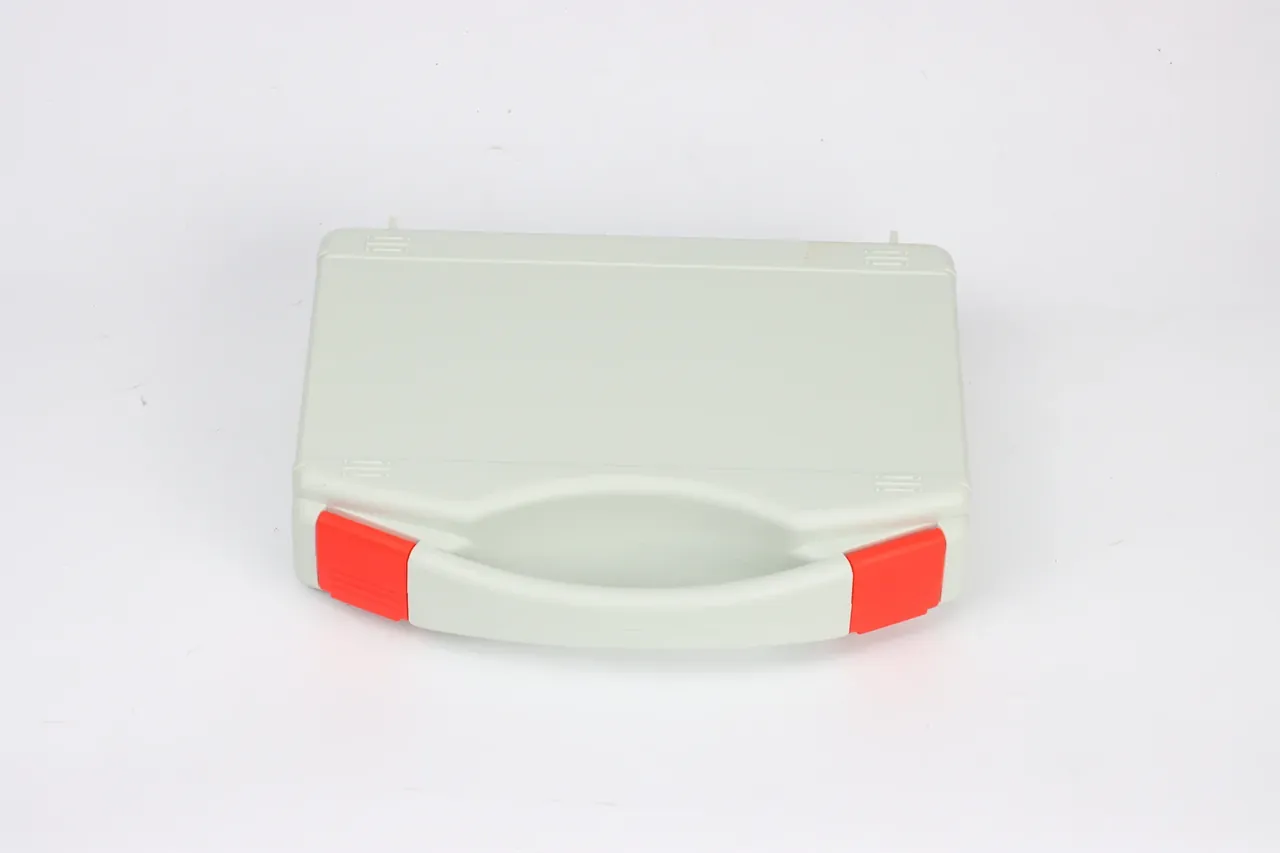
Quick answer: Acceptance of a Military Supply Case reduces to three countable things: 12 check items, three verdict lines and four disposal routes. Items decide what is measured, lines decide pass or reject, routes decide where a failed unit goes.
Table of contents
- Three Document Lines Behind the Verdict
- Twelve Check Items and How to Read Them
- Where the Verdict Line Sits
- Rework, Downgrade and Batch Quarantine
- FAQ
1. Three Document Lines Behind the Verdict
The floor argument is rarely about the gauge; it is about which document you judge against.
Three lines do it. The technical agreement carries special requirements: resin grade, colour code, nameplate content. Referenced standards carry method and level, such as MIL-STD-810H Method 516 for drop, ASTM B117 for 480 hours of salt spray, IEC 60529 for IP67 immersion. The drawing carries dimensions, tolerances and measuring points.
| Rank | Document | Governs |
|---|---|---|
| First | Technical agreement | Grade, colour, nameplate, packing |
| Second | Product drawing | Dimensions, tolerances, measuring points |
| Third | Referenced standard | Method, level, judgement condition |
Write that order into the plan with two hold points: no inspection before the material certificate, no drop test before the seal test.
2. Twelve Check Items and How to Read Them
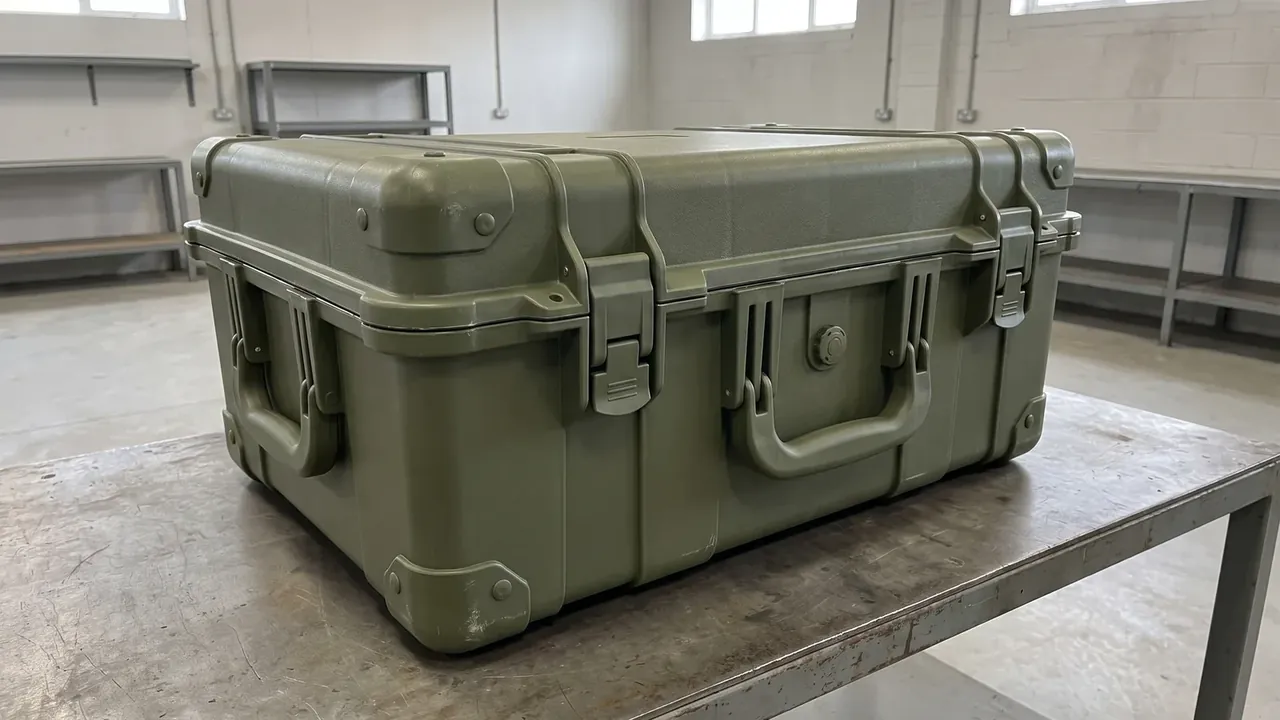
The twelve items split by consequence: A loses protection or traceability, B loses fit and consistency, C affects only appearance.
| No. | Item | Class | Instrument and reading |
|---|---|---|---|
| 1 | Material certificate | A | Grade, batch, COA |
| 2 | Wall thickness | A | Ultrasonic, 8 points, over 90 percent of nominal |
| 3 | Sealing | A | 15 kPa held 120 s, drop under 0.3 kPa |
| 4 | Drop | A | 0.9 m, corner, edge, face |
| 5 | Latch retention | B | Pull gauge, at least 420 N |
| 6 | Flatness | B | 300 mm straight edge, feeler under 1.2 mm |
| 7 | Colour difference | B | Colour meter at D65, under 1.5 |
| 8 | Marking | B | Cross-cut, 5B, no lift |
| 9 | Hardware torque | B | 5 N·m, no stripping |
| 10 | Appearance | C | Flash under 0.3 mm |
| 11 | Cleanliness | C | White cloth wipe, no oil |
| 12 | Packing | C | Count and label |
Item 2 drifts most. Press the probe onto a rib and the reading runs high, so put the eight points on the flat field between ribs; a Military Supply Case wall read on a rib flatters the batch.
3. Where the Verdict Line Sits
A verdict line is a release rule, not a pass mark. Class A is judged at Ac zero, so one failure rejects the batch; class B runs at AQL 2.5 and class C at AQL 4.0. A batch of 151 to 280 units draws 32 samples.
| Class | AQL | Samples | Verdict |
|---|---|---|---|
| A | 0.65, Ac zero | 32 | One failure rejects the batch |
| B | 2.5 | 32 | Up to 2 failures accepted |
| C | 4.0 | 32 | Up to 3 failures accepted |
Concession on a Military Supply Case is a narrow door beside the line, not a routine channel. It applies only when the defect affects neither sealing and load, nor traceability, nor assembly. Volume is capped at 5 percent of the batch, never carried across batches, and needs design and quality signatures.
Three conditions never qualify: wall below 90 percent of nominal, seal drop above 0.3 kPa, latch retention under 420 N.
4. Rework, Downgrade and Batch Quarantine
Quarantine comes first. A rejected Military Supply Case leaves the inspection area within 24 hours, red tag on, its own location, never on a rack with released stock.
Four routes follow, chosen by the nature of the defect:
- Rework: flash, burrs or shifted marking, followed by a full re-check
- Repair: repairable but irreversible defects, with a written plan and a repeat seal test
- Downgrade: one protection class lower, re-marked and booked separately
- Scrap: wrong material or seriously thin wall, scrapped with photo records
Batch boundaries matter more than tags. One cavity, one grade, one colour and 24 consecutive hours define a batch; quarantine follows the batch, not the failure count, because units nobody measured are the ones that escape.
Conclusion
Acceptance of a Military Supply Case fixes three things: 12 items fix what is measured, three lines fix accept or reject, four routes fix where failures go. A batch then rests on a plan that can be re-audited, not on one inspector, which is how a Military Supply Case programme stays predictable.
This article discusses only the container (case body) side of specifications and design intent, and does not cover any handling, loading or use of the contents.
Related Reading
- Packing standards and marking rules
- Acceptance: appearance, sealing and drop
- Inspection standards for air transport
Related Products
- 8 Series — Gun Cases; Military Equipment Cases; Camera Equipment Cases; Drone Cases; Watch Cases; Knife Cases; First Aid Cases; Electronics Equipment Cases
- WL8-2812 PP Gun Case — model WL8-2812
- All protective cases and toolboxes: 7 series, 158 models