

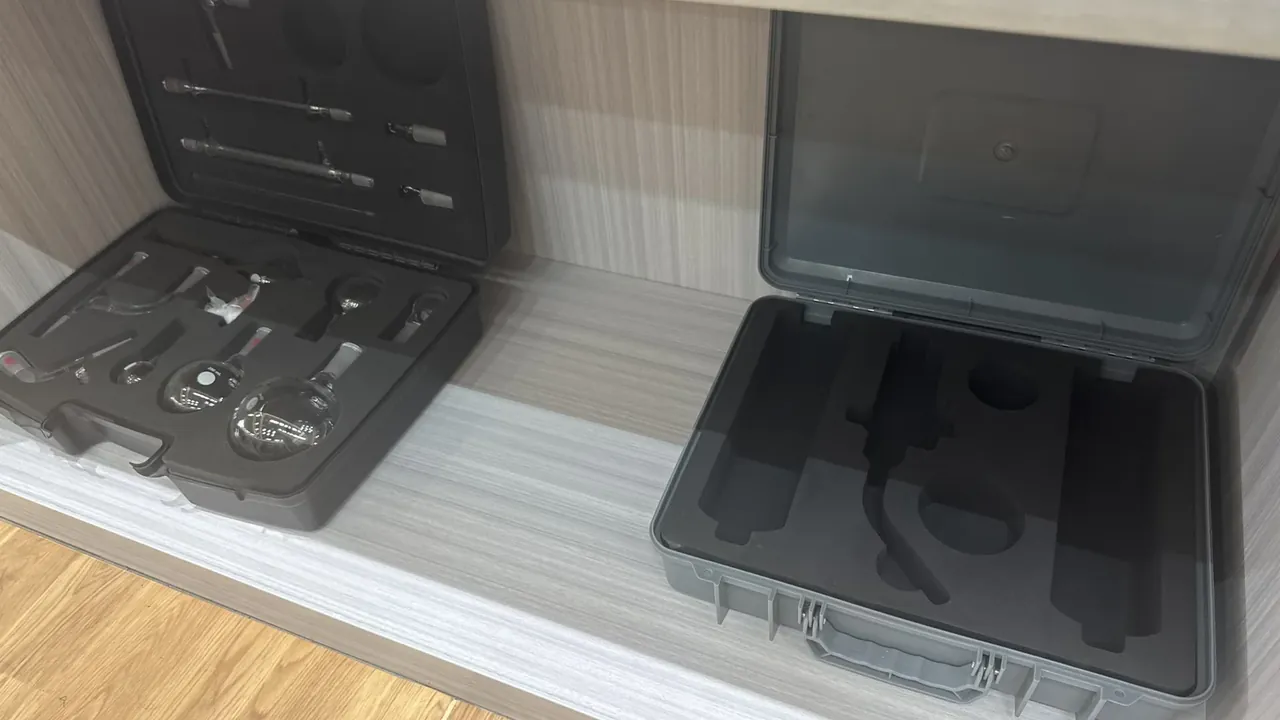
Quick answer: Maintenance on a Military Supply Transport Case is mostly measurement, not repair. Give every item a reading and a replacement line: gasket by compression set, latch by retention force, body by crack position, label by months in service. Four lines that can be measured, logged and repeated turn habit into a rule.
Table of contents
- How Often a Military Supply Transport Case Should Be Checked
- Gaskets: Measuring Compression and Rebound
- Latch Retention and Hinge Play
- Judging Cracks in the Case Body
- Marking, Cleaning and the Replacement Line
- FAQ
1. How Often a Military Supply Transport Case Should Be Checked
Failure arrives in stages: gasket rebound, then latch retention, then body cracks. Split those stages across intervals and each defect is handled before it becomes a leak.
| Interval | Item | Tool | Line |
|---|---|---|---|
| Every issue | latch, lid fit, label | eye and hand | one side lifting under 1 mm |
| 90 days | gasket dents, corner cracks | eye and feeler | no through crack |
| 12 months | compression set, retention | caliper, load cell | set under 20 percent, over 300 N |
| After impact | body cracks, hinge play | loupe and feeler | crack under 15 mm |
Log date, reading and action: a check without a reading did not happen.
2. Gaskets: Measuring Compression and Rebound
The gasket is the shortest-lived part on a Military Supply Transport Case and the only item measured in fractions of a millimetre. Compression belongs between 25 and 30 percent: below 25 it never seals, above 30 it stays loaded and loses rebound. Hardness near 55 Shore A is typical.
| State | Compression set | Rebound | Action |
|---|---|---|---|
| Normal | under 15 percent | within 1 s | keep in service |
| Watch | 15 to 20 percent | 1 to 3 s | retest at 90 days |
| Replace | over 20 percent | over 3 s | fit a new gasket |
| Stop use | any | any, with a through crack | replace and retest |
Three steps: a caliper on groove depth and bead thickness, a feeler gauge around the rim for gaps, a thumb press with a stopwatch for rebound. Fit the new bead unstretched with 1 percent allowance, joint opposite the hinge, then hold 60 seconds; a drop under 1 kPa passes.
3. Latch Retention and Hinge Play
On a Military Supply Transport Case the latch is the only metal part taking impact. A new case is accepted at 450 N, and 300 N in service is the replacement line: below it the hook slips in a drop.
Hinge play on a Military Supply Transport Case is a feeler gauge job, and 0.8 mm calls for action: pin wear and an ovalised seat let the lid shift fore and aft, which over-compresses the gasket on one side and starves the other, so water enters where the gap is widest.
4. Judging Cracks in the Case Body
Position decides the verdict on a Military Supply Transport Case. Within 20 mm of the sealing face no crack is acceptable, since a repair cannot be guaranteed to seal. At the corners, a crack under 15 mm and a fifth of wall thickness may be closed with a weld rod.
Read the rule as length, depth and position, with a steel rule, a loupe and a probe. Any one over the line retires the case, because a crack on a loaded corner runs along the weld edge. After a drop, add the diagonals: over 3 mm means the body has twisted and the seal has failed with no crack visible.
5. Marking, Cleaning and the Replacement Line
Labels are replaced every 24 months, or after 3,000 hours of UV. A dead label is not cosmetic: with the number unreadable the packing list no longer matches and handover means counting items.
| Agent | Where it is safe | Damage when misused |
|---|---|---|
| Neutral detergent, pH 6 to 8 | body, gasket | none |
| 70 percent alcohol | label, latch | ink lifts with wiping |
| Acetone, xylene | not used | chalking, stress cracking |
| Chlorinated disinfectant | not used | pitting, hardened gasket |
Clean with a neutral agent at pH 6 to 8 and water under 40 degrees Celsius, rinse and dry. Acetone, xylene, chlorinated solvents and caustic above pH 11 attack polypropylene, and the crack starts where the cloth passed.
Four lines: gasket set over 20 percent, latch under 300 N, a crack on the sealing face, diagonals out by 3 mm. Any one stops the case; other wear is repaired.
Conclusion
Maintenance earns its keep by moving every replacement ahead of failure: gasket by set, latch by force, body by crack position, label by months. Write all four as readings and judgement stops depending on the most experienced hands. A year of records shows how much life a Military Supply Transport Case has left.
This article discusses only the container (case body) side of specifications and design intent, and does not cover any handling, loading or use of the contents.
Related Reading
- Acceptance standards for a Military Supply Transport Case
- Service intervals for reusable shipping containers
- Preventing impact damage in case storage
- Case specifications: size, wall and load
Related Products
- 8 Series — Gun Cases; Military Equipment Cases; Camera Equipment Cases; Drone Cases; Watch Cases; Knife Cases; First Aid Cases; Electronics Equipment Cases
- WL8-2812 PP Gun Case — model WL8-2812
- All protective cases and toolboxes: 7 series, 158 models