

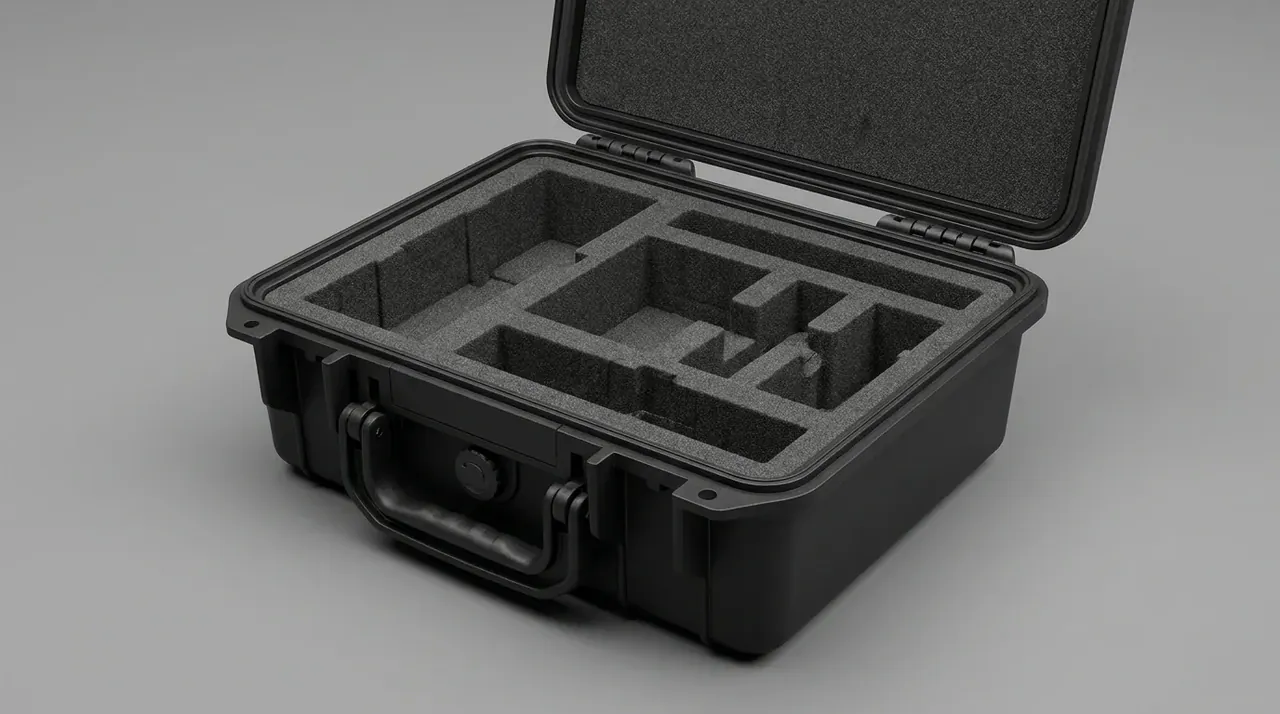
Quick answer: Military weapon ammo case sealed hard shell: 1 150 x 400 x 160 mm, 7.5 kg empty, 5.0 mm wall, 0.8 mm texture, four 500 N latches, 15 kPa valve.
Table of contents
- Three surface zones on one Military weapon ammo case sealed hard shell
- What 0.8 mm of texture buys and what it costs
- How 1 150 mm of lid is shared between four latches
- The 15 kPa valve and the 8 mm gasket
- Three-high stacking at 150 kg and 96 h of salt spray
- FAQ
1. Three surface zones on one Military weapon ammo case sealed hard shell
The texture comes out of the mould, so no paint step follows. A Military weapon ammo case sealed hard shell measures 1 150 x 400 x 160 mm outside and 1 100 x 350 x 120 mm inside, with 5.0 mm walls, the etched mould face transferring as the shell cools. The surface is deliberately uneven: lid and base faces take a fine matte at 3 mm pitch and 0.8 mm depth, the four edges a coarser pattern with R6 rounds, and the gasket groove, latch seats and label pad stay smooth. A matte grips a hand but not a gasket: its peaks and valleys leave micro-channels across the sealing face, and a 1 m / 30 min head follows them inward.
That line lives in the mould, not in tape; moving it means re-etching the tool, about 3 weeks.
| Surface zone | Texture and structure | Value |
|---|---|---|
| Lid and base faces | fine matte, 3 mm pitch, etched in mould | 0.8 mm deep |
| Four edges | coarser pattern plus R6 round, added stock | 5.0 mm wall |
| Gasket groove floor | smooth, ground flat | 0.4 mm flatness |
| Latch seats | smooth, three 2 mm ribs behind | 6.0 mm thick |
2. What 0.8 mm of texture buys and what it costs
An 0.8 mm depth is a compromise, and the cost runs both ways. Dry-handed the matte lifts friction from 0.35 to 0.55, so a gloved carry of a Military weapon ammo case sealed hard shell slides 1 mm instead of 4 mm. Cleaning pays for it: valleys 1.5 mm wide and 0.8 mm deep need two passes with a 4 MPa lance, where a 0.4 mm pattern clears in one. Wet, the matte turns slicker, because water fills the valleys and friction drops to 0.30.
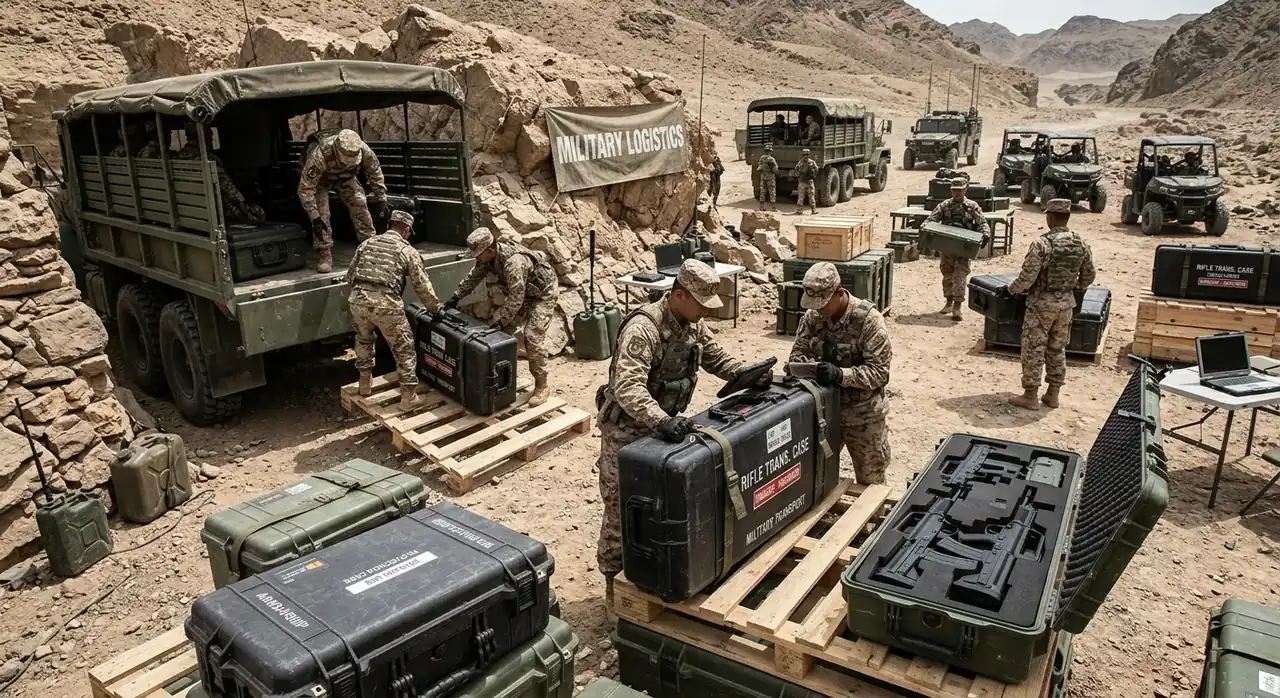
Scratch appearance is the second reason. A 0.2 mm gouge on a smooth shell reads from 300 mm away, while the same force on the matte of a Military weapon ammo case sealed hard shell breaks the ridges into flecks that vanish at 1 m.
3. How 1 150 mm of lid is shared between four latches
The longer the lid, the harder the edge is to clamp. On a Military weapon ammo case sealed hard shell the lid is 1 150 mm long and carries four latches, spaced unevenly on purpose: the outer two sit 60 mm from each end and the inner two split the remaining 1 030 mm into two 343 mm bays. Corners borrow stiffness from the side walls, while the middle bay relies on lid bending alone. At 15 kPa across a 0.46 m² lid the mid-span sags 1.2 mm, and an 8 mm gasket at 25% compression offers 2.0 mm.
| Latch position | From end face | Share of edge load |
|---|---|---|
| Latch 1 | 60 mm | 28% |
| Latch 2 | 403 mm | 22% |
| Latch 3 | 746 mm | 22% |
| Latch 4 | 1 090 mm | 28% |
Each latch is rated 500 N, so four give 2 000 N against roughly 6 900 N of lid force. A Military weapon ammo case sealed hard shell latch holds a local lift, not the whole pressure: in a 1.2 m drop the two front latches see 380 N each.
4. The 15 kPa valve and the 8 mm gasket
The relief valve on a Military weapon ammo case sealed hard shell opens at 15 kPa, one step below what the gasket can survive. Warming from −40 ℃ to 70 ℃ expands trapped air by 47% at constant pressure; with the valve shut, that 47% crushes the 8 mm gasket below 25% and it loses its rebound.
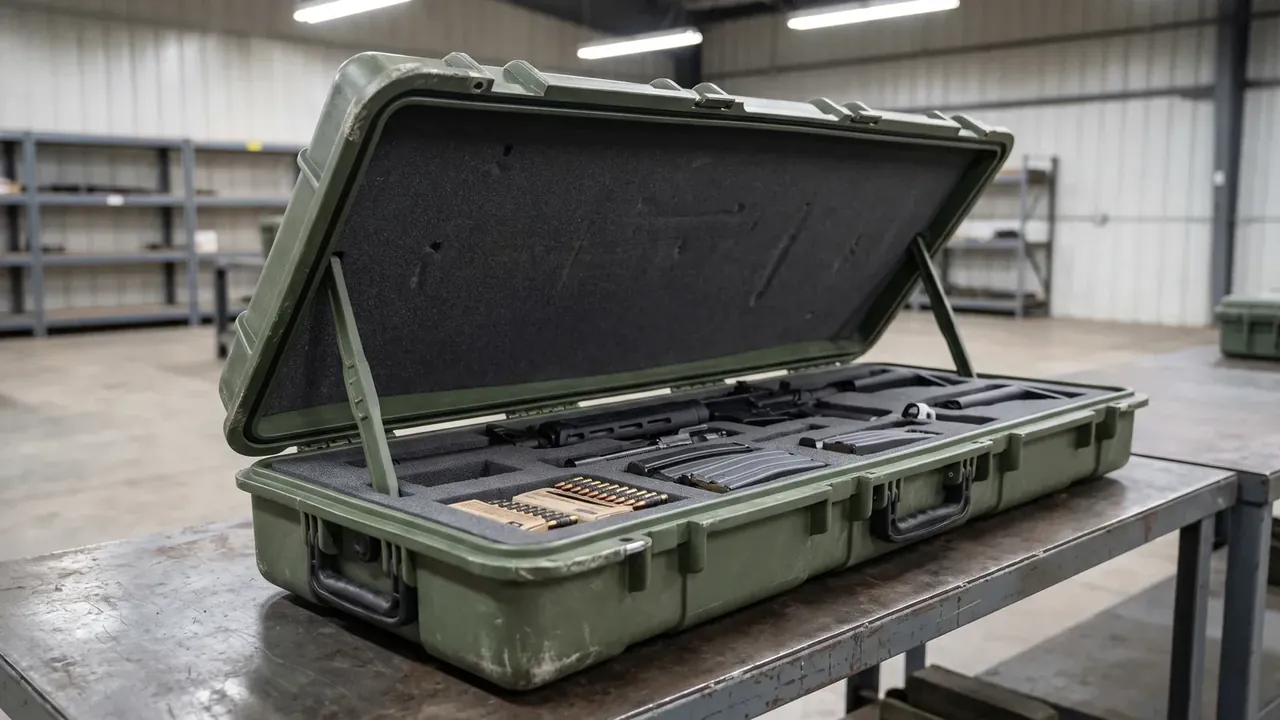
Left overnight in the cold, the same shell sits under vacuum, and at −3 kPa the 0.46 m² lid needs 1 380 N to break the seal. Hence the screw-type valve: two turns to bleed air in before the latches are flipped.
The gasket section is 8 mm in a 16 mm groove at 25% compression, which is 2.0 mm. Below 20% a 1 m / 30 min head finds the edge; above 35% the gasket takes a permanent set.
5. Three-high stacking at 150 kg and 96 h of salt spray
Stacking tests the lid, not the base. Three high puts 150 kg on the lid of the bottom case, the two above at 75 kg each, and after 24 h the mid-span takes a 0.9 mm set.
| Check | Condition | Pass line |
|---|---|---|
| Sealing | 1 m head, 30 min | no water inside |
| Drop | 1.2 m, one per face | latches shut, shell intact |
| Thermal | −40 ℃ to 70 ℃, 4 h each | no permanent gasket set |
| Salt spray | neutral, 96 h | no red rust at the scribe |
| Stacking | 150 kg, 24 h | set 1.5 mm or less |
Salt spray at 96 h attacks ridges before flats: a ridge 0.8 mm tall and 1.5 mm wide holds a film that dries fast, so salt crystallises along the ridge-to-valley line, and a 0.2 mm cut through a 5.0 mm wall is where corrosion starts. At −40 ℃ that wall keeps about 55% of its impact strength.
Conclusion
The texture on a Military weapon ammo case sealed hard shell is not decoration. At 0.8 mm it lifts friction to 0.55 and breaks a scratch into flecks; the 1 150 mm lid keeps 0.8 mm of margin on four 500 N latches; the 15 kPa valve absorbs the 47% volume change.
Related Reading
- How military gun case wholesale volumes are quoted
- Reading the waterproof rating of an ammo box
- What MIL-STD-810H actually tests
- The six-face order of a drop test
Related Products
- 8 Series — Gun Cases; Military Equipment Cases; Camera Equipment Cases; Drone Cases; Watch Cases; Knife Cases; First Aid Cases; Electronics Equipment Cases
- WL8-2812 PP Gun Case — model WL8-2812
- All protective cases and toolboxes: 7 series, 158 models