

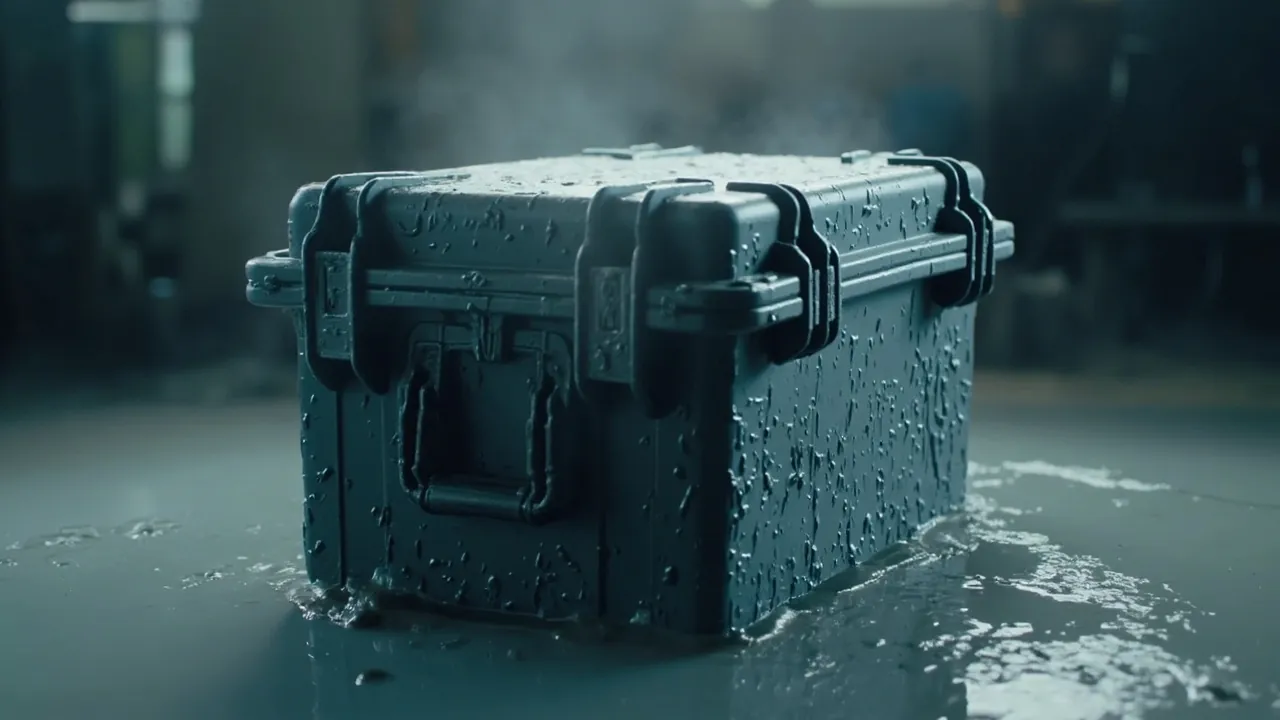
Short answer: there is no single waterproof rating for ammo boxes. Civil protective cases are usually labelled with an IP code under IEC 60529, which corresponds to the Chinese standard GB/T 4208-2017, and the common level is IP67. Military-specification cases are more often validated against methods in MIL-STD-810H, such as Method 506 for rain, and are not labelled with a single IP code. The two are not the same language. An IP code describes whether water enters under a defined flow or immersion condition for a defined time, a reproducible grading. A military standard describes whether packaging protects its contents under simulated climate and transport environments, a scenario-based pass or fail. So when you see "IP67 military waterproof case", two systems have been layered together: IP67 is the civil protection grade, while military is the application scenario or an additional validation. Understanding this prevents using a civil grade to infer military performance, and explains why two products both called "waterproof" can differ several times in price. This article breaks down each digit of the IP code, compares it with the rain method of MIL-STD-810H, and covers sealing structure, pressure valves, failure points and verification.
A common procurement puzzle is that a supplier says "waterproof" without stating to what level, for how long, or under what conditions it was tested, or supplies an IP67 report that cannot be tied to the delivered product. Water resistance is a conditional performance, and "waterproof" without test conditions cannot be accepted. This article compares the judgement logic, test methods, common failure causes and documentation requirements of the two systems, so that engineering and procurement staff can turn "waterproof rating" from an adjective into a quantified specification that can be written into a technical agreement, reproduced and accepted.
Table of Contents
- Short Answer: No Single Rating, Two Languages
- Reading the IP Code: IEC 60529 and GB/T 4208-2017
- The First Digit: Dust Protection Is Easily Overlooked
- What IPX4, IPX5, IPX6, IPX7 and IPX8 Really Mean
- Military Waterproof Requirements: MIL-STD-810H Method 506
- Five Differences Between Civil IP and Military Standards
- How Sealing Structure Determines the Rating: O-rings, Grooves and Compression
- Pressure Equalisation Valves: Why a Sealed Case Still Breathes
- Waterproof Rating Lookup Table
- How to Verify: Type Testing, Sampling and Field Checks
- Common Failure Points and Causes
- IP67 Is Not Long-Term Immersion: Limits of Time and Temperature
- Customisation and Selection: Setting the Rating from the Application
- FAQ
- Conclusion and Related Reading
Short Answer: No Single Rating, Two Languages
Treating "what waterproof rating does an ammo box have" as a question with a standard answer is the most common trap in procurement. The right mindset is to ask first which system is being used, then what level, and finally what the test conditions were.
Civil protective cases follow the IP system. IEC 60529, issued by the International Electrotechnical Commission, defines the ingress protection (IP) code for enclosures, and the corresponding Chinese standard is GB/T 4208-2017, Enclosure Protection Ratings (IP Code). The system uses two digits to describe dust and water protection, with defined test methods, water volumes, durations and pass criteria. Almost all waterproof labelling on protective cases, junction boxes and tool boxes comes from here.
Military-specification cases follow an environmental suitability system. Military packaging more often cites the MIL-STD-810H methods, of which Method 506 is rain, Method 507 is humidity, and Method 512 covers immersion in some revisions, with numbering to be checked against the specific version. The purpose of these methods is to validate the suitability of equipment or packaging under simulated climate and transport environments, and the pass criterion is whether the contents are affected, not simply whether water entered.
The two systems can be combined but not substituted. A product may hold both IP67 certification and MIL-STD-810H rain validation, which is common because customer groups and tender requirements differ. But seeing IP67 does not prove military rain validation, and seeing "military grade" does not prove IP67. Reports for each must be requested separately.
Core point: water resistance is a conditional performance, and a rating equals test method plus test parameters plus pass criteria. Missing any one of the three makes the rating unverifiable.
Reading the IP Code: IEC 60529 and GB/T 4208-2017
The standard form is "IP" followed by two digits, written IPXY, where X is the first characteristic digit (protection against solid foreign objects and dust) and Y is the second (water protection). A form such as "IPX7" appears when the first digit is not specified or not applicable; supplementary letters may also appear, such as in IP69K, and must be read against the standard text.
The first digit (dust and solid objects) takes values 0-6:
- 0: no protection
- 1: protected against solid objects 50 mm and larger, such as the back of a hand
- 2: protected against solid objects 12.5 mm and larger, such as a finger
- 3: protected against solid objects 2.5 mm and larger, such as tools or thick wires
- 4: protected against solid objects 1.0 mm and larger, such as thin wires or screws
- 5: dust protected, meaning dust does not enter in sufficient quantity to interfere with operation
- 6: dust tight, meaning no dust ingress
The second digit (water) takes values 0-8, plus 9K:
- 0: no protection
- 1: protected against vertical dripping water
- 2: protected against dripping water when tilted 15 degrees
- 3: protected against spraying water
- 4: protected against splashing water from all directions
- 5: protected against water jets from a nozzle in all directions
- 6: protected against powerful water jets in all directions
- 7: protected against short-term immersion at a defined pressure or depth and time
- 8: protected against continuous immersion under conditions agreed between manufacturer and user
- 9K: protected against high-temperature, high-pressure water jets, common in road vehicle applications
The key to reading this table is that a higher number means a stricter test, but the stricter test stresses a different direction. IPX5 and IPX6 are water jets, testing sealing under dynamic flow; IPX7 and IPX8 are immersion, testing sealing under hydrostatic pressure. There is no simple hierarchy between them: an IPX6 case does not automatically satisfy IPX7, and vice versa. Water protection must therefore be written to a specific position, for example IP67 or IPX7, not described loosely as "waterproof".
For a full comparison of the digits and the differences between adjacent levels, see the difference between IP65, IP66 and IP67 and what the IP67 protection rating is.
The First Digit: Dust Protection Is Easily Overlooked
Procurement attention almost always focuses on water, yet the first digit is often the key to long-term reliability. The reason is simple: once dust reaches the sealing face, water resistance almost inevitably fails.
How does dust break water resistance? Sealing relies on an O-ring and groove forming a continuous contact band under compression. If dust particles sit on the sealing face, they form micro-channels along which water enters under pressure, and the particles also wear the seal and accelerate ageing. Dust tightness, first digit 6, is therefore not only a dust requirement but a precondition for water resistance.
Common dust configurations. Most protective cases use an IP6X configuration, that is, first digit 6 (dust tight). The "6" in IP65, IP66 and IP67 all mean dust tight. Only a few cost-sensitive products used in clean environments drop to 5 (dust protected).
The link between sealing and material. Seal material choice directly affects long-term dust and water performance. Silicone has a wide temperature range and low compression set; nitrile rubber resists oil well; EPDM resists weather and ageing. Their applications and replacement cycles differ, as discussed in how to choose case seal materials.
Structural fit determines dust performance. Groove dimensions, compression, seal hardness and lid stiffness together determine whether the sealing face stays in contact. If the lid is not stiff enough, it bulges in the middle and the edges are not compressed properly, and even a compliant seal will let dust and water through. This logic is expanded in outdoor case seal ring design.
What IPX4, IPX5, IPX6, IPX7 and IPX8 Really Mean
Explaining water ratings properly requires setting out the test scenario, water pressure and duration for each digit. The table below gives a practical comparison.
| IP level | Protection against | Test method (abbreviated) | Typical application |
|---|---|---|---|
| --- | --- | --- | --- |
| IPX4 | Splashing water | Splash from all directions, oscillating tube or spray head | Outdoor rain, splash |
| IPX5 | Water jets | 6.3 mm nozzle, jets from all directions | Washdown, rain operations |
| IPX6 | Powerful jets | 12.5 mm nozzle, powerful jets | Heavy washdown, deck spray |
| IPX7 | Short-term immersion | Defined depth, often 1 m, defined time, often 30 min | Brief immersion, wading |
| IPX8 | Continuous immersion | Conditions agreed between manufacturer and user | Long-term underwater use |
| IPX4K/6K/9K | High-pressure hot jets | Special nozzles and temperature | Vehicles, pressure cleaning |
The difference between IPX4 and IPX5 is water volume and pressure. IPX4 is splashing, with gentle flow and no directed pressure; IPX5 uses a 6.3 mm nozzle and greater flow, testing the seal under clear dynamic pressure. Moving from IPX4 to IPX5 usually requires better grooves and higher seal compression.
The difference between IPX5 and IPX6 is intensity. IPX6 uses a 12.5 mm nozzle and a stronger jet, simulating deck spray or heavy washdown. Many cases labelled IP66 or IP67 cover this level.
IPX6 and IPX7 differ in direction rather than level. IPX6 is dynamic jetting, IPX7 is static immersion. The core of IPX7 is water pressure, roughly on the order of 0.01 MPa at 1 m depth under the standard condition, and duration, often 30 minutes. A case tested only for jets may not pass immersion, because immersion tests the overall closure under hydrostatic pressure and tiny leaks.
IPX8 is an agreed level. IPX8 does not fix a universal depth and time; the manufacturer and user agree them, so "IPX8" only has meaning with conditions attached, for example 10 m for 2 hours. This is easily blurred in procurement, so the conditions must be stated.
The relation between IPX7 and IPX8. Both involve immersion but simulate different conditions and are usually tested and labelled separately. For IPX7 immersion conditions and field verification, see how an IP67 immersion test is done.
Military Waterproof Requirements: MIL-STD-810H Method 506
Military packaging does not treat water resistance as a single metric but evaluates it within an environmental suitability framework. MIL-STD-810H, Environmental Engineering Considerations and Laboratory Tests, is the core document, with Method 506 for rain and Method 507 for humidity.
The logic of Method 506 rain. The test simulates rainfall using water droplets at a defined flow rate and wind speed, evaluating the product's suitability under rain. The judgement looks at functionality, sealing and the state of contents, not merely whether water is inside. The rain angle, wind speed, water volume and duration are selected by procedure and category, so the report must state which procedure was used.
The combination of humidity and temperature cycling. Military packaging pays more attention to the breathing effect caused by temperature and humidity cycling: as temperature falls, the internal pressure drops below ambient and draws water along the sealing face, and condensation forms. Method 507 exposes such problems through temperature and humidity cycling, which civil IP testing often does not cover because IP tests are mostly run at ambient temperature.
Military standards do not provide a single waterproof rating. They give a pass or fail under a defined environmental condition. Military-specification case water performance is therefore usually described as "passed MIL-STD-810H Method 506, Procedure X rain test", not as "IP67".
A common combined approach. Many products on the market advertise both IP67 and "military grade". This usually means IP certification to IEC 60529, giving a comparable grade, plus MIL-STD-810H validation covering rain, humidity, vibration and shock. It is a pragmatic combination, and both report sets should be requested. For the full certification set of military transport packaging, see what certifications an ammunition transport box needs.
Five Differences Between Civil IP and Military Standards
The differences become clear only when the two systems are placed side by side. The table below is the most practical comparison tool in procurement discussions.
| Dimension | Civil IP system (IEC 60529 / GB/T 4208) | Military environmental system (MIL-STD-810H etc.) |
|---|---|---|
| --- | --- | --- |
| Objective | Grade the enclosure's protection | Validate environmental suitability, protect contents |
| Expression | Two-digit IPXY code, comparable | Method number plus procedure or category, scenario-based |
| Test environment | Ambient temperature, standardised water and time | Simulated climate, including temperature-humidity cycling and wind |
| Pass criteria | Whether water enters, whether conditions are met | Whether function and contents are affected |
| Coverage | Dust plus water, possibly impact IK | Rain, humidity, vibration, shock, temperature combined |
First, the objective differs. IP is a grading system aimed at comparability; military is a suitability system aimed at scenario coverage. Using an IP grade instead of scenario validation misses temperature and vibration.
Second, the expression differs. IP uses two digits, concise but limited in dimensions; military uses method numbers and procedures, richer in information but harder to compare across products.
Third, the test environment differs. IP tests run at ambient temperature; military tests include temperature-humidity cycling and wind, closer to real use.
Fourth, the pass criteria differ. IP asks whether water entered; military asks whether contents and function are affected. The latter is more permissive and closer to the use case, which is exactly why it is unsuitable as an external label.
Fifth, the coverage differs. IP covers dust and water only, with IK impact in some national standards; military is a combined environmental matrix.
Practical advice. For routine outdoor protection, an IP grade is sufficient; for transport, long-term storage or extreme climates, military or transport standard validation should be added on top of IP.
How Sealing Structure Determines the Rating: O-rings, Grooves and Compression
A rating is designed, not printed. A protective case sealing system has three parts: the seal, the groove and the clamping force. All three must match; any shortfall makes the rating fail.
The seal (O-ring or moulded gasket). Cross-section shape, hardness, usually expressed on the Shore A scale, temperature range and ageing resistance determine long-term reliability. A round O-ring suits regular grooves, while a moulded gasket suits corners and irregular profiles.
Groove design. The width, depth and chamfer of the groove set the compression ratio and fill ratio of the seal. Too little compression gives insufficient contact; too much accelerates compression set and shortens life. In practice the compression ratio is kept within a sensible band, and the fill ratio is kept from becoming too high so the seal has somewhere to move under load.
Clamping force and lid stiffness. Sealing depends on the lid clamping down. If the lid is not stiff enough, it bulges in the middle and the edges are not compressed, so the sealing band is discontinuous. Reinforcement ribs and lid wall thickness are therefore the hidden support for sealing, the same structural logic as in how high-strength case structures are designed.
Surface quality. Scratches, sink marks or flash on the sealing face create leak paths. Parting line positions, ejector pin marks and gate locations on an injection-moulded part all affect sealing face quality and must be considered at the mould design stage.
Long-term behaviour: compression set and ageing. A seal gradually loses its resilience under long-term compression, which is compression set, and ages under ozone, ultraviolet and temperature cycling. Protection ratings are therefore new-case ratings, and long service requires maintenance or seal replacement; see case seal ageing and replacement.
Pressure Equalisation Valves: Why a Sealed Case Still Breathes
Many buyers are puzzled the first time they hear that a sealed case needs a vent valve. Why open a hole in something meant to be waterproof? The answer is pressure differential.
Where the pressure differential comes from. Three typical situations: altitude change in transport, such as air freight or mountain roads, where external pressure falls and the case becomes positively pressurised relative to outside; temperature change, where rising temperature expands the internal gas and increases positive pressure; and rapid opening or handling producing transient differentials. If the case cannot equalise fully sealed, positive pressure can push the lid open or displace the seal, while negative pressure can hold the lid shut and draw external moisture along the sealing face.
What the valve does. A pressure equalisation, or vent, valve allows gas to pass slowly while blocking liquid water. It usually uses a microporous membrane or a labyrinth structure to achieve air-permeable, water-blocking behaviour, letting the case balance internal and external pressure while keeping its waterproof rating.
The valve's relation to the rating. For a case fitted with a vent valve, the waterproof rating is determined by the valve itself together with its installation seal. If the membrane material is poorly chosen or the installation seal is poor, the valve becomes a leak point instead. Valve selection, installation torque and orientation all need to be controlled. See outdoor case pressure equalisation valves.
What happens without a valve. Nothing may go wrong in the short term, but after repeated temperature or altitude changes the seal may be squeezed and displaced repeatedly, accelerating ageing; opening the lid may be difficult or require destructive prying, which can damage the sealing face. For protective cases used frequently in transport or across climates, a pressure valve is almost essential.
Waterproof Rating Lookup Table
The table below gives recommended ratings and structural points by application, for selection and enquiry. The values are engineering recommendations; actual practice should follow the use environment and test reports.
| Application | Recommended rating | Structural points | Vent valve advised |
|---|---|---|---|
| --- | --- | --- | --- |
| Indoor dry environment | IP5X or none | Basic dust protection, no seal required | No |
| Outdoor rain, temporary open storage | IPX4 / IP54 | O-ring, basic groove, splash structure | Optional |
| Outdoor washdown, rain operations | IPX5 / IP65 | Dust tight plus jet seal, sensible compression | Yes |
| Heavy washdown, deck spray, wading roads | IPX6 / IP66 | High-strength seal, sufficient lid stiffness | Yes |
| Brief immersion, wading transport | IPX7 / IP67 | Double seal or moulded gasket, pressure valve | Yes |
| Long-term underwater or deep water | IPX8 (agreed conditions) | Agreed depth and time, dedicated seal design | Depends |
| Transport plus long-term storage | IP67 plus military rain and humidity | IP grading plus environmental validation | Required |
Two patterns emerge. First, higher ratings raise structural complexity and cost markedly. The step from IP54 to IP67 usually means an overall upgrade of seal, groove, clamping structure and vent valve, not simply adding a gasket. Second, transport and long-term storage should not look at IP alone. Military or transport validation should be added to cover temperature-humidity cycling and vibration.
How to Verify: Type Testing, Sampling and Field Checks
A rating claim must be supported by verification. Verification has three levels of increasing cost and rigour, chosen by project importance.
Level one: document review. Request the IP rating test report to IEC 60529 or GB/T 4208-2017, and check the product model, configuration, test conditions (depth, time, nozzle, water temperature), sample photos and conclusion. The key point is that the sample must match the delivered product, especially the seal model and lid structure. If the report covers a generic series, confirm that the purchased configuration is within scope.
Level two: sampling tests. For batch orders, sample randomly from the delivered lot and retest under standard conditions. Common quick methods include weighing the case before and after immersion to compare the weight gain, placing absorbent paper or a humidity indicator card inside to observe moisture, and vacuum leak testing by drawing a vacuum and watching for bubbles. These cannot replace standard tests but suit goods-in inspection.
Level three: application-condition testing. Validate in a way close to real use, for example retesting immersion after simulated transport vibration, or rechecking sealing after temperature cycling. This is exactly the military environmental logic: apply environmental stress first, then evaluate performance, rather than testing one item in isolation.
Reminder: a "waterproof test passed" statement must state the test conditions, including depth or pressure, duration, water temperature, sample state (empty or loaded) and whether a vent valve was fitted. A conclusion without conditions cannot be reused.
For verification details and common certification pitfalls, see how to verify IP67 certification.
Common Failure Points and Causes
Water ingress failures are rarely as simple as a bad seal; they are more often design, assembly or use issues. The table below lists high-frequency failure points.
| Failure point | Symptom | Main cause | Improvement |
|---|---|---|---|
| --- | --- | --- | --- |
| Dust on the sealing face | Micro-leak | Insufficient dust rating or accumulated dust | Raise to dust tight and clean the face periodically |
| Wrong groove compression | Leak or permanent seal set | Groove dimensions mismatch the seal | Redesign groove by compression and fill ratio |
| Insufficient lid stiffness | Edge leak | Middle bulges, edges not compressed | Add ribs or increase lid wall thickness |
| Aged seal | Leak after long service | Insufficient weathering resistance, over-service | Choose weather-resistant material and set a replacement cycle |
| Failed vent valve | Leak or hard to open under differential | Wrong membrane or installation | Control selection, torque and orientation |
| Scratched sealing face | Local line leak | Damage in assembly or handling | Control parting line flash, add protection |
| Uneven latch compression | Local leak | Latch count or position unsuitable | Optimise latch layout and clamping sequence |
| Temperature out of range | Hard at low temp or soft at high temp | Use beyond the material's temperature range | Select material by duty and validate |
Most failures can be prevented by stating the service conditions clearly and choosing the structure accordingly. This is why a waterproof rating must be tied to its application.
IP67 Is Not Long-Term Immersion: Limits of Time and Temperature
This is the point most in need of clarification in procurement. IP67 is defined as no ingress under a defined short-term immersion condition, typically 1 m for 30 minutes under the standard, and is not a guarantee that a case can sit underwater indefinitely.
Time. Short-term immersion performance cannot be extrapolated linearly to days or months of soaking. Under long-term immersion, compression set, water absorption and ageing accumulate, and leak risk rises with time. For long-term immersion, choose IPX8 and design to agreed depth and time.
Temperature. Material performance varies with temperature. At low temperature the seal hardens and resilience falls; at high temperature it softens and compression set accelerates. IP tests are usually run at ambient temperature, so the report does not cover sealing at temperature extremes. Where extremes occur, add sealing validation after temperature cycling.
Pressure. The IPX7 depth is defined, often 1 m. Deeper immersion means higher pressure and requires revalidation. Where the application involves depth, design and test to the actual depth.
Medium. IP tests use fresh water. Where the contact medium is seawater, oil or a chemical solvent, seal and case material compatibility must be assessed separately. Seawater also brings corrosion issues; see how to choose outdoor case materials and waterproof box material selection.
Practical advice. Write the four dimensions of the service condition, time, temperature, pressure and medium, into a checklist, then set the rating and structure from it, rather than choosing the highest-rated product first and hoping it fits.
Customisation and Selection: Setting the Rating from the Application
The correct flow for customising a protective case is to start from the application and derive the rating and structure, not to pick the highest-rated ready-made product.
Step one: define the application. Establish the sensitivity of the contents (moisture, dust, temperature change), the four dimensions of the environment (time, temperature, pressure, medium), and whether transport and long-term storage are involved.
Step two: set the rating combination. For outdoor rain only, choose IPX4 or IP54; for washdown, IPX5 or IP65; for wading, IPX7 or IP67; for long-term underwater, IPX8 with conditions; for transport and storage, add military environmental validation.
Step three: design the sealing system. Set seal form, groove dimensions, compression ratio, lid stiffness, latch layout and whether a vent valve is needed, according to the rating. Using high-performance engineering plastics with matched seal materials is common; see engineering plastics for protective cases.
Step four: verify and deliver. Validate the protection rating to IEC 60529 or GB/T 4208-2017, validate environment and transport to MIL-STD-810H and ASTM D4169 or ISTA, and deliver reports matching the delivered product.
JUNZHJIA, manufactured by KeXin New Materials (Guangdong) Co., Ltd., produces protective cases, tool boxes, military-specification storage cases and waterproof junction boxes, and can derive seal structure and protection rating from the application, with custom seals, pressure valves and test documentation, serving wholesale, distribution, OEM/ODM and global supply. For ratings versus real-world performance, see are waterproof ammo boxes really waterproof and where IP67 protective cases are used.
FAQ
Q: To what waterproof rating is an ammo box actually made? A: There is no single answer; it depends on which evaluation system the product uses. Civil protective cases are usually labelled to IEC 60529, or GB/T 4208-2017 in China, with IP67 common, that is first digit 6 (dust tight) and second digit 7 (short-term immersion, typically 1 m for 30 minutes). Military-specification cases are more often validated against MIL-STD-810H Method 506 rain and related methods and do not carry a single IP grade. Some products do both: IP for a grading label and military methods for scenario validation. The right question is therefore which system, what level, and under what test conditions, not "what is the waterproof rating". Buyers should require the level and conditions in writing, with matching reports.
Q: What is the difference between IP67 and IP68, and which is better? A: Both relate to immersion but simulate different conditions. IPX7 is short-term immersion under defined conditions, typically 1 m for 30 minutes; IPX8 is "continuous immersion", with depth and time agreed between manufacturer and user, not fixed by the standard. IPX8 is therefore not automatically better than IPX7 and must be judged by the agreed conditions: an IPX8 of 1.5 m for 1 hour may be slightly stronger than IPX7, while 10 m for 24 hours is far stronger. When you see IPX8, always ask for the conditions, otherwise no comparison is possible. Note also that IP grades exclude temperature, medium and long-term ageing, so a higher grade is not better in every environment.
Q: Between military standards and civil IP standards, which should I trust? A: They serve different purposes and cannot replace each other; choose by application. Civil IP is a grading system, comparable and easy to accept, suited to external labelling and routine procurement metrics. Military environmental standards are a suitability system covering rain, humidity, vibration and shock, closer to real use and suited to transport, long-term storage and extreme climates. If a product is used for both outdoor protection and transport storage, do both: use IP for a comparable protection grade and military or transport standards for environmental and transport stress. IP alone may miss temperature-humidity cycling and vibration; military alone leaves no comparable grading data.
Q: Why do products with the same IP67 label differ several times in price? A: Because the test conditions, sample consistency and structural level behind an "IP67 report" can differ greatly. First, the conditions may differ: depth, time, water temperature, empty or loaded, and whether a vent valve was fitted all affect the result. Second, sample consistency: whether the report sample uses the same seal and lid structure as the delivered product; if the report is for a generic series, the actual configuration may not be covered. Third, structural level: seal material, groove design, lid stiffness and latch layout determine long-term reliability, and a low-cost product may only pass the test when new and degrade quickly. Fourth, additional validation: whether military rain, humidity cycling and transport vibration are added. Align the rating, conditions, structure and report scope before comparing prices.
Q: Does fitting a pressure valve reduce the waterproof rating? A: Not necessarily; it depends on valve selection and installation. A pressure equalisation valve lets gas pass slowly while blocking liquid water, commonly via a microporous membrane or labyrinth. A compliant valve, properly installed, allows the case to keep its stated rating; but if the membrane is poorly chosen, the torque is insufficient or the orientation is wrong, the valve itself becomes a leak point. When buying a case with a vent valve, confirm that the valve's water resistance matches the overall rating and require the report to cover the test with the valve fitted. For transport subject to altitude or temperature change, a vent valve is necessary, because a fully sealed case with no balance can have its lid pushed open by the differential or draw in moisture.
Q: How can I do a rough water check without a laboratory? A: Three simple checks can be used for goods-in screening, not certification. First, the immersion-weighing method: weigh the empty case, immerse it for a set time, wipe it dry and weigh again; a clear weight gain indicates ingress. Second, a humidity indicator method: place absorbent paper or a humidity indicator card inside and check for moisture after immersion, which suits detecting small leaks. Third, a vacuum leak method: draw a vacuum inside and apply soap solution around the sealing face to look for bubbles, which locates the leak point. These only screen and cannot replace standard testing, and after testing the case must be thoroughly dried, especially for long-term storage. Record the test conditions so the result can be reproduced.
Q: Does the waterproof rating fall over time? A: Yes. A protection rating usually refers to the new-case state, and over long service the seal loses performance through compression set, ageing and wear. Factors include seal material weathering resistance, service temperature range, contact medium such as seawater or oil, opening and closing frequency, and storage practice. Good practice is to check the seal periodically on cases that must maintain protection, and replace it when it hardens, cracks, stays flattened or clearly loses resilience; for harsh environments such as high temperature, seawater or frequent opening, shorten the inspection and replacement interval. Replacement cycles depend strongly on material, with silicone, nitrile and EPDM differing, so selection and maintenance should follow seal material guidance.
Q: Does air freight or high-altitude transport affect water resistance? A: It can, mainly through pressure differential. In air freight and at high altitude, external pressure falls and the case becomes positively pressurised relative to outside; if fully sealed with no balance, the differential can push the lid open or displace the seal. On the return leg or when temperature falls, negative pressure forms, which can hold the lid shut and draw moisture along the sealing face. A pressure equalisation valve is designed for exactly this, allowing gas to pass slowly while blocking liquid water. Protective cases used for frequent air freight or cross-altitude transport should therefore have a vent valve, with the report confirming water performance with the valve fitted. Without a valve, assess the differential's effect on latches and seals and, if needed, recheck sealing after altitude or temperature change.
Q: What waterproof documentation should I ask a supplier for? A: Ask for four sets and check consistency. First, a protection rating report to IEC 60529 or GB/T 4208-2017, stating the level, test conditions (depth, nozzle, time, water temperature), sample state and conclusion. Second, environmental validation reports, such as MIL-STD-810H Method 506 rain and Method 507 humidity, plus ASTM D4169 or ISTA where transport is involved. Third, material and seal data: seal material, hardness, temperature range and replacement advice, plus the case material grade and weathering data. Fourth, a sample consistency statement covering structure, seal and configuration between the report sample and the delivered product. JUNZHJIA can provide the corresponding test documents and configuration statements so the reports can be used for acceptance.
Conclusion and Related Reading
Returning to the title question: there is no single waterproof rating for ammo boxes. Civil protective cases are graded with IP codes under IEC 60529 or GB/T 4208-2017, commonly IP67, while military-specification cases are validated against methods such as MIL-STD-810H and are not labelled with a single IP grade. The two systems differ in objective, expression and judgement; they can be combined but not substituted. The real key is to write "waterproof" as a conditional specification: with test method, test parameters and pass criteria all present, the rating can be reproduced and accepted.
Three practical recommendations: first, set the rating from the application, writing time, temperature, pressure and medium into a checklist. Second, the report and the product must match, checking model, seal, structure and whether a vent valve is fitted. Third, maintain long-service cases, inspecting and replacing seals periodically and retesting the rating where needed.
JUNZHJIA, manufactured by KeXin New Materials (Guangdong) Co., Ltd., produces protective cases, tool boxes, military-specification storage cases and waterproof junction boxes, serving wholesale, distribution, OEM/ODM and global supply, and can derive seal structure and protection rating from the application with supporting test documentation.
Related Reading