

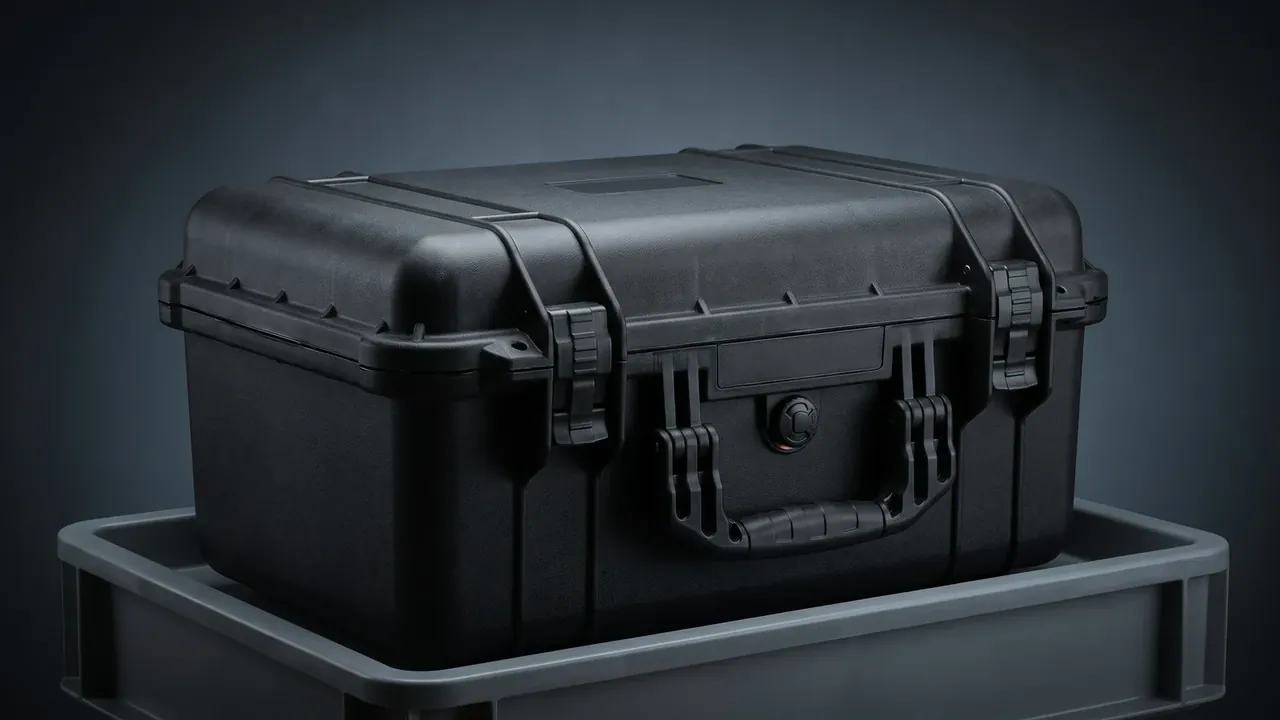
Quick answer: One six-face drop clause at 1,200 mm exposes every handling step. Range holding, magazine storage, road and rail transfer and resealing each get a measurable sequence, a torque figure and a pass line.
Table of contents
- What a 1200 mm Drop Test Actually Demands
- Setting Up at a Range Holding Position
- Stacking and Desiccant Swaps in a Magazine
- Tie-Down for Road and Rail
- Six Steps from Unsealing to Re-Sealing
- FAQ
1. What a 1200 mm Drop Test Actually Demands
The clause reads: with the load fitted, drop the assembly from 1,200 mm onto a 50 mm concrete slab, base, lid and each of 4 sides once. After opening, the cradle may shift no more than 3 mm.
Two Missile Warhead Containers built to one drawing still fail it differently. A properly seated unit holds 1.5 mm; one packed in a hurry lands at 5 mm with a 0.3 mm crease. Same drawing, 4 times the movement, and the variable is handling.
Handling has 4 stages: locating, clamping, sealing, recording. Each fails in its own way, and each has a measurable check.
| Scenario | Setup point | Usual mistake | Pass line |
|---|---|---|---|
| Range holding | Pads on the flange face, diagonal torque in rounds | One side driven down first | Shift ≤ 3 mm |
| Magazine storage | Load pillars plumb, skids clear of the sill | Case set straight on the floor | Lid sag ≤ 2 mm |
| Road transfer | 4 ratchet straps in crossed pairs | Strap looped over the top handle | 400 kg per strap |
| Rail marshalling | 4 feet seated in recesses | One foot left hanging | 4 g longitudinal |
Every pass line here can be measured. What cannot be measured counts as not assembled.
2. Setting Up at a Range Holding Position
A holding position may offer no more than one 1,200 mm × 800 mm steel pallet. The case stands on end and the lid swings to a 100 degree stop. Above 3 kPa of internal vacuum, crack the valve first, or the pressure drags the lip seal out of its groove.
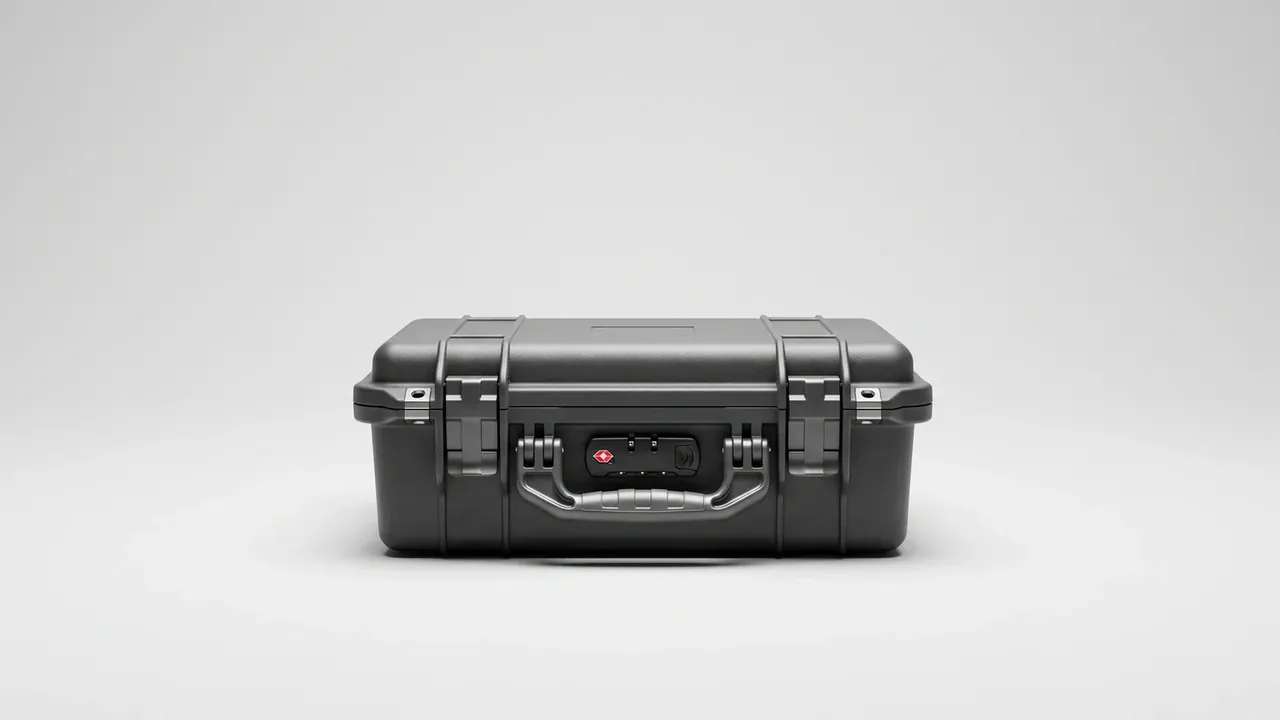
Cradle pads follow the flange of the packaged item, at 620 mm centres. Clamp screws run in 2 rounds: 4 N·m, then 8 N·m, diagonal both times. One pull straight to 8 N·m walks the item sideways by about 2 mm.
Torque goes on in rounds, not in one pull.
Resealing reverses that order: centre the lid, compress the seal, fit the tag. Its number goes on the record card with the opening time.
3. Stacking and Desiccant Swaps in a Magazine
A magazine holds 15 °C and 45% relative humidity year round, so the real load is stacking. At 3 tiers the bottom Missile Warhead Container carries 92 kg down the 4 corner pillars.
The lid is a thin shell. A centre load for 30 days sags it past 2 mm, which changes groove compression; airtightness fails a quarter later.
| Parameter | Value | Note |
|---|---|---|
| Stack tiers | 3 | 92 kg on the bottom unit |
| Skid height | 100 mm | Keeps the base off the floor |
| Inspection cycle | 90 days | Humidity read each visit |
| Internal humidity limit | 60% | Swap desiccant above this |
| Desiccant charge | 250 g | Rises 8 points over 30 days |
The 100 mm skid is the first line dropped from a work order. Damp rises through the base plate.
Keep a swap under 15 minutes: pull the bag, wipe the cavity, fit the new 250 g charge, close up. Past 30 minutes the charge is mostly spent.
4. Tie-Down for Road and Rail
A truck gives 4 load points, one foot per bottom corner, taking 25 mm straps at 400 kg. Leave 50 mm to the sidewall and fill it with foam.
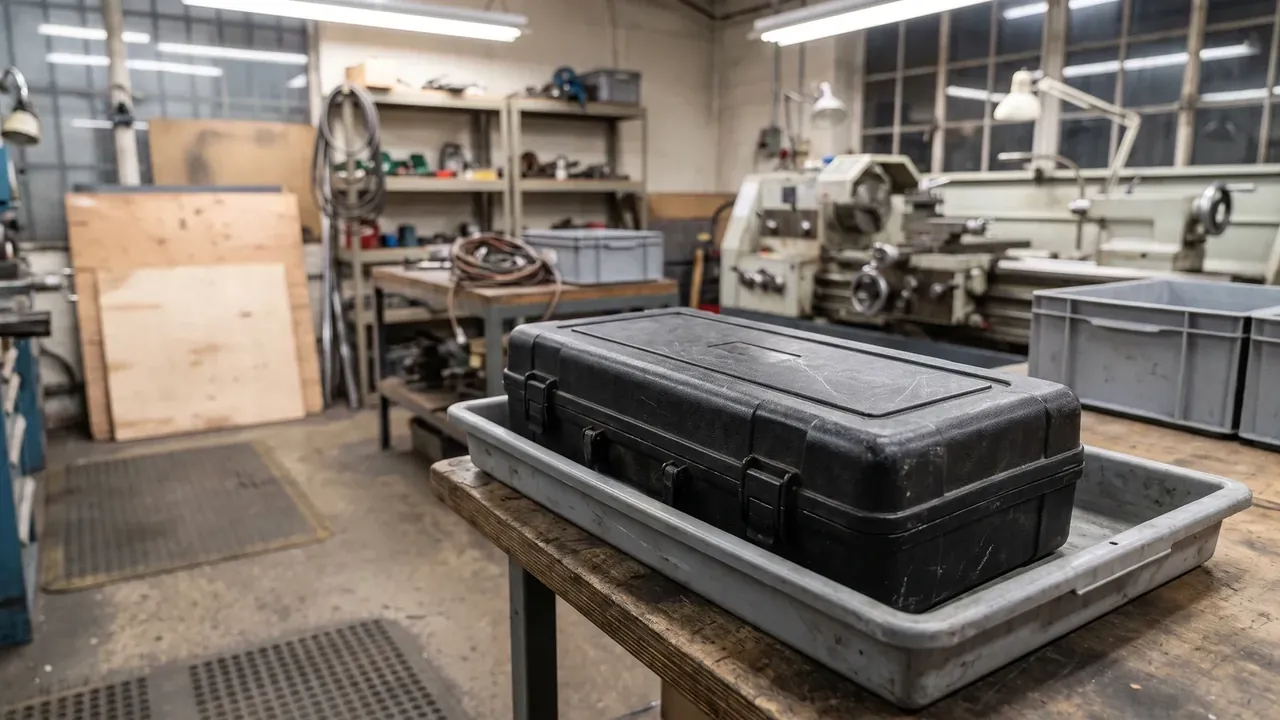
A strap looped over the top handle is the usual shortcut. The boss fails near 900 N, so one emergency stop distorts it; the lid then stops centring and leakage climbs from 0.5% to 3% in 2 hauls.
Rail marshalling applies 4 g longitudinally. Put a 20 mm timber pallet underneath with recesses for the feet, plus 2 cross battens. Recesses 15 mm deep are enough; deeper ones jam.
5. Six Steps from Unsealing to Re-Sealing
Prising a lid against a differential costs 1.5 mm of seal lift, and the lip rolls even when it looks seated. Vent through the valve.
| Step | Action | Typical time | Failure if skipped |
|---|---|---|---|
| 1 | Read gauge and vent | 30 s | Rolled seal lip |
| 2 | Cut tag, log the number | 60 s | No traceable state |
| 3 | Release latches, open to 100 degrees | 20 s | Lid falls back on hands |
| 4 | Remove or load the item | 90 s | Cradle out of position |
| 5 | Close and compress the seal | 45 s | One side uncompressed |
| 6 | Fit a new tamper tag | 30 s | Broken reseal record |
The 6 steps total 275 seconds. Step 2 goes missing most often: the cut tag lands in the bin and nobody can say when the case was opened.
A record is not paperwork. It is the pass line that outlives the shift.
Conclusion
The hard part is never force, it is sequence and record. A 3 mm shift after a 1,200 mm drop, a 2 mm sag after 30 days, 400 kg on a strap: those 3 numbers pin the work down. Hold all 3 and the Missile Warhead Container that comes back is the one that went out.
This article discusses only the container (case body) side of specifications and design intent, and does not cover any handling, loading or use of the contents.
Related Reading
- Cushioning and sealing options for a dedicated case
- Whole-case storage routine in an ammunition magazine
- Pallets and lashing on long-haul routes
Related Products
- 8 Series — Gun Cases; Military Equipment Cases; Camera Equipment Cases; Drone Cases; Watch Cases; Knife Cases; First Aid Cases; Electronics Equipment Cases
- WL8-2812 PP Gun Case — model WL8-2812
- All protective cases and toolboxes: 7 series, 158 models