

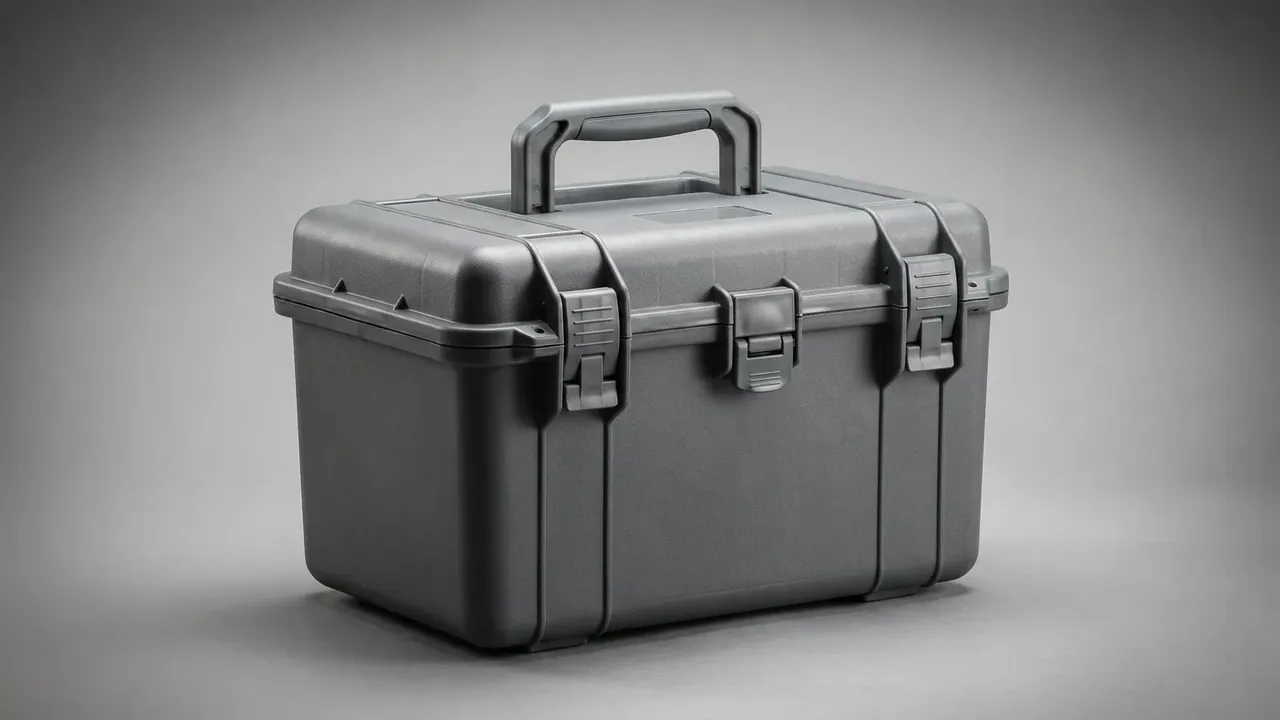
Quick answer: A Mobile plastic transport case with wheels is chosen from the route inward: body width against door and truck clearance, two fixed plus two swivel casters, six latches with two lock holes, IP54 sealing and a moulded asset number. An 800 mm body needs a 900 mm door, and 100 mm casters with dual brakes hold 150 N on a 10 degree ramp.
Table of contents
- Sizing a Mobile Plastic Transport Case with Wheels
- Caster Layout and Brake Setup
- Latches That Stay Closed in Transit
- Ingress Rating and Rain Testing
- Turnaround Labels and Service Cycle
- FAQ
1. Sizing a Mobile Plastic Transport Case with Wheels
Measure the route before the box: a Mobile plastic transport case with wheels wider than the aisle will not pass, and one that is too long shaves every corner. Check lift door, car depth and truck width.
At a 900 mm door an 800 mm body enters on the diagonal; a car under 1.4 m deep takes one per trip. A 2.4 m truck body carries two side by side, so the third goes on top and puts 170 kg on the bottom case.
| Route point | Clearance | Body width | Note |
|---|---|---|---|
| Lift door | 900 mm | 800 mm | Diagonal entry |
| Lift car | 1400 mm deep | 800 mm long | One per trip |
| Truck body | 2400 mm | 800 mm | Two side by side |
2. Caster Layout and Brake Setup
Four swivel casters make a case that wanders. Two fixed under the handle keep the track straight and two swivels steer; at 60 kg of cargo, rate each caster at 60 kg for 250 kg on the set.
Use 100 mm polyurethane casters so dock plates do not jam them, dual-action brakes that hold 150 N on a 10 degree ramp, and 2.5 mm yoke plates with double-row races.
| Layout | Casters | Route | Verdict |
|---|---|---|---|
| All swivel | 4 | Tight storeroom | Wanders, avoid |
| Two fixed, two swivel | 4 | Aisle and lift | Recommended |
| Fixed plus braked swivel | 4 | Truck and ramp | First choice |
3. Latches That Stay Closed in Transit
The usual transit failure is a lid that pops, not a body that cracks. A Mobile plastic transport case with wheels uses six latches, two with 8 mm lock holes, each folding twice: one hook takes the lid lip, the second compresses the gasket, so vibration cannot walk it back.
Verdicts come from tests: a 1.0 m drop on six faces with no latch released, then 10 to 500 Hz at 1.5 g for 30 minutes per axis with no fastener loose. Seal numbers on the handover sheet settle shortage claims at the gate.
4. Ingress Rating and Rain Testing
Rate transport sealing at IP54, not IP67. A Mobile plastic transport case with wheels is loaded in the open and rained on at the tail of a truck, so 10 minutes of spray with under 2 g gain on weighed paper covers road freight.
Set gasket compression at 25 to 30 percent: less leaks, more takes a permanent set. A 15 °C night-to-day swing also condenses inside, where a vent and 20 g of desiccant beat a thicker gasket, and a 2 mm channel outside the lip drains lid water to the corners.
5. Turnaround Labels and Service Cycle
A returnable needs an identity: a six-digit moulded number plus a QR label in a lid well where it will not rub off.
Track wear by distance rather than age. After 50 km of rolling, wheel diameter should stay within 1.5 mm of nominal; the handle is rated for 5000 cycles and fails at the mounting boss. Brakes are checked quarterly and the gasket must stay under 20 percent permanent set.
Conclusion
The sequence is route, casters, latches, sealing, then numbering and service intervals. Route fixes the outer width, the caster layout fixes how it pushes, and the 1.0 m drop verdict decides whether the lid stays closed on arrival. Written into a purchase order, that sequence buys a structure you can inspect, and a Mobile plastic transport case with wheels that clears the lift and the truck.
This article discusses only the container (case body) side of specifications and design intent, and does not cover any handling, loading or use of the contents.
Related Reading
- Wheeled protective case selection and load limits
- Military supply transport case scenarios
- How a transit case body is built
- Logistics support box selection and turnaround
Related Products
- 8 Series — Gun Cases; Military Equipment Cases; Camera Equipment Cases; Drone Cases; Watch Cases; Knife Cases; First Aid Cases; Electronics Equipment Cases
- WL8-2812 PP Gun Case — model WL8-2812
- All protective cases and toolboxes: 7 series, 158 models