

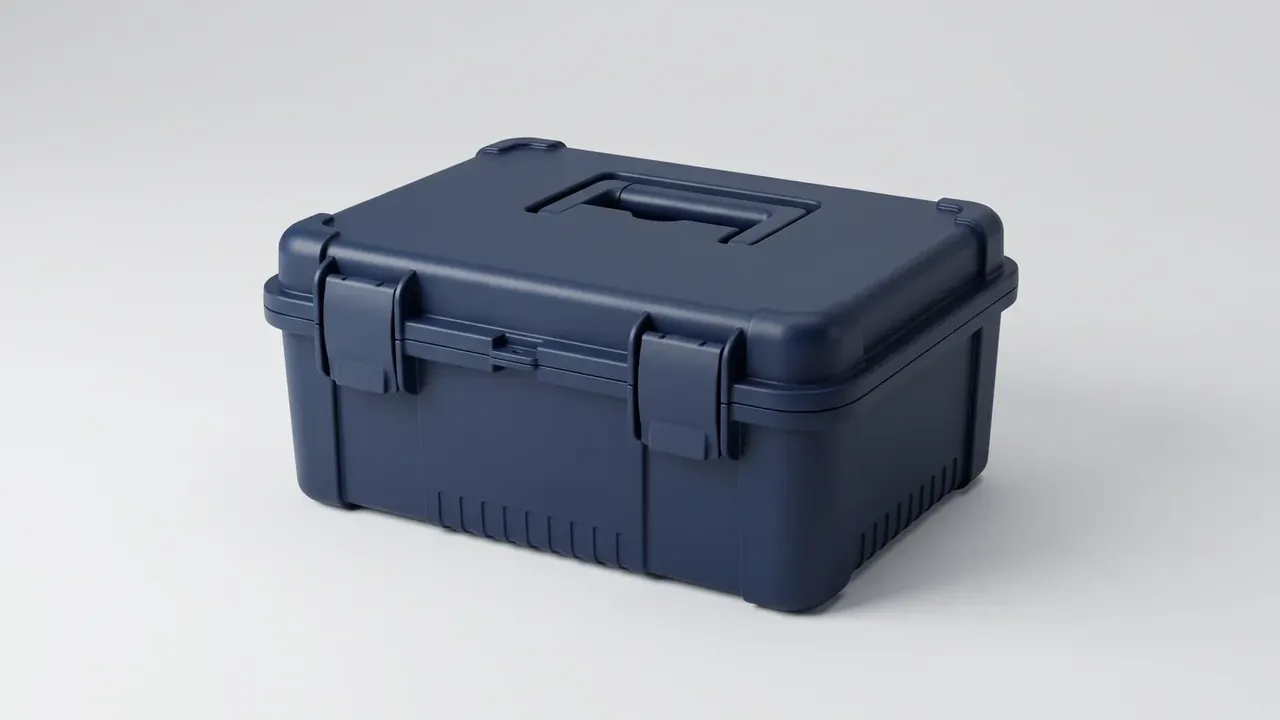
Quick answer: A mobile tool cabinet absorbs weight pressing down, sway while pushed and the forward tip of a brake stop. Five layers answer them: uprights, base plate, slides, one lock rod, shelf flanges, each with a dimension worth measuring.
Table of contents
- How the Mobile Tool Cabinet Frame Is Built
- Casters and the Base Plate
- Drawer Slides and Their Travel
- One Lock Rod for Every Drawer
- Shelf Reinforcement and Span
- FAQ
1. How the Mobile Tool Cabinet Frame Is Built
A cabinet on a shop floor takes weight pressing down, side sway while pushed, and the forward tip of a brake stop. The frame funnels all three into the uprights.
Uprights are 1.2 mm cold-rolled steel folded into a closed 40 mm by 40 mm post, one per corner plus a centre. A closed section twists at about three times the stiffness of an open channel.
Weld uprights to the base plate, square the diagonals, hang the panels, fit the top frame. Under 2 mm of error no drawer needs shims; 30 mm stitch runs at 80 mm pitch keep heat out of 0.8 mm sheet.
| Part | Material and size | Role |
|---|---|---|
| Upright | 1.2 mm cold-rolled, folded 40 by 40 mm | Carries vertical load |
| Base plate | 2.0 mm steel, caster seats punched | Splits weight four ways |
| Side panel | 0.8 mm steel, 15 mm flange | Carries slides, closes side |
A 1000 by 500 by 1600 mm cabinet weighs 68 kg empty; 0.8 mm uprights and two fewer posts bring 52 kg, but 2000 loaded pushes drift the diagonals past 4 mm.
2. Casters and the Base Plate
Two swivel casters and two fixed, the fixed pair under the handle. Brake a swivel so one step locks wheel and swivel, and the mobile tool cabinet holds on a slope.
Capacity cannot be added up: four casters at 90 kg suggest 360 kg, but an uneven floor loads three points, so a 0.6 factor leaves 216 kg and about 148 kg of payload after the 68 kg empty weight. A 100 mm wheel clears an 8 mm lip, 125 mm clears 15 mm. Polyurethane near Shore A 95 marks no epoxy; nylon cracks thin panels at the caster plate.
3. Drawer Slides and Their Travel
Travel comes first on a mobile tool cabinet. A two-section slide gives three-quarter extension and hides the back 125 mm of a 500 mm drawer; three-section runs full.
A 500 mm drawer needs 1.5 mm per side, and the mounting faces must stay parallel within 0.3 mm over 300 mm.
| Slide | Extension | Rated load | Sag at rated load |
|---|---|---|---|
| Two-section ball | Three-quarter | 25 kg | 5 mm |
| Three-section ball | Full | 45 kg | 6 mm |
Sag is the life number: 6 mm at the rated 45 kg is normal, 9 mm means worn balls. Keep the drawer under 600 mm wide.
4. One Lock Rod for Every Drawer
A mobile tool cabinet carries one lock, not one per drawer. An 8 mm rod runs through the front frame with a hook per drawer; a 90 degree turn moves it 12 mm.
That travel is the interlock: a drawer left 10 mm open holds the rod, so the key never reaches its stop. Mechanical, with no sensor and no battery.
Depth of bite beats rod diameter: 3 mm hooks biting 6 mm deform the frame first; at 3 mm of bite a screwdriver pops one open. The rod sits inside the folded frame, only a 25 mm lock face showing.
5. Shelf Reinforcement and Span
On a mobile tool cabinet, capacity lives in the flange. A 20 mm fold on 1.0 mm sheet makes a 20 mm beam, roughly eight times stiffer; three 4 mm swages give about twice.
At a 900 mm span, two brackets per side within 600 mm; at 1200 mm add a centre bracket or deepen to 25 mm. Holes sit at 25 or 32 mm pitch.
Conclusion
Five layers carry the structure: uprights, base plate, slides, one rod, shelf flanges. Weaken one and the cabinet tells you within three months. The craft sits in weld sequence, mounting-face parallelism and flange height, and the working life of a mobile tool cabinet follows from those five.
This article discusses only the container (case body) side of specifications and design intent, and does not cover any handling, loading or use of the contents.
Related Reading
- How to read wheel and body options
- Where it differs from other options
- How to read the specification table
- Inspection items for steel cabinets
Related Products
- 8 Series — Gun Cases; Military Equipment Cases; Camera Equipment Cases; Drone Cases; Watch Cases; Knife Cases; First Aid Cases; Electronics Equipment Cases
- WL8-2812 PP Gun Case — model WL8-2812
- All protective cases and toolboxes: 7 series, 158 models