

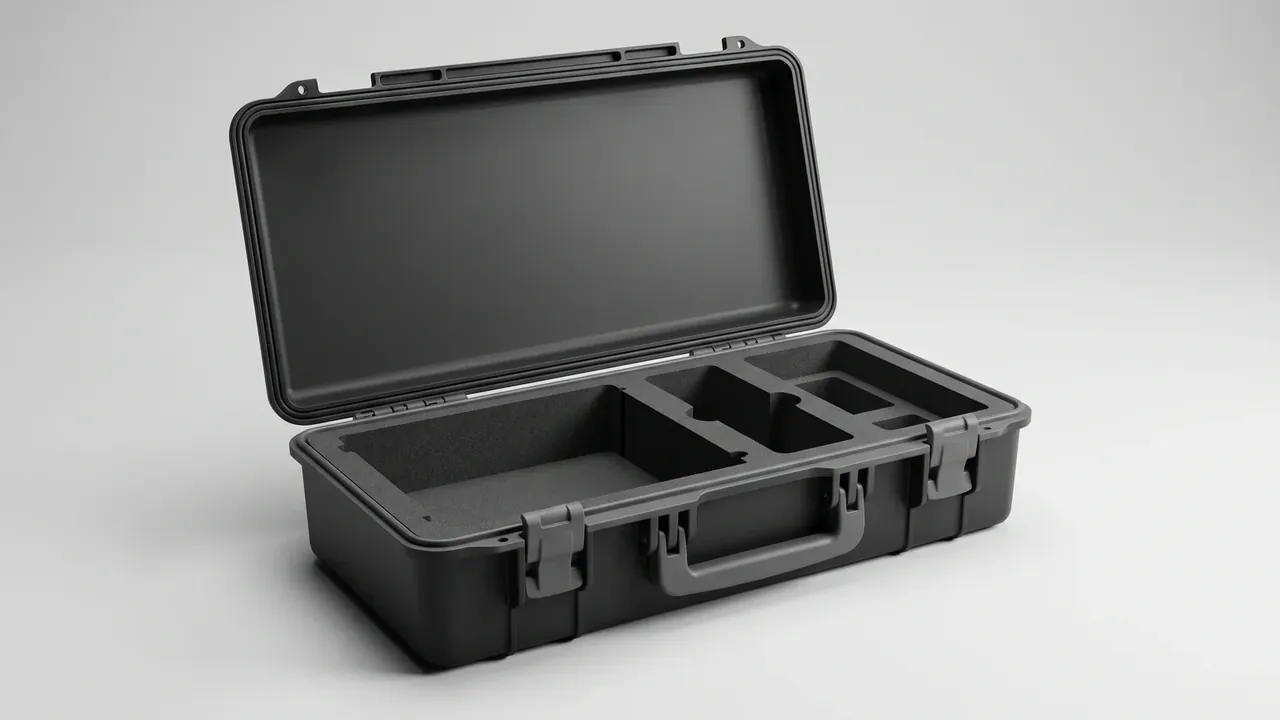
Quick answer: A moisture-resistant equipment storage case is accepted on four measurements, not on a badge: gasket compression with whole-case pressure drop, transmission rate, desiccant weight against the humidity target, and the annual load from opening cycles.
Table of contents
- Acceptance Items a Moisture-Resistant Equipment Storage Case Must Pass
- Seals and Vapor: Pressure Drop and Transmission Rate
- Desiccant Weight and Target Humidity Inside the Case
- Converting Opening Cycles into Annual Moisture Load
- Sampling Ratios and the Judgement Record
- FAQ
1. Acceptance Items a Moisture-Resistant Equipment Storage Case Must Pass
Disputes at goods-in start with a rating treated as a verdict. An IP rating answers water and particles, not vapor, and vapor attacks stored equipment.
The sheet lists gasket compression, whole-case pressure drop, transmission rate and desiccant weight against the humidity drop produced. The first two cover leakage, the last two absorption.
| Item | Condition | Pass limit | Re-check |
|---|---|---|---|
| Gasket compression | seam gap, lid closed | 25 to 32 percent | every batch |
| Permanent set | 70 °C for 24 hours | 20 percent or less | yearly |
| Pressure drop | 3 kPa held 120 seconds | 0.15 kPa or less | every batch |
| Transmission | 38 °C, 90 percent RH | 0.35 g per m² daily | yearly |
| Humidity drop | 60 L, 480 g silica gel | below 20 percent at 48 hours | every batch |
State the basis, foam deducted, or two inspectors measuring one moisture-resistant equipment storage case will differ by twenty percent.
2. Seals and Vapor: Pressure Drop and Transmission Rate
Pressure drop is the workshop test: plug the relief valve and cable port, charge to 3 kPa, hold for 120 seconds, accept 0.15 kPa or less.
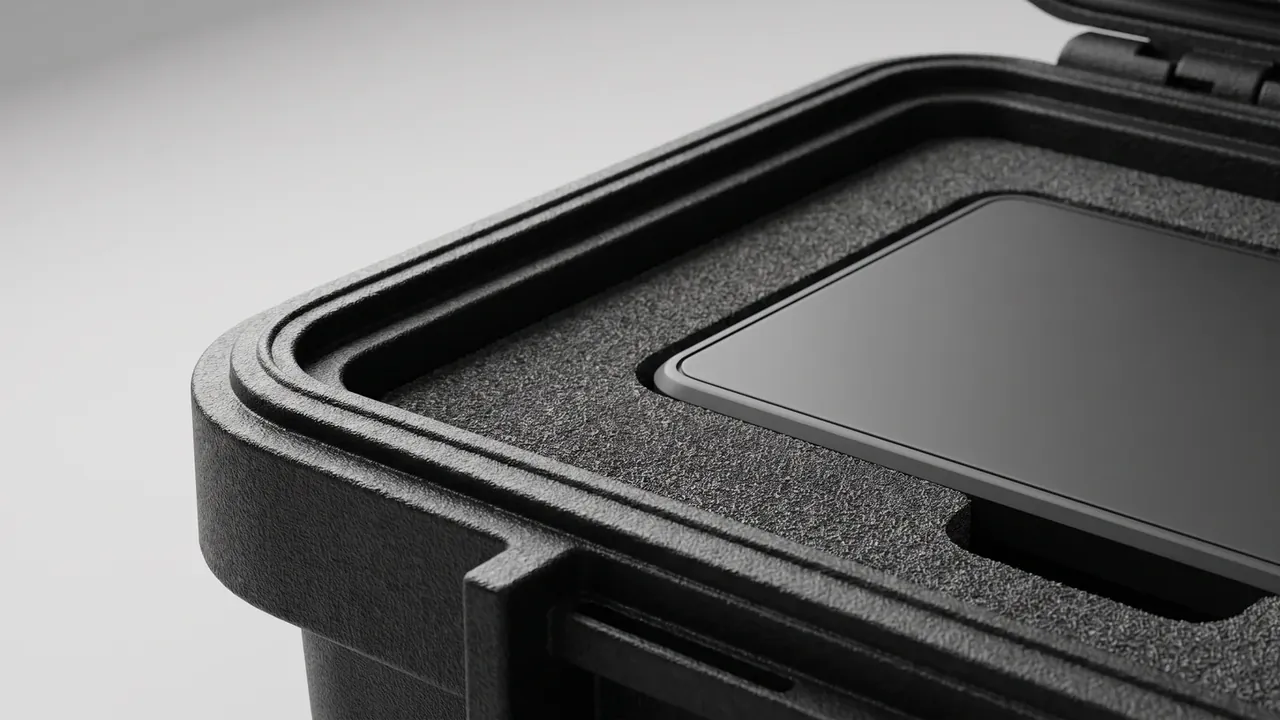
Pressure proves gas does not escape, not that vapor stays out. Transmission is measured at 38 °C and 90 percent relative humidity, where water per square metre per 24 hours must stay at or below 0.35 g; a 4 mm polypropylene wall is near that figure.
| Test | Load | Reading | Typical failure |
|---|---|---|---|
| Pressure drop | 3 kPa, 120 seconds | loss in kPa | valve seat warp |
| Transmission | 38 °C, 90 percent RH | grams per square metre | thin wall, insert edge |
| Immersion | 300 mm, 10 minutes | humidity rise | latch lug cracking |
Immersion: 300 mm for ten minutes, then humidity must not climb three points in two hours. Gaskets are judged at 25 to 32 percent.
3. Desiccant Weight and Target Humidity Inside the Case
Set the target first: electronics take 20 percent, optics 30 percent, general metal 40 percent, and each step down roughly doubles the desiccant.
A 60 litre interior takes 480 g of silica gel, about 8 g per litre; the same moisture-resistant equipment storage case given 240 g visibly slows its drop at 48 hours. Below 20 percent passes, while 25 to 30 percent means check the gasket, then ask whether the desiccant was already saturated.
4. Converting Opening Cycles into Annual Moisture Load
Ventilation is the item most often missing from the sheet. A moisture-resistant equipment storage case is never sealed for a year, and every opening exchanges air.
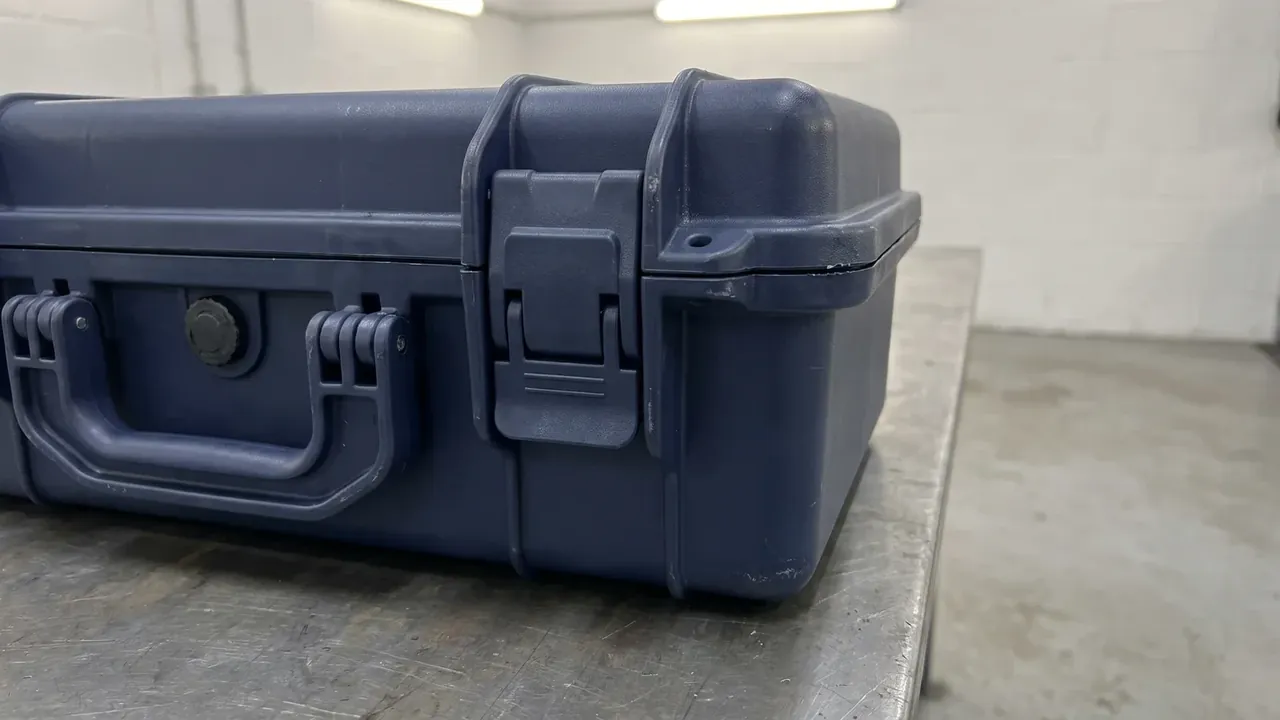
Air at 30 °C and 80 percent humidity carries about 24 g of water per cubic metre. A 60 litre interior opened for 60 seconds exchanges roughly 0.4 of its volume, bringing in 0.6 g; fifty openings a year totals 30 g, a tenth of the working capacity of 480 g of silica gel. Above that, add 10 percent desiccant or shorten the interval to six months. Leak paths also include the relief valve, cable port and label rivets.
5. Sampling Ratios and the Judgement Record
Sampling is defined per batch: one mould, one production run, one gasket lot. Two cases are drawn under 50 units, four up to 200, six up to 500, eight above.
One major defect rejects the batch; two minor are tolerated, provided no single moisture-resistant equipment storage case carries both. Record five fields per case: gasket lot, pressure drop, transmission, 48 hour humidity, opening-cycle figure.
Conclusion
Four numbers give acceptance a shared language: compression and pressure drop for leakage, transmission for permeation, desiccant for capacity, cycles for endurance. Fix the basis, sampling and record, and a moisture-resistant equipment storage case is accepted on evidence rather than a label.
This article discusses only the container (case body) side of specifications and design intent, and does not cover any handling, loading or use of the contents.
Related Reading
- Seals, desiccant and indicators in a dry case
- Seal ratings and desiccant change intervals
- How waterproof hard case ratings are judged
- Factory inspection items for military supply cases
Related Products
- 8 Series — Gun Cases; Military Equipment Cases; Camera Equipment Cases; Drone Cases; Watch Cases; Knife Cases; First Aid Cases; Electronics Equipment Cases
- WL8-2812 PP Gun Case — model WL8-2812
- All protective cases and toolboxes: 7 series, 158 models