

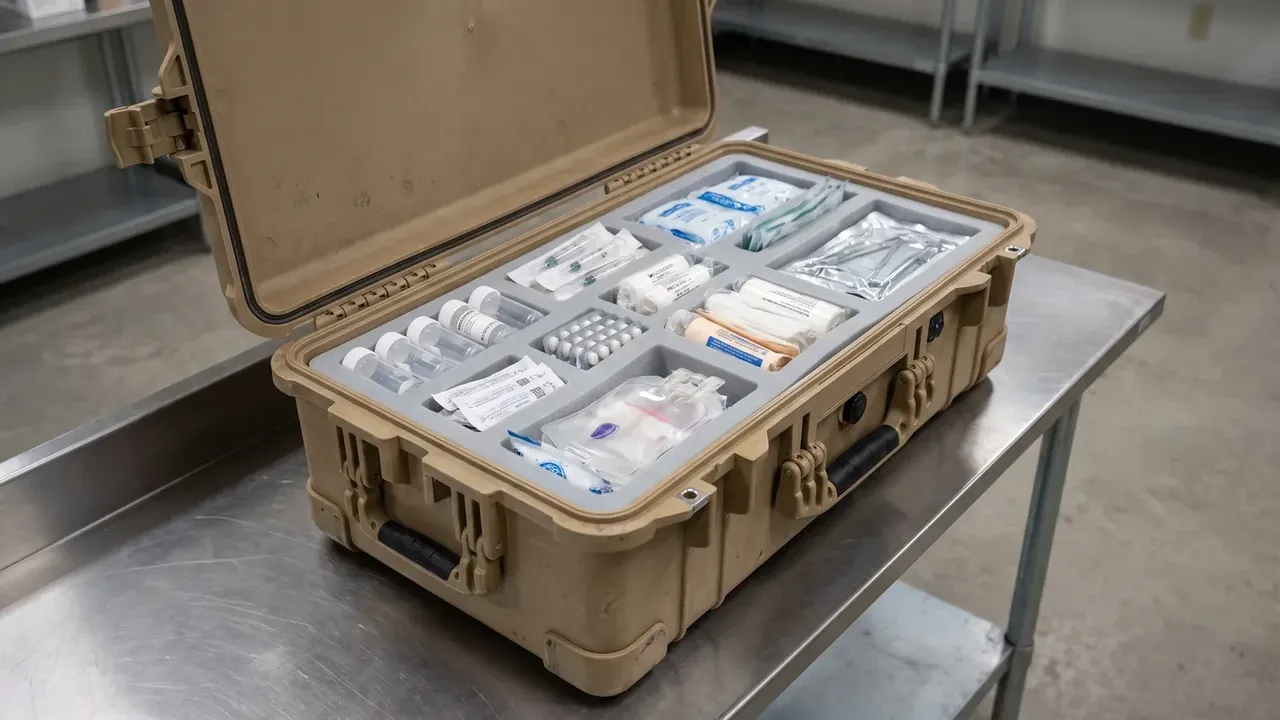
Quick answer: A Monitor & video transmitter protective case fixes one screen orientation: inward, 15 mm clear of the lid, foam on the 20 mm bezel only.
Table of contents
- Why a Monitor & video transmitter protective case allows one screen direction
- Setting the 15 mm air gap under the lid
- Die-cut foam on the bezel: a 20 mm bearing ring on four sides
- Six cavities and 25 mm EVA: separating accessories from the unit
- Acceptance after a 1.2 m drop: no bright dots, no whitening
- FAQ
1. Why a Monitor & video transmitter protective case allows one screen direction
The first thing to settle is not foam thickness but which way the panel faces. One local load leaves a permanent bright dot. A Monitor & video transmitter protective case writes that into the liner drawing: the screen faces inward, and the metal bezel carries the clamping force.
Get the direction wrong and every dimension downstream stops meaning anything.
| Device area | Dimension basis | Clearance value |
|---|---|---|
| Panel glass | 175 mm internal depth | Faces inward, 15 mm clear |
| Metal bezel | 20 mm on four sides | Foam presses here only |
| Rear housing | Beyond 3.5 mm wall | 25 mm EVA underlay |
| Accessory bays | 6 cavities | Kept apart from the unit |
2. Setting the 15 mm air gap under the lid
The 15 mm figure is the sum of three movements: lid liner compression, gasket rebound and the largest panel-to-lid displacement in a 1.2 m drop. A Monitor & video transmitter protective case asks for each to be measured on its own and then added.
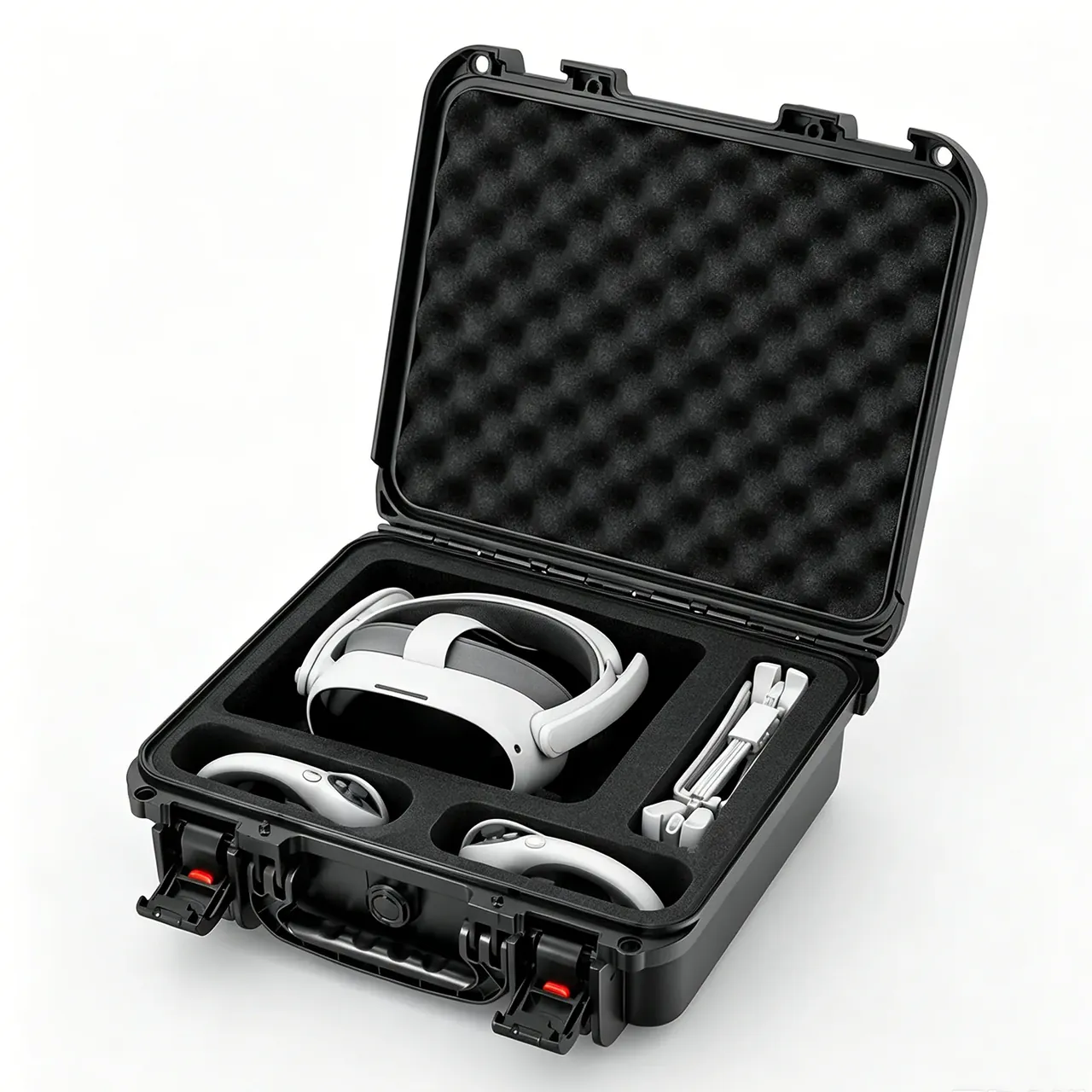
Add the three and you get the lower bound at which nothing touches. Lid foam gives up a few millimetres, a flattened gasket gives up more, and inertia at impact pushes the unit toward the lid. If the three add to more than 15 mm, the panel meets the lid liner for a fraction of a second. This is why the 15 mm is a hard dimension on a Monitor & video transmitter protective case: a feeler gauge goes in at all four corners after assembly, and any corner below 15 mm is rejected. Close the lid without the latches, slide the gauge above the panel and take the smallest reading. Thicker foam fails for the same reason, since more foam means more compression travel and less net clearance. An empty 5.0 kg shell carrying 8.8 kg sets that inertia scale.
3. Die-cut foam on the bezel: a 20 mm bearing ring on four sides
The bezel tolerates pressure and the panel does not, which decides the cutout shape. A full 25 mm EVA sheet is cleared where the panel sits, leaving a bearing ring 20 mm wide on each of the four sides.
| Fragility | Criterion | Treatment |
|---|---|---|
| Highest | One bright dot means rejection | Full cutout, no contact |
| Moderate | Bezel stress whitening | 20 mm ring on four sides |
| Low | Slight mark on rear housing | 25 mm EVA underlay |
| Lowest | Accessories striking each other | 6 separate cavities |
The 20 mm width has its own reason: narrower concentrates pressure and blanches the bezel, wider lets foam creep onto the panel chamfer. One inspection step on a Monitor & video transmitter protective case is dedicated to the frame: after a 1.2 m drop, raking light along all four edges reveals any whitened stress mark. Foam hardness is chosen with the 8.8 kg payload. Two latches rated 380 N each seat the ring against the bezel without squeezing the 15 mm gap thinner, while the 320 N handle rating covers carrying only.
4. Six cavities and 25 mm EVA: separating accessories from the unit
The unit takes the cavity centre, and the rest is divided into 6 cavities for small parts. More cells are not better: too many cut the liner's stiffness, so six groups the accessories by shape without leaving any part homeless.
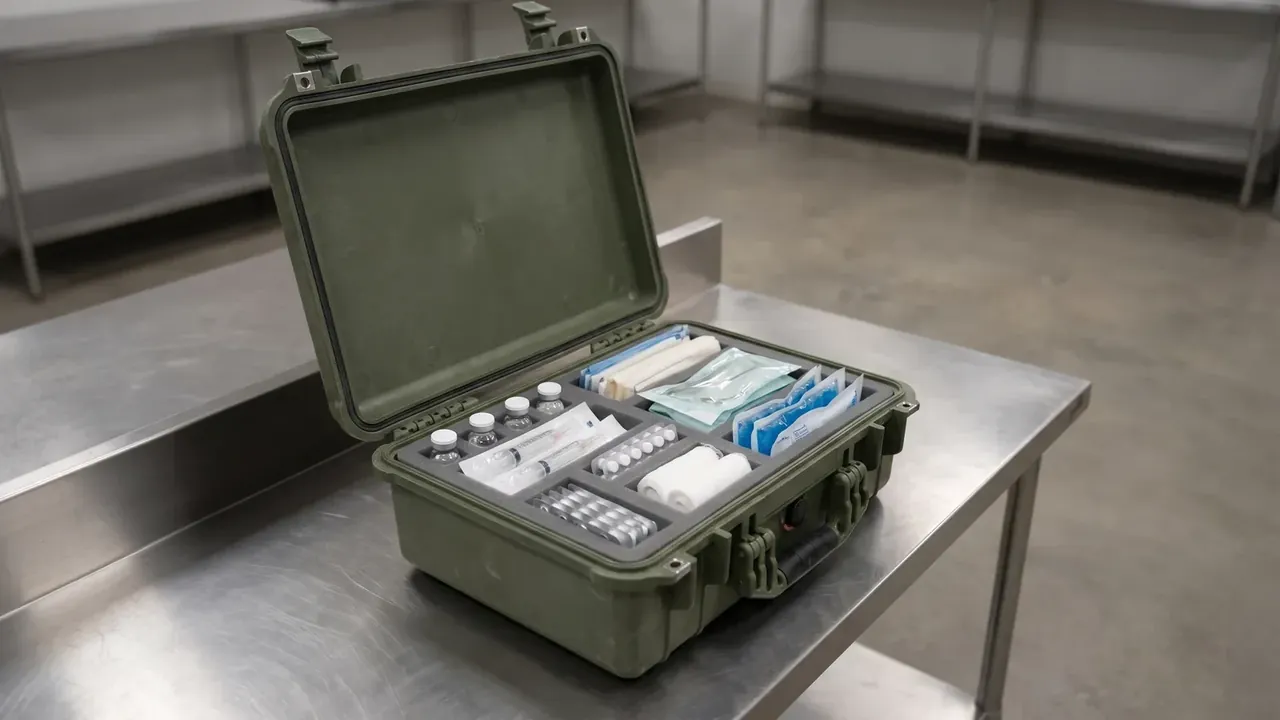
The dividers also keep accessories from competing with the unit for the 15 mm gap. A hard item above the unit becomes a fulcrum behind the panel at impact. So the 25 mm EVA underlay supports only the rear housing, and every cavity sits in a sunken zone below the panel datum. A Monitor & video transmitter protective case keeps that layout intact across minus 20 to 60 degrees Celsius, with rebound verified at both extremes. The shell is benchmarked to IP67 by test method.
5. Acceptance after a 1.2 m drop: no bright dots, no whitening
Every dimension is judged by one drop. The 1.2 m height is set at a full 8.8 kg payload; after it, only two things are read: bright dots on the panel and whitening on the bezel.
| Foam treatment | Material and thickness | Recheck item |
|---|---|---|
| Panel cutout | No contact face | No bright dots |
| Bezel bearing ring | 20 mm on four sides | No whitening |
| Rear underlay | 25 mm EVA | No permanent mark |
| Accessory dividers | 6 cavities | Dividers stay put |
The criteria sit on the outcome, not the process. A bright dot means the panel was pushed, whitening means the bezel was overpressed, and both point to a 15 mm gap or a 20 mm ring that failed. The acceptance sheet for a Monitor & video transmitter protective case carries only two visual lines. The allowance in a 540 by 400 by 220 mm outer size and a 485 by 345 by 175 mm cavity exists for those three movements.
Conclusion
A Monitor & video transmitter protective case reduces the problem to one action: face the screen inward, suspend the panel on a 15 mm gap and route force through a 20 mm ring on four sides. The 6 cavities, the 25 mm EVA and the seal benchmarked to IP67 all serve that action. After a 1.2 m drop, no bright dots and no whitening say more than any datasheet. Ask about screen direction first, then the gap, and only then the latch and handle ratings.
Related Reading
- Field configuration of live broadcast equipment cases
- Zoning and liners for broadcast and film equipment cases
- Field applications of electronic equipment protective cases
- Vibration control and structure in electronic equipment cases
Related Products
- 8 Series — Gun Cases; Military Equipment Cases; Camera Equipment Cases; Drone Cases; Watch Cases; Knife Cases; First Aid Cases; Electronics Equipment Cases
- WL8-2812 PP Gun Case — model WL8-2812
- All protective cases and toolboxes: 7 series, 158 models