

Quick answer: A multi-tier trolley toolbox for on-site work starts at the drawer count: three 80 mm tiers over a 45 L base bin, 8 kg per tier, 28 kg loaded.
Table of contents
- Setting the drawer count
- What goes in the deep base bin
- Drawer runners and stop blocks
- Loaded weight and stair work
- Unfolding order on site
- FAQ
1. Setting the drawer count
How many boxes a call needs depends on how many times you plan to open a lid in front of the customer. The list for one pump or switchgear visit barely changes: cordless tools and batteries, sockets and spanners, meters and consumables. A multi-tier trolley toolbox splits those families into three tiers, so one lift shows what the job asks for.
Match the tier count to that list before discussing capacity. An 80 mm tier takes a socket rail, a row of spanners or a multimeter lying flat. A drill stands taller, so it cannot ride in a drawer at all. Three tiers separate the families that get opened; they are not an attempt to move a workshop onto the van.
| Tier | Clear height | Usual contents | How often it opens |
|---|---|---|---|
| Top drawer | 80 mm | Multimeter, voltage tester, consumables | Every call |
| Middle drawer | 80 mm | Socket rail, hex keys, spanners | Most calls |
| Lower drawer | 80 mm | Spare batteries, ties, seals | Now and then |
| Base bin | 45 L | Cordless tools, cable reel, samples | Job by job |
Four tiers force the clear height down until a socket rail will not stand. Two tiers push the load into an oversized base bin, and the meter used on every call ends up at floor level. A multi-tier trolley toolbox at three tiers puts the drawer block and the bin at the divide.
2. What goes in the deep base bin
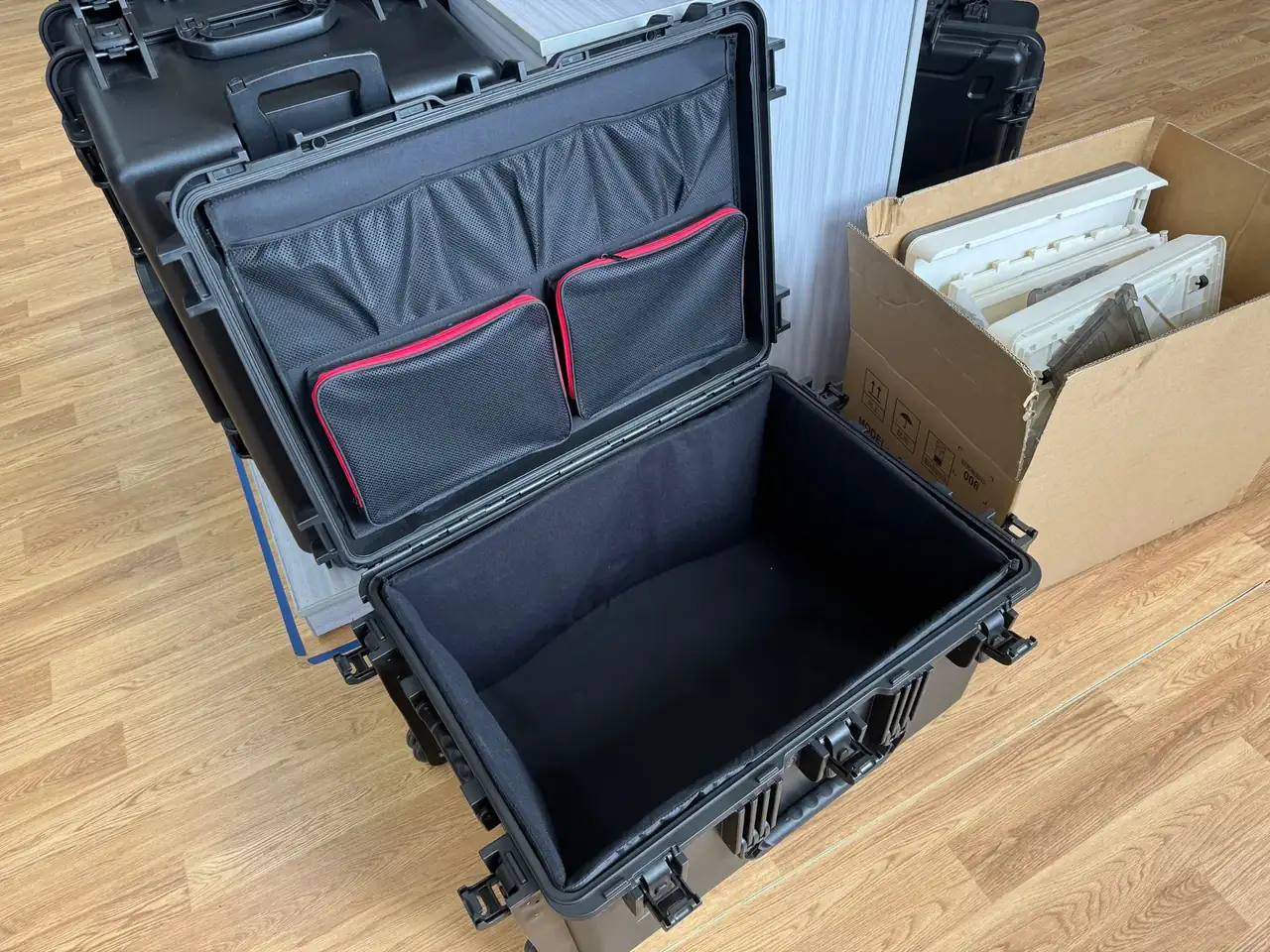
The 45 L base bin exists for things that cannot be layered. A drill in its case, a grinder, a small vacuum, a cable reel, a part waiting to be swapped: none of these sit in a drawer without fouling the lid. A multi-tier trolley toolbox leaves that bin undivided so the 45 L stays one block of space.
Where the bin opens decides whether it works on site: a side-opening bin stays reachable with every drawer out, a top-opening bin does not. Try the side door at full travel before buying.
Weight does not belong down there: in a 28 kg load a cast-iron fitting drops the centre of gravity to the floor and the case noses forward when towed. Heavy items ride in the middle drawer of a multi-tier trolley toolbox.
3. Drawer runners and stop blocks
Runner travel decides whether you can see the back row. At 380 mm a drawer opens far enough to read the whole rail at a glance; short of that, the last sockets are found by touch. A multi-tier trolley toolbox built around that travel lets you pick a socket without lifting the drawer out.
Two stops do the work: the first tells the hand it has gone far enough, the second keeps the drawer on its runners, and the gap between them absorbs momentum.
The selection rule is blunt: once a tier carries more than 8 kg and the runner end sags past 1.5 mm, that tier needs twin runners. Below the line a single runner holds a full socket rail near that limit and a spanner row well under it. Above it, a thicker runner is the wrong fix; two runners share the load and keep the end up.
Stop blocks wear on their own terms: plastic goes brittle in the cold, chips, and then lets the drawer run past its end.
| Runner set | Travel | Stops | Tier load it suits |
|---|---|---|---|
| Single runner | 380 mm | 2 | Up to 8 kg |
| Twin runner | 380 mm | 2 | Above 8 kg |
| Single runner with centre support | 380 mm | 2 | Up to 8 kg on a deep drawer |
4. Loaded weight and stair work
A 28 kg case is about the limit one person handles without thinking about it: a van sill sits near waist height, and 28 kg goes up in one motion. A multi-tier trolley toolbox leaves the rest of that budget for tools.
Stairs are a different problem. On four flights in a walk-up with no lift, castors stop helping and the case has to be carried. Hauling 28 kg up four flights means a rest on the way; pulling the heaviest drawer out for a second trip is easier on the back.
| Situation | Weight in hand | How it moves | Watch for |
|---|---|---|---|
| Flat ground and car park | 28 kg whole | Towed on castors, handle out | Extend the handle fully first |
| Thresholds and kerbs | 28 kg whole | Lifted by the side handle, tilted | Drawers locked before lifting |
| Four flights of stairs | Split into two trips | Drawer first, case after | Heaviest drawer on the lower trip |
| Inside the room | 0.6 m² footprint | Set down, opened, backed to a wall | Keep clear of door swings |
Loading order changes how heavy the case feels. Bin first, drawers second, and the mass sits low and tows straight; load the drawers first and a multi-tier trolley toolbox tips forward every time the bin opens.
5. Unfolding order on site
The 0.6 m² footprint is about one large floor tile. Choose the spot before the case leaves the van: against a wall, clear of door swings and consumer units, drawers facing the side you stand on.
Work the tiers by frequency. Set the case down, extend the handle, square it up, then open the top tier for the meter, the middle for sockets, and the bin only when the job needs it. A multi-tier trolley toolbox ordered this way keeps the two most-used groups at standing height.
Layering is not about carrying more; it is about bending less. A call involves five or six lid openings, each a crouch, a search and a close. With tiers ordered by use, two crouches cover the visit: one for the meter, one for the spare.
Packing up runs in reverse. Count what is in each tier, push the drawers home and lock them, then retract the handle. A missing socket is usually a drawer not fully home when the lid came down.
Related Reading
- Usable volume, cavities and corner radii
- How a heavy-duty industrial trolley case carries load
- What a factory checks before ordering plastic trolley boxes
- Castors and telescopic handles working together
JUNZHIJIA
Related Products
- 8 Series — Gun Cases; Military Equipment Cases; Camera Equipment Cases; Drone Cases; Watch Cases; Knife Cases; First Aid Cases; Electronics Equipment Cases
- WL8-2812 PP Gun Case — model WL8-2812
- All protective cases and toolboxes: 7 series, 158 models