

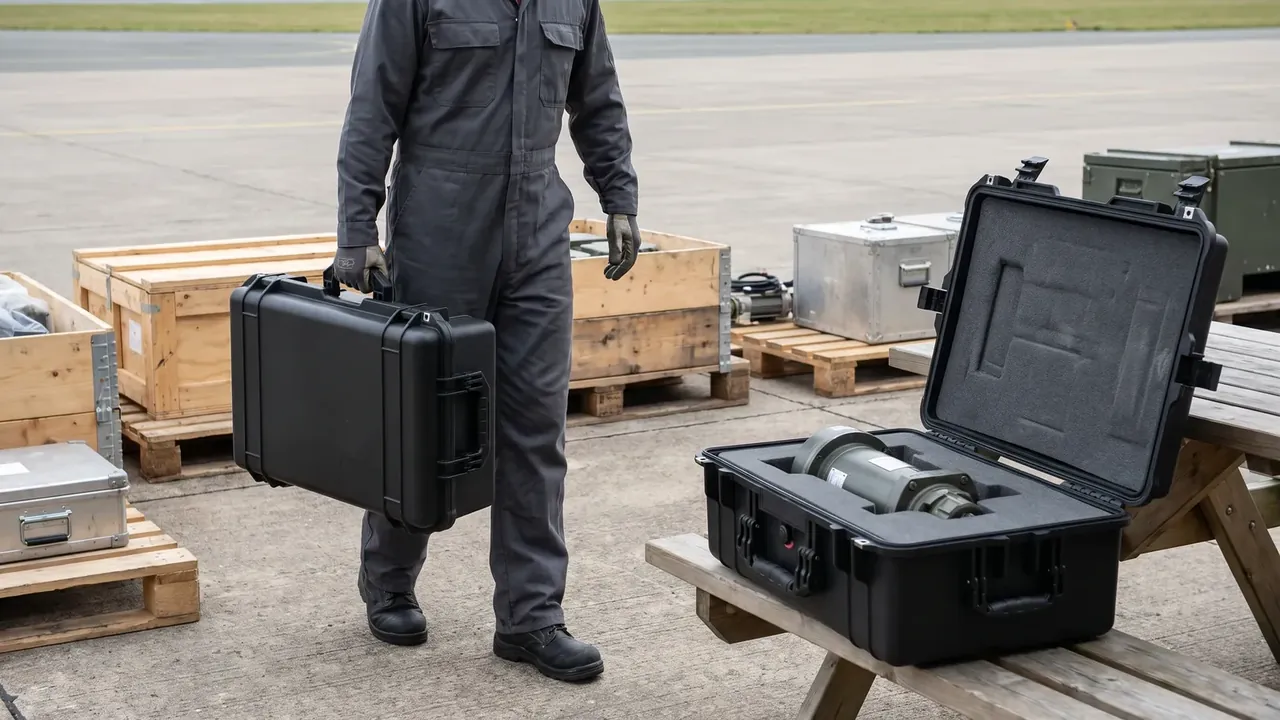
Quick answer: A musical instrument pedal & audio briefcase caps lid rattle at 32 dB(A) and mouth shift at 0.6 mm after 500 cycles, set by a 0.35 mm gap and 2.4 mm pad.
Table of contents
- Hinge bushing clearance in the musical instrument pedal & audio briefcase
- Mouth damping pad thickness
- Rattle readings across loading cycles
- Mouth shift on the drop retest
- Clearance reject line for performance batches
- FAQ
1. Hinge bushing clearance in the musical instrument pedal & audio briefcase
This musical instrument pedal & audio briefcase measures 490×350×180 mm outside, 430×295×125 mm inside, with a 3.7 mm wall. Its lid turns on a pin held by a bushing with 0.35 mm clearance per side. Too tight and the bushing grips the pin after a temperature swing, so opening turns gritty within 4200 cycles; too loose and the lid wanders, the overlap shrinks, and the single gasket drops below 18% compression. The 0.35 mm grade balances rotation against a located lid.
The bushing is a replaceable wear sleeve, not moulded into the lid. In the musical instrument pedal & audio briefcase the 3.8 kg empty and 7.5 kg load sit on the base, so the hinge carries only the lid; shoulders at both pin ends stop axial drift over 500 cycles.
| Clearance grade | Side play after cycling | Use |
|---|---|---|
| 0.20 mm | 0.15 mm | Too tight, reject |
| 0.35 mm | 0.22 mm | Baseline |
| 0.50 mm | 0.58 mm | Too loose, reject |
2. Mouth damping pad thickness
A 2.4 mm damping pad runs around the mouth. On the rig the musical instrument pedal & audio briefcase relies on it to soak up vibration: thinner, and 500 cycles compress it flat so rattle climbs; thicker, and the lid is propped up, shift passes 0.6 mm, and the two latches at 325 N each work harder. The 2.4 mm value quiets the joint without lifting the lid.
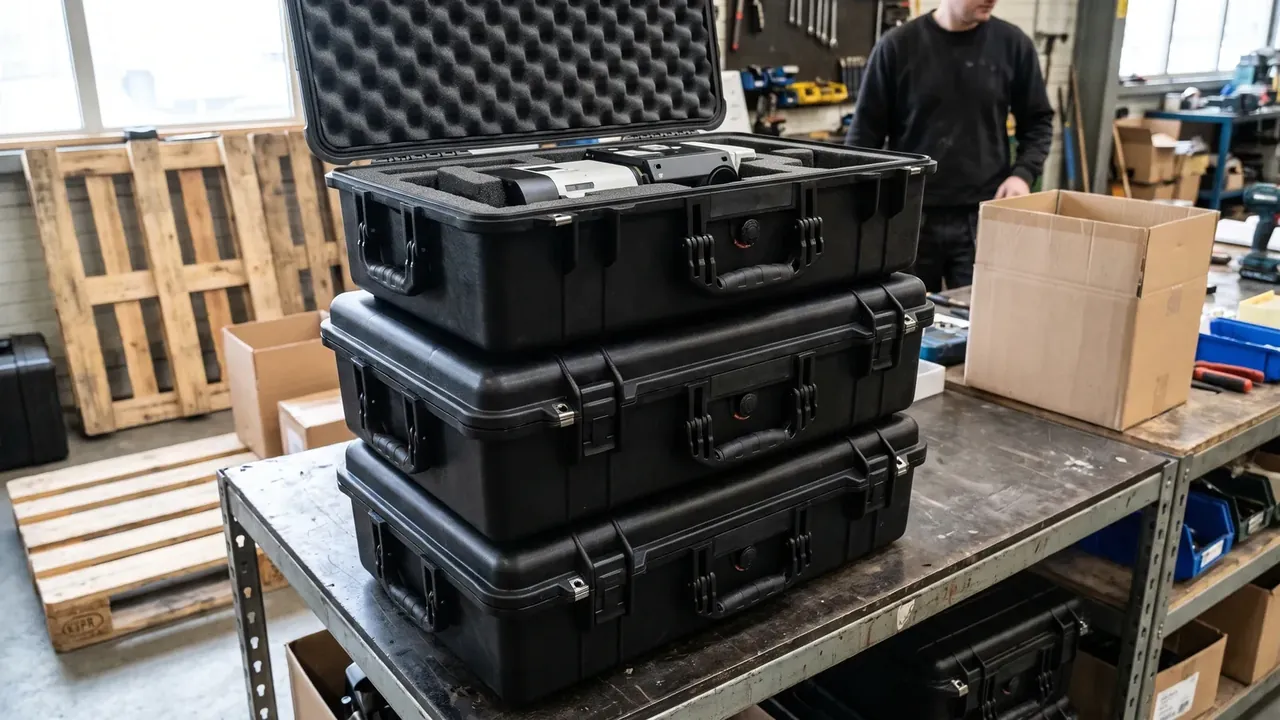
The pad is bonded with mitred corners, set apart from the single gasket groove at 18% compression so it presses only the overlap; even if it creeps, groove compression is unchanged. Bushing clearance and pad thickness together fix the rattle of the musical instrument pedal & audio briefcase after loading, and IP65 is listed only as a reference method.
3. Rattle readings across loading cycles
The rig runs 500 cycles, with rattle logged at 0, 100, 250 and 500. At each stage the musical instrument pedal & audio briefcase is read with a sound level meter 100 mm above the mouth, averaged over three steady readings. The start is 24 dB(A) at zero cycles, and the end must stay within 32 dB(A).
| Loading cycles | Mouth rattle (dB(A)) | Rise vs start |
|---|---|---|
| 0 | 24 | 0% |
| 100 | 26 | 8% |
| 250 | 29 | 21% |
| 500 | 32 | 33% |
The 500-cycle row touches the 32 dB(A) ceiling; one more dB(A) fails the batch. Three samples per batch with a spread above 2 dB(A) send the check back to bushing press-fitting. Once 4200 cycles stack up, another loading round tests whether wear widened the clearance. Joining the four stages shows whether the mouth of the musical instrument pedal & audio briefcase loosens at end of life.
4. Mouth shift on the drop retest
The musical instrument pedal & audio briefcase takes vibration across the whole shell during loading, while the drop retest focuses on the hinge seat, four corners and pin shoulders, measured with a dial gauge after a 0.9 m drop against 0.6 mm. Once shift passes that line, the pad is pulled open and rattle follows.
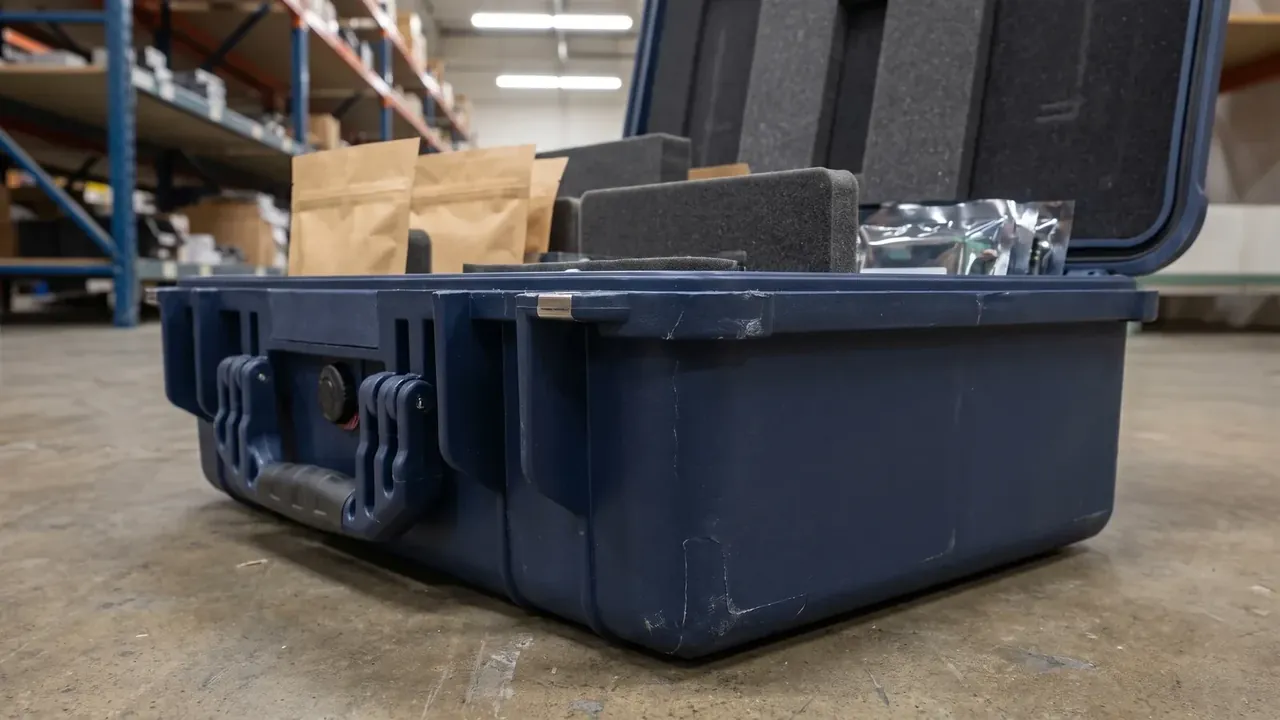
If the two 325 N latches loosen first, the fault is how the overlap meets the bushing, not the drop height. Mouth reset after the 0.9 m drop, a repeat clearance reading and the IP65 reference share one round, because a hairline crack along the hinge seat shifts the clearance. These points confirm the mouth of the musical instrument pedal & audio briefcase still seats after ageing.
5. Clearance reject line for performance batches
The reject line sits on two figures: the upper deviation of the 0.35 mm clearance, and rattle after 500 cycles. Each musical instrument pedal & audio briefcase batch is measured for clearance first, then rattle backs out pad compaction; both are needed before sign-off.
| Rattle reading | Bushing clearance | Mouth shift |
|---|---|---|
| 36 dB(A) | 0.50 mm | 0.72 mm |
| 32 dB(A) | 0.35 mm | 0.58 mm |
| 30 dB(A) | 0.34 mm | 0.52 mm |
| 27 dB(A) | 0.22 mm | 0.40 mm |
Take the 36 dB(A) row: at 0.50 mm clearance and 0.72 mm shift it crosses both the 32 dB(A) and 0.6 mm lines and is rejected. JUNZHIJIA centres performance batches on 0.35 mm, 2.4 mm and 32 dB(A) at 500 cycles, with clearance, pad thickness and end rattle on one line; a batch missing any of the three leaves the pass count.
Conclusion
Reducing the rattle question of the musical instrument pedal & audio briefcase to the case itself, it comes down to whether bushing clearance and mouth pad still hold 32 dB(A) and 0.6 mm after loading. A 0.35 mm clearance, 2.4 mm pad, 500 cycles, 32 dB(A) of rattle and a repeat after 4200 cycles all run on one batch. Measure clearance and pad, run staged readings, then the 0.9 m drop reset and shift retest; swapping the order lets rig knocks be scored as lid noise. Sign-off rests on all three figures on one line.
Related Reading
- How instrument cases protect wood, brass and electronics
- Audio rack case cooling and damping on tour
- Guitar cases for instrument transport and humidity
- EVA, EPE and PU foam compression and rebound for instrument cases
Related Products
- 8 Series — Gun Cases; Military Equipment Cases; Camera Equipment Cases; Drone Cases; Watch Cases; Knife Cases; First Aid Cases; Electronics Equipment Cases
- WL8-2812 PP Gun Case — model WL8-2812
- All protective cases and toolboxes: 7 series, 158 models