

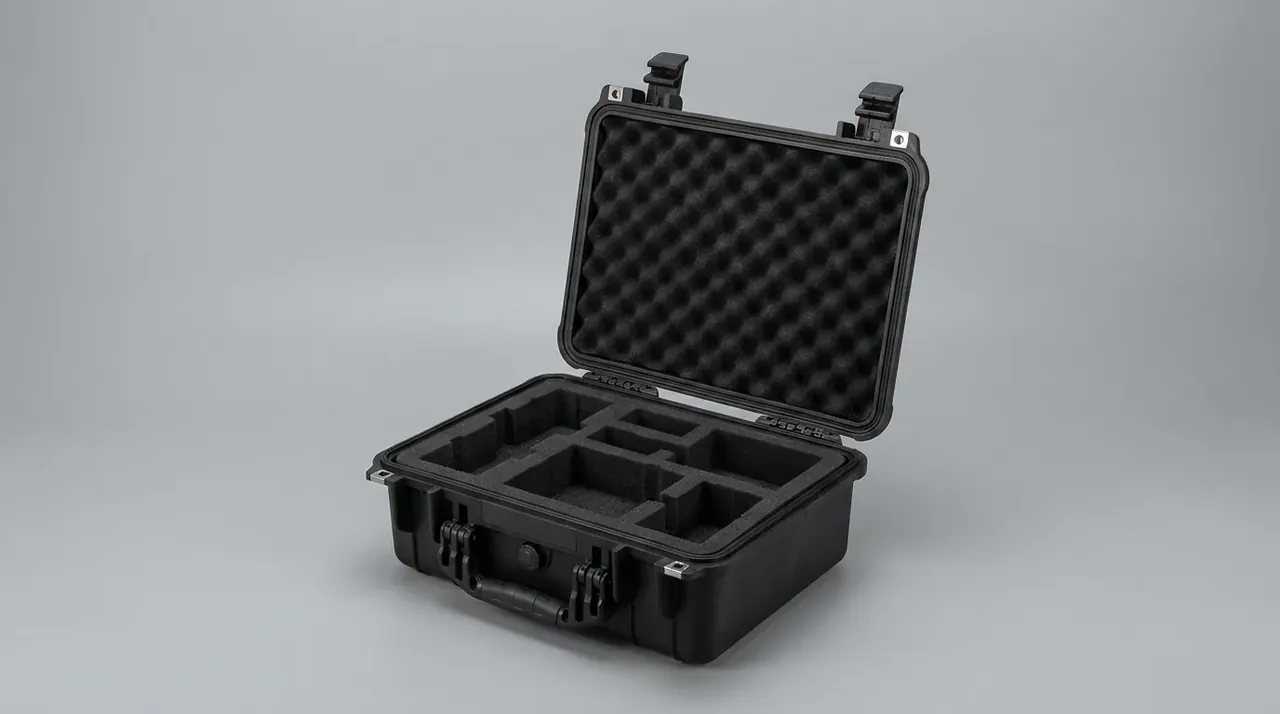
Quick answer: A sealed audio rack case at 30 °C reaches 71 °C inside after 40 minutes, so a 600 W amplifier needs 92 m³/h of flow to hold a 20 K rise.
Table of contents
- The heat budget: 600 W and 71 °C
- Inlet area and face velocity
- Internal rise: 35 °C outside, 55 °C inside
- Fan noise on stage
- Rubber pad hardness and 1–200 Hz
- FAQ
1. The heat budget: 600 W and 71 °C
A 600 W amplifier sealed in an audio rack case takes the internal air to 71 °C in 40 minutes at 30 °C ambient, a rise of 41 K. The same unit on an open rack sits at 46 °C, so the shell traps a 25 K penalty.
Sealed, heat leaves only by convection and radiation. A 0.9 m² shell moving 600 W must run 38 K above ambient, and 71 °C is where that balance lands; a 10 mm lid gap still only reaches 62 °C.
| Configuration | Inlet | Airflow | Inside at 40 min | Rise |
|---|---|---|---|---|
| Sealed | 0 | 0 | 71 °C | 41 K |
| One side perforated, no fan | 40 cm² | 8 m³/h | 63 °C | 33 K |
| Two sides perforated, no fan | 100 cm² | 22 m³/h | 57 °C | 27 K |
| Two sides, 2 × 80 mm fans | 100 cm² | 92 m³/h | 50 °C | 20 K |
| Two sides, 2 × 92 mm fans | 140 cm² | 130 m³/h | 46 °C | 16 K |
The 92 m³/h row is the line: a 20 K rise holds 55 °C inside on a 35 °C stage, and the next step buys only 4 K more.
2. Inlet area and face velocity
Area is flow divided by velocity: 92 m³/h is 0.0256 m³/s, and at 2.5 m/s through the mesh the net opening is 102 cm².
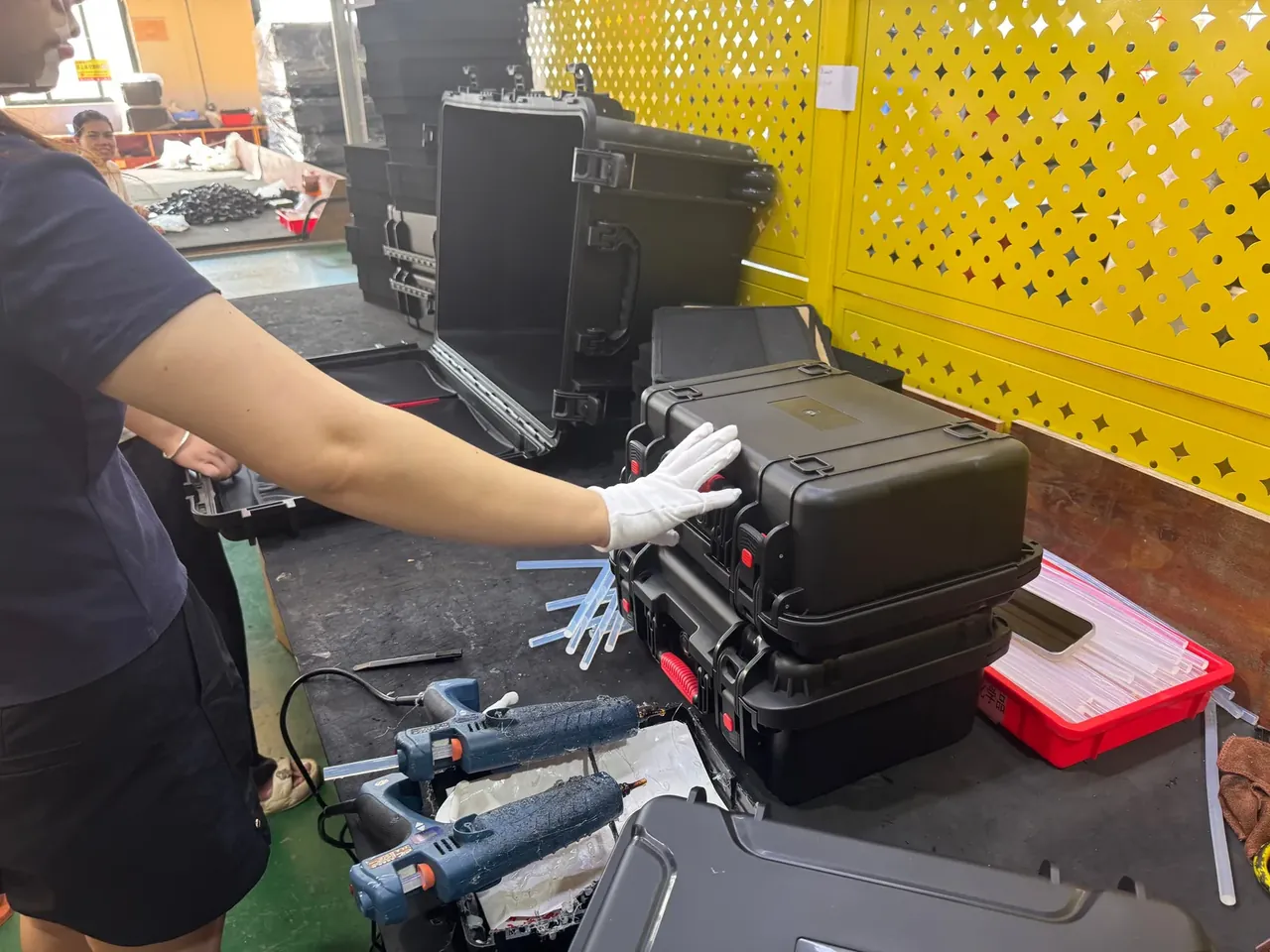
At 45% open area that is 227 cm² of panel, about 120 mm × 95 mm per side; 6 mm round holes resist 1.8 times more than louvre slots and drop the fan to 74 m³/h. Velocity runs between 1.8 and 3.5 m/s, and inlet low with exhaust high 260 mm apart cuts recirculation from 32% to 9%. Dust takes 45% open area to 28% within 3 shows, costing 22 m³/h and 5 K.
3. Internal rise: 35 °C outside, 55 °C inside
The criterion is 55 °C inside at 35 °C ambient, a 20 K allowance. It sits between two hard stops: the amplifier derates above 45 °C inlet and loses 30% of output at 55 °C, and a 60 °C panel cannot be handled in thin gloves.
| Ambient | Inside at 92 m³/h | Rise | Verdict |
|---|---|---|---|
| 25 °C | 45 °C | 20 K | Pass |
| 30 °C | 50 °C | 20 K | Pass |
| 35 °C | 55 °C | 20 K | On the line |
| 40 °C | 60 °C | 20 K | Fail |
Read 50 mm in front of the exhaust every 5 minutes and take the 40 minute plateau, since the first 10 minutes understate the result by 12 K. At 74 m³/h the 35 °C case reaches 59 °C, so write the airflow beside the temperature.
4. Fan noise on stage
Two 80 mm fans at 32 dB(A) add to 35 dB(A), which vanishes in an 85 dB(A) show but becomes the loudest source in a 42 dB(A) hall.
Row three hears the blade-pass tone near 4 kHz, a narrow band that lifts the A-weighted level by 3 dB(A) yet is the first thing the ear catches.
Size beats damping. A 120 mm fan moves 92 m³/h at 1,450 r/min and 24 dB(A), 11 dB(A) below the pair, and an 8 mm rubber gasket takes 3 dB(A) more. Blade-pass is speed times blades over 60, so 1,450 × 7 gives 169 Hz; a 5 mm lining cuts 4 dB(A) but eats 8% of the clear space. Mounting is worth 2 dB(A), and a 40 °C thermostat keeps the first 20 minutes of a night set silent.
5. Rubber pad hardness and 1–200 Hz
The pads between rack and case floor set the resonance: a 40 kg rack on four Shore A 40 pads settles 2.2 mm and resonates at 16 Hz, inside a 1–200 Hz sweep.
| Hardness | Deflection | Resonance | Isolation, 1–200 Hz | Movement |
|---|---|---|---|---|
| Shore A 30 | 3.4 mm | 12 Hz | 62% | 1.2 mm |
| Shore A 40 | 2.2 mm | 16 Hz | 74% | 0.8 mm |
| Shore A 50 | 1.4 mm | 21 Hz | 68% | 0.5 mm |
| Shore A 60 | 0.9 mm | 27 Hz | 55% | 0.3 mm |
Transport is a 0.5 g sweep from 1 to 200 Hz. With 74% isolation the rack sees 0.13 g, while Shore A 60 isolates nothing below 40 Hz and amplifies 1.4 times at 27 Hz. Four corner pads on a forward-biased rack split the peak into 14 and 19 Hz and drop isolation to 61% until they move 20 mm toward the centre of mass. Stacking puts 120 kg on the bottom of four cases, so the corner slots must engage and the rack bolts down with four M6 screws at 6 N·m; pads isolate, bolts stop movement.
Conclusion
Cooling and damping in an audio rack case come down to two thresholds: a 20 K rise and 92 m³/h. A 600 W amplifier sealed in the case climbs to 71 °C, twice the allowance, while 100 cm² of inlet and two 80 mm fans bring it to 50 °C in 40 minutes and hold 55 °C on a 35 °C stage. Area alone is not enough: 260 mm between inlet and exhaust, 45% open mesh and a clean every 3 shows each protect the same 5 K. Damping runs separately, where Shore A 40 pads put the 16 Hz resonance at the edge of the sweep and leave 0.13 g at the rack; pads isolate, and four M6 screws at 6 N·m stop movement. Measure airflow and rise first, then set pad hardness and fan noise, and put all three on the show tech sheet.
This article discusses container-side specifications and design implications only, and does not cover any handling, loading or use of the contents.
Related Reading
- Stage lighting and audio case selection
- Repairing a cracked case shell
- Asset tagging for touring cases
- Rack component cases for warehouses
Related Products
- 8 Series — Gun Cases; Military Equipment Cases; Camera Equipment Cases; Drone Cases; Watch Cases; Knife Cases; First Aid Cases; Electronics Equipment Cases
- WL8-2812 PP Gun Case — model WL8-2812
- All protective cases and toolboxes: 7 series, 158 models