

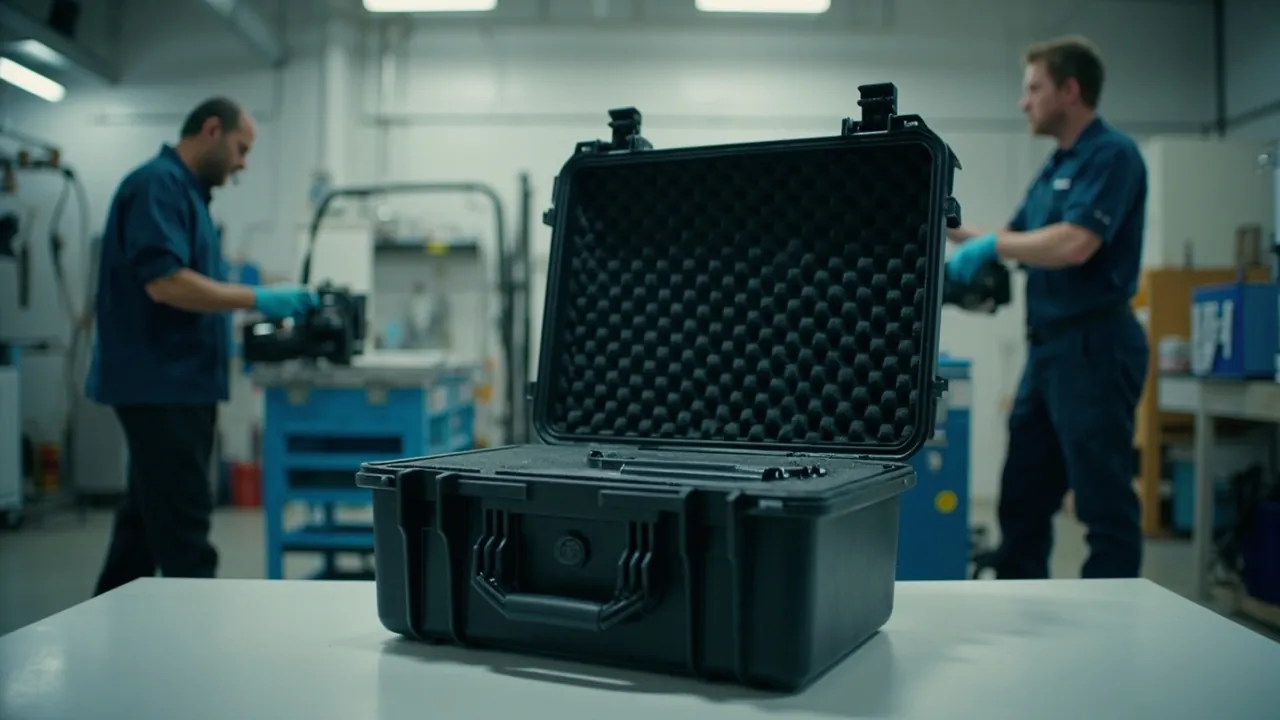
When a warehouse racking or steel structure project is delivered, the failure rarely starts with the drawing. It starts on the last mile between the factory gate and the construction site. Uprights are thin-walled, slender members typically 3,000 to 12,000 mm long, and their punched end holes and welded base plates are the precision anchors of the whole system. Beams carry welded connector end plates at both tips, and once those plates bend out of tolerance the beam will simply not engage the upright. The conclusion is straightforward: uprights and beams cannot be shipped loose. They require a dedicated parts case or box pallet with custom inserts, separated cavities, and controlled sealing that solves four problems at once - impact, deformation, coating damage, and moisture-driven corrosion.
Loose shipping carries a hidden cost structure that most quotations ignore. In long-haul road transport combined with repeated handling, the incidence of dented upright punch holes and distorted beam connectors is far from negligible. Sites then have to ream holes, touch up coatings, or scrap entire members, and the rework plus schedule slippage usually costs more than the packaging itself. This article is written for racking manufacturers, steel structure contractors, export buyers, and third-party logistics engineers. It sets out component risk profiles, case structure and insert selection, ingress protection levels and the standards behind them, vibration and stacking validation methods, and acceptance and maintenance rules, and it explains the practical engineering capability behind custom inserts and OEM/ODM supply.
Table of Contents
- 1. Why Rack Uprights and Beams Need a Dedicated Parts Case
- 2. Component List and Risk Profile: Uprights, Beams, Bracing and Connectors
- 3. Failure Mode Analysis: Impact, Deformation, Coating Damage and Hole Misalignment
- 4. Size and Weight Boundaries: Packing Very Long Uprights
- 5. Case Structure and Material Selection
- 6. Insert Design: EVA, EPE, PE Foam and Wood-Plastic Dividers
- 7. Sealing and Ingress Protection: An IEC 60529 and GB/T 4208 View
- 8. Rust and Coating Protection: VCI and Desiccant Strategy
- 9. Transport Vibration and Shock: GB/T 4857.23 and ISTA Programs
- 10. Stacking, Lifting and Heavy-Load Handling Awareness
- 11. Labelling, Traceability and Site Delivery Management
- 12. OEM/ODM Customization Workflow and Prototype Validation
- 13. Cost Structure and Procurement Decision Model
- 14. Acceptance, Cleaning and Service Life Management
- Frequently Asked Questions
- Conclusion & Related Reading
1. Why Rack Uprights and Beams Need a Dedicated Parts Case
Warehouse racking is a classic case of a product that is simultaneously precision-sensitive and finish-sensitive. Uprights are usually cold-formed thin-walled steel, commonly 1.8 to 2.5 mm thick, with a perforated C or sigma profile. Beams are either welded box beams or rectangular tube beams, with connector end plates 3 to 5 mm thick; hole position tolerance is typically held in the sub-millimetre to half-millimetre range. Any mechanical shock in the supply chain therefore translates directly into "it will not assemble on site."
Three traditional packing methods dominate the market: loose bundling, timber pallet plus stretch wrap, and simple carton wrapping. All three share the same weaknesses. There is no separated cavity, no rigid positioning, and no controllable moisture barrier. Uprights rubbing against each other wear through galvanized or powder-coated surfaces, exposing base metal and opening a corrosion pathway. Stacked beams let connector plates collide, and that deformation is usually irreversible.
The value of a dedicated parts case shows up at four levels:
- Geometry protection. Inserts create separate cavities so each component has zero freedom to move, diverting impact energy into the case rather than the part.
- Surface protection. Soft inserts prevent metal-to-metal contact and stop coating scratches and powder shedding.
- Environmental isolation. A sealed structure plus desiccant or vapour-phase corrosion inhibitor keeps sea freight humidity and diurnal condensation outside the case.
- Handling efficiency. Packing by installation zone lets crews rack components by case number, cutting secondary sorting and wrong-part rates.
Rule of thumb: packaging is usually only a few percent of racking project value, but a single site rework event - crane time, labour, and schedule delay - can exceed the entire packaging budget. A parts case is insurance, not consumable.
For rental racking or demountable steel structures that shuttle between factory and site repeatedly, the case itself becomes a reusable asset. In that scenario, review the cycle-count and hinge fatigue assessment methods described in protective case service life and reuse years.
2. Component List and Risk Profile: Uprights, Beams, Bracing and Connectors
A standard beam-and-upright racking system contains far more part types than outsiders assume. Before planning a pack, build a component list with a sensitivity rating.
| Component | Typical material / finish | Typical size range | Critical sensitivity | Recommended protection |
|---|---|---|---|---|
| --- | --- | --- | --- | --- |
| Upright | Cold-formed steel, galvanized or powder coated | 3,000-12,000 mm long | Punched ends, base plate weld, straightness | IP65-class sealing plus rigid cavities |
| Beam | Welded box or rectangular tube, powder coated | 1,200-3,600 mm long | Connector plate hole pitch, hooks | Separated cavities with soft isolation |
| Diagonal / horizontal bracing | Angle or round tube | 600-1,500 mm long | End bolt holes | Bundling with cushions |
| Connectors and safety pins | Forged or stamped parts | Small | Loss in mixed loads, corrosion | Small-part box plus desiccant |
| Shelf panels | Cold-rolled folded sheet | 800-1,300 mm wide | Rolled edges, flatness | Vertical slot racking |
| Base plates and anchors | Steel plate, alloy steel | Small | Thread damage | Thread sleeves in separate cavities |
| Rails (shuttle systems) | Hot-rolled section | Very long | Straightness, butt-joint faces | Dedicated long-material case |
| Corner guards and bumpers | Plastic or steel | Small to medium | Brittle fracture | Cushioning inserts |
Two things stand out. Uprights and beams consume most of the protection budget, while small parts are mainly a loss-prevention and corrosion problem. In practice, follow the "one installation unit, one case" principle: group the uprights and beams for the same aisle and the same level into the same case set, and label the case with aisle and level numbers.
3. Failure Mode Analysis: Impact, Deformation, Coating Damage and Hole Misalignment
You cannot design effective protection without naming the failure paths. Five modes dominate field experience.
Mode one: end-hole impact damage. Upright ends are the interface to other members. Once a punch hole edge is rolled over or torn, bolt insertion is blocked. This usually happens when an upright end strikes the ground or the truck sideboard during loading.
Mode two: connector plate deformation. Beam connectors are cantilevered thin plates with low bending resistance. Lateral stacking or side impact bends them outward, inward, or twisted; once the hole pitch exceeds tolerance, the beam will not seat.
Mode three: coating damage. A scratched zinc layer loses its sacrificial anodic protection. Powder coating that chips exposes base metal, and red rust appears quickly in humid air. Sea freight with salt-laden air accelerates this considerably.
Mode four: straightness loss. As vertical load-bearing members, uprights govern rack verticality and safety. Long-term lateral stacking pressure and poor support spacing cause plastic bending.
Mode five: small-part loss and thread damage. Safety pins, bolts, and anchors vanish easily in mixed loads, and damaged threads require re-tapping on site.
It must be emphasised: racking is a load-bearing structure. Field straightening and field repainting both reduce design capacity. The goal of packaging is not "deal with it later" but "compliant on arrival."
4. Size and Weight Boundaries: Packing Very Long Uprights
Upright length forces the fundamental packaging decision. Industry practice splits into four bands.
Short uprights (up to 3,000 mm). Standard large protective cases work well. Uprights lie horizontally, divider ribs space them apart, and 6 to 12 pieces fit per case with stacking allowed.
Medium uprights (3,000-6,000 mm). A box pallet is the usual answer: a heavy-duty pallet base, steel corner posts, protective side and top panels, with uprights standing or inclined and strapped down.
Long uprights (6,000-12,000 mm). Custom long-material cases or frame boxes are required. Sometimes the member is split into two sections and joined on site. Here, case stiffness, lifting points, and truck matching become the core issues.
| Packing mode | Length band | Loading method | Advantages | Limitations |
|---|---|---|---|---|
| --- | --- | --- | --- | --- |
| Standard protective case | Up to 3,000 mm | Horizontal, separated cavities | Stackable, well sealed | Length constrained |
| Box pallet | 3,000-6,000 mm | Vertical or inclined, strapped | Stiffness plus forklift handling | Large empty return volume |
| Long-material frame case | 6,000-12,000 mm | Horizontal on multi-point supports | Suits very long parts | Requires dedicated vehicles |
| Split delivery | Above 12,000 mm | Multiple cases plus site joining | Reduces transport difficulty | Adds site operations |
Whichever mode is chosen, keep support count and spacing sensible. Under its own weight, an upright can sag or bow. As a rule, support spacing should not exceed roughly 1,500 to 2,000 mm, and end overhang should stay under about 500 mm.
5. Case Structure and Material Selection
The material system must satisfy four requirements at once: rigidity, weather resistance, recyclability, and reusability. The main options are as follows.
Rotomoulded HDPE cases. One-piece seamless moulding, excellent impact resistance, and low-temperature performance down to roughly minus 40 degrees Celsius. Well suited to sea freight and outdoor circulation, and able to support an IP67 protective case structure.
Injection-moulded PP cases. High dimensional accuracy and consistency, ideal for small to medium parts cases and automated line integration, though large formats are limited.
Composite sandwich panel cases. Fibreglass or aluminium skins over honeycomb or foam cores deliver high specific strength and suit very long upright cases, at a higher cost.
Steel-timber hybrid structures. A steel frame with timber or composite panel cladding offers high load capacity at controllable cost, and is common for heavy racking components. Note the fumigation and phytosanitary compliance requirements for timber.
Recommended selection order: first define load and stiffness class from part mass and length, then define sealing and weather class from the transport environment, and only then decide appearance and branding.
6. Insert Design: EVA, EPE, PE Foam and Wood-Plastic Dividers
Inserts are the soul of a parts case. Without a competent insert, a case is merely a more expensive container.
| Insert material | Density / hardness | Rebound and cushioning | Processing | Suitable parts |
|---|---|---|---|---|
| --- | --- | --- | --- | --- |
| EVA foam | Medium to high density, adjustable hardness | Good rebound, compression resistant | CNC routing, die cutting | Connector plates, precision connectors |
| EPE pearl foam | Low density | Good cushioning, moderate rebound | Heat pressing, lamination | General padding, end caps |
| PE foam | Medium density | Relatively hard | Die cutting, bonding | Divider ribs, locating blocks |
| PU foam | Pour-in-place | Excellent conformity | On-site pouring | Irregular shapes |
| Wood-plastic or plywood | Rigid | No cushioning | Sawing, assembly | Large-part cavity dividers |
| Honeycomb board | Light and rigid | Limited | Die cutting, folding | Lightweight dividers |
The three-layer principle. The base layer is a load-bearing layer of high-hardness foam or a timber deck. The middle layer is a locating layer of CNC-routed conformal slots. The top layer is a compression layer of soft foam or elastic straps. Together they deliver "no rattle when lifted, no impact when set down."
For racking manufacturers that change models frequently, a modular insert built on a removable divider system can serve multiple variants using movable slats. Slot tolerance, draft angle, and splicing details are covered in the custom foam insert design guide. JUNZHJIA can perform 3D scanning from customer-supplied upright section drawings and beam connector drawings, then deliver a CNC-routed insert design with a validated prototype so connector slot clearance stays within the specified range.
7. Sealing and Ingress Protection: An IEC 60529 and GB/T 4208 View
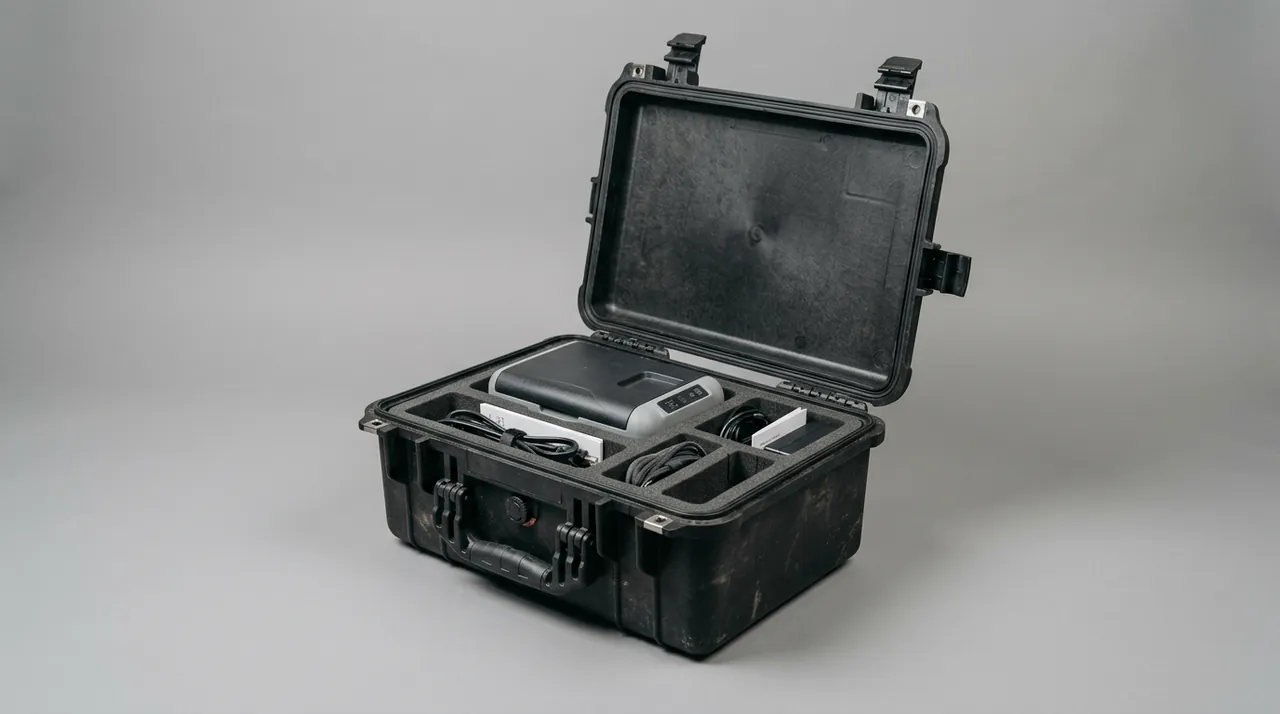
Ingress protection is the quantified promise a parts case makes about environmental intrusion. IEC 60529, and the equivalent national standard GB/T 4208, define the IP code: the first digit covers solid particle ingress and the second covers water.
| IP rating | Dust | Water | Typical application |
|---|---|---|---|
| --- | --- | --- | --- |
| IP54 | Partial dust protection | Splash resistant | Indoor short-haul circulation |
| IP65 | Dust tight | Jet-water resistant | General road transport, indoor storage |
| IP66 | Dust tight | Powerful jet resistant | Open-yard storage, rain exposure |
| IP67 | Dust tight | Temporary immersion | Sea freight, intermodal, quay transfer |
| IP68 | Dust tight | Continuous immersion | Special conditions, by agreement |
For racking parts cases, the recommended baseline is IP65, raised to IP67 for sea freight and open storage. Achieving it depends on three factors: gasket material and compression, the clamping force distribution across latches and hinges, and control of case deflection. Gasket selection - the weather resistance and compression-set differences between silicone, EPDM, and TPE - and its match to the case hinge and latch sealing structure determine real-world performance, which often diverges from laboratory ratings.
Note that an IP rating is determined under standardised test conditions. After compression, drops, and stacking deformation in real transport, sealing performance degrades. Design in compression margin, and inspect gasket ageing after every reuse cycle.
8. Rust and Coating Protection: VCI and Desiccant Strategy
Corrosion risk for racking components comes from three water sources: surface moisture carried in at packing, condensation during transit, and liquid water ingress from outside. A sealed case solves the third; the first two need dedicated corrosion control.
Desiccant sizing. The common approach estimates from free internal volume and transit duration. For a well-sealed case, silica gel desiccant is typically dosed at roughly 0.5 to 1.0 kg per cubic metre of free volume, adjusted for packaging material moisture vapour transmission rate, transit time, and destination climate.
Vapour-phase corrosion inhibitor. VCI sublimates inside a closed space and adsorbs onto metal surfaces as a molecular film, which suits complex geometry such as upright punch holes, connector edges, and threads that are hard to coat. The case must be well sealed or the inhibitor concentration cannot be maintained.
Surface separation. Galvanized and powder-coated parts should not touch directly, since the softer coating scratches easily. Also avoid prolonged contact with acidic species in timber.
For sea freight, use a three-part combination: VCI film, desiccant, and an IP67 sealed case, with a humidity indicator card inside so arrival condition can be judged immediately. A dedicated desiccant pocket and humidity card holder can be designed into export cases so the desiccant cannot shift and press against components in transit.
9. Transport Vibration and Shock: GB/T 4857.23 and ISTA Programs
The transport environment is the most commonly underestimated design input. Road vibration energy concentrates between roughly 3 and 100 Hz, and the 5 to 20 Hz band excites slender uprights most strongly.
The GB/T 4857 series is the national framework of basic test methods for transport packages, and GB/T 4857.23 specifies random vibration testing to simulate real transport spectra. The wider method set is summarised in GB/T 4857 transport packaging standard explained.
The ISTA series approaches this from the distribution chain: Series 1 (non-simulation integrity), Series 2 (partial simulation), Series 3 (general simulation), and Series 7 (development). For racking components delivered door-to-door to project sites, ISTA 3A and 3E class programs are a reasonable reference; see choosing ISTA transport test procedures.
| Test | Reference standard | Example condition | Failure of interest |
|---|---|---|---|
| --- | --- | --- | --- |
| Random vibration | GB/T 4857.23 / ASTM D4728 | Road spectrum, duration scaled to distance | Insert collapse, part migration |
| Drop | GB/T 4857.5 / ISTA 1A | Height set by package mass | Case cracking, end damage |
| Stacking | GB/T 4857.3 / GB/T 4857.4 | Load and duration per stack | Case creep, lower-case deformation |
| Conditioning | GB/T 4857.2 | High humidity and temperature cycling | Gasket ageing, condensation |
| Environmental | MIL-STD-810H (test method reference only; not a military certification) | Temperature, humidity, vibration, shock | Combined environmental fitness |
MIL-STD-810H provides a systematic environmental test methodology often used as a design reference. It must be stated clearly that citing this standard is a test-method reference only; it does not represent a military certification, nor any national defence procurement qualification. For compliant wording, see MIL-STD-810H case environmental testing explained.

10. Stacking, Lifting and Heavy-Load Handling Awareness
Racking parts cases are heavy-load units. Single-case mass commonly reaches 200 to 800 kg, and long-material cases can exceed 1,000 kg. Handling safety must be designed in from the start.
Lifting points. Long-material frame cases should have four lifting lugs positioned symmetrically about the centre of gravity, with rated load and lug identification marked. Single-point lifting that twists the case is prohibited.
Forklift handling. Leave standard fork pockets in the base, commonly 90 to 100 mm high, and mark the insertion direction on the side. Very long cases should use twin forks or a purpose-built spreader rather than a single fork, which twists or tips the case.
Stacking limits. Maximum stack height must be derived from top-surface load capacity and base-case creep behaviour, then marked prominently on the case together with a do-not-stack notice. Inside sea containers, limit to two or three layers and lash the load.
Personnel safety. Heavy case handling requires safety footwear, a marked lifting exclusion zone, and a single appointed signal person. This is the baseline of heavy-load handling awareness.
Heavy packaging rarely fails gradually. It fails once. When a case becomes unstable during lifting, the loss is not only the cargo but human safety.
11. Labelling, Traceability and Site Delivery Management
Site execution depends on finding the right part quickly. A label system should cover four layers:
- Case master label: project number, case number, aisle, level, component name and quantity, gross and net weight, stack limit, lifting marks.
- Component label: upright specification, length, hole pattern, batch number.
- Tamper evidence: one-time seals or tamper-evident labels so en-route opening can be detected.
- Compliance marking: for export timber packaging, ISPM 15 treatment and marking requirements apply.
Use abrasion-resistant synthetic or laminated labels so they do not fall off in humid conditions. For projects requiring open-case sampling, build the sampling rules on the approach described in custom case acceptance sampling with AQL.
12. OEM/ODM Customization Workflow and Prototype Validation
For a racking manufacturer, a parts case is not a commodity; it is tooling bound tightly to product geometry. A typical customization workflow has six stages:
- Requirement intake: component list, drawings or physical scanning, transport route and destination climate, annual volume.
- Concept design: case structure, insert cavities, sealing concept, labelling system.
- Prototype validation: first-article trial fit, dimensional and clearance checks, drop and vibration pre-testing where required.
- Pilot run: confirm process stability and assembly efficiency.
- Volume supply: establish batch traceability and quality records.
- Iteration: refine inserts and labelling from field feedback.
When selecting a supplier, focus on structural design capability, insert machining accuracy, ability to provide test documentation, and delivery reliability. The methodology is set out in how to choose a protective case OEM factory. JUNZHJIA is manufactured by Kexin New Materials (Guangdong) Co., Ltd. and serves wholesale, distribution, and OEM/ODM customers with integrated services from structural design and insert customization through volume supply. Seals and hardware can be matched per model, and supporting test documentation can be provided for tendering and acceptance.
13. Cost Structure and Procurement Decision Model
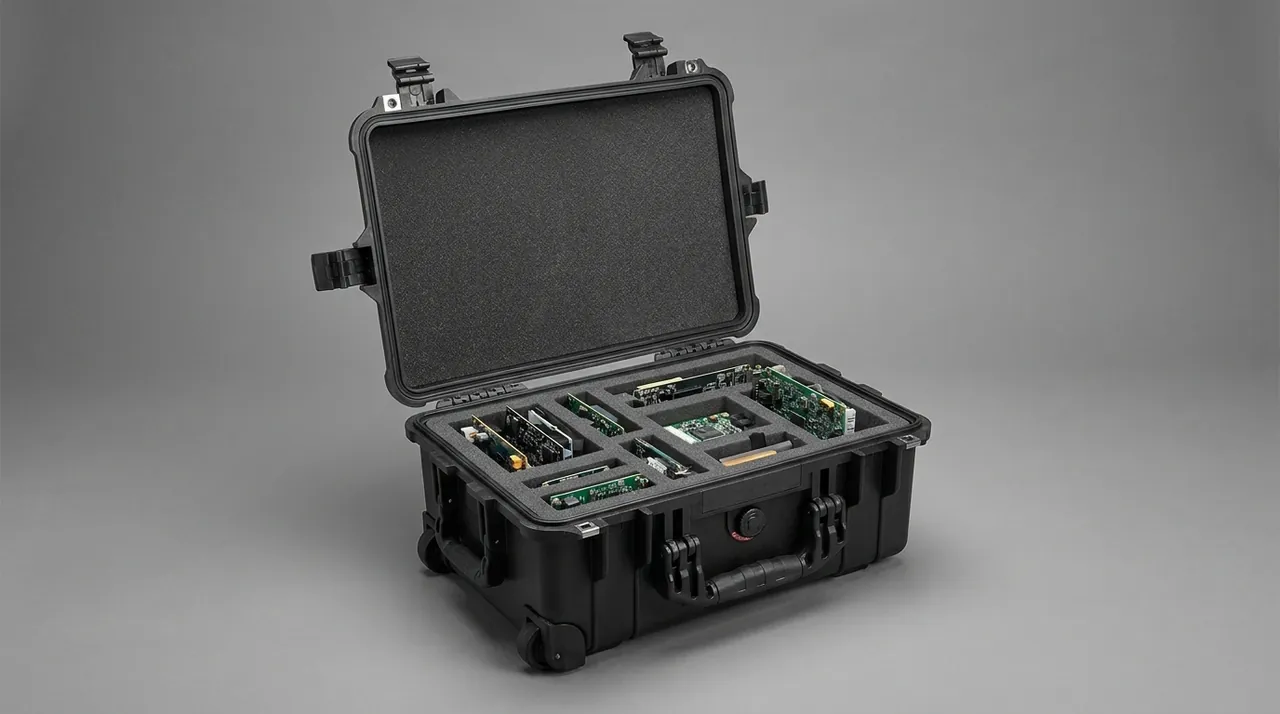
The cost of a parts case is not a single unit price; it is a life-cycle calculation.
| Cost item | Description | Optimization direction |
|---|---|---|
| --- | --- | --- |
| Case body | Material, tooling amortization, processing | Increase commonality, design for reuse |
| Inserts | Material, CNC machining time | Modular inserts, reduce routed area |
| Sealing and hardware | Gaskets, latches, hinges | Match to actual IP requirement, avoid over-design |
| Transport | Volume, weight, empty return | Collapsible or nestable design |
| Site cost | Sorting, rework, losses | Pack by aisle, clear labelling |
| Reuse benefit | Cycle count | Improve stiffness and repairability |
The core conclusion: when cargo value is high, transport distance is long, and site rework is expensive, invest first in inserts and sealing. For short-haul, low-value, single-use scenarios, a lighter approach is justified. Tooling investment and amortization methods are covered in custom case mould cost analysis.
14. Acceptance, Cleaning and Service Life Management
Incoming acceptance should cover appearance (case cracks, gasket integrity), quantity (matching the packing list), tamper evidence (intact or not), humidity indication (colour change), and sampled components (holes, coating, straightness).
Routine cleaning and maintenance. Wipe the case with a mild detergent and soft cloth; avoid solvent-based cleaners that attack gaskets. Inspect gaskets periodically for compression set and replace them as soon as hardening or cracking appears. Cleaning details are in protective case cleaning and care.
Life management. Keep a case-number register recording usage counts and repair history, and set mandatory inspection points by cumulative cycle count for high-intensity circulation. Wheels and trolley handles on wheeled cases are wear parts; selection and replacement are covered in case wheels and trolley handle configuration.
Frequently Asked Questions
Q: Our uprights are longer than 6 metres. Does loose shipping really cause problems, and will a dedicated case just increase freight cost?
A: It does cause problems, and usually more than expected. Uprights above 6 metres are slender thin-walled members whose punched ends and base plate welds are precision-critical. When shipped loose, ground contact, sideboard impact, and friction between adjacent uprights can roll hole edges, bend sections, or damage coatings. More importantly, once the zinc layer is scratched and base metal is exposed, red rust develops quickly in humid sea freight conditions, and the member is often scrapped or downgraded on site. On freight cost, a case does add tare weight and volume, but competent designs control this by matching case dimensions to container internal profiles, using nestable or collapsible structures, and packing by project to raise load fill. In most engineering cases the freight increment from packaging is significantly lower than a single site rework event involving labour, crane time, and schedule delay. Quantify your transport route and rework probability before setting the case class.
Q: Can a bent beam connector plate be straightened on site, and how do we prevent it at the packaging stage?
A: Field straightening is not recommended. A beam connector is a cantilevered thin-plate load-bearing element, and its hole pitch and hook depth are set by the design capacity. Cold hammering introduces work hardening, micro-cracks, and residual stress. The part may look right afterwards, but its capacity can no longer be verified, which is a classic safety hazard. Prevention depends on three measures. First, cavity separation so each beam connector sits in its own pocket and never touches a neighbour. Second, soft cushioning such as EVA or PE foam protectors over the connector area to spread any contact force. Third, rigid end stops and straps to limit axial movement so the beam cannot hammer back and forth in transit. Also, orient all beams in the same direction when packing and prohibit alternating orientation, because alternating stacks place connectors directly against the web of the next beam and are the highest-risk configuration for deformation.
Q: For racking parts cases, should we choose IP65 or IP67?
A: The deciding question is whether immersion or powerful jetting is possible anywhere in the transport and storage chain. IP65 means dust-tight and protected against nozzle-directed water jets, which suits general road transport, indoor storage, and covered loading docks. IP67 goes further and requires no harmful ingress after temporary immersion, which suits sea freight, quay transfer, open yards, intermodal movements, and locations exposed to heavy rain and standing water. The practical rule of thumb is: domestic short-haul with frequent circulation and controlled warehousing takes IP65; export sea freight, open storage, and unprotected project sites take IP67. A caution is warranted, however. IP ratings come from standardised IEC 60529 and GB/T 4208 testing, and real performance also depends on gasket compression, latch clamping distribution, and case stiffness. Ask the supplier to explain the sealing architecture and validate a complete production case before committing to volume. As a further refinement, you can specify different classes for different case families within the same project, for example IP65 for short-haul internal cases and IP67 for sea freight cases.
Q: For sea freight export, should we use desiccant or VCI film for corrosion protection?
A: They are complementary rather than alternatives, and mature programmes use both. Desiccant lowers the internal relative humidity to below the critical corrosion threshold. Vapour-phase corrosion inhibitor forms a molecular film on metal surfaces, protecting even locations where local humidity is elevated. For racking components, the value of VCI is especially clear at upright punch holes, beam connectors, and threaded holes, which are geometrically complex and difficult to coat. At the same time, when internal free volume is large and transit is long, the dehumidifying capacity of desiccant is the foundation that keeps the whole volume dry. Two operating requirements matter. First, the case must be well sealed; otherwise desiccant saturates early from external vapour ingress and the VCI concentration cannot be maintained. Second, place a humidity indicator card inside so condition can be assessed immediately on arrival, giving the traceability record a physical basis. Where the route is especially long or includes several transhipments, consider adding a shock and tilt indicator as well.
Q: Should parts cases be drop and vibration tested, and how do we choose the standards?
A: Yes, particularly for export projects and high-value components. Drop testing verifies structural integrity and insert restraint under handling drops, and can follow GB/T 4857.5 or ISTA 1A with height set by package mass. Random vibration testing verifies whether inserts collapse, components migrate, or fasteners loosen under long-haul road or rail spectra; domestically this follows GB/T 4857.23, and international projects can reference ASTM D4728. If you need to simulate a complete distribution chain, ISTA Series 2 or Series 3 programs are appropriate, with Series 3 closer to real intermodal movement. Overall, test standard selection should match the real route rather than chasing the most severe level. Where combined temperature, humidity, and vibration conditions apply, MIL-STD-810H methodology can be referenced, but note that it serves here only as an environmental test method reference and is not a military certification. A useful discipline is to agree the test matrix in writing with the customer before prototyping, so acceptance criteria are fixed at the start rather than renegotiated after a failure.
Q: What must be written into the operating procedure for heavy parts case handling?
A: At least four items. First, lifting points: long-material and heavy cases must have symmetric lifting points defined at the design stage, with rated load marked, and single-point lifting or uncertified slings are prohibited. Second, forklift operation: the base should have fork pockets sized to the truck forks, with the insertion direction marked on the side; very long cases should use twin forks or a spreader to avoid twisting or tipping from single-fork loading. Third, stacking: maximum stack layers must be marked prominently, and inside sea containers layers should be limited and lashed to prevent movement in a seaway. Fourth, personnel protection: heavy case handling requires a marked lifting exclusion zone, safety footwear and gloves, and a single appointed signal person. Emphasise that heavy packaging failure is typically single-event and irreversible. Once stability is lost during lifting or stacking, the loss is not just cargo but direct risk to people, so the procedure cannot remain a document on a shelf.
Q: How do we decide between EVA, EPE, and PE foam for inserts?
A: Judge by component mass, surface sensitivity, and whether the case will be reused long term. EVA foam offers adjustable density and hardness, good rebound, and resistance to compression fatigue; it suits heavier connector plates, fittings, and multi-trip applications, at a higher cost. EPE pearl foam is low density with good cushioning at low cost, ideal for end caps, interlayer padding, and single-use or low-frequency packaging, but its rebound and creep resistance are weaker than EVA and it compresses permanently under sustained load. PE foam is harder and suits divider ribs, locating blocks, and base layers, but should not contact high-gloss surfaces directly because the hardness can leave marks. The common practical combination is a PE or timber base layer for load bearing, a CNC-routed EVA middle layer for conformal location, and an EPE or soft foam top layer for compression and cushioning. A supplier can perform 3D scanning from component drawings, propose a layered insert scheme, and validate clearances with a physical prototype.
Q: Is there a limit on case reuse cycles, and how do we extend service life?
A: There is a limit, and it depends on usage intensity rather than calendar age. The main factors are the UV and low-temperature resistance of the case material, the fatigue life of hinges and latches, the compression set and ageing of gaskets, and cumulative damage from each handling event. Practical measures to extend life include avoiding long-term outdoor sun exposure to slow polymer ageing; periodic cleaning and gasket inspection with immediate replacement of hardened, cracked, or permanently flattened gaskets; lubrication and fastener checks on latches and hinges; and a case-number register that records usage counts and repair history with mandatory inspection points set by cumulative cycles. For high-intensity circulation, specify repairability at purchase so gaskets and hardware can be replaced individually instead of scrapping the whole case. As an industry rule of thumb, a well-designed and well-maintained industrial protective case can be circulated through a long series of reuses under moderate intensity, though the actual figure should always be based on physical inspection results.
Conclusion & Related Reading
Protecting warehouse racking and steel structure components in transit is fundamentally a contest between precision and impact. Upright punch holes and straightness, beam connector hole pitch, and coating integrity are all hard specifications that cannot be recovered cheaply on site. Get five things right - separated cavities, soft isolation, controlled sealing, vapour-phase corrosion inhibition, and vibration validation - and the parts case stops being a cost line and becomes a stabiliser for project delivery quality.
The selection path can be summarised in one sentence: define inserts and stiffness from component precision and mass first, then define sealing and IP class from the transport route, and finally define labelling and delivery structure from the way the project is organised. For customers needing custom inserts, OEM/ODM volume supply, or supporting test documentation, JUNZHJIA provides integrated support from structural design through volume delivery.
Related Reading