

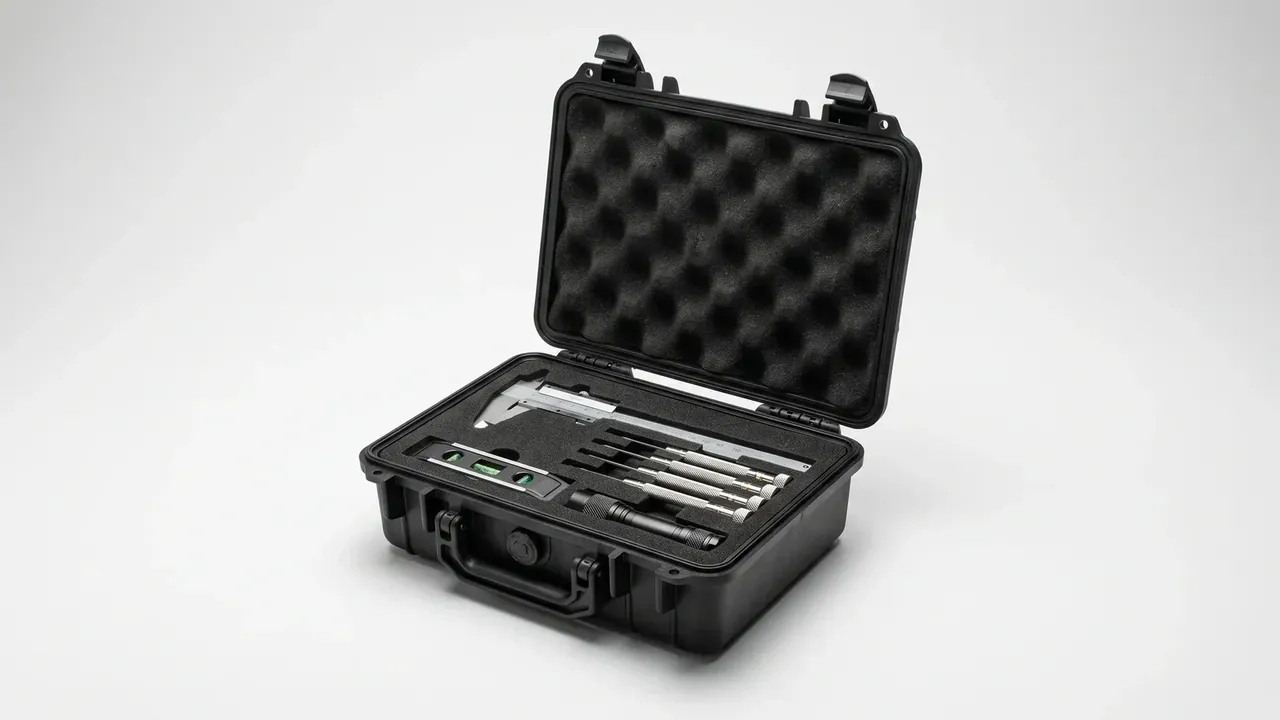
Quick answer: Thickness comes from contact pressure, not density. A 3.2 kg instrument dropped 1.2 m pulls about 55 g, which spreads to 0.19 MPa over 90 cm², so 20 mm of 70 kg/m³ EVA compressing 15% is enough; EPE suits instruments under 1 kg, and PU is for curved shapes only.
Table of contents
- Pressure First, Density Second
- EVA at 15% Compression
- EPE After 50,000 Closes
- PU: Curves Now, Chalk Later
- Three Layers and Their Jobs
- Half a Millimetre a Side
- FAQ
1. Pressure First, Density Second
Instrument case foam is chosen by the pressure an instrument can survive: weight times peak acceleration, divided by contact area. A 3.2 kg instrument dropped from 1.2 m onto 20 mm of EVA sees about 55 g and 0.19 MPa across 90 cm².
What the housing tolerates is a question for the mechanical engineer. A sheet-metal chassis takes 0.8 MPa, an extruded aluminium frame 0.3 MPa, a glass panel only 0.1 MPa. Once that ceiling is known, thickness stops being a matter of taste.
Halve the base from 20 to 10 mm and peak acceleration climbs to 95 g, pushing pressure to 0.33 MPa. The 10 mm saved is about CNY 4 of material; the dented aluminium it causes is not.
2. EVA at 15% Compression
EVA is closed-cell, usually 60 to 90 kg/m³. At 70 kg/m³ its 25% compression stress is 0.18 MPa with 48% rebound, so a 3.2 kg instrument sinks only 15% into a 20 mm base layer, leaving 17 mm of travel for the drop.
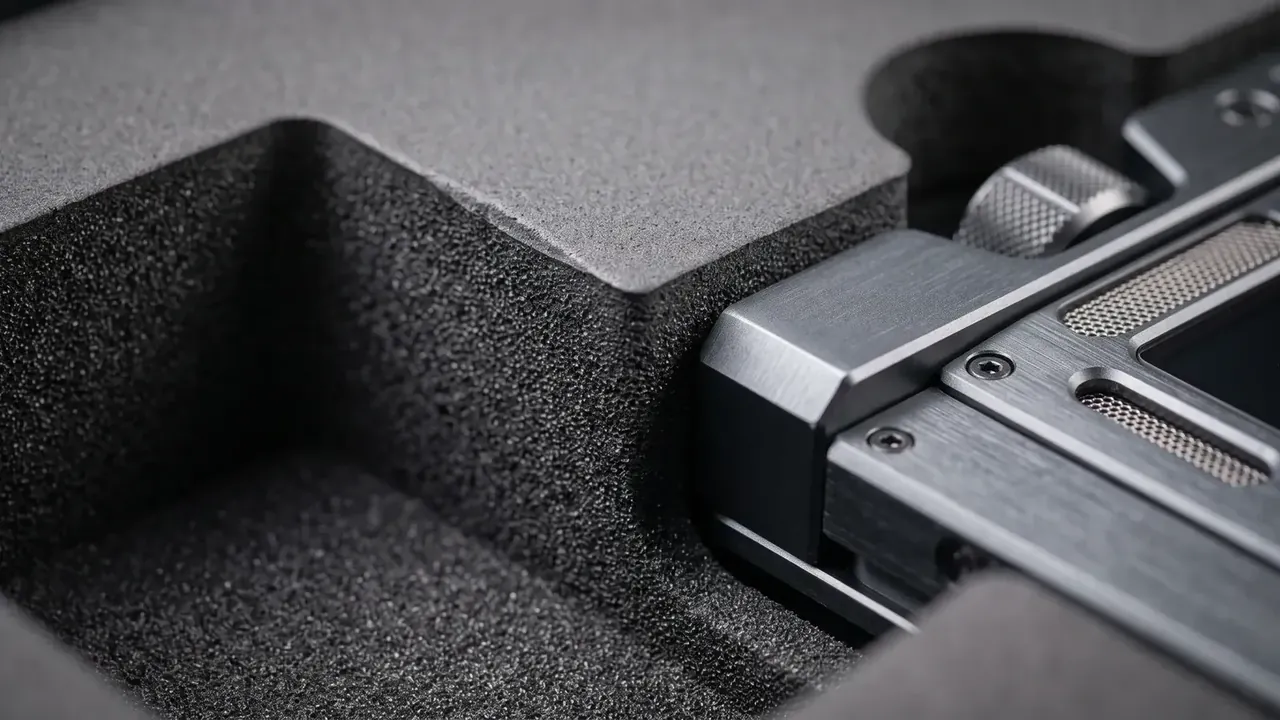
Water uptake is where EVA beats PU: 0.8% after 24 hours of immersion. The same closed cells trap air, so an instrument with a battery needs a 5 mm vent channel.
| Parameter | EVA | EPE | PU |
|---|---|---|---|
| Density | 70 kg/m³ | 30 kg/m³ | 28 kg/m³ |
| 25% compression stress | 0.18 MPa | 0.09 MPa | 3.5 kPa |
| Water uptake, 24 h | 0.8% | 0.4% | 220% |
| Price | CNY 26/kg | CNY 15/kg | CNY 34/kg |
Heat is the weak point. Above 60 °C the modulus falls, and a closed van reaches 65 °C, where compression set rises from 4% to 9% and the pocket loosens by 0.6 mm in one season. For southern projects, specify 80 kg/m³ EVA.
3. EPE After 50,000 Closes
EPE is expanded polyethylene at 30 kg/m³, with 0.09 MPa at 25% compression and 52% rebound. Softer than EVA and travelling further, it suits handheld terminals and thickness gauges under 1 kg.
Its weakness is fatigue. Twenty closes a day for seven years is 50,000 cycles, and a 20 mm EPE mid layer ends at 18.4 mm, an 8% loss that turns a snug pocket into a loose one; EVA loses 3% on the same test. A die cut 40 mm deep also leaves a 0.5 mm burr.
What keeps EPE in the catalogue is price: CNY 15 a kilo, about CNY 40 less per full interior than EVA, and a 3-day sample against 5.
4. PU: Curves Now, Chalk Later
PU is open-cell, 28 kg/m³, with only 3.5 kPa at 25% compression: the softest of the three and the least useful as a shock absorber. Its value is conformity. A curved handle, an odd probe, a 20-piece batch where a die makes no sense, all hand cut in about 2 hours.
The cost is life. Stored at 30 °C and 70% RH, PU chalks after 24 months: 0.2 mm of surface turns to powder, compression set reaches 18%, and a pocket that once gripped now rattles. Open cells take up 220% water, so a wet season puts the interior at 85% RH.
| Instrument weight | Base | Mid | Lid | Material |
|---|---|---|---|---|
| under 1 kg | 15 mm | 25 mm | 20 mm | EPE |
| 1 to 3 kg | 20 mm | 30 mm | 25 mm | EVA 70 |
| 3 to 8 kg | 25 mm | 40 mm | 25 mm | EVA 80 |
| above 8 kg | 30 mm | 50 mm | 30 mm | EVA 90 with a timber frame |
One niche remains: flame retardancy. Treated PU reaches UL94 HF-1 and self-extinguishes in 2 seconds, at 10% of its rebound, so power and petrochemical clients specify it.
5. Three Layers and Their Jobs
A full interior is three layers plus two accessories, each doing one job.
- Lid foam: 25 mm egg-crate, 12 mm peak height, holding the top face down in transit
- Mid foam: 40 mm die-cut, pockets 0.5 mm larger per side, fixing the instrument laterally
- Base foam: 20 mm plain sheet, absorbing vertical impact, and the only layer replaced alone
- Side strips: 15 mm, filling the gap to the case wall
- Separators: 0.3 mm PET, so a shifted adhesive cannot glue all three together
In a 380 × 260 × 95 mm interior, 20 plus 40 plus 25 leaves 10 mm for the handle and any protrusion; below 2 mm the lid will not close. Layers are bonded with tape rated at 12 N per 25 mm, since below 8 N two weeks at 65 °C opens the joint.
6. Half a Millimetre a Side
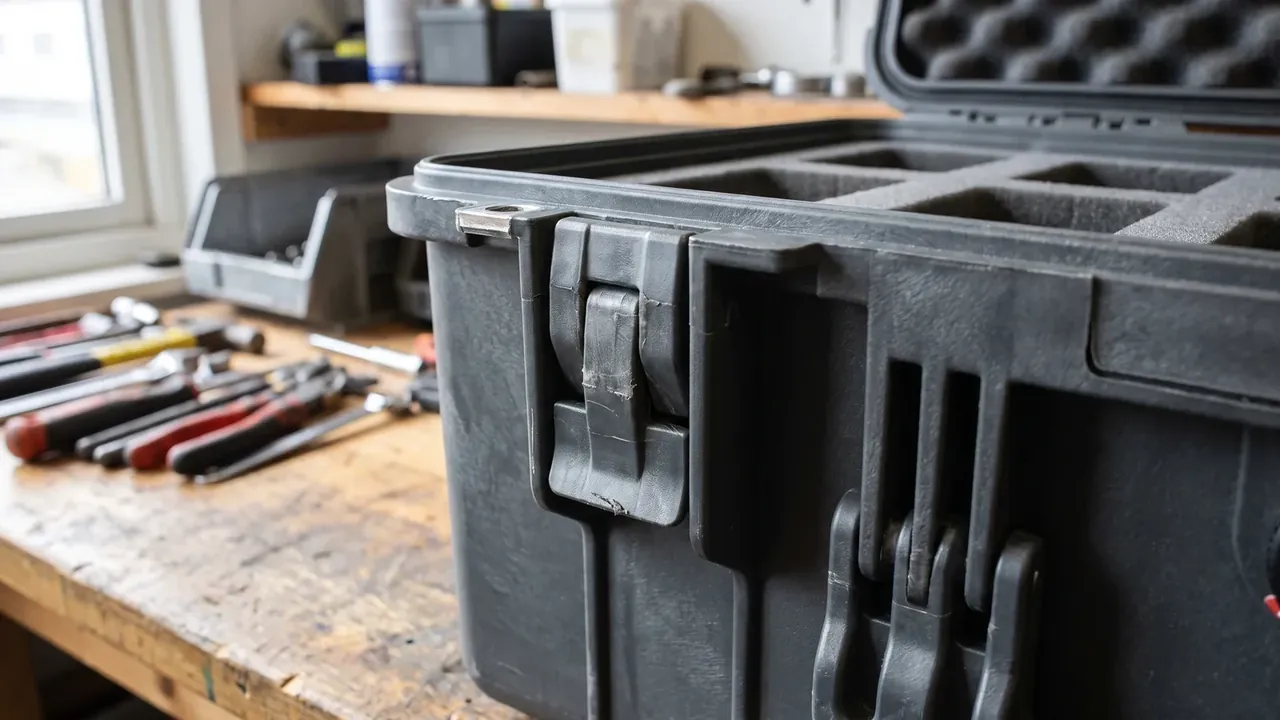
Pocket clearance decides whether the interior works. Half a millimetre a side is the EVA default: under 0.3 mm the instrument will not go in, over 0.8 mm it moves, and 2 mm of movement works a connector loose.
| Method | Tolerance | Minimum radius | Cost per set | Batch |
|---|---|---|---|---|
| Steel die | ±1.0 mm | 3 mm | CNY 8 | above 300 |
| CNC routing | ±0.5 mm | 1 mm | CNY 22 | 10 to 300 |
| Waterjet | ±0.3 mm | 2 mm | CNY 30 | 5 to 50 |
A pocket deeper than 40 mm is cut in two passes: one pass lets the die drag the wall on ejection and widens tolerance from ±1 mm to ±3 mm, while two 20 mm passes hold ±0.5 mm. Die clearance follows the material: 0.3 mm for EVA, 0.8 mm for EPE, none for PU. A 600 × 400 mm die costs about CNY 1,800 and runs 30,000 strokes.
Conclusion
The order is pressure, travel, material, cutting: work out the 0.19 MPa class from weight and drop height, set 20 mm of base foam at 15% compression, pick the polymer by cycle count and curvature, then hold half a millimetre a side.
This article discusses only the container (case body) side of specification and design, and does not cover any handling, loading or use of the contents.
Related Reading
- How custom foam inserts are built and layered
- Density, hardness and tolerance for foam inserts
- Die cutting, CNC and waterjet compared
- Instrument case bodies and interior dimensions
- Bonding and installing a foam insert
Related Products
- 8 Series — Gun Cases; Military Equipment Cases; Camera Equipment Cases; Drone Cases; Watch Cases; Knife Cases; First Aid Cases; Electronics Equipment Cases
- WL8-2812 PP Gun Case — model WL8-2812
- All protective cases and toolboxes: 7 series, 158 models