

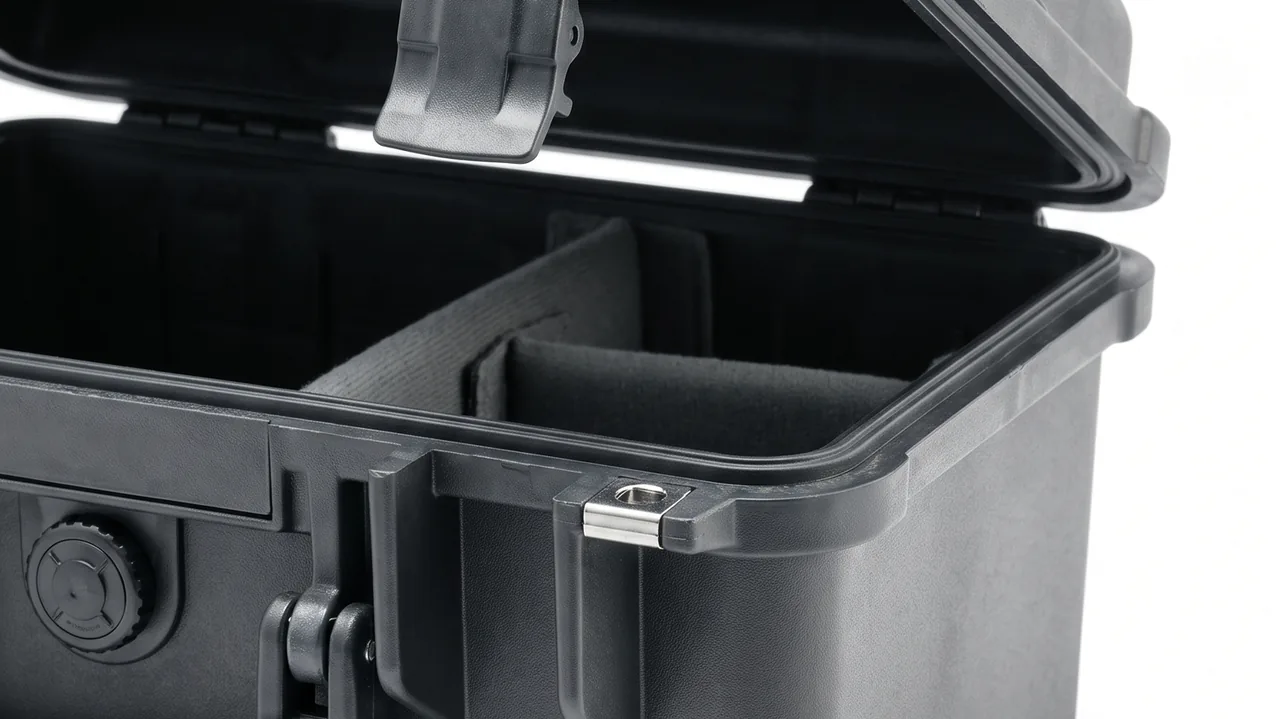
The soundboard of a hand-built classical guitar is typically 2.0 to 2.5 millimetres thick. Spruce has impressive tensile strength along the grain but is remarkably fragile across it, and the bond between soundboard and braces relies on hide glue or PVAC that is acutely sensitive to humidity cycling. Three of the damage patterns touring players meet most often have nothing to do with dropping the instrument. The first is a winter move from a heated room to a waiting vehicle, where relative humidity falls from 55 to 20 percent in twenty-four hours and hairline cracks appear along the braces. The second is two weeks above 80 percent during the rainy season, lifting the soundboard, raising action and leaving fret ends sharp. The third is opening the case after an air freight leg to find the neck angle shifted and the intonation drifted.
JUNZHIJIA's core protection principle for guitar cases is this: an instrument case is not a box that wraps a guitar, it is a micro-environment that travels with the instrument, and it must simultaneously solve shock isolation in transit, moisture stability in storage and zero-pressure contact at every handling; without all three, protection is merely self-comfort.
Table of Contents
- Why a Guitar Needs a Dedicated Case: Three Typical Failure Scenes
- Shell, Liner and Neck Support: Three-Point Location
- Materials and Processes: ABS, PP and Rotomoulded PE
- The Liner System: Density, Rebound and Contact Pressure
- Temperature and Humidity: Moisture Content and Finish Cracking
- Humidity Control: Desiccant, Humidifiers and Buffer Bay Design
- Pressure Equalisation Valves and Air Freight
- Latches, Hinges and Handles on Tour
- Drop and Vibration Validation: ISTA and Instrument Fragility
- Dimensional Chains: Dreadnought, Classical, Electric and Bass
- Accessory Bays and Cable Management
- Acceptance, Maintenance and Documentation
- Frequently Asked Questions FAQ
- Conclusion and Related Reading
Why a Guitar Needs a Dedicated Case: Three Typical Failure Scenes
Instrument damage differs from industrial equipment damage in one crucial respect: it happens silently and it is irreversible. A damaged meter can be replaced, but a guitar that has come unglued will never sound the same again. Among non-impact guitar injuries, humidity-related failures rank first, followed by accumulated loosening from transport vibration, with direct drop shock a distant third.
The first failure mode is drying cracks. The equilibrium moisture content of wood tracks ambient relative humidity. As relative humidity falls from 55 to 20 percent, the equilibrium moisture content of spruce drops from roughly 10 to 5 percent. Total volumetric shrinkage is only 1 to 2 percent, yet because the soundboard is restrained by braces and ribs, shrinkage stress concentrates in the thin panels between braces and eventually tears the wood along the grain. These cracks are common in northern winters and cluster at the two stress concentration points every luthier knows: beneath the bridge and at the end of the fingerboard.
The second mode is moisture swelling. In damp conditions the wood expands, the soundboard arches, action rises and playability suffers. Worse, adhesive layers gradually hydrolyse under sustained humidity and mould metabolism, so braces release and buzzes appear. Above 80 percent relative humidity for more than two weeks, the joint between a rosewood fingerboard and a maple neck can develop a step, because the two species expand at different rates.
The third mode is transport damage. Road transport vibration concentrates between 3 and 200 hertz, and the first resonance of a guitar usually sits between 100 and 200 hertz, so it is easily excited. Sustained resonance produces fretting wear at the neck joint, accumulating into a changed neck angle and drifting intonation. Where drop shock does occur, it most often presents as a broken headstock, the most fragile cantilever on the instrument, with a far smaller bending section than the neck.
These three modes map onto three protection mechanisms: humidity stability, vibration isolation and shock cushioning. A soft gig bag offers trivial scratch and shower resistance and does nothing for any of them, while a competent hard shell case turns all three into verifiable metrics. On instrument case projects, JUNZHIJIA requires that after ISTA 2A drop and ASTM D4169 vibration testing, peak acceleration transmitted into the case stays below 60 percent of the instrument fragility level and internal relative humidity stays within plus or minus 5 percent.
Shell, Liner and Neck Support: Three-Point Location
The structural design of a guitar case rests on one premise: a guitar is not a rigid body but a highly compliant assembly of thin panels, long beams and cantilevers. A case therefore cannot be designed by filling space around an object; it must locate the instrument at a limited number of contact points, touching only preselected high-stiffness regions and maintaining clearance elsewhere.
The standard three-point scheme places the first support at the lower bout near the end pin, the second at the heel where the neck meets the body, and the third at the neck cradle. These correspond to the stiffest regions of the instrument: the rib and tail block junction, the neck-to-body joint, and the neck shaft. The liner provides conforming support at those three points, while relief channels cut 3 to 5 millimetres outside the body outline everywhere else.
The relief channel is critical. The fault of many cheap cases is precisely that they grip too tightly: the liner contacts the body all the way round, so any dimensional change from humidity, or any deformation of the case under transport compression, loads the soundboard and back directly, the two most fragile panels on the instrument. The correct approach keeps a 5 to 8 millimetre air layer over both, supporting only at the ribs, which matches the instrument's own load path.
The neck cradle is the component that most distinguishes an instrument case from a general protective case. It must limit fore and aft movement of the headstock and avoid a concentrated load on the neck. The ideal cradle uses a wedge-shaped channel lined with 3 to 5 millimetres of low density foam, wall angles matched to the neck section and a contact length of at least 80 millimetres to spread pressure. On custom projects, JUNZHIJIA cuts the cradle to the measured neck section, since sections vary by more than 10 millimetres between guitar types.
Materials and Processes: ABS, PP and Rotomoulded PE
Material selection for guitar cases differs from industrial protective cases in one decisive way: an instrument case is carried on a human shoulder every day, so weight sensitivity is extreme, yet impact and stacking performance must still be adequate.
ABS, vacuum formed or injection moulded, is the most common. It offers high surface hardness, good gloss and a leathergrain texture, and the double-wall structure from vacuum forming, a hard outer shell plus a flocked inner liner, balances weight against stiffness well; an empty steel string case weighs 3.5 to 5.0 kilograms. The drawbacks are low-temperature brittleness, with corner cracking possible below 0 degrees Celsius, and weatherability that yellows under long sun exposure.
Injection moulded PP copolymer beats ABS on impact and low-temperature performance and is less dense, 0.90 against 1.05, so an equivalent structure is 10 to 15 percent lighter. The penalties are lower surface hardness that scratches easily and poor paint adhesion, forcing pre-treatment or self-coloured material, though for players who check instruments into aircraft holds frequently, the cold-weather toughness of PP is a real advantage.
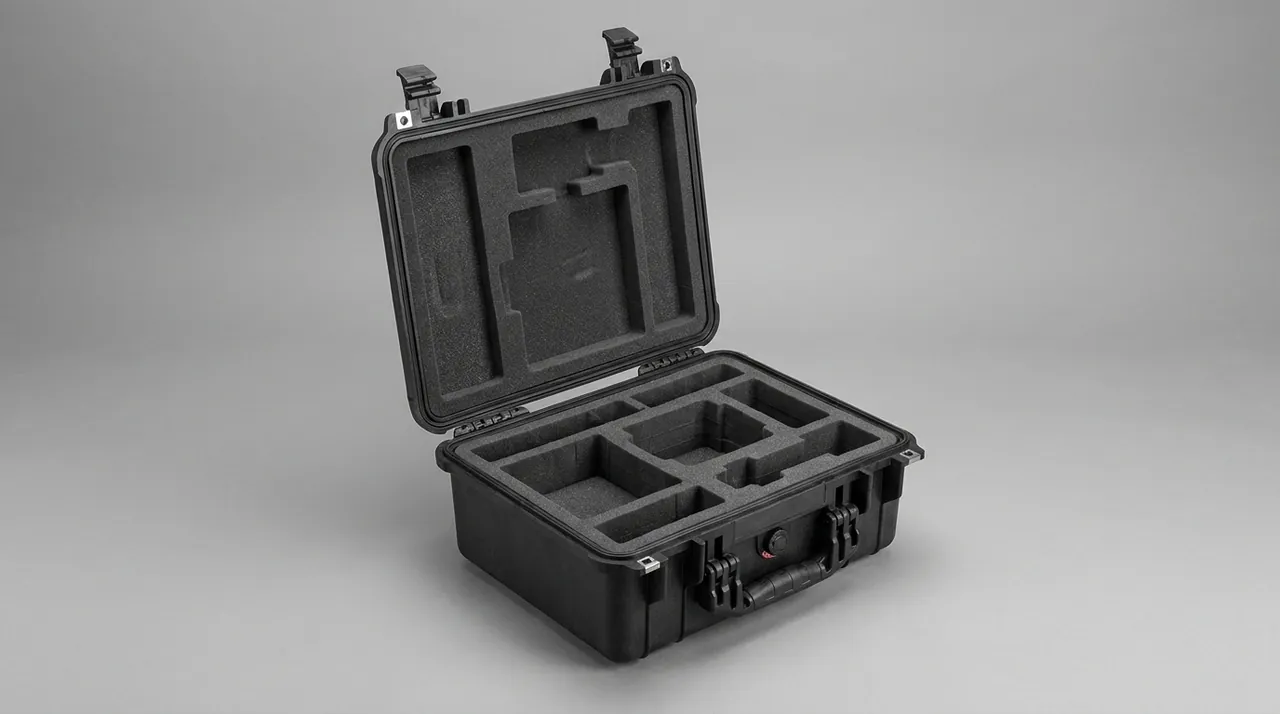
Rotomoulded PE comes into its own for very large formats such as bass and double guitar cases, and for extreme protection. Rotomoulded parts have no weld lines, thicken naturally at the corners and deliver the best drop performance, and can be sealed to IP65 or even IP67, suiting sea freight and outdoor stages. The penalties are higher weight and looser tolerance, plus or minus 2 to 3 millimetres.
| Process and Material | Typical Empty Weight, Steel String Case | Low-Temperature Impact | Surface Hardness and Finish | Dimensional Tolerance | Typical Protection Class |
|---|---|---|---|---|---|
| --- | --- | --- | --- | --- | --- |
| ABS vacuum formed double wall | 3.5 to 5.0 kg | Moderate, corners crack below 0 C | High gloss, leathergrain possible | plus or minus 1.0 mm | IP54 level splash resistance |
| Injection moulded PP copolymer | 3.2 to 4.5 kg | Excellent, tough at minus 20 C | Lower, scratches easily | plus or minus 0.5 mm | IP54 to IP65 |
| Rotomoulded PE one piece | 5.0 to 8.0 kg | Best, no weld lines | Matt, good weatherability | plus or minus 2 to 3 mm | IP65 to IP67 |
The Liner System: Density, Rebound and Contact Pressure
The liner is the most underestimated and most frequently mis-specified part of a guitar case. Its job is not to be as soft as possible, but to hold pressure on the instrument below a safe threshold under a defined shock input: for a given impact energy, larger contact area and longer compression travel produce lower peak pressure. Liner design must therefore balance density, which sets support stiffness, against thickness, which sets compression travel, while the covering fabric must be non-shedding, colour-fast and low friction.
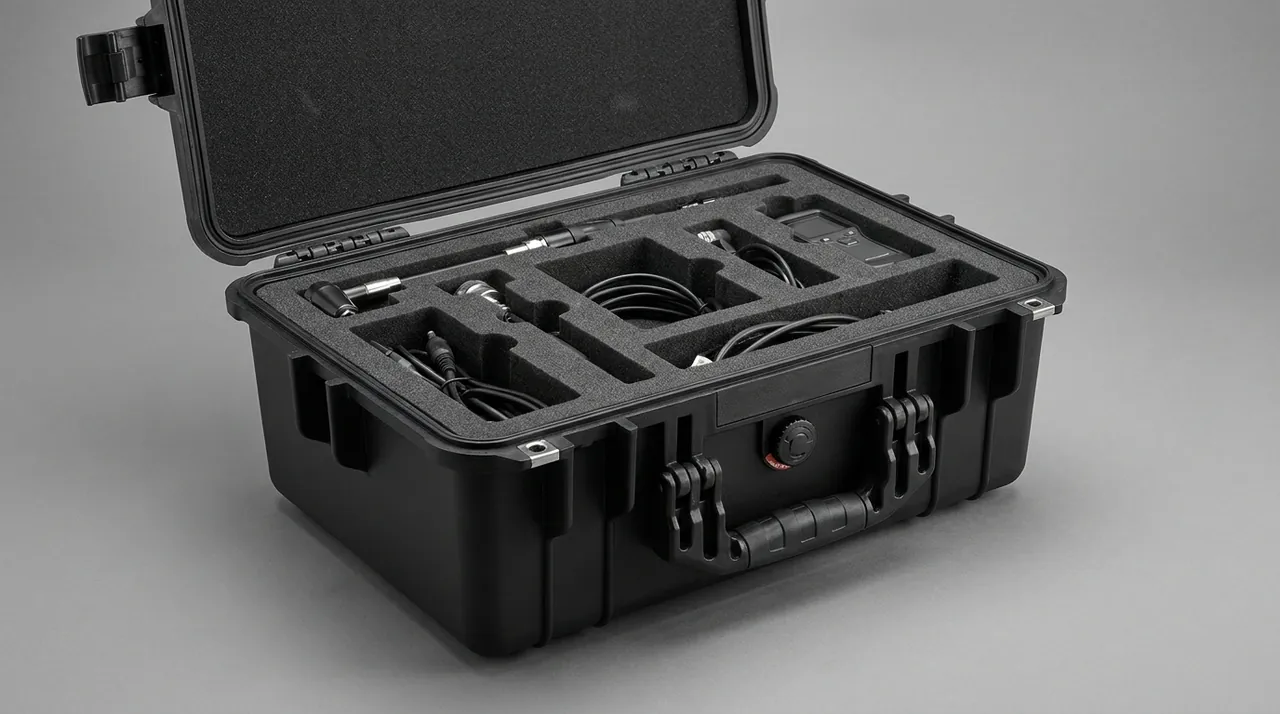
The three common materials behave distinctly in instrument service. EPE expanded polyethylene, at 20 to 35 kilograms per cubic metre, is light, resilient and cheapest and is the most widespread choice, but it creeps visibly under sustained load, so within two or three years the cavity grows and the instrument loosens. EVA foam, at 60 to 120 kilograms per cubic metre, thermoforms into precise three-dimensional cavities and suits high-end custom cases, but stiffens when cold and adds weight. IXPE irradiation cross-linked foam has a fine uniform cell structure, minimal creep and a service range from minus 60 to 90 degrees Celsius, making it the ideal long-term material at two to three times the price of EPE.
A practical criterion applies to contact pressure: under static support, pressure at the contact face should sit between 3 and 7 kilopascals. Below 3 kilopascals the support is inadequate and the body rocks in its cavity; above 7 kilopascals the constraint is excessive and the soundboard and back take unintended load. At 25 percent static compression EPE generates roughly 15 to 25 kilopascals, so contact area must be enlarged, for example by changing point support to area support with a contact width of at least 40 millimetres.
Typical materials are knitted polyester velour or microfibre suede. Cheap velour bleached with chlorine must be avoided, because residual chloride accelerates corrosion of bridge, tuners and frets in damp conditions, and dark fabric with unfixed dye can stain a pale spruce top. JUNZHIJIA requires covering fabric to pass colour fastness to rubbing at grade 4 or better and to be certified chloride free. Further classification appears in Cushion Liner Case.
Temperature and Humidity: Moisture Content and Finish Cracking
The sensitivity of a guitar's wooden structure to humidity exceeds what most owners imagine. Equilibrium moisture content varies non-linearly with relative humidity: at 20 degrees Celsius, spruce reaches roughly 6 percent at 30 percent relative humidity, about 9 percent at 50 percent, about 13 percent at 70 percent and over 18 percent at 85 percent. Below the fibre saturation point of 28 to 30 percent, each 1 percent moisture change produces about 0.003 to 0.005 percent dimensional change along the grain but 0.1 to 0.2 percent across it.
That explains why guitars always crack along the grain. Across-grain coefficients are tens of times greater, and the soundboard is restrained across the grain by its braces, so shrinkage stress cannot relieve. The accepted safe band is 40 to 60 percent relative humidity, corresponding to 7 to 11 percent moisture content: below 40 percent cracking risk climbs sharply, above 65 percent glue hydrolysis and mould risk rise, and beyond 80 percent the instrument is in the danger zone.
Temperature matters too and usually couples with humidity. A sudden drop raises relative humidity, and if the case is sealed and its inner wall falls below dew point, condensation forms inside, the most dangerous moment when carrying an instrument in from cold outdoors into a warm room, because vapour condenses directly onto the finish and hardware. The remedy is slow re-warming: leave the case closed for two to four hours so temperatures converge. JUNZHIJIA states this explicitly in the documentation shipped with instrument cases.
The finish tolerates a different band from the wood. Nitrocellulose lacquer is soft and breathable, buffering humidity change well, but crazes under sudden cooling. Polyester and polyurethane are hard and impermeable, slowing moisture exchange, but once the film cracks because the substrate has moved, the crack is deeper and more visible. Whatever the finish, avoid direct sunlight, since ultraviolet yellows nitrocellulose and oxidises surface resins.
Humidity Control: Desiccant, Humidifiers and Buffer Bay Design
Humidity control in a guitar case does not follow the logic of an industrial dry cabinet. Industrial practice pursues dryness; an instrument case pursues stability at 45 to 55 percent, so it needs the ability both to absorb moisture and to release it when the environment is dry.
Two approaches deliver bidirectional regulation. The passive approach relies on conditioning media, most commonly silica gel compounded with montmorillonite, whose adsorption and desorption curves are flat near 50 percent relative humidity, giving buffering as conditions swing; a working dosage is 50 to 80 grams per 10 litres of free internal volume, using a product with a saturation indicator. The active approach places a two-way humidity pack that absorbs above its set point and releases below it, maintained every two to six months.
Buffer bay design makes the passive approach work. The bay belongs on the natural convection path, usually at the headstock end or low on the body side, screened off so the medium never touches wood or finish. Bay volume should be 3 to 5 percent of free internal volume: too small and buffering is inadequate, too large and it steals storage space.
One detail routinely overlooked is the humidity shock caused by opening the case. Every opening exchanges air almost instantly, so in a 70 percent environment a single opening can lift internal relative humidity by 10 to 15 points, which makes frequent inspection itself a risk behaviour. JUNZHIJIA recommends an indicator card behind a viewing window in the lid, read without opening, with openings limited in humid seasons. More on damp environments appears in Outdoor Case Rain and Humidity.
Pressure Equalisation Valves and Air Freight
Air freight is among the harshest duties a guitar case faces. At cruising altitude, cargo hold pressure is roughly 70 to 75 kilopascals, equivalent to 2500 to 3000 metres elevation, against 101 on the ground, a differential of up to 30 kilopascals. For a rigid sealed case that differential has two effects: a sustained outward force on the sealing face that can defeat the seal or deform the lid, and a violent expansion of internal air at the instant of opening.
For the guitar the direct risk is not the differential, since air cavities in the wood equalise at the same rate, but two derived problems: a locally enclosed air pocket between body and liner, where an over-tight cavity traps air, creating suction that tugs at the finish; and accelerated condensation on the cold inner wall when internal humidity is high and temperature falls.
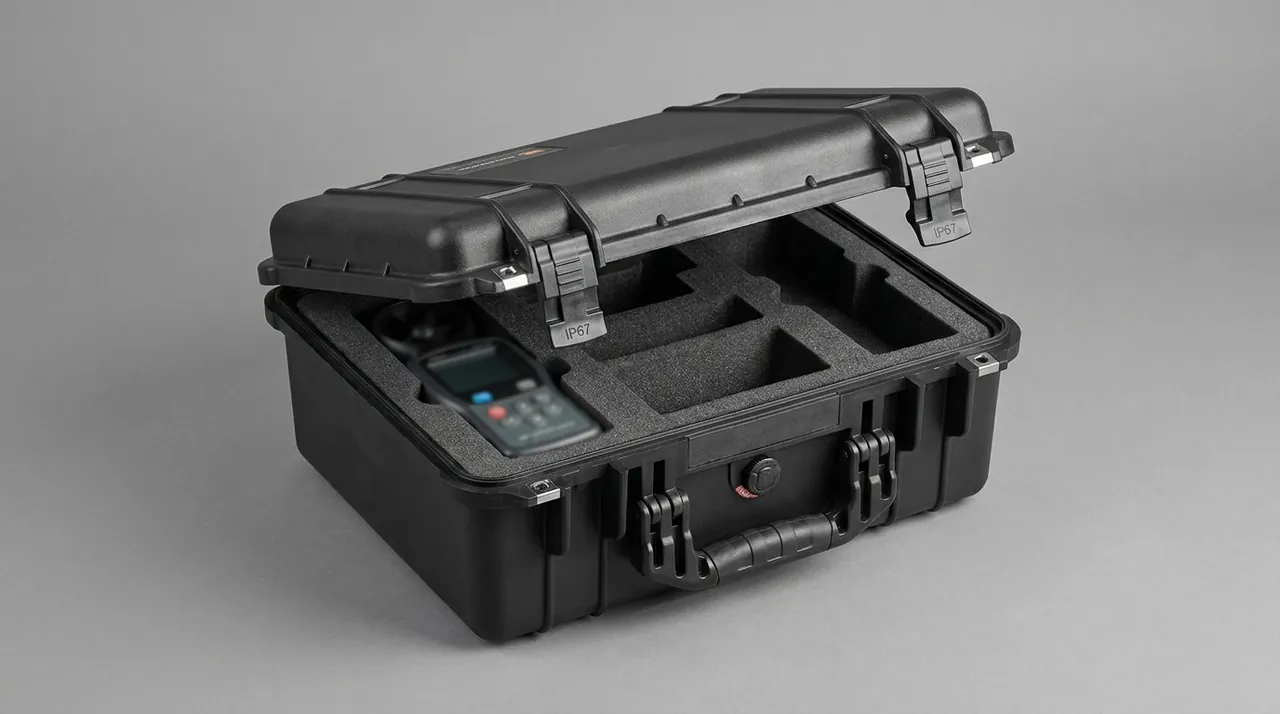
The remedy is a pressure equalisation valve. An expanded PTFE microporous membrane valve passes air while blocking liquid water and particulates, holding the differential negligible, typically specified at airflow of at least 300 millilitres per minute at 7 kilopascals with protection no lower than IP67. It belongs on the lid where it cannot be struck, with a guard mesh inside to stop liner fibre blocking the membrane.
Two further requirements apply to air freight. The case should pass the full ISTA 3A sequence, including random vibration, drop and compression, because air cargo handling is far rougher than road handling, and a lockable latch or hasp meeting TSA screening practice should be fitted so inspection does not mean destructive opening. Valve principles are explained more fully in Case Pressure Equalization Valve.
Latches, Hinges and Handles on Tour
Touring places demands on case hardware that static storage never does. The case is opened at least twice a day, often by different people, in a dark backstage corridor or a cramped vehicle, frequently while wearing gloves or carrying something else, so hardware must satisfy four requirements at once: high cycle capability, fast action, single-handed operation and low misuse rate.
Latch selection divides between butterfly and push-button types. Butterfly latches are simple, cheap and reliable, but need two hands and an outward pull that is awkward in tight spaces. Push-button latches open with one hand and give clear engagement feedback, suiting high-frequency use, though they have more parts and fail more often. For medium instrument cases, JUNZHIJIA specifies at least four latches, one at each end and two along the long side, so the sealing face loads evenly, each with a hasp.
Hinge life is the core requirement. At two openings a day over five years a hinge sees roughly 3600 cycles, and with touring the design life should be at least 10000. Metal hinges should use stainless pins with self-lubricating bushes and pass salt spray; integral polymer hinges common on injection cases must be checked for cold embrittlement, making a minus 20 degree Celsius drop test mandatory. JUNZHIJIA's criterion is that after 10000 cycles latch opening force varies by no more than 15 percent and the hinge shows no looseness.
Handles must serve one-handed carrying and two-person lifting. The primary handle sits at the midpoint of the long side or at the end, with a soft over-mould at least 25 millimetres wide, and must attach with through-going metal pins rather than self-tapping screws, since a loaded case generates several times its own weight in shock load at the instant of lifting. Where a case exceeds 8 kilograms, a trolley handle and wheel set should be fitted, with rubber-coated bearing wheels validated over a five kilometre run. Related hardware discussion appears in Toolbox Hinge Latch Seal.
Drop and Vibration Validation: ISTA and Instrument Fragility
Instrument cases cannot be validated by drop testing alone. The most characteristic transport damage to a guitar comes from the cumulative effect of random vibration rather than a single high-energy impact, so drop and vibration testing must be used together, with vibration carrying at least equal weight.
Drop testing follows GB/T 4857.5 and ISTA 2A. For cases of 5 to 10 kilograms the height is typically 760 to 800 millimetres, covering six faces, three edges and one corner in ten drops. An additional corner drop toward the headstock should be added, since a broken headstock is the most common real-world pattern. Acceptance requires no through-thickness crack in the shell, no latch release, liner displacement no greater than 5 millimetres, and no damage to the weighted dummy body inside.
Vibration testing follows ASTM D4169 assurance level II or ISTA 3A, using a road spectrum from 1 to 200 hertz for 60 to 120 minutes. The core criterion is transmissibility, the ratio of acceleration at the instrument position to table input, attenuated through the first resonance band of 100 to 200 hertz. JUNZHIJIA's criterion is transmissibility no higher than 0.8 with a peak no higher than 15 g, against a guitar fragility level typically between 25 and 40 g.
Fragility is the maximum acceleration a product survives without damage, measured by shock response spectrum testing per ASTM D3332. On a guitar it is lowest toward the headstock, because the cantilever amplifies stress, and highest on the sides, so liner design must follow the lowest fragility direction. On custom projects, JUNZHIJIA runs spectrum testing on a weighted dummy before cutting the liner cavity.
| Test Item | Reference Standard | Typical Parameters | Instrument Case Criterion |
|---|---|---|---|
| --- | --- | --- | --- |
| Drop test | GB/T 4857.5 / ISTA 2A | 760 to 800 mm, ten drops plus headstock corner drop | No through crack, liner shift 5 mm or less |
| Random vibration | ASTM D4169 / ISTA 3A | Road spectrum, 1 to 200 Hz, 60 to 120 min | Transmissibility 0.8 or less, peak 15 g or less |
| Shock response spectrum | ASTM D3332 | Directional fragility measurement | Liner designed to lowest fragility direction |
| Compression test | GB/T 4857.3 / ISTA 3E | Three-layer equivalent load for 24 h | Deformation 1.5 percent or less, latches hold |
| Thermal humidity cycling | Internal specification | minus 10 to 50 C, 30 to 85 percent RH | Internal swing within plus or minus 5 percent |
| Open close life | Internal specification | 10000 cycles | Opening force change 15 percent or less |
| Salt spray | GB/T 10125 | 96 h neutral salt spray | No red rust on hardware |
Dimensional Chains: Dreadnought, Classical, Electric and Bass
Dimensional fit is where guitar cases most often go wrong. Variation between body shapes is far greater than most buyers assume. Among steel string guitars, a dreadnought body is about 505 millimetres long, 400 millimetres at its widest and 100 to 125 millimetres deep, while an OM body is about 490 by 380 millimetres. A classical body is about 485 by 370 millimetres, yet its neck measures 52 millimetres at the nut against 43 millimetres for a steel string neck. An electric body of Stratocaster pattern is about 445 millimetres long and only 45 to 55 millimetres deep, while a bass body exceeds 540 millimetres with a neck longer than 850 millimetres.
A universal case is inevitably a compromise: built to the largest shape it leaves small instruments loose, and built to the smallest it cannot accept larger ones. JUNZHIJIA decomposes fit into three independent dimensions, the body cavity, the neck channel and the headstock cavity, each from measured data plus clearance: 3 millimetres on body depth, 4 on width, 5 on length, and 2 on neck channel width.
Two schemes serve users covering several shapes. Interchangeable liner modules build the shell to the largest shape, usually a dreadnought, supplied with plug-in trays cut for different bodies, so changing the tray changes the fit. An adjustable support system with sliding blocks around the body cavity covers a wider range but is fiddly to set and gives less stiffness than a cut cavity.
The custom workflow runs: the customer supplies measured drawings or the instrument, JUNZHIJIA performs three-dimensional scanning or manual measurement, generates a liner cutting drawing, builds a first article and trial-fits, then proceeds to batch production. Trial fit uses a 0.1 millimetre feeler gauge between soundboard and liner with the latches open; it must pass freely, and once closed the body must show no perceptible movement. A comparable approach appears in Case Removable Divider System.
Accessory Bays and Cable Management
For touring players the real pain is often not the instrument but the accessories. Straps, spare strings, picks, tuners, effects units, cables, power supplies and capos, left loose inside a case, travel freely, collide with the instrument and spill across the floor at opening, so JUNZHIJIA places accessory space in a separate bay, isolated from the body cavity.
Three principles govern accessory bay design. Hard isolation means the bay needs its own cover or pouch so nothing migrates into the body cavity, with a mesh pocket inside the cover for flat items. Fixed location means zones divided by use frequency and shape, with small items such as picks and capos most accessible, cables held by elastic straps, and heavy items in cushioned cells. Tangle prevention means cables coiled in a figure of eight and secured with a hook and loop tie, avoiding tight bends that break inner conductors.
For electric guitar and bass players, the weight of effects and power supplies cannot be ignored: a multi-effects unit with its supply can exceed 2 kilograms, and carried alongside the instrument, relative motion in transit delivers localised impacts to the body. Such items belong in a bay on the opposite side, secured in an EVA cavity, with weight distribution considered at design stage.
One further detail is humidity and corrosion. Metal accessories such as strings, capos and tuners rust readily in damp conditions and should be sealed in volatile corrosion inhibitor bags, while leather straps crack in dry air and belong in a breathable cloth pouch.
Acceptance, Maintenance and Documentation
Acceptance of an instrument case divides into incoming inspection and in-service maintenance. Key incoming items are a shell free of cracks and sink marks, latches operating smoothly with definite engagement feedback, hinges free of looseness, liner cavities matching the drawing and free of burrs, covering fabric free of delamination and shade variation, and a continuous seal profile if fitted. For batch purchases, AQL 2.5 sampling is recommended, with the first article retained as a sealed reference.
In-service maintenance centres on humidity monitoring and liner condition. Check the indicator card monthly through the viewing window without opening; open quarterly to check the liner for widening impression marks or poor rebound; replace conditioning medium annually or when the indicator colour changes; tighten and lubricate latches and hinges every two years. If a cavity has grown so the body rocks inside it, replace the liner module promptly, since continued use means lost cushioning.
Documentation is the part most often skipped and yet most valuable. A complete set includes the liner cutting drawing and compatible body shape list, a temperature and humidity maintenance guide, latch operating instructions, a fragile marking card, and test reports covering drop, vibration and thermal humidity cycling.
JUNZHIJIA organises documentation along exactly these lines and can produce it bilingually, so airport security or freight handlers can be briefed during international tours. Acceptance criteria are discussed further in Custom Case Acceptance AQL and How to Choose a Case OEM Factory.
Frequently Asked Questions FAQ
Q: Why does a guitar still crack when it hangs on the wall inside a gig bag, and can a hard shell case solve that?
A: A gig bag provides almost no humidity barrier. Both the outer fabric and the padding of an ordinary padded bag are breathable, so moisture exchange between the air inside and the room is fast, and internal relative humidity simply follows the room with a slight lag. Hanging a guitar in a bag is therefore close to exposing it directly: heated northern rooms in winter routinely fall below 20 percent relative humidity, while southern rainy seasons sit above 80 percent for weeks, and both extremes do damage. A hard shell case creates a closed cavity with buffering capacity: the seal profile blocks air exchange, the shell material adds thermal inertia, and a conditioning medium regulates in both directions, holding internal relative humidity within plus or minus 5 percent. To be clear, a case cannot create or destroy water; it delivers buffering plus bidirectional regulation. In persistently dry conditions you still need a two-way humidity pack and periodic recharging, but the case makes that regulation tens of times more efficient.
Q: What relative humidity should be maintained inside the case, and what is the most reliable way to monitor it?
A: The safe band for a guitar's wooden structure is 40 to 60 percent relative humidity, corresponding to 7 to 11 percent moisture content, with 45 to 55 percent the ideal narrow target. Below 40 percent, the risk of soundboard cracks along the grain rises sharply; above 65 percent, glue hydrolysis and mould risk climb; beyond 80 percent, two weeks can bring a lifted soundboard and sharp fret ends. For monitoring, a digital hygrometer with a numeric display is strongly preferable to a colour-change card alone. Cards read only to about plus or minus 5 percent and colour judgement is subjective, whereas a digital unit reaches plus or minus 3 percent and records maximum and minimum, revealing whether an extreme swing occurred in transit. Mount it in the body cavity rather than outside, and away from the conditioning bay, where local readings are distorted. JUNZHIJIA recommends a viewing window in the lid so readings need no opening, which minimises the humidity shock that every opening causes.
Q: Is a softer liner always better, and why do some expensive cases cut their cavities so loosely?
A: Soft is not automatically better; the liner must balance support stiffness against pressure control. A liner that is too soft compresses excessively under static load, so the body rocks in its cavity and collides during transport. One that is too hard offers almost no compression travel and passes impact energy straight into the instrument. The correct logic provides definite support over limited contact area, keeps a 5 to 8 millimetre air layer above the soundboard and back, touches only high-stiffness regions such as the ribs and the neck, and holds contact pressure between 3 and 7 kilopascals. A loose-looking cavity is exactly this idea in practice, because it avoids over-constraining the fragile panels: wood changes dimension as humidity changes, so a liner gripping all the way round loads the soundboard and back, whereas clearance at the ribs absorbs that change while three-point location still restrains overall movement. JUNZHIJIA verifies this with a feeler gauge: with latches open, a 0.1 millimetre gauge passes freely, and with latches closed the body shows no perceptible movement.
Q: Is a pressure equalisation valve necessary when checking a guitar into aircraft holds, and what happens without one?
A: It is recommended, particularly for a fully sealed hard case. Cargo hold pressure at cruising altitude is roughly 70 to 75 kilopascals against 101 on the ground, a differential up to 30 kilopascals. On a rigid sealed case that differential pushes the sealing face outward continuously, which can defeat the seal, bulge the lid, or load the latches so heavily that they spring open dangerously at unpacking; the instant pressure change on opening also expands internal air violently. For the guitar, the direct risk is not the differential itself, since air cavities in the wood equalise at the same rate, but two derived problems: a locally trapped air pocket between body and liner creates suction that can tug at the finish, and if internal humidity is high while temperature falls, decompression accelerates condensation on the cold inner wall. An expanded PTFE membrane valve keeps the differential negligible while blocking liquid water and particulates, specified at IP67 or better with airflow at least 300 millilitres per minute. A guard mesh inside prevents liner fibre blocking the membrane.
Q: Among EPE, EVA and IXPE liners, which should an instrument case use?
A: The answer depends on duty intensity and budget. EPE expanded polyethylene, at 20 to 35 kilograms per cubic metre, is light, resilient and cheapest and is the most common choice, but it creeps visibly under sustained load, so within two or three years the cavity grows and the instrument loosens, suiting home storage with infrequent handling. EVA foam, at 60 to 120 kilograms per cubic metre, thermoforms into precise three-dimensional cavities with good support stiffness and a crisp appearance, suiting high-end custom cases, but it stiffens when cold and its density adds weight. IXPE irradiation cross-linked foam has a fine uniform cell structure, retains more than 95 percent of thickness after 1000 hours at 25 percent compression against 85 to 90 percent for EPE, works from minus 60 to 90 degrees Celsius, and is closed cell so it does not take up water, making it the best choice for touring and long-term storage at two to three times the price of EPE. The practical answer is zoned specification: IXPE or high density EVA at the three support points for dimensional stability, EPE elsewhere to control cost and weight.
Q: After carrying a guitar in from cold outdoors, should the case be opened immediately or left closed for a while?
A: It must be left closed. The reason is condensation. In cold conditions both case and instrument are at low temperature, and if the case is opened on entering a warm room, warm moist indoor air meets the cold instrument surface, drops below dew point, and deposits water directly onto the finish, metal bridge, tuners and frets. That condensate causes local moisture uptake in the surface wood, which can produce blushing under the finish and local cracking, and it provides the starting point for electrochemical corrosion on hardware. The correct procedure is to leave the case closed for two to four hours so internal and external temperatures converge before opening; the insulation of the shell and the sealed structure slow re-warming considerably, which is one of the added values of a hard case. Where the temperature difference is extreme, for example minus 10 degrees outdoors into 25 degrees indoors, extend that to six hours. The same applies in reverse when moving from humid heat into strong air conditioning, to avoid finish crazing from sudden cooling.
Q: Can one case serve a steel string, a classical and an electric guitar, and what is the most sensible way to do it?
A: It can, but only by accepting a compromise, and what matters is how that compromise is made. The dimensional differences are real: a dreadnought body is about 505 millimetres long, 400 millimetres wide and 100 to 125 millimetres deep; a classical body is about 485 by 370 millimetres but measures 52 millimetres at the nut against 43 millimetres for a steel string neck; an electric body is only 45 to 55 millimetres deep, so a cavity cut to dreadnought depth leaves it floating. Two routes exist. The first is interchangeable liner modules: the shell is built to the largest shape, usually the dreadnought, and supplied with plug-in trays cut for each body type, so swapping trays restores a near-custom fit at the cost of carrying spare trays. The second is an adjustable support system using sliding blocks that follow different outlines, which covers a wider range but is fiddly to set and gives less support stiffness than a cut cavity. JUNZHIJIA recommends the first, because it preserves the precision of three-point location.
Q: What customisation does JUNZHIJIA offer on guitar cases, and how long does tooling usually take?
A: Customisation spans four layers: shell, liner, hardware and documentation. At the shell level, external dimensions, material and process among ABS vacuum forming, injection PP and rotomoulded PE, wall thickness, colour and surface texture, stacking location features, and the presence of a trolley, wheels and pressure valve can all be specified. The liner is the heart of instrument case customisation: cavities can be generated from measured body data or three-dimensional scanning in EPE, EVA or IXPE, with plug-in trays or adjustable supports, and with integrated accessory bays, humidity buffer chambers and hygrometer viewing windows. At the hardware level, latch type and count, hinge form, and the presence of a hasp or TSA accepted lock can be chosen. At the documentation level, JUNZHIJIA supplies liner cutting drawings, humidity maintenance guidance, fragile marking cards and test reports, available bilingually. The workflow runs through requirements review and body measurement, scheme and drawings, first article and physical trial fit, then batch production with AQL acceptance.
Conclusion and Related Reading
An instrument's value lies in sound that matures over years, and that maturity is fragile: one humidity failure, one rough journey or one over-tight liner cavity can erase it. A guitar case turns transport and storage from risk into controlled process. JUNZHIJIA supports custom shells, measured liner cavities and OEM or ODM programmes.
Related Reading