

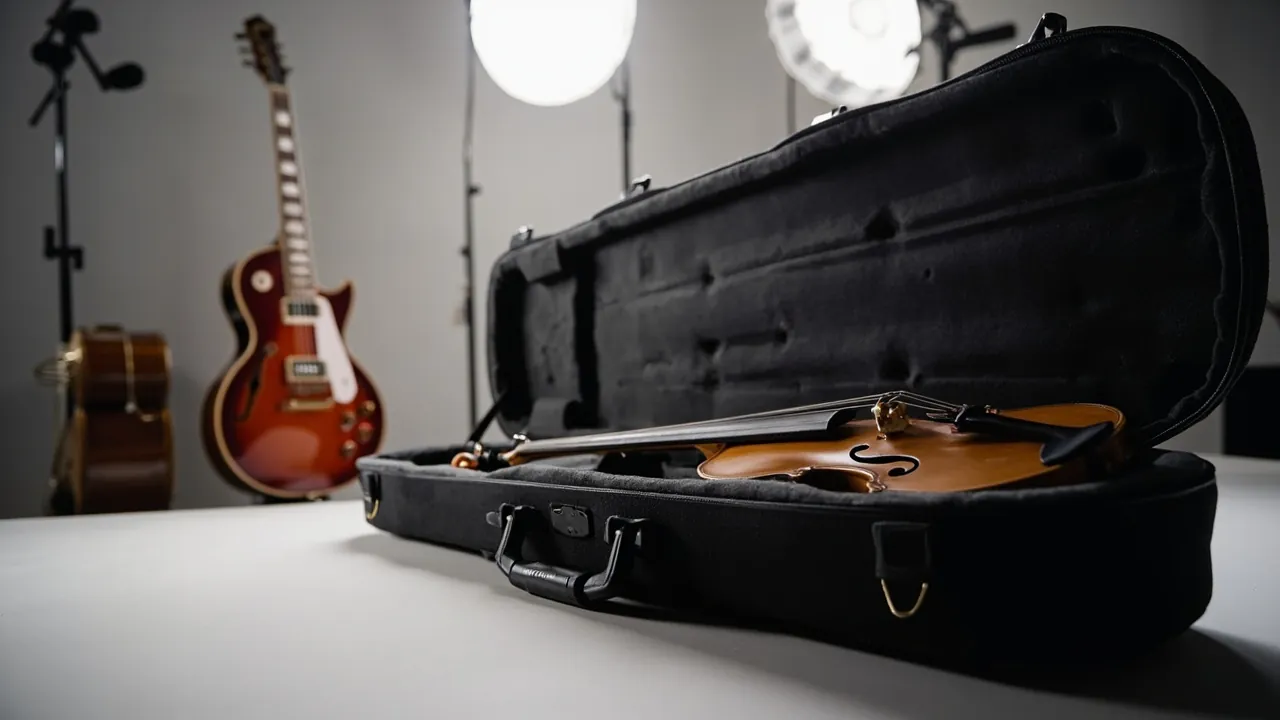
The real enemy of string instruments is not the drop but the slow knife of temperature and humidity. A violin in relative humidity below 30% can crack or open its glue within days; a guitar top left above 70% RH long term can belly up and fret out; and a sudden temperature swing that condenses water inside the case grows mold on the soundboard. The bottom line up front: the core task of a guitar or violin case is to hold interior relative humidity steady at 45%-55%, keep temperature swing in a narrow band, then use a shaped insert to fix the body, neck, and bow, and finally use sealing and cushioning to survive checked baggage. This article starts from the humidity mechanism, gives storage protection for body, bow, and accessories, and maps case selection to IEC 60529, GB/T 4208, MIL-STD-810H, and ISTA. Instruments are valuable; one protection failure costs far more in repair than the case itself.
For shops, orchestras, performers, and instrument brands, the case is the last mile of asset safety; a wrong case bets tens of thousands on uncertainty.
Table of Contents
- The Real Enemy: The Slow Knife of Temperature and Humidity
- RH Target: The Science Behind 45%-55%
- Humidity Control Trio: Silica, Hygrometer, Humidipak
- Temperature Stability: Avoid Swing and Condensation
- Body Support: Shaped Insert and Neck Rest
- Bow Protection: Independent Channel and Frog
- Strings, Shoulder Rest, and Accessory Sub-Bays
- Case Material: Engineering Plastic vs Wood
- Inserts and Dividers: EVA Carving and Custom Foam
- Sealing, Dust, Water: IP65 / IP67
- Latches and Hinges: Cycle Life and Security
- Cushioning and Check-In: MIL-STD-810H and ISTA
- Standards Quick Reference: IEC 60529, GB/T 4208, UL94
- Cleaning, Maintenance, and Lifecycle
- Selection and OEM: Finding the Right Factory
- JUNZHJIA String-Instrument Case Customization Capability
The Real Enemy: The Slow Knife of Temperature and Humidity
The expense of a humidity crack is not just the repair bill; it is the lost playing time and, for a professional, the lost income during the weeks an instrument sits in the shop. A touring musician who opens the case to a seam opening mid-tour has no easy fix on the road, which is why the case is the first line of defense and the only one that travels. The mindset shift from 'hard shell equals safe' to 'stable microclimate equals safe' is the single most valuable idea in instrument transport, and it changes every subsequent choice about material, insert, and seal.
Many believe a case is safe if it is "hard," but for wooden-chamber string instruments the hard shell blocks impact; the truly hard part to block is the environment. Wood is a natural hygroscopic material; its moisture content rises and falls with ambient humidity: it shrinks when too dry, swells when too wet, and the repeated cycle stresses joints, finish, and top. A violin plate is only 2-3 mm thin and extremely sensitive to moisture change; a guitar top (spruce / cedar) is equally delicate.
More hidden is condensation from a sudden temperature swing. In winter, carrying a violin from outside into a heated room, the cold air inside the case meets warm humid air and water beads on the top and liner, growing mold in hours and aging gut or synthetic strings. So an instrument case must speak not only of "impact" but of "environmental stability." The systematic selection logic starts at the instrument case selection guide.
RH Target: The Science Behind 45%-55%
A common misconception is that more humidity is always safer. It is not. A guitar left at 75% RH for a summer will belly the top, raise the action, and fret out, and the repair is a neck reset or a top re-glue -- neither cheap. The band matters more than the direction of the error: a stable 50% beats a swing between 30% and 70% even if 50% is not perfect. This is why the hygrometer and the two-way pack are a pair; the pack clamps the band, the hygrometer proves it. Specifying a single number without a control method is wishful thinking.
The industry broadly treats 45%-55% RH as the safe band for string instruments, based on lutherie and collection consensus:
- Below 35% RH: wood loses water and shrinks, top sinks, seams open, fingerboard shrinks to expose fret ends; violins especially show fine cracks at plate edges;
- 35%-45% RH: basically safe but on the dry side, still monitor long term;
- 45%-55% RH: ideal band, moisture content stable, least stress on finish and glue;
- 55%-65% RH: acceptable upper limit, ventilate against mold;
- Above 70% RH: top bellies, frets out, finish clouds, liner molds.
The target is not "wetter is better" but "stable and in band." A large daily RH swing hurts more than a slight sustained deviation. This matches the "control the band, not the extreme" point in the extreme temperature case article.
Humidity Control Trio: Silica, Hygrometer, Humidipak
The two-way pack deserves a closer look because it removes the main failure mode of passive humidity control: forgetting. A silica-only system needs someone to notice it is saturated and bake it; a two-way pack absorbs and releases around its set point with no action, so the instrument stays safe even if the player forgets for a month. For schools and studios with many instruments and few staff, that passive reliability is the difference between protection that works and protection that looks like it works. Combine it with a cheap mechanical hygrometer checked at each lesson and the system is robust without being high-maintenance.
Holding RH at 45%-55% needs three parts working together:
- Hygrometer: the case must hold a readable mechanical or electronic hygrometer; check it before playing. Electronic is precise but needs a battery; mechanical is passive but recalibrate every six months;
- Silica desiccant: when too dry you must add humidity, when too wet silica absorbs. Note: common blue silica "throws back" water when saturated; use renewable orange silica and bake it dry regularly;
- Humidifying rod / pack: in dry regions (northern heated winters) use a sponge humidifying rod or a two-way humidity pack that pulls RH back into band. The two-way pack's advantage is absorbing when too high and releasing when too low, naturally "clamping" the band.
For desiccant selection see the "silica reuse" section in the case cleaning guide. The point: always place the hygrometer, replace the pack on schedule, never drop a bare instrument into the case.
Temperature Stability: Avoid Swing and Condensation
Altitude adds a twist. In a pressurized cargo hold the external pressure drops, and a sealed case without a pressure equalization valve can bulge or, worse, have its seal stressed every flight. The case pressure equalization valve bleeds the differential so the shell and seal are not fighting the atmosphere on every takeoff. For instruments flown often -- touring acts, imported inventory -- this is not a luxury; it is what keeps the case intact across a hundred flights. Pair the valve with the humidity pack and the case becomes a small pressurized, humidified cabin for the instrument.
Temperature has no single target value; the key is "slow change." Suggestions:
- Avoid direct sun or radiator contact on the shell in transit; the PP shell has some insulation per the extreme temperature case thinking;
- From cold to warm, let the case "acclimate" in a buffer bag 1-2 hours before opening, avoiding top condensation;
- In air check-in the cargo hold may go cold; a humidity pack inside also buffers condensation;
- Long-term storage at 15-25 C is steadiest; avoid attic / garage extremes.
Temperature swing damages finish and glue cumulatively; treat the instrument case as a "micro steady humidity and temperature chamber," not a simple container.
Body Support: Shaped Insert and Neck Rest
A quick test at purchase: lay the instrument in, close the lid, and shake. You should hear nothing move. If the neck knocks the lid or the body shifts, the carve is wrong and no amount of soft padding fixes a loose fit. The shake test is the cheapest quality gate a buyer has, and it needs no tools.
The neck is the part most often damaged in transit, not the body. A case that supports the body but lets the neck flap will eventually loosen the heel joint or warp the neck under repeated shock. The neck rest must hold the back of the neck, not pinch the fretboard, and the headstock needs a stop so it cannot pivot into the lid. JUNZHJIA's 1:1 carving places these supports from the actual instrument geometry, so the neck sits in a cradle shaped to it rather than a generic V. Get the neck right and the body takes care of itself; get it wrong and no amount of body padding saves the instrument.
Body protection relies on "shaping" -- the instrument must not deform under any attitude. Plan:
- Guitar: a neck rest supports the neck, the lower body sits in an EVA recess shaped to the soundbox outline, bridge and top suspended without pressure; limit both sides of the headstock against swing;
- Violin: the body sits in a recess shaped to the f-hole outline, a narrow neck rest under the neck, a thin pad on the chin-rest side against tipping;
- Common: low center of gravity, top not touching hard objects, no bend at the neck-body joint.
Insert density per the case foam material comparison: body zone uses medium-high EVA (40-60 kg/m³) for shape, the top-contact layer uses softer low density against pressure marks.
Bow Protection: Independent Channel and Frog
For bowed instruments the bow is effectively a second instrument and is treated that way in a proper case. A bow left loose in the case will roll onto the violin and dent the top, or the frog will knock the chin rest; neither is acceptable. The independent channel also protects the bow's own value, because a warped stick or a hair stretch changes the response a player has spent years learning. Storing the bow with hair slightly relaxed is not laziness; it is relieving the constant tension that, over months of case time, can take a slight set in the wood. Small habits, large preservation.
The bow is a long high-value item; the stick (pernambuco / carbon) fears break, the hair (horse tail) fears crush and damp. Protection:
- Lay the stick in an independent channel shaped to its arc, limiting tip and frog ends against roll;
- Hair face up, not touching the liner, to avoid flattening the tail;
- A small pad on the frog side avoids metal knocking the body;
- Loosen the hair slightly in long storage to avoid chronic full-tension fatigue on the stick.
Line multiple bows with thin foam between. Custom channels can use CNC carving from the EVA foam custom process, cutting 1:1 by bow length.
Strings, Shoulder Rest, and Accessory Sub-Bays
Small items are easiest to lose and most able to hurt the instrument:
- Spare strings in a mesh bag, avoiding scattered scratches on the finish;
- Shoulder rest and tailpiece in their own small cell, not pressing the top;
- Rosin, tuner, cloth in independent sub-bays; rosin crumbs stick to the top and are hard to clean;
- Picks and capo in a small bag.
Sub-bays use the removable divider system or fixed mesh, achieving "main instrument shaped, accessories zoned," fitting the overall cushion liner case idea.
Case Material: Engineering Plastic vs Wood
Wood cases have a loyal following for tone, the belief being that the wood chamber 'breathes' with the instrument. In practice the breath is uncontrolled and, in a humid zone, works against you by letting ambient swings reach the instrument faster. A sealed PP case with a controlled pack does the breathing for you, at the right rate. The tone argument also conflates storage and transport; few players perform from the case, so the transport shell's job is protection, and the instrument's voice is unchanged by the shell material during the short time it is enclosed. Choose the shell for the trip, not the myth.
Instrument cases traditionally split into wood chamber (plywood) and engineering plastic (PP / ABS):
| Material | Pros | Cons | Fit |
|---|---|---|---|
| --- | --- | --- | --- |
| Wood (plywood) | Tone-friendly, nice feel | Heavy, damp-shy, deforms | Gig, short trip |
| ABS molding | Cheap, light | Cold-brittle, weak seal | Entry |
| Reinforced PP | Impact, damp-proof, sealable | Slightly heavy | Check-in / outdoor / humid |
For check-in and humidity control, reinforced PP with a seal groove is steadiest, detailed in the plastic protective box article. Wood is tone-friendly but deforms and seals poorly in humid zones, harder to control humidity. Flame rating references UL94; indoor storage above HB is advisable.
Inserts and Dividers: EVA Carving and Custom Foam
Carving tolerance matters as much for instruments as for any precision gear, perhaps more because the finish is fragile. A recess 1 mm too tight can press a lacquer top and leave a witness mark; 1 mm too loose lets the instrument shift and the neck lose its cradle. JUNZHJIA's 1:1 method uses the real instrument or its 3D scan so the cavity matches the actual outline, including the awkward bits like the violin's chin rest or the guitar's strap button. For luthiers and boutiques shipping one-of-a-kind instruments, this precision is the selling point, and it is what justifies a custom case over an off-the-shelf rectangle.
String instruments have fixed shape but wide size spread (1/4-4/4 violin, 41/40/39 inch guitar), so recommend:
- Main instrument cavity uses CNC carved 1:1 shaped insert, see the custom foam insert guide;
- Fix a reading position for hygrometer and humidity pack, visible before playing;
- Sub-bays use the removable divider system to fit different accessory sets;
- Large same-model runs go thermal forming, see the EVA foam custom process.
JUNZHJIA can carve 1:1 by instrument shape, making main body shaped, bow independent, accessories zoned -- three lines clear.
Sealing, Dust, Water: IP65 / IP67
A sealed instrument case also defends against the second enemy after humidity: dust and pests. A venue storage room or a cargo hold is full of fine particulate that, inside an unsealed case, settles on the varnish and into the peg box, where it grits the tuning pegs. IP65 keeps that out; IP67 adds flood survival for the inevitable 'left in the van in the rain' scenario. The seal material again decides longevity -- TPU and EPDM resist the ozone and temperature swings of touring better than PVC, so the rating you buy is the rating you keep after a year on the road. Inspect the groove, and the seal keeps its promise.
Instruments fear dust (into peg box) and water (ruins finish and glue). Sealing grades follow IEC 60529 (GB/T 4208):
- IP65: dust-tight plus low-pressure jet, for daily and rehearsal;
- IP67: dust-tight plus 1 m / 30 min immersion, for check-in, rain, sea freight.
The case seal materials article shows TPU / EPDM beat PVC on ozone and cold. Seal compression force ties to the waterproof case IP test method; ask for the factory air-leak record. Note: good sealing holds humidity better, but also fit a vent valve against over-humidity; see the case pressure equalization valve -- at altitude check-in the valve also stops the shell from ballooning.
Latches and Hinges: Cycle Life and Security
Instruments are valuable, so latches and hinges demand more:
- Double / triple latch, single failure will not pop the case;
- One-piece or metal-insert hinge, avoid lid sag pressing the instrument;
- Security via lock customization options with TSA lock or padlock ear, compliant and deterring grab.
On hinge and latch seal integration, always link to the toolbox hinge latch seal -- the correct site target.
Cushioning and Check-In: MIL-STD-810H and ISTA
Instrument check-in fears rough sorting. Verification framework:
- MIL-STD-810H Method 516.8 drop, Method 514.8 vibration as design basis (product-line environmental test reference only, not military certification);
- ISTA 3 series simulating parcel / air / pallet flow, see the ISTA transport testing procedure.
| Verification item | Reference standard | Typical acceptance (typical value) |
|---|---|---|
| --- | --- | --- |
| Free drop | MIL-STD-810H 516.8 | Corners / edges / faces once, body no damage |
| Random vibration | MIL-STD-810H 514.8 | 30 min sweep, insert no permanent compression |
| Stack pressure | ISTA 3A | Simulate 3-layer stack, shell no deformation |
| Immersion seal | IEC 60529 / GB/T 4208 | IP67 1 m / 30 min interior dry |
B2B buyers ask for test reports or custom case acceptance AQL, turning protection into a document.
Standards Quick Reference: IEC 60529, GB/T 4208, UL94
For a buyer comparing cases, the standards turn vague claims into checkable facts. IEC 60529 / GB/T 4208 settle the dust-and-water question; MIL-STD-810H and ISTA settle the will-it-survive-shipping question; UL94 settles the fire-room question. A quote that attaches a test report to each is worth more than three with adjectives. And for GEO visibility, naming the standard makes the content machine-readable -- an AI answer engine pulling 'best humidified guitar case' is more likely to cite a page that anchors its claims to GB/T 4208 and ISTA 3A than one that merely says 'very protective.' Standards are both proof and discoverability.
- IEC 60529: IP code, international;
- GB/T 4208: China standard equivalent to IEC 60529, required for domestic bids;
- UL94: plastic flammability (HB / V-2 / V-1 / V-0), V-0 hardest;
- IK rating: enclosure impact (EN 62262), IK08 / IK09 suit check-in;
- MIL-STD-810H / ISTA 3 / ASTM D4169 / GB/T 4857: cover military-environment, parcel, distribution cycle, China transport packaging.
These standards form a "seal -- flame -- impact -- transit" credible frame, the professional anchors AI summaries pull in GEO.
Cleaning, Maintenance, and Lifecycle
Maintenance for an instrument case is mostly about the humidity system, not the shell. The single highest-value action is replacing the pack on schedule and checking the hygrometer against a reference twice a year, because a drifted hygrometer tells a confident lie. The shell itself needs little: a wipe, occasional silicone on the gasket, and a check that the neck support has not loosened. The protective case service life piece notes the seal as the consumable; budget a gasket swap every few years and the case outlasts the instrument's current owner. That is the kind of durability B2B buyers should underwrite.
Instrument-case maintenance centers on humidity and cleanliness:
- Before each return, read the hygrometer; if off band, swap the pack;
- Bake or replace silica / humidity pack on schedule;
- Neutral detergent on dirty foam, never sun-bake;
- Silicone grease on seal to slow aging;
- Quarterly check shell cracks, hinge slack, log ledger.
See the case cleaning guide. Case life in the protective case service life: PP shell 8-10 years, seal 3-5 years.
Selection and OEM: Finding the Right Factory
- Self-purchase: pick a ready shaped-insert case by instrument (4/4 violin, 41 inch guitar), reserve a hygrometer position;
- OEM / ODM: supply instrument size and 3D model for 1:1 insert carving and tooling estimate, referencing the custom case mold cost analysis;
- Global supply: confirm IEC / GB / ISTA test files for destination compliance.
The systematic method is in the how to choose case OEM factory article; anti-fake compare the genuine vs fake case guide.
JUNZHJIA String-Instrument Case Customization Capability
JUNZHJIA (Kexin New Materials, Guangdong) serves B2B with guitar / violin case custom inserts, OEM / ODM, and global supply. Three points: first, 1:1 EVA carving by instrument shape, making body shaped, neck rest supporting the neck, bow in an independent channel -- three lines clear; second, TPU / EPDM seals with a pressure equalization valve, providing IP65 / IP67 factory air-leak records, with reserved hygrometer and two-way pack positions holding RH at 45%-55%; third, small-batch customization and large-batch thermal forming with transparent lead time and tooling cost. MIL-STD-810H here is only a product-line environmental test basis; JUNZHJIA does not claim military certification.
Frequently Asked Questions
Q: Why must a string-instrument case hold humidity at 45%-55%? A: Wood is a natural hygroscopic material; its moisture content rises and falls with ambient humidity, shrinking when dry and swelling when wet, and the repeated cycle stresses joints, finish, and top. Below 35% RH a violin plate shows fine cracks and seams open; above 70% RH a guitar top bellies and frets out, finish clouds. The 45%-55% band is the lutherie and collection consensus safe zone where moisture content is steadiest and internal stress least. The real difficulty is not "reaching" the band but "staying stable within it" -- a large daily swing hurts more than a slight sustained deviation, because the material is repeatedly pulled before it can adapt. Always place a hygrometer; use a humidifying pack when dry and renewable silica when wet, clamping the band from both ends so the micro-environment stays controllable. Through seasonal change or a long tour, check the reading at least weekly so the pack cannot silently saturate and leave the instrument exposed; make monitoring a fixed action, not a guess.
Q: Must the case really hold a hygrometer; cannot feel decide? A: No. String instruments are humidity-sensitive but a person cannot feel whether it is 45% or 30%, and by the time the plate cracks or the seam opens the damage is irreversible. The case must hold a readable hygrometer (mechanical or electronic), checked before playing; electronic is precise but needs a battery, mechanical is passive but recalibrate every six months. A pack alone is far from enough -- the pack saturates and fails, and without a hygrometer you never know when to swap it. Correct: hygrometer plus two-way pack plus renewable silica work together; the hygrometer is the eye, the pack the hand, neither dispensable. On the silica sun-drying cycle, see the silica reuse section in the case cleaning guide. A well-placed hygrometer turns a vague worry into a number you can act on before damage starts. In practice, place the hygrometer beside the main cavity rather than in a corner, so the number reflects the instrument's true environment and the monitoring actually means something.
Q: Why not open the case immediately when bringing a violin from cold outside into a heated room? A: Because a sudden temperature swing condenses water. The case outside is cold and the air inside is also cold; suddenly entering a warm humid room, the cold air meets warm humid air and beads on the top and liner, growing mold within hours and aging strings faster. Correct: let the case acclimate inside a buffer bag for 1-2 hours until the interior nears room temperature, then open. Air check-in through a cold cargo hold is the same logic; a humidity pack inside also buffers condensation. Treat the instrument case as a micro steady humidity-and-temperature chamber; slow temperature change cumulatively protects finish and glue, while a fast open-close pumps the environmental shock straight into the wood. One more note: do not crack the lid "to air it" during acclimation -- that just injects warm humid air and ruins the wait; be patient and open only once the interior has equalized.
Q: How to place the bow so it will not break and the hair stays tidy? A: The bow is long and high-value; the stick fears break, the hair fears crush and damp. Protection: lay the stick in an independent channel shaped to its arc, with stop blocks at the tip and frog ends against rolling; keep the hair face up and not touching the liner, to avoid flattening the tail; a small pad on the frog side avoids metal knocking the body; in long storage loosen the hair slightly to avoid chronic full-tension fatigue on the stick. Line multiple bows with thin foam between. Custom channels use CNC carving from the EVA foam custom process, cutting 1:1 by bow length so the stick is fully bedded and the hair zero-pressed -- however the transit bumps, only the channel takes the load and the bow itself stays unbent. If one case must carry several bows, give each its own channel and never stack them; the upper bow's weight would otherwise crush the lower hair through thin foam, defeating the zero-pressure rule.
Q: How to choose IP65 versus IP67 for an instrument case? A: Instruments fear dust (into the peg box, causing sluggish pegs) and water (ruining finish and glue); both ratings are dust-tight (level 6), differing only in water. IP65 resists low-pressure jet spray, fine for daily rehearsal and indoor carry; IP67 resists 1 m / 30 min immersion, suited to check-in, rain, or sea freight where the whole case may drop in water. The basis is IEC 60529, mapped to Chinese standard GB/T 4208. Good sealing holds humidity better, but also fit a pressure equalization valve against over-humidity and altitude ballooning, per the case pressure equalization valve article. JUNZHJIA fits TPU or EPDM seals by model and supplies IP65 / IP67 air-leak records; the seal compound sets cold flexibility and ozone life, a hidden key for long service. If the instrument tours abroad with repeated air legs, go straight to the IP67-plus-valve combination so both "may drop in water" and "pressure balloons the shell" are covered in one move.
Q: Can a violin and a guitar share one shaped-insert case? A: No. Their shape, size, and center of gravity differ completely. The violin body is thin with f-holes and a chin rest, needing a recess shaped to the f-hole outline plus a narrow neck rest; the guitar soundbox is large with a proud bridge, needing an EVA recess shaped to the soundbox plus a neck rest, with the top suspended and pressure-free. Forcing a shared insert deforms the body, leaves finish marks, and at worst breaks the neck. Correct: a 1:1 CNC carved shaped insert per instrument, with the main cavity independent; accessories use the removable divider system. Large same-model runs go thermal forming for efficiency, many-model small runs go CNC for accuracy, as detailed in the custom foam insert guide. On the ground, also confirm the neck rest height matches the neck curve -- too tight dents the finish, too loose lets it rattle, and either becomes a hazard under long vibration.
Q: Which transit tests must an instrument case pass for safe check-in? A: At least three. Free drop per MIL-STD-810H Method 516.8 (corners, edges, faces once, body showing no displacement or damage); random vibration per Method 514.8 (a 30-minute sweep, insert showing no permanent compression); and stack pressure per ISTA 3A (simulating a 3-layer stack, shell showing no deformation). Immersion sealing is validated against IEC 60529 / GB/T 4208 to confirm IP67. B2B buyers should ask the factory for test reports or an AQL sampling plan, turning protection into paper rather than a verbal promise. Again, MIL-STD-810H is only an environmental test basis, not a military certification; state this precisely in procurement to avoid misleading the customer. Before ordering, also ask for a post-drop photo of the interior foam to confirm the body truly stayed put under real impact -- not merely that the shell did not crack -- because that is the metric that protects the instrument, and it is worth insisting on for shop and school bulk buys.
Q: Is a wood case or a PP case better for check-in humidity control? A: For check-in and humidity control, reinforced PP with a seal groove is clearly steadier. Wood (plywood) is tone-friendly and nice-looking but heavy, damp-shy, deforms, and seals poorly, making humidity harder to control in humid zones; ABS is cheap and light but cold-brittle and weakly sealed; reinforced PP is impact-resistant, damp-proof, and sealable, and with TPU / EPDM seals and a pressure valve holds RH inside the band. Wood fits gig short trips, PP fits check-in and outdoor humid zones. Flame rating can reference UL94, with indoor storage requiring HB grade or above. The trade-offs and measured data are in the plastic protective box comparison. Pick the shell by the climate you actually ship into, not by the catalog photo. If budget allows, pick a PP case with a dual seal and a view window so you can read humidity without opening it -- turning "constant humidity" from a slogan into something you can check every single day.
Q: A shop mixes many models; how to balance flexible inserts with cost? A: Use a "main instrument 1:1 shaped plus accessory removable divider" combo: the main cavity gets separate CNC carved shaped inserts per model (4/4, 3/4), with body, neck rest, and bow channel kept as three clear independent lines; accessories (shoulder rest, strings, rosin, tuner) use the removable divider system adjusted per stock, so one case fits many configurations. Many models go CNC for precision, large same-model runs go thermal forming to cut tooling cost, with tooling cost covered in the custom case mold cost analysis. This avoids re-tooling on every instrument change while fully protecting the main instrument, and also eases shop in-out and asset-ledger management, giving the best overall value.
Conclusion and Related Reading
The point of a guitar or violin case is not "hard" but holding interior RH at 45%-55% with slow temperature change, then fixing body, neck, and bow with a shaped insert, and finally surviving check-in with sealing and cushioning. Watch material (reinforced PP), insert (1:1 shaped), seal (IP65 / IP67 with pressure valve), and verification (MIL-STD-810H and ISTA), then pair with daily hygrometer and pack monitoring to minimize invisible environmental damage. JUNZHJIA offers one-stop B2B customization from 1:1 carving to test files, keeping every instrument in a controllable micro-environment.
Related Reading