


Quick answer: An off-road vehicle exterior gear protective box has to stay attached before it protects anything: four mounting feet at 400 N each, M8 bolts at 24 N·m, an empty weight near 6 kg and a wading depth held to 500 mm. Fix those five, and the 120 km/h wind load and 1000 h UV exposure become numbers you can design against.
Table of contents
- Mounting Faces and Support Points
- Bracket-to-Shell Stiffness
- Wind Load, Road Vibration and Fastener Locking
- Sealing, Wading and Drain Holes
- UV, Temperature Swing and Shell Colour
- Quick Release, Security and Monthly Checks
- FAQ
1. Mounting Faces and Support Points
Once an off-road vehicle exterior gear protective box hangs off the body, the first question is whether the body can take the load. Roof crossbars are usually rated 75 kg and a spare-wheel carrier about 40 kg. Hang a 25 kg loaded case on a bar and it looks fine standing still, but a speed bump applies a factor near three, so 75 kg arrives in one hit and the bar is at its limit.
Put supports where structure exists. Four feet beat two: one at each corner, spaced at no less than 60% of the case length. Drop that spacing below 40% and the case rocks on the bar like a seesaw, working the latches loose on every trip.
| Mount | Typical rating | Fits case weight | Note |
|---|---|---|---|
| Roof crossbar | 75 kg | ≤20 kg | feet span ≥60% of length |
| Spare-wheel carrier | 40 kg | ≤12 kg | add a backing plate |
| Side rail | 30 kg | ≤8 kg | shallow cases only |
| Rear hitch receiver | 100 kg | ≤35 kg | needs anti-sway geometry |
2. Bracket-to-Shell Stiffness
Thicker brackets are not the answer; contact area is. Every extra 1000 mm² of bracket-to-shell contact drops local pressure by roughly 20%. A 2 mm rubber gasket between the two faces both takes up flatness error and separates dissimilar materials that would otherwise corrode against each other.
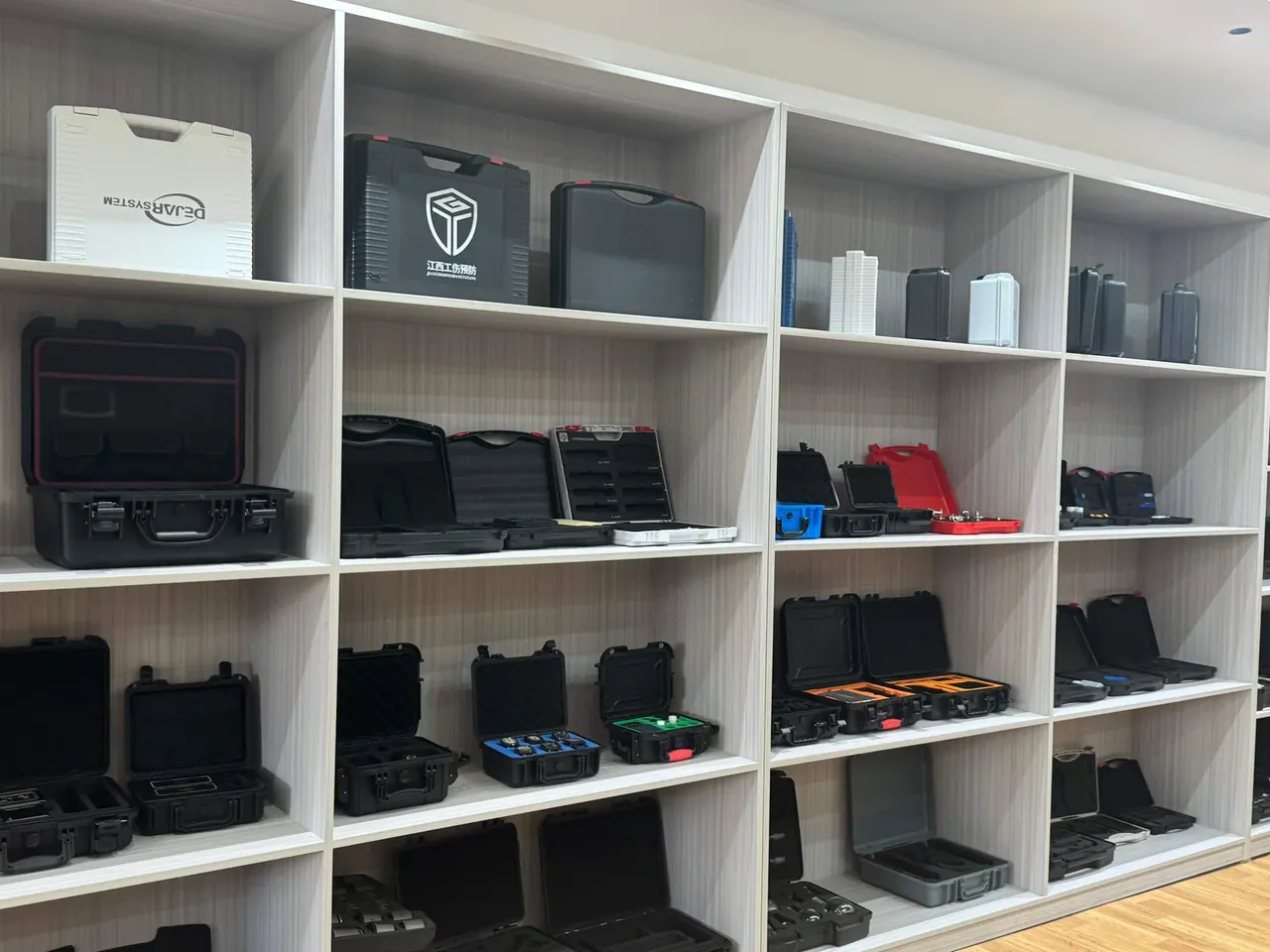
Use M8 grade 8.8 bolts at 24 N·m into nylon-insert nuts. Below 18 N·m they back off within 300 km. Above 30 N·m the brass insert pulls out of the wall, and at 70℃ that failure comes much sooner.
Reinforcement belongs in the mould, not in the field. Moulded shells get a 4 mm pad at each foot; rotomoulded shells go from 4 mm to 6 mm locally, backed by two 20 mm ribs inside. Adding washers afterwards leaves the whole load on a few screw heads and star cracks appear within six months.
3. Wind Load, Road Vibration and Fastener Locking
At 120 km/h the stagnation pressure on a front face is about 0.7 kPa. A 0.15 m² face sees roughly 100 N; bolt a thin panel to the side and the area doubles along with the force. The load itself is modest; the problem is that it never stops working on the bracket welds.
Gravel road vibration is the real test. Levels reach 3 g, concentrated between 10 and 50 Hz, which sits close to the first mode of a lightweight bracket. Check the mode: a 2 mm wall square tube pushes natural frequency above 80 Hz and out of the road input band. Skip the check and a single trip will loosen the joints.
Locking stacks three ways: nylon-insert nuts, threadlocker and a spring washer. The threadlocker does most of the work, holding viscosity from -30℃ to 70℃ and staying effective for about five teardowns before it needs reapplying.
4. Sealing, Wading and Drain Holes
Sealing for off-road use is a wading duty, not a rain duty. At 500 mm of wading depth, the lower edge sees about 5 kPa of water pressure; a gasket compressed under 30% will pass water, while one at 30% holds for 30 minutes.
Water that gets in has to get out. Two 6 mm drains sit at the lowest points on either side of the base, each covered by a one-way membrane. A hole without a membrane lets water back in during a crossing; a membrane without a hole traps condensation. Clear the drains once a year: blocked, internal humidity passes 70% within two weeks.
The vent valve handles the other half. Crossing a 1500 m pass produces about 0.18 bar of differential, enough to make the lid fight its latches. Set the valve to crack between 0.25 and 0.35 bar: fast enough to equalise, stiff enough not to admit water at a ford.
5. UV, Temperature Swing and Shell Colour
A case that lives outdoors accumulates roughly 1000 h of UV in a year. Plain PP keeps about 70% of its tensile strength after that; a compound with 2% carbon black holds 85%. Darker shells run hotter: black reaches 70℃ at midday, while a light shell sits about 15℃ lower.
The temperature swing shows up in fits, not in the shell. With a 0.5 × 10⁻⁴/℃ difference in expansion between lid and base, a 600 mm case moves about 3 mm between -30℃ and 70℃. That travel has to be absorbed by latch stroke, so leave 4 mm of stroke or the latch bottoms out.
Colour is also a practical decision. Dark absorbs heat and ages the gasket faster; light shows every mud splash. Most fleets settle on olive drab or dark grey, which sits between the two and shows the least difference after 3000 km.
6. Quick Release, Security and Monthly Checks
An exterior case has to come off quickly. Four bayonet feet with an 8 mm lock cylinder take under 30 seconds. Past two minutes, owners leave the case mounted permanently and the security design is wasted.
Pick the lock for the setting. A padlock suits an overnight camp; an internal deadbolt suits driving. Keep bolt engagement at 12 mm or more and the keyway at 8 mm so a pry bar has nothing to bite, and recess the exposed hardware 3 mm.
The monthly check covers four items only.
| Item | Tool | Limit |
|---|---|---|
| Foot bolts | preset torque wrench | 24 N·m |
| Latch effort | force gauge | 60 to 90 N |
| Gasket flattening | steel rule | width ≤2 mm |
| Drain holes | 4 mm probe | clear of silt |
Re-torque the feet, measure latch effort, replace any gasket flattened past 2 mm, and run a probe through both drains. Do those four and an off-road vehicle exterior gear protective box will usually finish a season without a mounting failure.
Related Reading
- Choosing anti-slip feet for a case
- Assembly dimensions and tolerances
- Cleaning and disinfecting a case
- What to weigh when picking accessories
Related Products
- 8 Series — Gun Cases; Military Equipment Cases; Camera Equipment Cases; Drone Cases; Watch Cases; Knife Cases; First Aid Cases; Electronics Equipment Cases
- WL8-2812 PP Gun Case — model WL8-2812
- All protective cases and toolboxes: 7 series, 158 models