

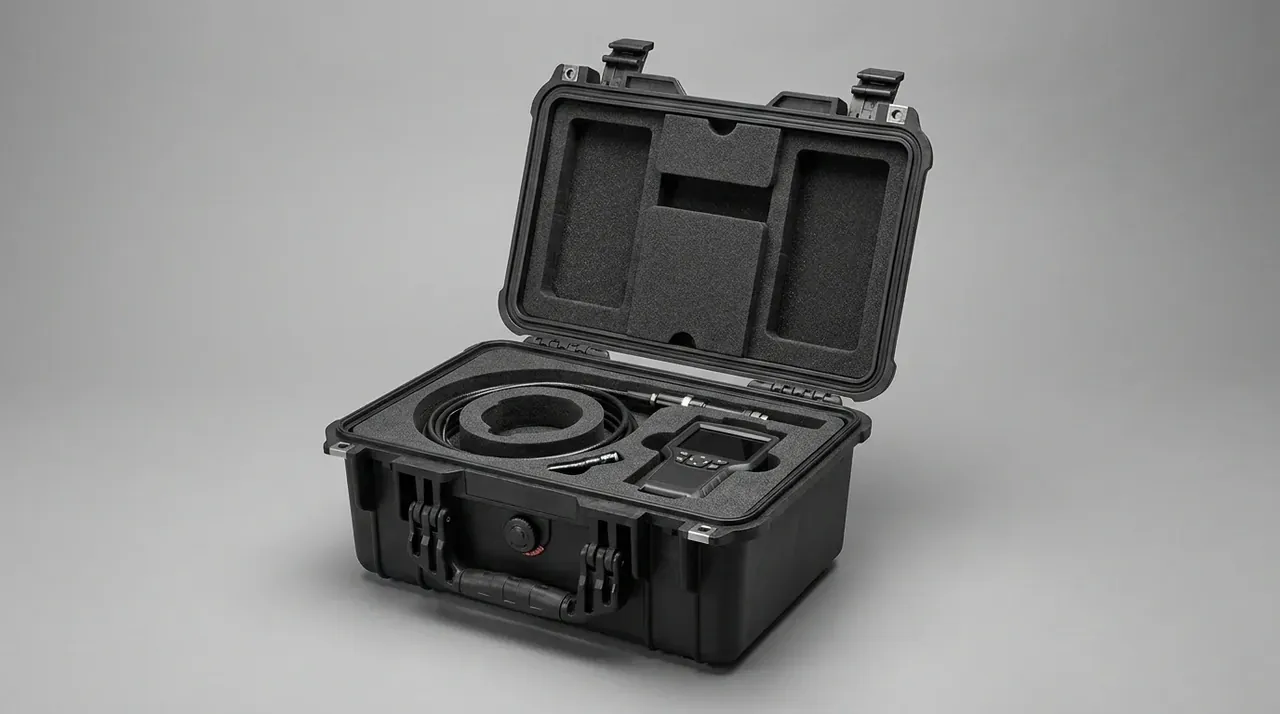
Quick answer: An oilfield tool case cleans in 12 min instead of 40 when the shell sheds slurry: four Ø12 mm drains, a 4° floor and a pull-out gasket.
Table of contents
- Where the 40 minutes go
- Cleaner choice: alkaline, solvent, steam
- Drain holes and floor tilt
- Removable gasket and roughness
- Cycle, drying and reset
- FAQ
1. Where the 40 minutes go
Eight 900 mm × 500 mm × 420 mm oilfield tool cases are washed every 30 days in mud service. The old routine — pre-rinse, scrub, rinse, wipe — took 40 min; a different shell takes 12 min, and all 28 min of the saving comes from water leaving on its own and a gasket that comes out.
Scrubbing was 18 min of the 40, the only stage needing force. Its length follows the number of square corners more than the oil thickness: 12 internal corners, six strokes each, 576 strokes for eight cases.
| Stage | Manual scrub (min/8) | Revised shell (min/8) | Source of the gain |
|---|---|---|---|
| Pre-rinse | 6 | 2 | Drains dump most of the slurry |
| Soak and scrub | 18 | 5 | R5 mm corners take a brush head |
| Rinse | 7 | 2 | 4° floor tilt holds no water |
| Dry | 9 | 3 | Gasket out, groove can be blown |
| Total | 40 | 12 | — |
The 12 min splits into 2 min pre-rinse, 5 min soak and wash, 2 min rinse and 3 min blow-dry; only the soak needs an operator, so labour for eight cases is under 6 min.
The difficult part of an oilfield tool case is never the oil. A 2 % alkaline bath loosens film in minutes; mud cakes in corners where neither water nor a brush reaches, so the shell has to provide the path first.
2. Cleaner choice: alkaline, solvent, steam
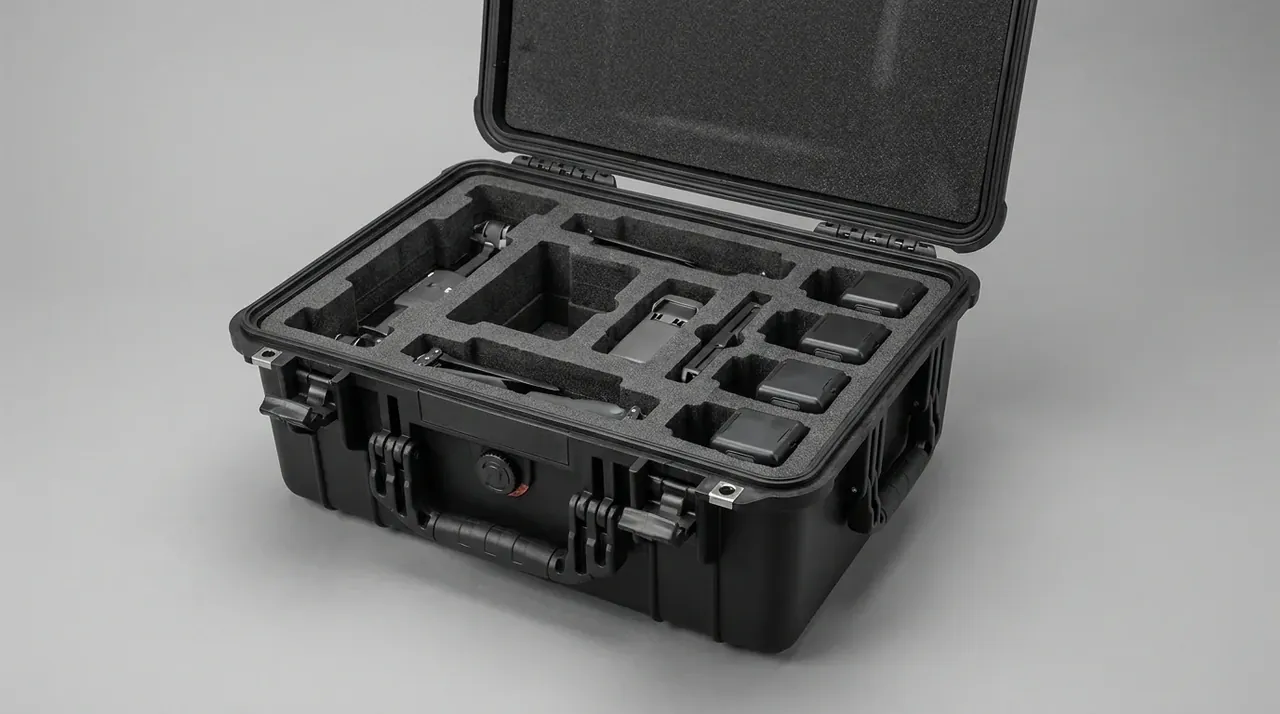
Three cleaner families exist: alkaline, solvent and steam. PP and ABS sit far apart on resistance, and one wrong choice turns the surface chalky or tacky with no way back.
| Cleaner | Parameters | PP | ABS | Verdict |
|---|---|---|---|---|
| Alkaline | 2 %, 55 ℃, 8 min | <0.3 % mass change | 0.8 %, gloss loss | Both materials |
| Solvent | Wipe under 30 s | About 2 % swell | Dissolves, goes tacky | ABS excluded |
| Steam | 0.15 MPa, 111 ℃, 60 s | Tolerated | Distorts above 90 ℃ | ABS excluded |
| High pressure | 8 MPa, 40 ℃ | Fine | Fine | Needs a removable gasket |
Alkaline is the default: 2 %, 55 ℃, 8 min, keeping PP below 0.3 % mass change while ABS moves 0.8 % with light gloss loss. At 5 % or 70 ℃ the ABS loss becomes permanent haze.
Solvent is for local patches under 30 s of wiping; PP swells about 2 % while ABS turns tacky. Steam at 0.15 MPa clears grooves in 60 s, and ABS distorts past 90 ℃. Mixing the two drops a deposit that plugs the drains.
3. Drain holes and floor tilt
Drains decide whether rinse water leaves by itself. Four Ø12 mm holes sit at the lowest corners, centres 15 mm from the wall, with the floor falling 4° toward them.
At 4° the 20 L of rinse water empties in 90 s; at 1° it takes 4 min and leaves a 2 mm film that dries into a mud line. Chamfer each hole 1 mm and fit contrasting silicone plugs, since a case without them collects 300 mL in the first rain.
Three positions are off limits: within 10 mm below the gasket groove, the hinge side, and directly under a rib, where mud follows the rib back to the hole.
4. Removable gasket and roughness
The gasket is the part cleaning damages first. EPDM at 60 Shore A, in three lengths set into a 3 mm wide, 2.5 mm deep groove, unbonded, pullable by hand, joints staggered 20 mm.
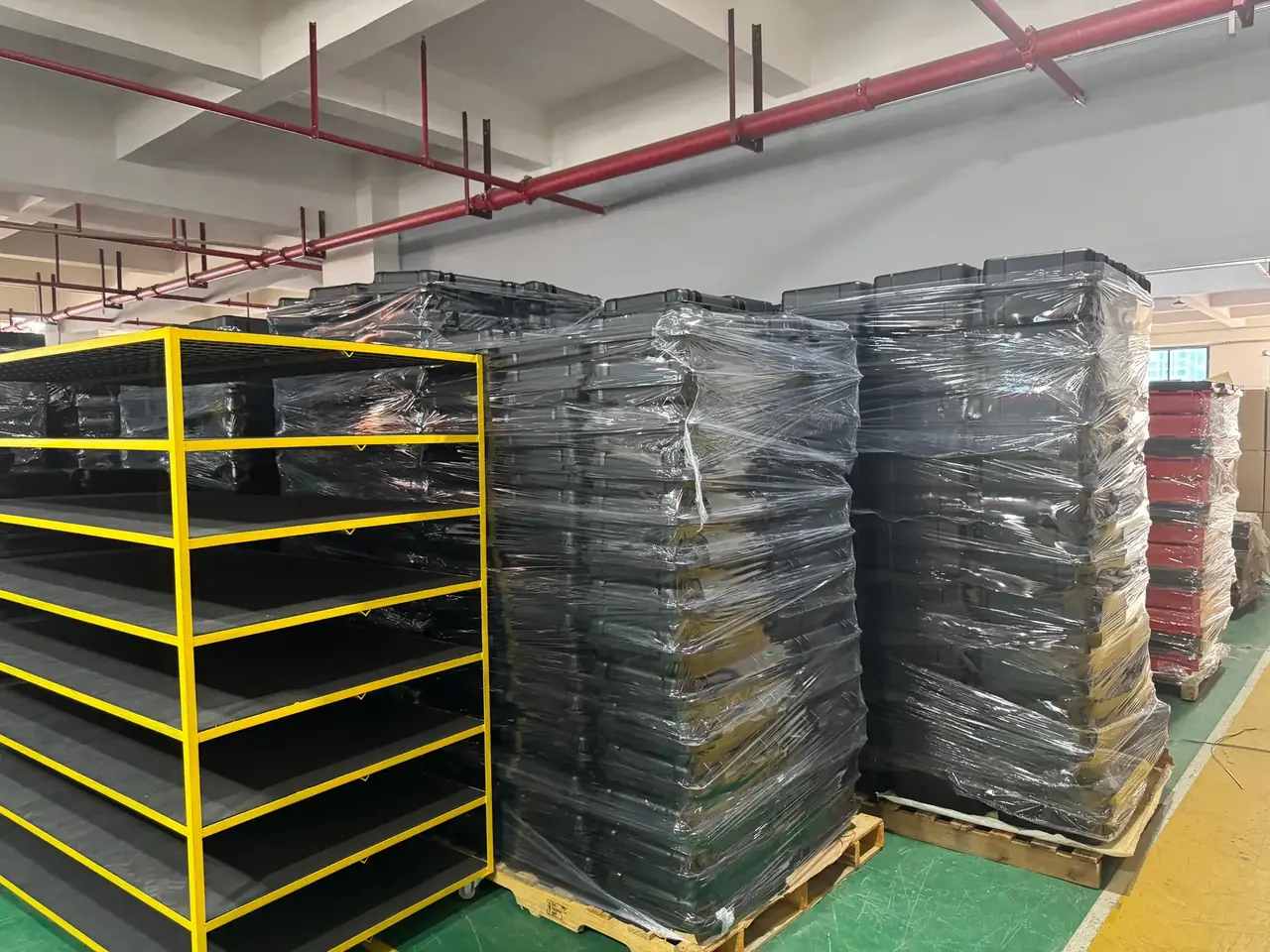
Removability is the point: with the gasket out, an 8 mm brush clears the groove in one pass instead of picking mud out by hand.
Roughness drives residue: a mould face at Ra 1.6 μm leaves about 40 % less than Ra 3.2 μm, and the field test is a white tissue over 100 mm with no oil trace, under 0.2 g/m². Internal radius R5 mm and ribs 40 mm apart keep the brush head clear.
5. Cycle, drying and reset
The cycle follows the duty: 30 days or 250 operating hours in mud, 15 days for heavy oil. Stretch it and slurry crusts over the drains, adding 15 min to the next wash.
Drying and reset run as one sequence: 60 ℃ forced air for 25 min, or 90 min at 25 ℃, with groove moisture under 0.1 g before the gasket returns, or mould grows under the seal. Reset order is plugs, gasket, lid, two pre-press strokes.
The annual sum is easy: 3.5 min saved per case per wash, 42 min over 12 washes, 5.6 h for eight cases. One crew running six sets frees 33.6 h a year.
Conclusion
Cleaning speed on an oilfield tool case comes from the shell, not the cleaner label. Four Ø12 mm drains and a 4° tilt empty 20 L of rinse water in 90 s; a gasket in three removable lengths lets the groove be cleaned to the bottom; R5 mm corners and an Ra 1.6 μm face hold residue under 0.2 g/m². Choose by material: PP takes all three cleaners, ABS only alkaline, because steam and solvent distort it or turn it tacky. Set the cycle by duty, 30 days in mud and 15 for heavy oil, and the eight-case wash falls to 12 min against 40, which is 42 min saved per case across a year. Two checks close the job: no oil trace on a white tissue over 100 mm, and groove moisture below 0.1 g before the lid closes on the next shift.
| Method | Material | Key parameters | Shell feature needed | Time per case |
|---|---|---|---|---|
| Alkaline soak | PP, ABS | 2 %, 55 ℃, 8 min | Four drains, 4° floor | 1.5 min |
| Solvent wipe | PP only | Under 30 s | Flat faces, no deep grooves | 2 min |
| Steam | PP only | 0.15 MPa, 111 ℃, 60 s | R5 mm corners, 40 mm rib pitch | 1.2 min |
| High pressure | PP, ABS | 8 MPa, 40 ℃ | Removable gasket, 1 mm chamfer | 1.0 min |
This article discusses container-side specifications and design implications only, and does not cover any handling, loading or use of the contents.
Related Reading
- Judging salt residue after case washing
- Gasket groove width and depth
- Tool case dividers and handle layout
- Enclosure protection for oilfield pump parts
Related Products
- 8 Series — Gun Cases; Military Equipment Cases; Camera Equipment Cases; Drone Cases; Watch Cases; Knife Cases; First Aid Cases; Electronics Equipment Cases
- WL8-2812 PP Gun Case — model WL8-2812
- All protective cases and toolboxes: 7 series, 158 models