

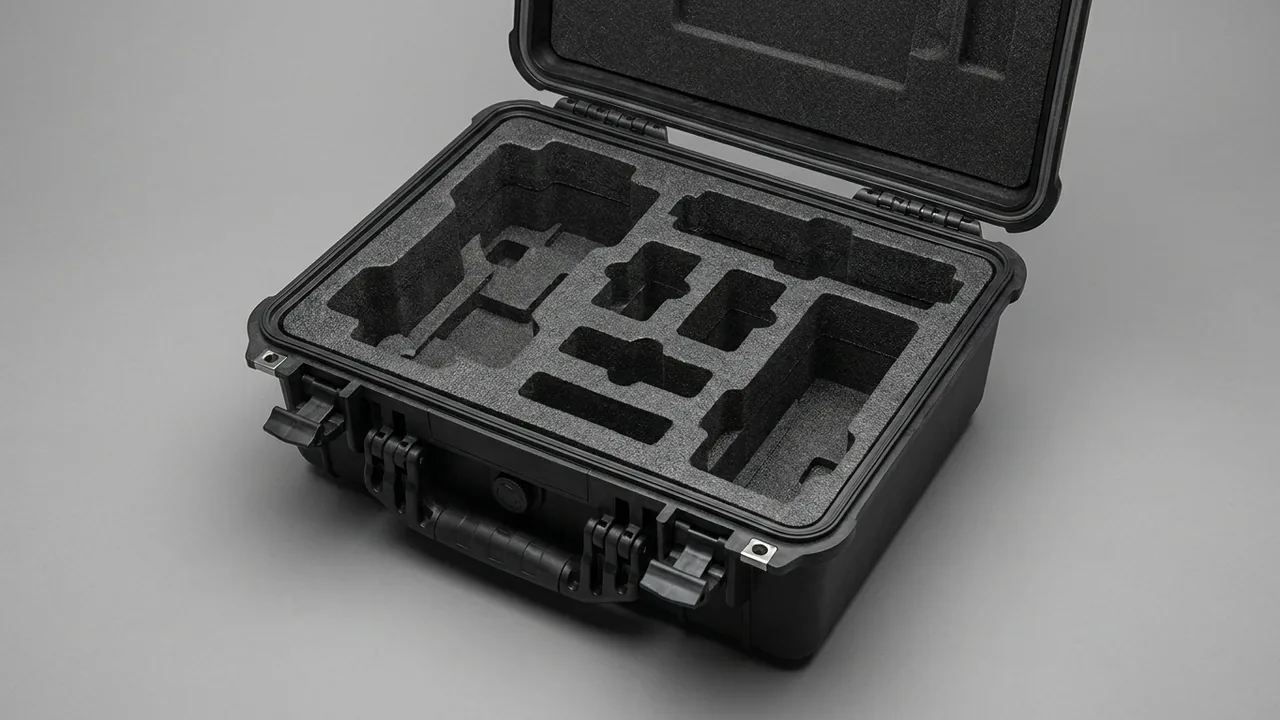
Reciprocating plunger pumps serve extraction, water injection, fracturing and gathering duty, and their high-value internals - the plunger itself plus the suction and discharge valve packs made of seats, cages, springs and guides - demand pristine surface condition. When such parts meet impact, corrosion or abrasive grit during shipment and pad staging, pump efficiency slips at best and a full teardown or downhole event follows at worst. The up-front conclusion: a purpose-built oilfield pump case must defeat four threats together - general corrosion, sulfide stress cracking, shock and impact, and static ignition - using model-specific EVA or PE foam compartments that hold every component apart. The sections below walk from hazard identification and case architecture through material standards to packing routine, ending with a selection and acceptance checklist.
Across desert, offshore and arctic supply chains, pump spares survive repeated handling, long road and sea legs, and open-yard exposure. A 30 to 120 mm plunger often needs a finish near Ra 0.2, where any scratch becomes a corrosion start; the valve seat face tolerates zero hard-particle dents. Wooden crates, woven sacks or bare pallets neither block sulfur-laden moisture and salt spray nor restrain parts during drops and vibration, so rejection stays high. For procurement and maintenance leads, treating transit protection as its own engineering line is the straightest way to lower life-cycle cost.
Table of Contents
- 1. Four Core Risks in Plunger Pump Transit
- 2. Case Structure: Compartments, Frame and Load
- 3. Corrosion and Sour-Service Materials
- 4. Explosion-Proof and Static-Control Design
- 5. Custom Inserts for Plungers and Valve Packs
- 6. Sealing and Pressure Equalization
- 7. Shock Isolation and Drop Protection
- 8. Salt Spray and Hydraulic Cleanliness
- 9. Packing and Fixing Procedures
- 10. Transport, Handling and Yard Storage
- 11. Inspection Documents and Compliance Delivery
- 12. Size Specification and Selection Table
- 13. Typical Applications and Cases
- 14. Maintenance, Refurbishment and Service Life
- Frequently Asked Questions
1. Four Core Risks in Plunger Pump Transit
Distribution damage to these parts falls into four buckets, each with a clear design answer. First, mechanical bruising: the plunger OD, valve seat cone and cage guide score, dent or chip when they hit each other or hard objects, wrecking the seal fit. Second, corrosion and stress cracking: H2S, CO2 and formation water drive sulfide stress cracking and hydrogen-induced cracking in ordinary carbon steel and some stainless, and even brief salt-air exposure during transit can seed defects. Third, contamination: sand, weld spatter and swarf entering valve gaps cause abrasive wear at start-up. Fourth, static and spark risk: in hydrocarbon zones a case without a ground path and spark-safe build may ignite gas when opened or rubbed.
These hazards interact. A rough shuffle both bruises parts and breaks a seal so spray enters; a missing ground sparks at opening. The case must answer all four as a system, not one. Buyers should audit against the four rather than asking only if the box is tough. For broader pump and valve thinking, see pump valve parts case selection. It is worth separating damage that shows up immediately from damage that shows up later. A chipped cage guide or a bent spring is visible at unpacking and gets a part rejected on the spot. A hairline score along a plunger outside diameter, or a single hard particle pressed into a lapped seat face, looks harmless in daylight and turns into a packing leak or an internal bypass after a few hundred hours at pressure. That second class of damage is the expensive one, because it is discovered during a workover, when the pump has already been built up, installed and run. Fracturing duty sharpens the fourth risk into a fifth. Proppant is a hard, angular solid carried at high concentration, and a grain of it left on a valve seat land or between a plunger and its packing scores metal on the very first stroke. Injection-water service adds scale and iron sulfide particles, and carbon-dioxide flooding adds a mildly acidic condensate that keeps a wet film on any surface it touches. A case built for these pumps therefore treats the interior as a clean, dry, particle-controlled volume rather than as a padded box, which is the reason a fracture-spread case and a warehouse shelf are managed to different rules.
2. Case Structure: Compartments, Frame and Load
These cases use a three-layer build: shell, insert and compartment divider. The shell is modified polypropylene blend or aluminum frame; PP is light and salt-spray resistant, aluminum carries heavier plungers and full packs. The insert is machinable EVA or cross-linked PE foam milled to the part. Compartment dividers are the crux: plungers, seats, cages and springs sit in separate cavities to stop metal-on-metal hits and galvanic coupling of dissimilar metals.
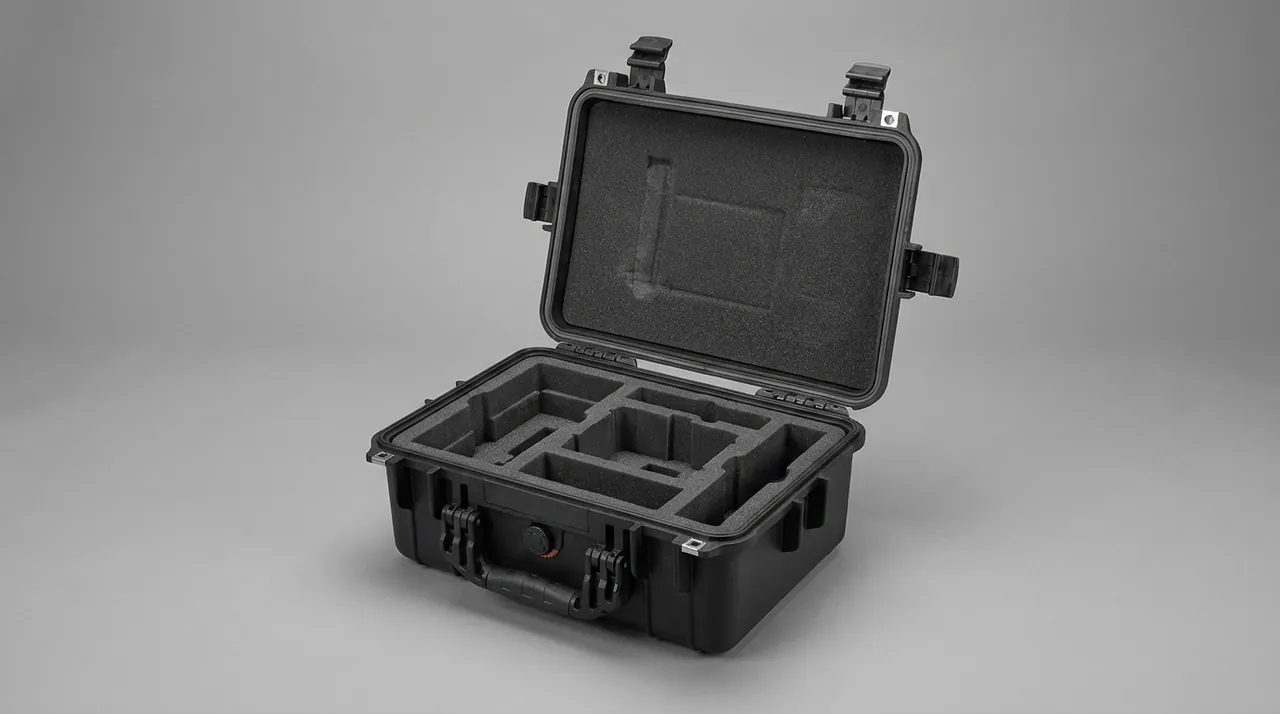
Load drives the frame. A large plunger weighs kilograms; a full pack often passes twenty kilograms, so the shell needs metal ribs and handles and latches rated for the loaded weight with margin. Forklift slots and lift points suit muddy pads. Units that travel with rigs or workover spreads use the reinforced-frame idea in drilling rig component case. Standardize outside size for container and pickup stacking.
3. Corrosion and Sour-Service Materials
Sour and abrasive duty both bear on plunger pump metallurgy. Valve seats and cages are typically 17-4PH or a hardened stainless with a lapped seat land, plunger bodies carry a ceramic or tungsten-carbide coating over a stainless core, and the fluid end is carbon steel behind a corrosion barrier. The transit case has to agree with that metallurgy rather than fight it: every cradle, divider screw and ground stud that shares space with a coated plunger or a lapped seat land is chosen as duplex or low-carbon martensitic stainless under NACE MR0175 / ISO 15156, so a week of humid pad air cannot start galvanic attack where the coating is thinnest. Shell coatings follow a zinc-rich epoxy primer and a polyurethane topcoat, checked by GB/T 10125 salt spray with the hours before first red rust logged as the acceptance figure. Foam in a fracture-service case must also survive proppant dust and oily packing rings, which is why closed-cell cross-linked PE with an anti-static, low-bleed formulation is preferred to open-cell sponge. Where an OD or a seat land is lapped fine, the cavity carries vapour-phase inhibitor paper so the enclosed volume stays actively passivated. Refinery-side pump spares are screened the same way in refinery pump parts case, which keeps one material rule across upstream and downstream.
4. Explosion-Proof and Static-Control Design
The ignition-relevant object here is not the case but its contents: a fluid end pulled wet with hydrocarbon, valve cages still carrying solvent, packing rings that out-gas. Opening such a case in Zone 1 or Zone 2 is the moment that matters, so the design answers the intent of GB 3836 and ATEX 2014/34/EU at that moment. A bonded ground stud on the frame lets the fitter clip a wrist strap and drain charge before the latch moves; the latch itself is a treated-steel or brass pattern selected so steel never strikes steel; the liner is conductive foam held inside the static-dissipative band, not an insulating sponge that can store a charge. The cavities are also shaped to accept a brass or nylon drift, so a seat cage is never freed with a steel hammer. Where a valve pack carries an inventory radio tag, a shielded pocket keeps it readable on the shelf and quiet in the truck. The underlying scheme is described in ESD shield case design. A case is not powered equipment, so the statement issued with it describes design intent and test method rather than an equipment certificate.
5. Custom Inserts for Plungers and Valve Packs
Custom inserts are the soul of case fit. A plunger is a slender body of revolution needing V or half-round cradles with multi-point axial support to control bending, plus end caps for location. Valve seats and cages are axi-symmetric precision parts whose cavities should leave 0.5 to 1 mm compression against measured OD so foam rebounds snug without over-pressure. Springs should lie flat in shallow cavities, not be compressed into set. All cavity walls get a brushed or soft film lining to stop foam debris adhesion.
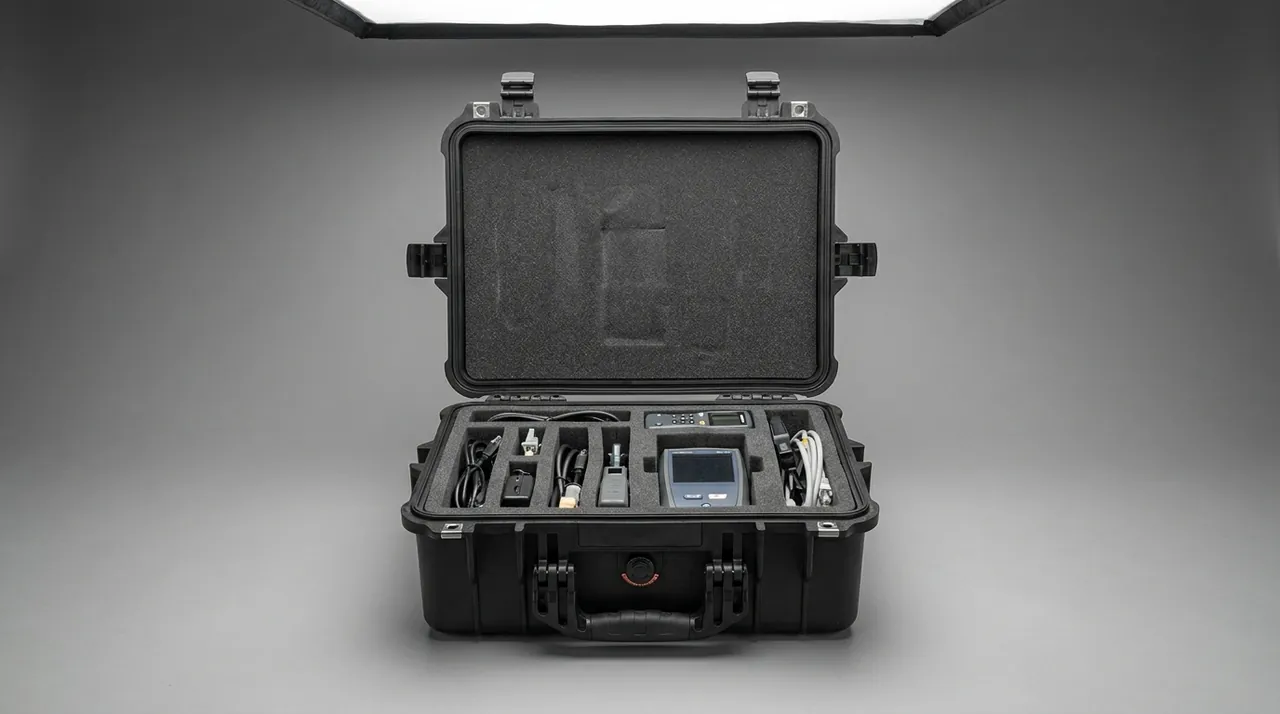
Insert machining should follow a CNC path: first 3D scan or measure the part, then generate cavity tooling, then batch-check fit, as described in EVA foam insert custom process. For multi-model maintenance sites, use modular inserts - one shell with swappable trays changed per workover task. Material comparison is in case foam material comparison.
6. Sealing and Pressure Equalization
Pad and platform legs put a pump case through mud splash, wash-down, rain and salt fog, so the seal target is IP67 under GB/T 4208 / IEC 60529, meaning dust-tight and no ingress during temporary immersion. A moulded EPDM or silicone gasket sits in a machined lid groove, and the latches are spaced so the whole ring compresses evenly instead of pinching at one corner. Sealing alone does not survive air freight: a case closed at pad altitude and opened at a mountain location pulls a pressure differential that either glues the lid shut or stretches the gasket past recovery, which is why a case pressure equalization valve with an ePTFE membrane is specified for any case that flies or crosses a range. On a sea leg the membrane takes a salt-resistant filter element, with its replacement interval written into the case log. Seal geometry is compared with IP67 protective case when the same shell family is reused for other pump spares.
7. Shock Isolation and Drop Protection
A plunger is a slender column with a fine finish and a valve spring is a fatigue-rated part, so the case is verified against environmental test methods rather than judged by feel. MIL-STD-810H is applied here strictly as the reference method behind transport simulation: drop, random vibration and temperature-humidity cycling, with no military certification claimed, as the shipping papers state. The test set looks at a 1.2 m corner-edge-face drop, a vibration profile for road and air legs, and a humidity cycle that mimics a monsoon pad. Inside, each plunger sits in its cradle with a 10 to 20 mm buffer between cavity and shell, while a lapped seat cage can hang on an elastic sling so it floats clear of the foam. Method references are set out in MIL-STD-810H case compliance and GB/T 4857 transport packaging.
8. Salt Spray and Hydraulic Cleanliness
Two figures decide whether a pump case did its job. Salt-spray endurance comes first: shell metalwork and liner hardware face GB/T 10125 neutral salt spray, reported as hours before red rust appears, while any bought carbon-steel fastener is expected to clear 240 hours. The second is internal cleanliness. A plunger pump fluid end works on close-clearance fits between plunger, packing and stuffing box, and a valve cage guides the seat on a narrow land, so one hard particle trapped on that land scores a seat face at first stroke. The interior is therefore held to a hydraulic cleanliness figure built on ISO 4406 bands such as 19/17/14, agreed per assembly, and verified by a pre-close inspection. Practical means are low-shedding liner stock, wipeable interior walls, supplied port plugs and dust caps for every open fluid passage, a packing bench kept clear of grinding, and a particle-count card or cleanliness indicator read at opening. Process equipment follows the same discipline in heat exchanger parts case.
9. Packing and Fixing Procedures
Packing procedure is where the design either pays off or is wasted. One, check the pick list and the serial numbers of plunger, packing set, seat, cage and spring against the cavity map. Two, clean handling prints and oil from surfaces with the specified solvent. Three, wrap lapped seat lands in inhibitor paper or seal them into a rust-inhibiting bag. Four, load the plunger upright in its V-cradle and confirm the end caps locate the axis, then bed packing rings flat, and give cage, guide and spring each their own pocket with the spring held at free length. Five, close with a desiccant pack and a humidity card in the lid pocket, then fasten the latches. Six, apply the packing list, the serial label and, where the case passes through a hazardous area, the applicable hazard and explosion-proof markings. Seven, log the drop and vibration spot check. The two shortcuts seen most on pads, stacking springs and cages into one pocket to save time and travelling without desiccant, undo more engineering than they save. Documents travel in a waterproof pouch, and the serial label needs the durability covered by case lock customization options.
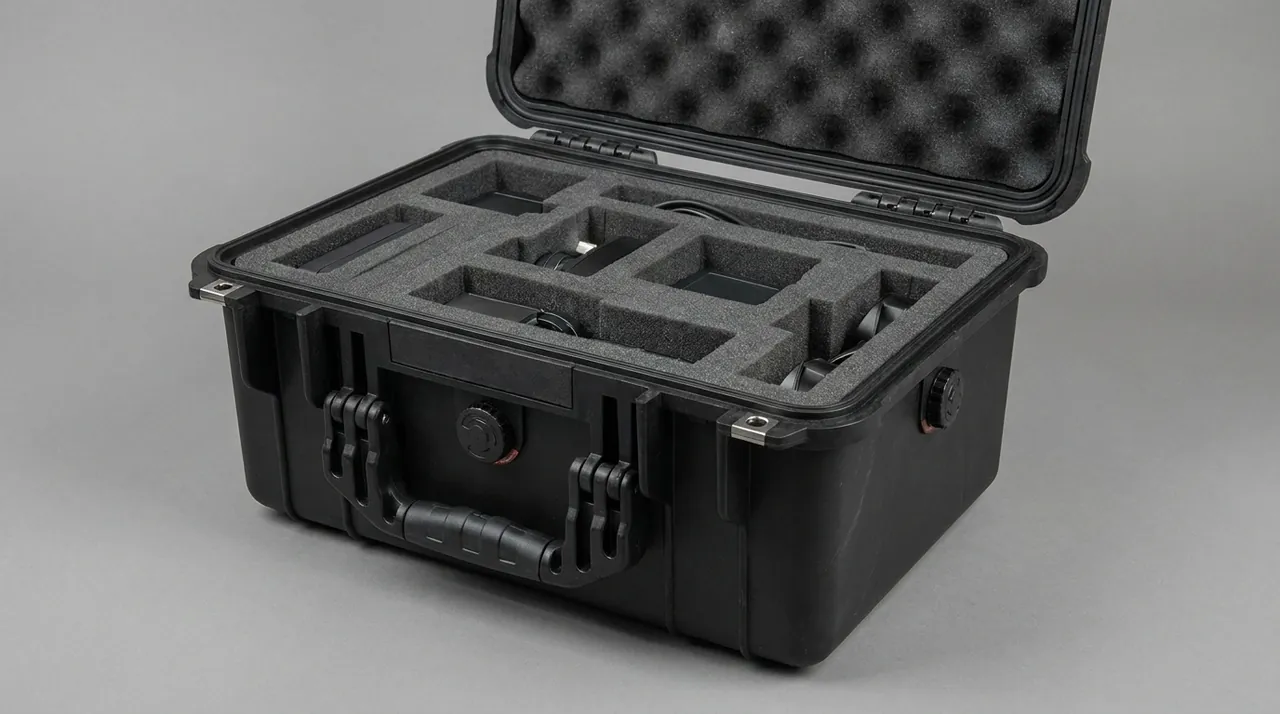
The two habits that cost most on a pad are crowding several valve cages into one cavity to save a minute, and travelling a long leg without desiccant; each one cancels a decision the liner was built to enforce. Release paperwork rides in a waterproof pouch, and the case lock customization options chosen for the serial label keep it legible through salt fog. Packing is carried out away from welding and grinding so no swarf can settle into an open cavity.
10. Transport, Handling and Yard Storage
Transit continues the logic of the cavity. On a flatbed the case is strapped to the deck so it cannot slide or be crushed under a second tier; on a supply boat it rides below deck, or under salt-fog sheeting with the vents open; outdoors it stands on dunnage under a cover, so neither water nor sunlight ages the foam. Handlers use the forklift slot or lift eye and never drag or drop the case. Where a case ships with a small volume of lubricant, inhibitor or cleaner, ADR for road and IMDG for sea govern marking, documentation and packaging, as set out in ADR/IMDG hazmat transport case. On arrival, open and read the humidity card, inspect the seat lands and pull a cleanliness sample before the part goes anywhere near the pump, then feed the result back to the supply chain. Storage discipline is part of the same routine, described in protective case service life.
11. Inspection Documents and Compliance Delivery
On the procurement side the document pack carries the same weight as the moulding. The JUNZHIJIA manufacturing site operated by Kexin New Materials (Guangdong) Co., Ltd. in Guangdong builds pump cases around the measured envelope of a specific plunger and valve pack together with its sour, abrasive and salt-spray duty, and runs both an OEM route, private-label volume against a customer drawing and brand, and an ODM route that starts at cavity layout and material selection and ends at salt-spray and drop verification, shipping for wholesale, agency and global supply. Available on contract are material certificates for stainless grade and hardness, salt-spray records, cleanliness reports, static and ground measurements, IP verification and a material compliance statement to NACE MR0175 / ISO 15156. Buyers screening factories can start from how to choose case OEM factory and identify genuine vs fake case, and fix the incoming sampling rule with custom case acceptance AQL. Every certificate is tied to the lot number, so a pad audit can trace one case back to its foam batch.
12. Size Specification and Selection Table
Typical ranges for plunger pump cases are listed below as engineering values, not as mandatory figures:
| Part type | Typical OD (mm) | Unit weight (kg) | Shell material | Insert plan | Protection target |
|---|---|---|---|---|---|
| --- | --- | --- | --- | --- | --- |
| Thin plunger | 30 to 60 | 1 to 4 | Modified PP | EVA V-cradle | IP67 |
| Large plunger | 60 to 120 | 4 to 12 | Aluminum frame | PE cradle + cap | IP67 |
| Seat/cage | 40 to 150 | 0.5 to 6 | Modified PP | CNC cavity | IP67 |
| Spring set | - | 0.2 to 1 | Modified PP | Shallow flat + strap | IP67 |
| Full valve pack | - | 10 to 25 | Aluminum frame | Modular liner | IP67 + EX |
A second view is load count versus transport mode:
| Transport mode | Per-case load | Cushion need | Note |
|---|---|---|---|
| --- | --- | --- | --- |
| Road transfer | 1 to 3 sets | Medium | Strap to stop slide |
| Sea export | Full lot | High | Salt tarp + desiccant |
| Air urgent | Single | High | Equalization valve required |
| Pad storage | Spare stock | Medium | Elevate and cover |
For tooling and MOQ, see custom case mold cost analysis.
13. Typical Applications and Cases
Three field patterns keep recurring. In desert waterflood and workover work, a maintenance station loads a week of plungers, packing sets and valve packs into compartment cases that ride with the workover rig, so a failed pump is rebuilt from the case instead of from a distant warehouse. On an offshore platform in sour service, every cradle and stud in the case is duplex or low-carbon martensitic to match the pump, the frame carries a ground stud, and the case moves on the supply-boat rotation. In a cold or arctic field, foam that stiffens below the local minimum is replaced with a soft low-temperature formulation and the end caps are made more positive, so a cold plunger cannot drift. The common thread is treating transit protection as a front-end input to the pump maintenance plan rather than a repair order raised after a scored plunger. Adjacent case types are set out in wellhead equipment case and LNG plant equipment case, with a comparable heavy-duty reference in mining equipment parts case.
14. Maintenance, Refurbishment and Service Life
A pump case earns its cost back over many workovers provided it is maintained on a schedule. After each trip, wash out mud and oil, inspect the gasket for compression set or cracking, renew the desiccant and the humidity card, and check latch and hinge tension. Replace any liner that has begun to shed or whose cavity has lost shape, and touch in coating damage on metal shells before rust works under the film. The routine in how to clean protective case extends service life noticeably. Life itself tracks duty: continuous salt fog and direct sun shorten it, an indoor spare store lengthens it. Keep a ledger by lot with trip count and inspection result, and retire a case at the end of its rated life or after structural damage. Because latches and hinges are the parts that fail first, the pattern described in toolbox hinge latch seal reduces how often they need attention.
Frequently Asked Questions
Q: How does a case for plunger pump parts differ from an ordinary tool box? A: An ordinary tool box answers one question, whether the parts fit and whether it can be lifted. A case for a plunger pump answers four. It has to hold back general corrosion in a wet, salty pad atmosphere; it has to survive sour service, because a fracturing or injection fluid can carry hydrogen sulfide while the case hardware sits beside lapped seat lands; it has to absorb shock and random vibration without letting a slender plunger bend or a valve cage chip; and it has to behave in a hazardous area, because the contents can still be wet with hydrocarbon when the lid opens. In practice that means cavities milled to the measured plunger, seat, cage, guide and spring rather than a general foam block, stainless cradles and studs selected to NACE MR0175 / ISO 15156, a bonded ground stud and a conductive liner, and an IP67 seal with a pressure equalization valve for air legs. The difference shows in the paperwork too: a purpose-built case ships with material certificates, salt-spray hours, a cleanliness figure and a static-control statement, while a generic box can prove none of them.
Q: A plunger is slender and bends easily; how is deformation held in check? A: Deformation in a slender plunger is controlled by supporting it at several points and fixing it axially, not by burying it in a thicker block of foam. The liner uses three to five V or half-round cradles distributed along the measured length, so self-weight divides between supports instead of hanging as a cantilever, and each end then gets a cap or a sprung retainer that stops the axis sliding. Where a plunger is very long relative to its diameter, a light elastic strap over the cavity, or elastic slings that let the part float clear of the foam, add the last measure of control. Fit tolerance matters as much as support count: a loose cavity lets the plunger chatter against its cradle and polish the OD, while an over-tight one crushes the cradle and marks the surface. Cross-linked PE with good rebound is the usual stock, changed to a soft low-temperature grade for cold fields. Depots that rebuild several pump models use swappable modular trays so one shell serves each model without compromise.
Q: Why does a sour-service pump spare need NACE MR0175 / ISO 15156 hardware around it? A: A sour stream, one carrying hydrogen sulfide, attacks certain steels by a mechanism that gives no warning: sulfide stress cracking and hydrogen-induced cracking can fracture a high-strength part under tensile stress while the surface still looks sound. NACE MR0175 / ISO 15156 is the internationally used rule that sets hardness, strength, microstructure and heat-treatment limits for material entering that service. A transport case never sees pump pressure, and that is exactly why the trap is easy to fall into: a divider screw, a cradle bracket or a ground stud that would be perfectly adequate on a warehouse shelf can corrode in wet sour air, and the corrosion product then lands on a lapped seat land or inside a valve cage. The screen is therefore applied to every metal item that shares space with the pump internals, favouring low-carbon martensitic or duplex stainless, with a qualified coating on any carbon-steel item. The material compliance statement shipped at delivery is a working acceptance document, not an optional annex.
Q: Is IP67 enough for a pump case that crosses an ocean? A: IP67 under GB/T 4208 / IEC 60529 is the right floor rather than the whole answer. It means the enclosure is dust-tight and survives short immersion, which covers the rain, mud splash and wash-down a pump case meets on a pad. Sea transport adds two things IP67 alone does not address. The first is salt: external metalwork is coated in a zinc-rich epoxy primer and a polyurethane topcoat, the hours-to-red-rust figure being read from GB/T 10125 salt spray, and the valve breathable element is a salt-resistant filter. The second is pressure: a case closed at pad level and opened after a flight or a mountain crossing develops a differential that either jams the lid or stretches the gasket, so a pressure equalization valve with an ePTFE membrane is mandatory on any case travelling that way, not an accessory. Add a salt-fog cover, a realistic desiccant charge and a humidity card, and leave vent gaps in a stack.
Q: Does a pump case need desiccant, and how often is it renewed? A: In any humid, sour or sea-going duty a plunger pump case should carry desiccant and a humidity card, and the two work as a system. Desiccant holds relative humidity down so surface condensation cannot form on a lapped seat land or a coated plunger, which is the point at which electrochemical corrosion begins; the card is the inexpensive instrument that shows whether the seal actually held. How often to renew it follows the duty rather than the calendar. A sealed case in an indoor spare store may only need a check every few months. A case opened at every transfer on a wet pad should be renewed each time. A long ocean leg is treated as one interval and renewed at the far end. Keep desiccant out of the part cavities, in a mesh pocket in the lid, so its dust never reaches a precision face. Vapour-phase inhibitor paper can be used at the same time and the mechanisms complement each other, but VCI does not dry the air and cannot replace desiccant.
Q: How is static control closed on a case used for plunger and valve-pack parts? A: Static control on a pump case is a chain with three links, and the chain fails if any link is missing. The first is the liner: conductive foam held inside the static-dissipative band, so a charge on a solvent-wet cage or a plastic-wrapped plunger can move rather than accumulate. The second is the ground path: a bonded copper or treated-steel stud on the frame with a wrist-strap interface, used before the latch is touched, so operator and case reach the potential of the surrounding steelwork together. The third is the tool interface: latches, hinges and cavity edges arranged so a seat cage is freed with a brass or nylon drift and never with a steel hammer, plus a no-spark resting position for the tools used on the lid. A shielded pocket keeps an inventory tag quiet in transit. This is built to the intent of GB 3836 and ATEX 2014/34/EU for hazardous-area work. The statement supplied with the case sets out design and test method rather than an equipment certificate.
Q: What lead time and minimum order apply to custom plunger inserts? A: A custom plunger and valve-pack insert moves through four stages before volume: measure or scan the actual parts, build the cavity tooling path, machine the first liner, then re-check fit by loading the real assembly. First samples typically need somewhere between a few days and two weeks, depending on how many distinct parts the cavity map covers and how loaded the shop is at the time. Volume lead time then tracks tooling and order size. Minimum order quantity is a matter of the cooperation model. An OEM programme that puts a customer drawing and brand on a standard shell, or an ODM programme that begins at cavity design, can usually be negotiated down to a low minimum, in some cases a single sample case. A dedicated shell mould by contrast carries tooling cost, analysed in the mould cost reference. A practical sequence is to validate the cavity layout with modular trays first and only then commit to volume tooling.
Q: How should a batch of pump cases be accepted against the specification? A: Work through the four risk classes in order and sample with AQL, rather than judging by how solid the case feels. Start with structure: plunger, seat, cage, guide and spring each in a separate cavity, dissimilar metals kept apart, the frame carrying a full pack that can exceed twenty kilograms, latches and hinges sound. Then material, read from certificates for cradles, dividers and fasteners plus the sour-service statement. Then sealing, by IP verification or a spray and immersion spot check on a sampled case. Then static control: bonded ground stud present, conductive liner inside its resistance band, no-spark interface at the lid. Then cleanliness, against the agreed ISO 4406 figure and the state of every port plug and dust cap. The document pack is the final item and not the least: salt-spray hours, drop results run to the MIL-STD-810H method and labelled non-military, cleanliness report and material certificates. Record each check against the lot number, and refuse anything not corrected and re-inspected.
Q: When does a pump case shipment become dangerous goods? A: A dry plunger, seat and cage travelling in inhibitor paper are not dangerous goods, and that is the normal condition of a pump case. The question arises when the case also carries a service lubricant, a corrosion inhibitor or a cleaner, or when a fluid end goes back wet. Small volumes of those materials can bring the shipment inside dangerous goods rules, and road movement then follows ADR while sea movement follows IMDG, for classification, packaging, marking and the shipping declaration. The workable arrangement is a compliant small pack fixed in an isolated cavity, correct hazard marks on the outside of the case, a safety data sheet and shipping document travelling with it, and a qualified hazardous-goods forwarder where the route calls for one. Confirm the full list of companion materials with the logistics and compliance team at the planning stage rather than at the port gate, and write the responsibility boundary into the contract.