

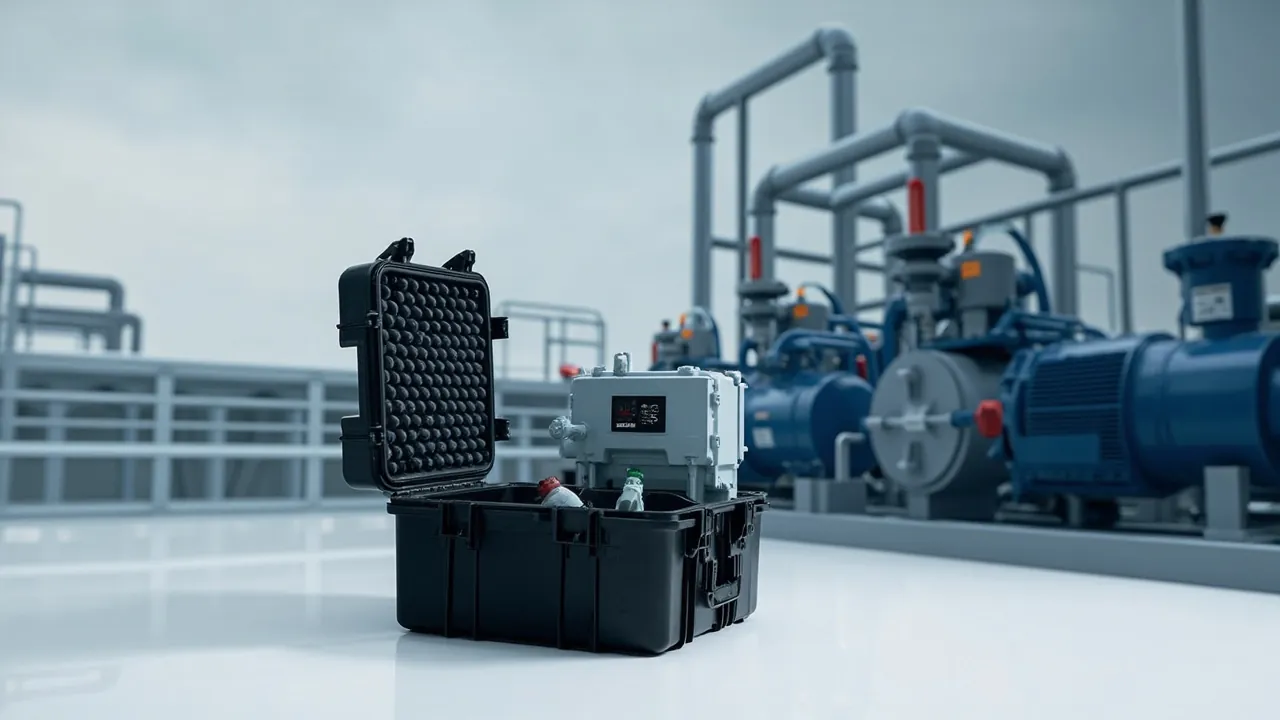
Pumps and compressors are the heart of any refining or petrochemical train, and mechanical seals, rotors, impellers, bearing shells and dry gas seals are the most delicate parts of that heart. The conclusion up front: a refinery pump and compressor parts case is not an ordinary toolbox. It is a combined protection system covering shock, vibration, moisture, particulate contamination and traceability. Mechanical seals must be separated and located by compartmented inserts so their faces never strike each other, rotors must be supported at the journals to prevent bending, and the case shell should be rated at least IP65, with IP67 preferred for ocean freight or long-term open-yard storage. Get those three things right and the three most common transport losses, namely chipped seal faces, bent rotors and corroded bearing journals, largely disappear at the source.
Most procurement and warehouse teams have seen the same scene. An imported cartridge seal arrives, and the stationary ring face shows radial cracking. A costly screw compressor rotor fails a straightness check and has to go back for re-straightening. A long-awaited spare part develops a ring of surface rust on the bearing journal because it sat in a damp container, and the maintenance crew has to descale and re-measure before installation. These losses are rarely caused by a courier dropping the box. They come from a packaging concept that does not match the component's physical weaknesses. This article works backwards from failure modes to packaging design, and gives directly usable guidance on case selection, insert design, test verification and incoming inspection for spare parts, equipment engineering and procurement staff in refining, petrochemical and coal chemical plants.
Table of Contents
- 1. Why Refinery Pump and Compressor Parts Need Dedicated Cases
- 2. Where Mechanical Seals Fail: From Faces to Bellows
- 3. Preventing Bending and Impact Damage on Rotors, Impellers and Shaft Trains
- 4. Case Shell Selection: IP Rating, Material and Load Capacity
- 5. Insert Design: Compartments, Location and Contact Surface Control
- 6. Vibration and Shock: Putting ISTA and ASTM D4169 to Work
- 7. Moisture and Rust Control: Desiccants, VCI and Sealing Strategy
- 8. Cleanliness Control and ISO 4406 Particle Awareness
- 9. Corrosion and Salt Spray: ISO 9227 and NACE Awareness
- 10. Working Near Hazardous Areas: The IEC 60079 Boundary
- 11. Incoming Inspection and Handover: AQL Sampling and Traceability Labels
- 12. Custom Insert Workflow and OEM/ODM Delivery
- 13. Selection Decision Tables and Common Misconceptions
- Frequently Asked Questions
- Conclusion & Related Reading
1. Why Refinery Pump and Compressor Parts Need Dedicated Cases
Spare parts procurement in refining follows a different logic from general machinery. Unit value is high, lead times are long, and substitutability is poor. A mechanical seal for a hydrogenation feed pump often carries a 12 to 24 week lead time, and rotor or impeller repair cycles for screw and centrifugal compressors are measured in weeks as well. That means every day a component spends in transit is a day of unplanned downtime risk for the unit, and the cost of a single packaging-induced failure dwarfs the cost of the packaging itself.
From a protection engineering standpoint, refinery pump and compressor parts share three characteristics that rule out generic packaging.
- Many precision mating surfaces. The flatness of mechanical seal faces is often expressed in optical interference bands. Even a small point impact can chip a face edge and produce a leak immediately after commissioning.
- High length-to-diameter ratios and low stiffness. Rotors, long shafts and impeller shaft assemblies frequently exceed a 10:1 length-to-diameter ratio. Stretch the simply supported span, and self-weight plus vibration produces permanent bending.
- Surface condition sensitivity. Journals, seal chambers, O-ring grooves and labyrinth seal teeth are toleranced in microns. Rust, scratches or embedded debris can scrap the part or force a rework.
The core value of a dedicated case is therefore not that it holds the part, but that it keeps the mechanical, humidity and particulate loads of transport and storage within the component's allowable limits. This follows the sensitivity-tiered philosophy described in the instrument case selection guide, with the additional twist that refinery parts concentrate their sensitivity in the seal interface and shaft train accuracy.
A common misconception equates a sturdy case with adequate protection. In reality, case strength only solves the problem of the shell being crushed. Whether the component survives depends on whether the insert restrains it reliably and attenuates impact energy to an acceptable level. The shell is the enclosure. The insert is the protection.
2. Where Mechanical Seals Fail: From Faces to Bellows
Mechanical seals are the most critical wear component in refinery pumps, and their transport damage follows a clear transmission chain: the outer diameter takes the hit, the load travels to the faces, and the result shows up as leakage. Using the classification logic of API 682, the standard for shaft sealing systems for centrifugal and rotary pumps in the petroleum, petrochemical and natural gas industries, seals can be grouped into single, dual, tandem and cartridge types. Cartridge seals are assembled and set at the factory, which paradoxically raises the packaging requirement, because there is no field adjustment margin left. The as-shipped state is the final state.
The vulnerable points and failure mechanisms are summarized below.
| Location | Material / behavior | Typical transport failure | Insert countermeasure |
|---|---|---|---|
| --- | --- | --- | --- |
| Seal faces (rotary / stationary) | Silicon carbide, carbon, tungsten carbide, extremely flat | Edge chipping, radial cracking, face scoring | Independent compartments, never face to face without a separator |
| Bellows assembly | Metal or rubber bellows with axial elasticity | Crushed convolutions, loss of spring, weld cracking | Limit axial travel, prevent lateral squeeze |
| Springs and drive pins | Small parts, easily displaced | Springs popping out, pins bending, preload loss | Keep factory preload, never ship disassembled in bulk |
| O-rings and gaskets | Rubber / FKM, sensitive to oil, ozone, heat | Deformation, aging, tacky surface | Separate sealed bag, store away from light and heat |
| Cartridge setting clips | Plastic or metal setting plates | Clip breakage causing premature face contact | Protect clips with sleeves, prevent movement inside the case |
| Shaft sleeve and gland | Stainless or alloy, tight fits | Scoring, deformation | Non-shedding separator between mating surfaces |
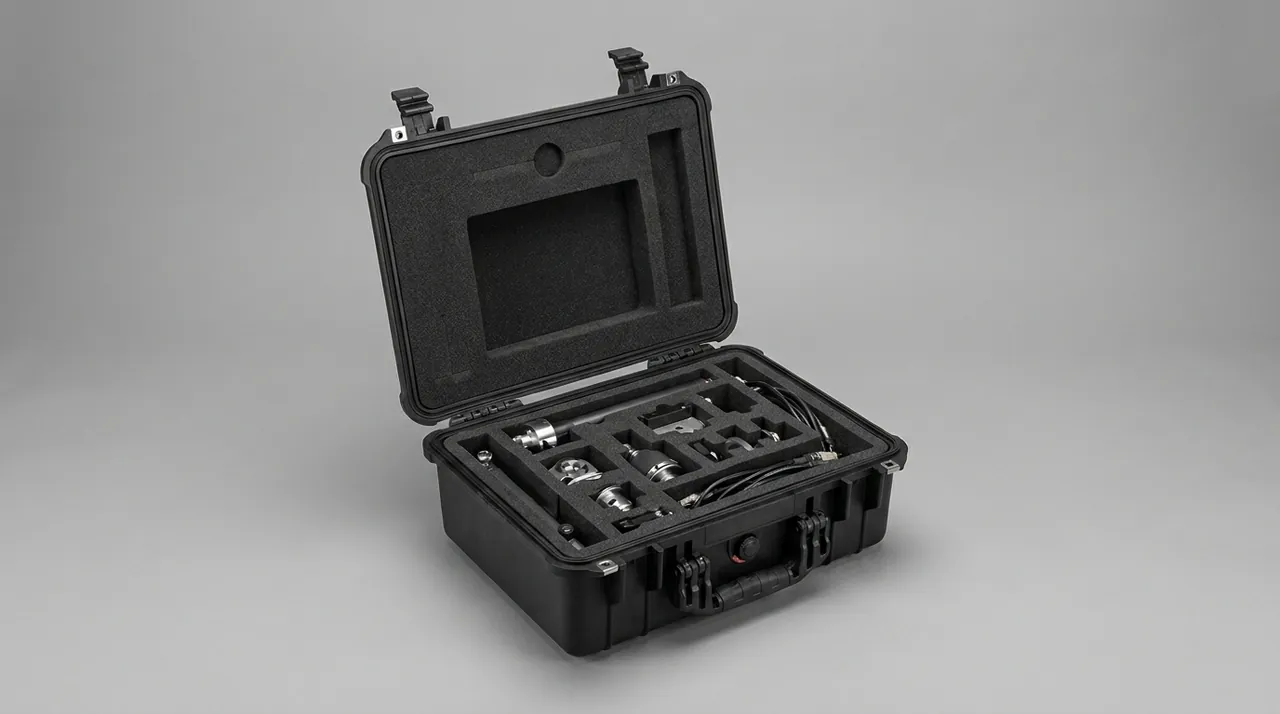
The critical rule: a seal insert must deliver per-part compartments, faces that never oppose each other, and zero axial movement. The most practical approach is to machine location bores in EVA or PE foam matched to the seal outer diameter, with the bore depth at 60 to 70 percent of seal height so the lower portion is fully surrounded and restrained. A rigid divider goes between adjacent seals. For cartridge seals, the insert also needs a relief pocket for the setting clips so they do not deform under load.
For guidance on elastomer compatibility and storage limits, see seal material and case compatibility, which collects the practical boundaries between common elastomers, media and temperatures. A frequent refinery problem is that seals sit in an open yard for months in their cases. Ultraviolet light and day-night temperature swings age the outer O-rings early, and leaks appear shortly after installation. A light-blocking case, desiccant in the insert, and a discipline of moving parts to the warehouse on arrival are far cheaper than replacing O-rings later.
3. Preventing Bending and Impact Damage on Rotors, Impellers and Shaft Trains
The packaging challenge for rotor-class parts is self-weight. A screw rotor that is 1.5 m long and weighs 120 kg, simply supported at both ends with an unsupported middle, can develop dynamic deflection several times its allowable value under transport vibration. Engineering practice offers three principles.
- Place supports near the center of gravity and use enough of them. Three to five support points are typical. Both journals are mandatory supports, with intermediate points added according to length-to-diameter ratio. Support spacing should generally not exceed 15 to 20 times the shaft diameter.
- Use a soft support material with low compressibility. EVA in the 60 to 90 kg/m3 density range works well. Higher density crushes journals; lower density collapses under vibration and loses restraint.
- Never allow metal-to-metal contact. Every support and contact surface needs an EVA, PE or felt separator, and contact must avoid bearing seats, seal seats and threads.
For impellers and guide vanes, the main risks are blade impact damage and hub deformation. Blade walls are often only 3 to 8 mm thick, so a localized load can cause permanent deformation. Once impeller balance is disturbed, the field has to rebalance the part, which is expensive. The recommended method is to insert profile-matched support blocks between the blades so the load transfers from the thin blades to the rigid hub and shroud region.
Shaft train parts such as compressor crankshafts and gearbox shafts require bending protection and rust protection in equal measure. Rust on a journal usually means grinding and re-fitting a new bearing, which is economically painful. The waterproof case IP design guide covers desiccant quantities, humidity indicator cards and breather valve configuration for this scenario.
For very long parts beyond roughly 1.8 m, a single case is often impractical. Use either a long case with a multi-point support beam, or split cases joined on site. A long case needs longitudinal ribs and metal edge wrapping, plus forklift and lifting markings at both ends.
4. Case Shell Selection: IP Rating, Material and Load Capacity
The shell underpins every other measure. Selection must lock down the ingress protection rating, material, hinge and latch style, sealing method and load capacity, not just the internal dimensions.
Ingress protection follows IEC 60529, the international standard for degrees of protection provided by enclosures, and its Chinese equivalent GB/T 4208. The commonly used ratings for refinery parts cases are shown below.
| Rating | Dust | Water | Typical scenario | Recommendation |
|---|---|---|---|---|
| --- | --- | --- | --- | --- |
| IP54 | Limited dust protection | Splash resistant | In-plant shuttling, covered warehouse | Not recommended for inter-regional freight |
| IP65 | Dust tight | Water jet resistant | Normal road and rail freight, indoor storage | Minimum bar for refinery parts cases |
| IP67 | Dust tight | Temporary immersion (1 m / 30 min) | Ocean freight, open yards, rainy regions | Recommended for exports and coastal plants |
| IP68 | Dust tight | Continuous immersion by agreement | Special conditions | Usually over-engineered here |
Note: an IP rating describes the shell's protection against solids and water. It does not guarantee that the contents survive a drop. IP67 keeps water out; impact resistance comes from the insert and the structural design.
Three material families dominate the market.
- One-piece injection molded PP or PE cases. Excellent sealing, good chemical resistance, low weight. Higher tooling cost and limited maximum length. Well suited to seals, instruments and small valves.
- Copolymer polypropylene panel cases with aluminum frames. Flexible dimensions, high strength, available in very long formats, sealed by gaskets compressed by latches. Suited to rotors, long shafts and tube bundles.
- Rotomolded LLDPE cases. Best impact resistance, large formats possible, can incorporate a metal internal frame. The trade-off is weight and volume cost. Suited to heavy items and lifting applications.
For flammability, cases entering chemical plant areas or fire-sensitive storage can be specified to meet a UL94 vertical burn rating such as UL94 V-0, with material certificates requested. This is not an explosion-proof claim; it simply reduces the material's own fire contribution.
Hardware reliability is routinely overlooked. Hinges, latches and gaskets are the weakest links in case service life. Detailed selection and fatigue testing guidance is available in toolbox hinge, latch and seal selection. JUNZHJIA builds heavy-duty cases with metal corner wraps, reinforcing ribs and replaceable gaskets, validates hinges and latches by open-close cycles, and can supply material and test documentation for incoming inspection.
5. Insert Design: Compartments, Location and Contact Surface Control
The insert is the final deceleration layer of the protection system and the place where custom case value concentrates. Insert design for refinery pump and compressor parts normally follows this sequence.
- Build the component list. Record part, weight, envelope dimensions, maximum length-to-diameter ratio and the location of all sensitive surfaces: seal faces, journals, threads, coatings.
- Fix the shipping attitude. Seals must keep their factory axial setting. Rotors should ship horizontally on multiple supports, never cantilevered vertically for long periods.
- Divide the insert into compartments. One part per compartment, heavy never resting on light, hard never resting on soft. Allow 1 to 2 mm assembly clearance per compartment: too tight damages parts during handling, too loose allows movement.
- Design location and limit features. Use steps, bosses, profile pockets, clamp bars and straps to restrain the part in all three axes so it neither falls out when inverted nor shifts when shaken.
- Control contact surfaces. Add lint-free cloth, PE film or felt wherever a precision surface touches. Separate stainless from carbon steel to avoid galvanic corrosion.
- Leave ergonomic margin. Heavy parts need handle cutouts or tilt ramps so field staff do not pry them out with a screwdriver.
Insert material comparison:
| Material | Density range | Cushioning | Formability | Durability | Typical use |
|---|---|---|---|---|---|
| --- | --- | --- | --- | --- | --- |
| EVA foam | 60 to 120 kg/m3 | Excellent | CNC carved, bondable | Excellent | Seals, valves, instruments |
| PE foam | 25 to 45 kg/m3 | Good | Easy to cut | Fair | Large-part bedding, filling |
| PU foam | 30 to 80 kg/m3 | Excellent | Molded in one piece | Fair | Full wrap of irregular parts |
| XPE crosslinked foam | 30 to 60 kg/m3 | Good | Thermoformable | Good | Thin-wall parts, panels |
| Felt / nonwoven | Not applicable | Poor | Easy to cut | Fair | Surface anti-scratch layer |
| Plywood or engineered wood frame | Not applicable | Poor | Requires machining | Excellent | Heavy load-bearing structure |
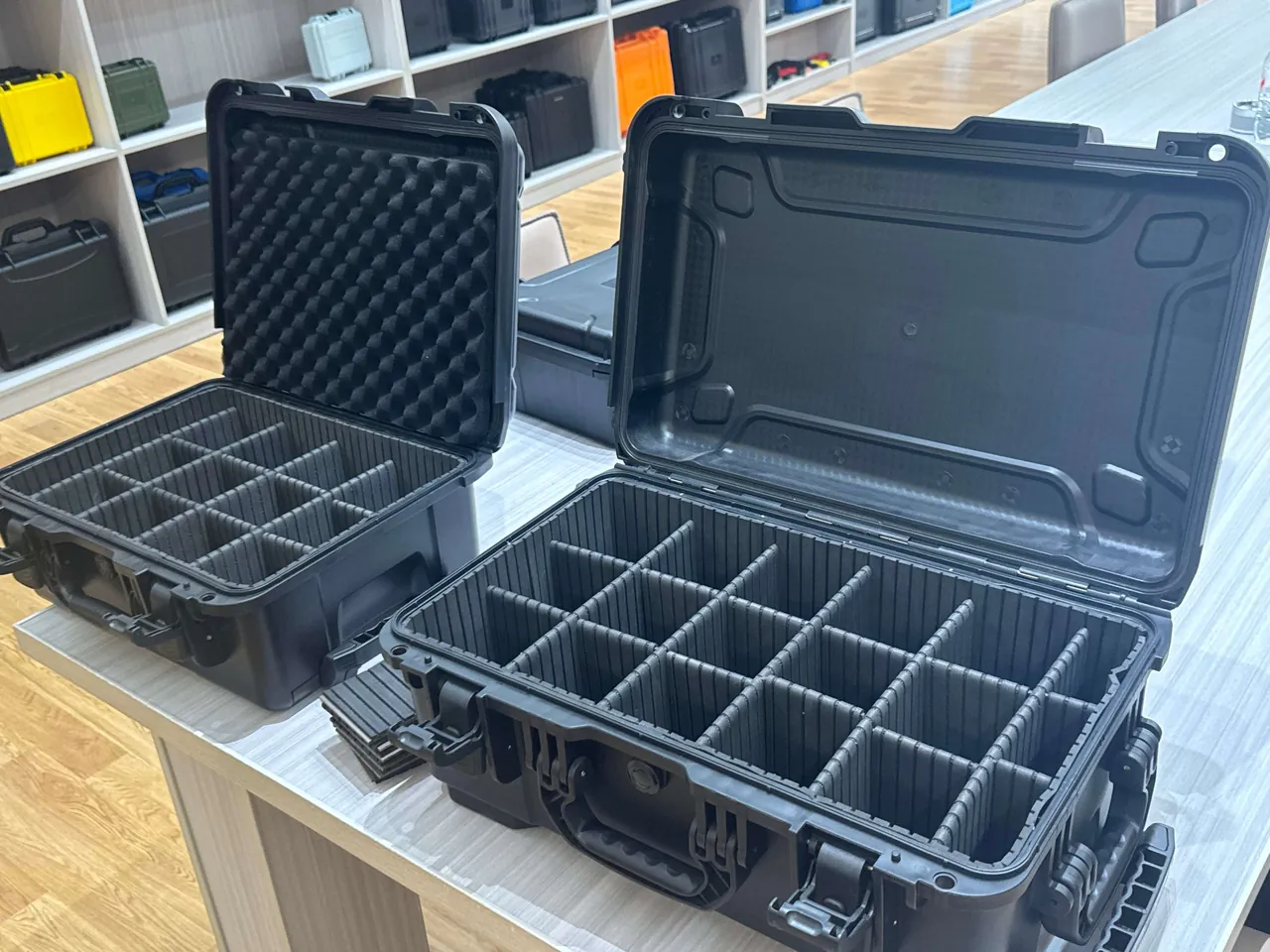
For compression curves, compression set and behavior under temperature-humidity cycling across foam types, case foam material comparison provides a fuller data set that can feed directly into a selection review. Where inserts must be reconfigured frequently, a removable divider system using adjustable dividers allows mixed batches of spares in one case.
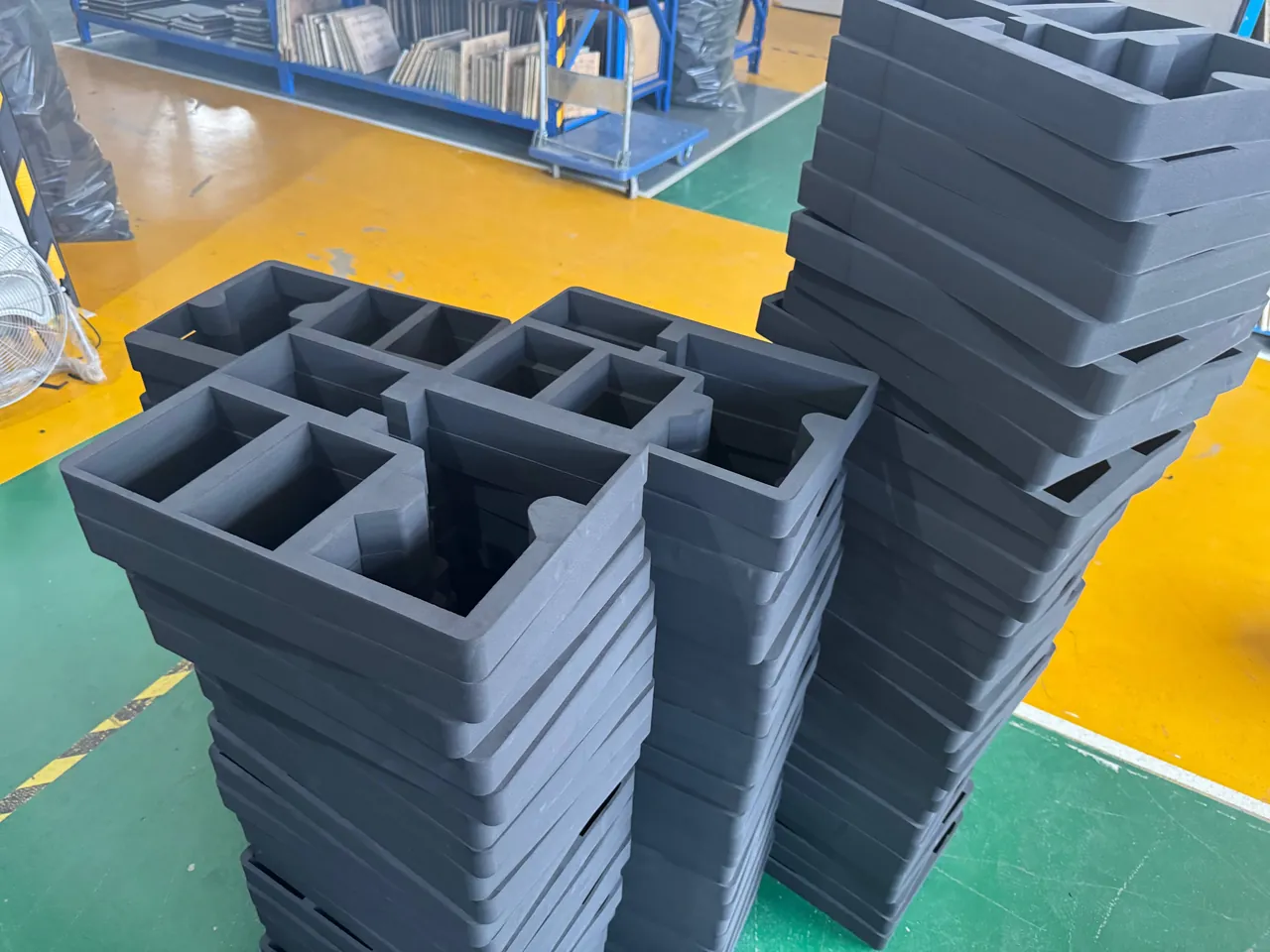
JUNZHJIA custom inserts typically combine CNC-carved EVA with localized molded PU: a high-density EVA outer ring for restraint stiffness, and low-rebound PU in the precision contact zones to absorb high-frequency vibration energy. The combination performs well in measured tests on seal and rotor class parts.
6. Vibration and Shock: Putting ISTA and ASTM D4169 to Work
Transport vibration energy comes mainly from road excitation and handling drops. The two impose different requirements: long, low-amplitude excitation causes fatigue, while short, high-amplitude events test strength. Packaging must handle both.
Three international test families are commonly combined.
- ISTA. The ISTA 1 series is a non-simulation integrity test suitable for pre-shipment pass-fail screening. The ISTA 3 series, general simulation performance tests, adds conditioning, random vibration, drops and shock, and tracks real distribution environments more closely. For spares exported to Europe and North America, buyers frequently specify ISTA 3A as an acceptance criterion.
- ASTM D4169. This standard frames testing around a distribution cycle, letting you select a sequence and assurance level per transport mode. For long-haul air plus road combinations, DC 13 or DC 18 style sequences are commonly used. Sequence selection is covered further in ASTM D4169 distribution cycle testing.
- GB/T 4857. The Chinese family of basic transport package test methods, covering stacking, vibration, impact and drop. It is the most frequently cited basis in domestic tenders. See GB/T 4857 transport packaging for practical notes.
In real verification practice, MIL-STD-810H is often cited as the source of environmental test methods, for example Method 514 for vibration, Method 516 for shock and Method 507 for humidity. It must be stated clearly that citing MIL-STD-810H methods is only a way to standardize test conditions and levels. It does not mean the product holds any military certification, nor that it has passed every test in the standard. Procurement and technical documents should describe the cited methods and levels accurately.
A practical verification package for refinery parts cases:
- Random vibration per ISTA 3 or GB/T 4857.23, watching for insert displacement and any contact between the part and the case wall.
- Drop testing at a height set by total package weight, with corners, edges and faces each dropped once before opening and inspection.
- Stacking and compression based on estimated static load from storage tiers and duration, checking that the case does not collapse and the insert does not lose resilience.
- Temperature and humidity conditioning to simulate container interiors before vibration and drop runs.
- Post-test inspection: seal faces under magnification or optical flat, rotor straightness, journal roundness and rust.
Rule of thumb: for seal-class parts, insert permanent deformation after drop testing should stay within 10 percent of original thickness. For rotor-class parts, the straightness change after testing should stay within half of the drawing tolerance.
7. Moisture and Rust Control: Desiccants, VCI and Sealing Strategy
Rust on refinery spares is a particular problem in humid southern regions and in ocean freight. Humidity control has two fronts: lowering the initial water content inside the case and blocking moisture ingress from outside.
Practical measures:
- Desiccant selection and quantity. Montmorillonite clay, silica gel and molecular sieve are common. Quantity is calculated from free internal volume, transit duration and target humidity. A useful rule is 1 to 2 kg of high-performance desiccant per cubic meter of free volume, doubled for long ocean voyages.
- Humidity indicator cards. Place a card in a visible location inside the case so it can be read immediately on opening and used as acceptance evidence. A common target is below 60 percent relative humidity at opening, and below 50 percent for precision parts.
- Vapor corrosion inhibitor. For carbon and alloy steel parts, use VCI film, VCI paper or VCI emitters to create a protective atmosphere in an enclosed space. Confirm compatibility with copper, zinc and magnesium, which VCI can attack.
- Sealing and pressure equalization. Gaskets provide airtightness, but pressure differentials make the case breathe. For cross-climate shipments or air freight, fit a pressure equalization valve, as described in case pressure equalization valve, to avoid difficult opening or gasket damage.
- Surface preparation before packing. Apply compatible rust preventive grease to journals and seal faces, then wrap in lint-free material. Verify compatibility between the rust preventive and any coating.
One caution: more desiccant is not automatically better. Excessive desiccant drives internal humidity very low, which can dehydrate and shrink certain elastomers, notably natural rubber and some nitrile compounds. Build differentiated plans by material.
8. Cleanliness Control and ISO 4406 Particle Awareness
The service life of mechanical seals and precision hydraulic components is highly sensitive to particulate contamination. ISO 4406 expresses solid particle contamination level using three code numbers for particles larger than 4, 6 and 14 micrometers respectively. Although the standard targets operating fluids, the logic matters in spare parts packaging too: particles, fibers and dust inside a case that reach a seal chamber or bearing cavity amount to pre-installing abrasive debris.
Executable cleanliness measures:
- Choose closed-cell, low-shedding insert foams and avoid aged, crumbling material.
- Clean insert cavities with lint-free cloth and isopropyl alcohol, then let them dry naturally before loading parts.
- Cap all ports, oil ways and seal chambers with dedicated plugs or heat-shrink caps to keep debris out.
- Double-pack precision parts: a PE bag for dust, then the insert for shock, secured with a tie.
- Unpack in a clean area where possible, rather than opening the case on the process unit.
For mixed loads that include static-sensitive items such as compressor vibration probes or seal leakage sensors, ESD shielding case design explains zoning and grounding practice. Sensitive electronics should be in a separate case or at least a separate zone from heavy metal parts.
9. Corrosion and Salt Spray: ISO 9227 and NACE Awareness
Refinery parts often travel to coastal refineries or offshore platforms, and the case itself sits in a high salt spray environment. It helps to treat case corrosion and component corrosion as two separate problems.
- Case level. Metal hardware such as hinges, latches and corner wraps should be stainless steel or coated carbon steel. Evaluate with neutral salt spray testing per ISO 9227, the standard for corrosion tests in artificial atmospheres, salt spray tests. For coastal or offshore use, a practical requirement is 96 to 480 hours of neutral salt spray with no red rust, with the exact duration set by contract.
- Component level. The petrochemical industry applies specific requirements for resistance to environmental and sulfide stress cracking, commonly cited through the NACE MR0175 / ISO 15156 family. A packaging case itself is not subject to NACE material certification. However, if a buyer requires spares to remain in as-built condition in a sour environment, the packaging must not introduce new corrosion risk. That means no sulfur-bearing or chlorine-bearing foams, adhesives or label stock.
- Isolation. Stainless and carbon steel parts must be in separate compartments. Wooden components require attention to fumigation and moisture content, including ISPM 15 requirements for exports, to avoid leachates and moisture affecting parts.
Procurement tip: state in the technical requirement that packaging materials must be free of sulfur, free of chlorine and free of recycled content. This eliminates a whole class of hidden corrosion complaints at the source.
10. Working Near Hazardous Areas: The IEC 60079 Boundary
Refining and petrochemical plants contain explosive gas atmospheres. IEC 60079, the international family for equipment in explosive atmospheres, with its Chinese counterpart GB 3836, is the governing framework. The key point here is this.
A protective case is an outer packaging container, not explosion-proof electrical equipment. Packing pump parts in an IP67 case grants no explosion protection certification whatsoever, and the fact that the parts themselves serve a hazardous area does not imply that the packaging needs such certification. The case's role is to have parts unpacked and handed over at the periphery of the process area, in a warehouse or in a maintenance shop. The case itself does not operate while energized.
In practice, packaging design should still observe the following.
- Avoid static-accumulating plastic inserts in direct contact with metal parts, adding conductive layers or grounding where needed.
- Mark cases and labels with wording such as "not an explosion-proof container; do not open inside a hazardous area," with exact wording per plant HSE rules.
- If handling must occur inside a classified area, follow hot work and static control rules, and never drag metal case parts across the ground.
- For used or returned parts containing residual oil or liquid, drain and clean to hazardous goods requirements before packing, applying ADR and IMDG hazmat transport packaging rules where relevant.
Drawing the boundary clearly and marking it on the case prevents unnecessary back-and-forth between procurement and HSE.
11. Incoming Inspection and Handover: AQL Sampling and Traceability Labels
The value of a packaging concept is proven at acceptance. Three items belong in the purchase contract.
- Arrival condition check. Case intact, no water ingress marks, gaskets complete, humidity card in the correct color range, seal numbers continuous.
- Sampling inspection on opening. Determine the sampling plan per GB/T 2828.1, the standard for sampling procedures for inspection by attributes, against an agreed AQL. See custom case acceptance and AQL for worked examples and typical AQL values.
- Component condition verification. Inspect seal faces, journals, mating surfaces and coatings item by item, and record deviations against factory records.
Suggested inspection checklist:
| Check item | Method | Acceptance basis | Action on failure |
|---|---|---|---|
| --- | --- | --- | --- |
| Case appearance and sealing | Visual plus seal number check | No damage, no water ingress | Isolate the case, inspect contents fully |
| Internal humidity | Humidity indicator card | RH at or below 60 percent (50 percent for precision) | Replace desiccant and recheck |
| Insert integrity | Visual and tactile | No powdering, no collapse, no displacement | Replace the insert |
| Seal faces | Magnifier or optical flat | No chipping, cracks or scoring | Return and trigger an 8D analysis |
| Rotor straightness | Dial indicator | Within drawing tolerance | Return for straightening or claim |
| Journal dimensions and rust | Micrometer plus visual | Dimensions in tolerance, no rust spots | Recheck and assess usability |
| Labels and documents | Cross-check model, batch, certificates | Consistent and traceable | Reissue documentation |
Labels deliver the highest return for the lowest cost. Use weather-resistant plates on every case showing part name and model, equipment tag number, quantity, manufacturing date, packing date, a unique case number and a QR code linking to the electronic record. For a refinery, the value of spares that can be found, matched and traced usually pays for itself within a single turnaround.
12. Custom Insert Workflow and OEM/ODM Delivery
For petrochemical users with recurring, volume supply, packaging belongs inside supplier system management rather than being purchased ad hoc per order. JUNZHJIA, manufactured by Kexin New Materials (Guangdong) Co., Ltd., serves global wholesale, distribution and OEM/ODM customers with one-stop support from case selection and insert customization to documentation. A typical workflow:
- Requirements gathering. The customer supplies part drawings or physical samples, a packing list, transport modes (sea, air, road), destination regulatory requirements, annual volume and batch cadence.
- Concept design. Deliver case specification, material, protection rating, hardware configuration, insert layer drawings and 3D assembly views.
- Prototype confirmation. Build the first case and insert; the customer loads parts to verify handling convenience and restraint.
- Test verification. Run vibration, drop, stacking and temperature-humidity cycling as agreed, with test records issued.
- Production and quality control. Batch sampling with first-article and process records retained.
- Documentation. Material certificates, protection rating statements, test records, packing drawings and label templates.
- Continuous improvement. Adjust inserts and hardware from field feedback under version-controlled drawings.
When evaluating suppliers, use the criteria in how to choose a protective case OEM factory. Three points matter most: capability with non-standard dimensions, verifiable test records, and references in the same industry. For tooling amortization, minimum order quantities and lead time structure, custom case mold cost analysis helps with the economic case.
Users should also manage packaging as an asset with a finite life. Shells and inserts age: gaskets harden, foam powders, latches loosen, hinges deform. Use protective case service life to set up a periodic inspection schedule, with a full assessment typically after 3 to 5 years or more than 200 open-close cycles.
13. Selection Decision Tables and Common Misconceptions
For quick decisions, the common scenarios are mapped below.
| Scenario | Component traits | Recommended case | Recommended insert | Key verification |
|---|---|---|---|---|
| --- | --- | --- | --- | --- |
| Cartridge seals, 15 to 40 kg each | Precision faces, setting clips | Injection molded PP, IP67 | High-density EVA compartments with clip relief | Drop plus random vibration |
| Loose rotary and stationary rings, O-rings | Many small parts, easily scattered | Mid-size molded case, IP65 | Multi-pocket EVA plus individual sealed bags | Vibration plus opening count check |
| Screw or centrifugal compressor rotors | High length-to-diameter ratio, heavy | Panel and aluminum frame long case, IP65 | Multi-point journal saddles plus profile cradles | Stacking, vibration, straightness recheck |
| Impeller and guide vane assemblies | Thin blades, balance sensitive | Panel case, IP65 | Blade-to-blade profile supports plus hub location | Drop plus rebalance check |
| Dry gas seals and instrument parts | Clean and static sensitive | Molded case, IP67 | Zoned layout, ESD layer, desiccant | Humidity and ESD checks |
| Returned parts for repair | Residual oil, contaminated | Washable case, IP65 | Oil-resistant replaceable insert | Seal integrity plus cleanliness |
Common misconceptions:
- Myth one: the harder the case, the better. A rigid case with a poor insert transmits impact straight through. Divide the work: the shell resists compression, the insert absorbs energy.
- Myth two: a packed-tight insert is a stable insert. Interference fits make parts hard to remove and crush precision surfaces. Assembly clearance plus limit features beats brute force.
- Myth three: IP67 solves everything. IP covers dust and water only, not shock, vibration, static or temperature-humidity cycling.
- Myth four: desiccant can just be dropped in. Quantity needs calculation, placement should be distributed, and it must not touch metal parts where it may leak after absorbing moisture.
- Myth five: MIL-STD-810H is a certification. It is a source of test methods, not a certificate. Descriptions must be precise.
- Myth six: one insert design lasts forever. Part models change and batches shift. Insert drawings need version control.
Frequently Asked Questions
Q: Why is IP65 or IP67 emphasized for refinery pump parts cases? Would an ordinary wooden crate do?
A: A wooden crate can work for dry, short-distance shipments with covered storage, but refinery spares normally travel through multimodal freight, open transshipment yards and months of storage, where wood cannot deliver consistent sealing, weathering resistance or compression strength. IP ratings are defined by IEC 60529 and the equivalent Chinese standard GB/T 4208. IP65 means dust tight and resistant to water jets, while IP67 adds protection against temporary immersion, typically one meter for thirty minutes. Choosing IP65 or above addresses three practical problems: moisture damage from rainy seasons and container condensation, high-pressure washdown or standing water during transshipment, and seal reliability after repeated opening and closing. Wooden crates used for export also trigger ISPM 15 fumigation requirements and can release moisture depending on lumber content, which is a genuine risk for stainless journals and lapped seal faces. On a life-cycle basis, a sealable molded case or a panel-and-frame case usually costs less, because it survives many trips rather than one. When you write the requirement, specify the rating, the gasket material and the expected latch open-close cycles together, and require the supplier to state all three in the delivery documentation so the choice can be verified at goods-in rather than assumed.
Q: What is the most common mistake when packing mechanical seals?
A: The single most common error is placing two seal faces directly opposite each other with no separator between them. Rotary and stationary faces are precision-lapped mating surfaces, and even a small point impact in transit can chip an edge or cause scoring, which shows up as continuous leakage shortly after commissioning. The correct approach is to give each seal its own compartment, keep face orientation consistent but place a rigid divider between adjacent seals, and machine bore depth to 60 to 70 percent of seal height so the seal body is surrounded and restrained by foam rather than free to move. Cartridge seals must retain clearance for their setting clips, and you should never remove the clips to save room and ship the seal loose, because the factory axial setting is the final setting and there is no field adjustment margin. Also avoid mixing seals in the same compartment as metal tools, bolts or shaft sleeves, and never use aged, crumbling foam as cushioning, since powder from degraded foam migrates into seal chambers and acts as an abrasive. Finally, confirm that the insert allows one-hand removal so field teams do not pry seals out with a screwdriver.
Q: How do I stop rotor-class parts from bending in transit?
A: Control the supports and the span. Use three to five support points, with both journals as mandatory supports and intermediate points added according to the length-to-diameter ratio. Support spacing should generally not exceed 15 to 20 times the shaft diameter so there is no long unsupported span, and supports should sit at rigid nodes such as baffle or impeller locations where possible. EVA in the 60 to 90 kg/m3 density range gives enough restraint stiffness without crushing journals; too hard damages the surface, too soft collapses under vibration and loses restraint. Add a lint-free separator at every contact surface and avoid bearing seats, seal seats and threads entirely. Ship horizontally rather than cantilevered vertically for extended periods. After transport, recheck straightness and runout against factory records, and measure the same reference points before packing so the comparison is meaningful rather than anecdotal. As a rule of thumb, straightness change after drop testing should stay within half the drawing tolerance; anything beyond that warrants a factory assessment rather than field straightening. For very long rotors, use a dedicated cradle with steel supports and EVA pads so the load path runs through the structure instead of the shaft.
Q: What does adequate moisture protection look like for ocean freight to a coastal refinery?
A: Build four layers. First, surface treatment: apply compatible rust preventive grease to journals and seal faces and wrap them in lint-free material. Second, vapor phase protection: use VCI film or emitters for carbon and alloy steel, after confirming compatibility with copper, zinc and magnesium, which VCI can attack. Third, moisture absorption: dose desiccant by internal free volume, commonly one to two kilograms per cubic meter, doubled for long ocean voyages, and fit a humidity indicator card for immediate reading on opening. Place desiccant so it cannot touch metal parts, where it may leak after absorbing moisture. Fourth, sealing and pressure management: gaskets provide airtightness while a pressure equalization valve handles cross-climate and air freight differentials, preventing hard opening or gasket damage. For acceptance, aim for relative humidity below 60 percent at opening and below 50 percent for precision components. Remember that over-dosing desiccant can dehydrate and shrink certain elastomers, notably natural rubber and some nitrile compounds, so build the plan by material rather than applying one number everywhere. Record the desiccant quantity and the humidity card reading on the packing sheet so the next shipment can be tuned against real results.
Q: Does a packaging case need explosion-proof certification?
A: No, and it should not be requested. A protective case is an outer packaging container, not electrical equipment for explosive atmospheres, so the certification framework of IEC 60079 and its Chinese counterpart GB 3836 does not apply. Putting pump parts in an IP67 case creates no explosion protection certification, and the fact that the parts serve a hazardous area does not imply that the packaging needs one. The correct approach is to define the boundary clearly: parts are unpacked and handed over at the periphery of the process area, in a warehouse or in a maintenance shop, and the case carries a marking such as not an explosion-proof container, do not open inside a hazardous area, with exact wording following plant HSE convention. If handling inside a classified area is unavoidable, follow site hot work and static control requirements, and never drag metal case parts across the ground where they can generate sparks. Where packaging involves used parts with residual oil or liquid, hazardous goods packaging rules apply instead. Writing the boundary into the purchase specification prevents procurement and HSE from reopening the same question on every order.
Q: How do I choose insert material, and how do EVA and PU foam differ?
A: EVA is a closed-cell foam that can be CNC carved, available across a wide density range, commonly 60 to 120 kg/m3. It offers tunable stiffness, good weathering and low shedding, making it the first choice for locating compartments and load-bearing restraint in seal and valve inserts. PU foam is usually molded in one piece and its rebound behavior absorbs high-frequency vibration energy well, so it suits wrapping irregular parts and precision contact zones, but durability is moderate and it can collapse after prolonged compression. The common engineering combination is a high-density EVA outer ring for restraint with low-rebound PU in precision contact zones for energy absorption, which balances the two requirements instead of trading one against the other. PE foam is low density and low cost, suitable for bedding and filling large parts rather than load-bearing location. XPE crosslinked foam is thermoformable and suits thin panels. When specifying, confirm that materials are free of sulfur, free of chlorine and free of recycled content, and check compatibility with component coatings and elastomers before approving the sample.
Q: Which standards should packaging verification cite, and how should I explain them to a customer?
A: Organize along three lines: transport performance, environment and materials. For transport performance, ISTA series tests such as the ISTA 3A general simulation performance test and ASTM D4169 distribution cycle sequences are common, while GB/T 4857 is frequently cited in domestic tenders. For environmental conditions, cite MIL-STD-810H method numbers and levels such as vibration, shock and humidity, while stating clearly that these are only method sources and do not represent military certification or a full pass. For materials, cite UL94 for case flammability, ISO 9227 neutral salt spray for metal hardware corrosion resistance, and IEC 60529 with GB/T 4208 for ingress protection. Write these citations into the technical requirement and require suppliers to provide test records and material certificates so acceptance has a documented basis. Beyond citing standards, turn them into named acceptance actions such as insert displacement inspection and seal face re-check on opening, so the references become checkable steps rather than compliance language in a folder. Finally, keep the exact method numbers and levels in the packing documents so a third party can reproduce the test conditions.
Q: Do spare parts cases need traceability labels, and what is practical?
A: Very much so. Refineries hold a wide range of spares, and differences between batches of the same model are easy to miss, which is exactly how a wrong part reaches a maintenance crew during a turnaround. Give each case a weather-resistant plate carrying at minimum the part name and model, the equipment tag number, quantity, manufacturing date, packing date, a unique case number and a QR code pointing to the electronic record. Mount it where it will not wear, away from gaskets and the opening seam. Place a packing list in a moisture barrier bag inside the case along with copies of quality certificates, and keep the case number visible outside so records can be cross-checked without opening. Combined with AQL sampling, you can bind inspection records to case numbers and build a complete chain from part to case to batch to inspection record. The investment is small, the labels survive years of handling, and the efficiency gain during a turnaround is significant because searching stops and verification begins.
Q: Can one insert serve multiple part models, and does that hurt protection?
A: Yes, with care. For small parts of similar shape and weight class, such as O-rings, gaskets and seal rings in different sizes, a multi-pocket insert with numbered pockets is efficient and does not reduce protection, and it simplifies counting on arrival and issue. For parts with large weight differences or different sensitive surfaces, mixed loading creates two risks: heavy parts squeezing light ones under vibration, and galvanic corrosion or scratching between dissimilar materials in contact. In those cases use a removable divider system with adjustable dividers and numbered inventory control, so the layout can be rebuilt without remaking the whole insert. Another option is a master case plus custom trays, where trays are model-specific and the case is common, preserving flexibility while keeping location accuracy for precision faces. Either way, run a loaded vibration and drop verification to confirm that nothing shifts or contacts anything it should not, because a layout that looks correct on the bench often behaves differently once mass and vibration are applied.
Conclusion & Related Reading
The essence of a refinery pump and compressor parts case is translating three component traits, namely precision, high length-to-diameter ratio and surface sensitivity, into an executable language of structure and inserts. IP65 or IP67 sealing handles water and dust, compartment location and journal saddles handle vibration and shock, desiccants with VCI and cleanliness control handle rust and particulate contamination, and labels with an inspection regime handle traceability. Do all four and the high-frequency losses of chipped seal faces, bent rotors and corroded journals fall systematically.
Write the protection rating, insert type, test basis and acceptance method into your technical requirement, and require suppliers to provide material certificates and test records. JUNZHJIA, manufactured by Kexin New Materials (Guangdong) Co., Ltd., supports non-standard case design, custom inserts and OEM/ODM volume delivery, and supplies inspection and packing documentation per project so petrochemical users can fold packaging into the spare parts quality system rather than leaving it as evidence in a post-incident dispute.
Related Reading