

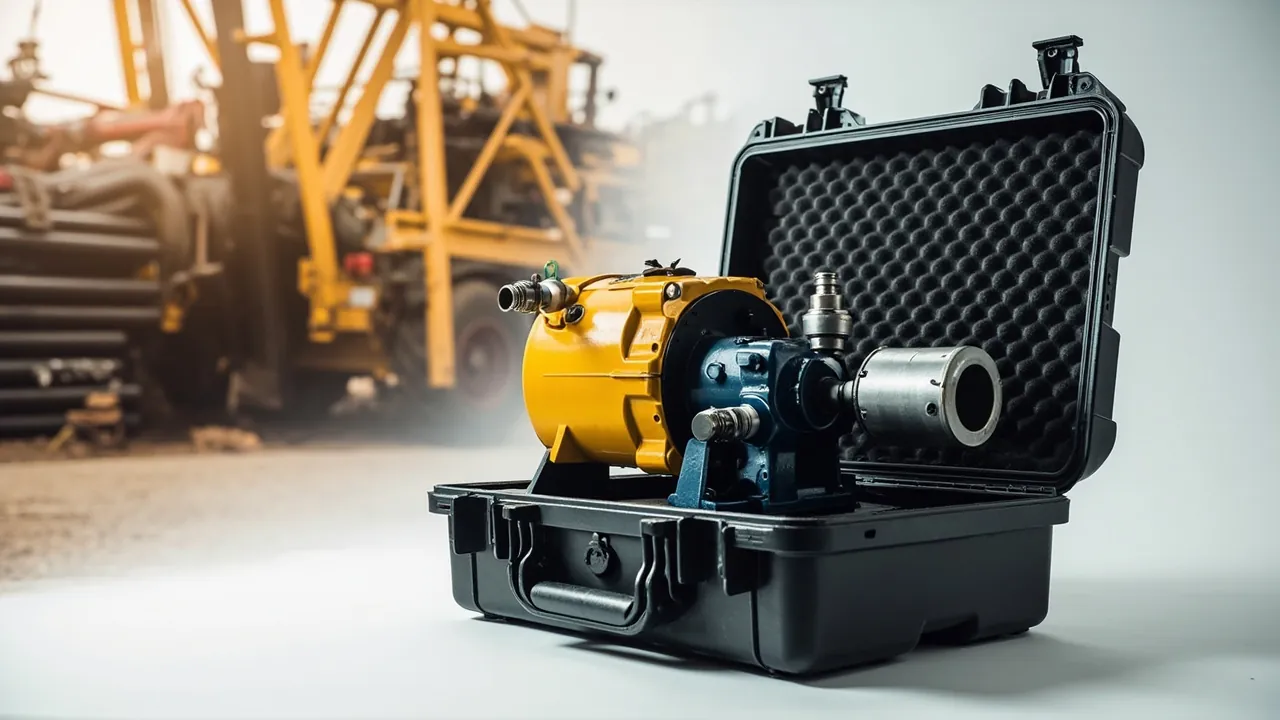
The acceptance criterion for a drilling rig and drilling tool parts case can be compressed into one field phrase: after arrival, the joint must still make up, the seal must still seal, and the pump must still pump. That means transport protection must hold three things at once: threads and shoulder faces undamaged, rubber and sealing components undistorted, and hydraulic and lubrication components uncontaminated. Failures in oilfield drilling tools are strongly sequential. Once a drill pipe tool joint thread has a burr from an impact, making up the connection can cause galling, and a single galling event can scrap an entire drill pipe. Once a shoulder face has an indentation, the connection no longer seals properly after make-up, and high-pressure mud cuts through the joint and rapidly erodes the shoulder. Once a bit nozzle is blocked or a cutting element has spalled, rate of penetration falls immediately and the bottom-hole assembly may fail, at the cost of a trip and additional drilling time.
Drilling operations impose packaging requirements that differ completely from those of ordinary industrial spares, for four reasons. First, handling is extremely rough. Moving drilling tools around a rig site relies on cranes, catwalks, air winches and rig floor handling machines, with limited space and heavy time pressure, so the packaging must be fault tolerant. Second, offshore and desert conditions stack extreme environments. Offshore platform salt spray, desert heat and dust, and condensation caused by day-night temperature swings all accelerate corrosion and elastomer ageing. Third, spares are high in value and long in lead time. Drill pipe, drill collars, bits and mud pump fluid-end components are long-lead, high-value items, and a damaged delivery often cannot be replaced within the operating window. Fourth, compliance requirements are strict. Thread protection and inspection practice for drilling tools, the technical requirements for drill string elements, and the packaging itself are all governed by the petroleum industry standards framework.
This article is written for drilling rig manufacturers and suppliers, drilling contractors and rig materials management teams, drilling tool rental and inspection service providers, and oilfield materials trading and export companies. It covers drill pipe and tool joints, drill collars and heavy-weight drill pipe, stabilisers, bits including roller cone and PDC types and coring tools, mud pump fluid-end components, top drive and rotary table components, wellhead and blowout preventer components, and hydraulic and lubrication elements. It covers failure modes, thread and shoulder protection methods, cradle and anti-bending design for long heavy items, cleanliness control, standards references, comparison tables, a packing standard operating procedure and goods-in acceptance criteria. All figures are industry-typical or empirical; drawings, technical conditions, the relevant API and ISO standards and destination regulations always take precedence. JUNZHJIA provides dedicated cradles and form-fitted inserts for long and heavy items, thread protector selection support, sealed dust-control and humidity-control configurations, and OEM/ODM supply with inspection documentation for drilling rig and tool applications.
Table of Contents
- 1. Why drilling tools and rig spares need a dedicated case: from shippable to make-up ready
- 2. Category map and failure-mode comparison
- 3. Drill pipe and tool joints: API thread protection and shoulder face protection
- 4. Drill collars, heavy-weight drill pipe and stabilisers: heavy load plus threads
- 5. Bits and coring tools: bearings, cutting elements and nozzles
- 6. Mud pump components: liners, pistons, valve assemblies and fluid ends
- 7. Top drive and rotary table components: combined hydraulic and electrical items
- 8. Wellhead and blowout preventer components: seals and hydraulic controls
- 9. Hydraulic and lubrication systems: ISO 4406 cleanliness and port capping
- 10. Long and heavy cylindrical items: cradle, anti-bending and anti-roll design
- 11. Sealing, dust exclusion and salt spray protection: IEC 60529, GB/T 4208 and IP6X
- 12. Transport test references: ISTA, GB/T 4857, ASTM D4169 and MIL-STD-810H
- 13. Packing standard operating procedure and goods-in verification
- 14. Procurement evaluation and the OEM/ODM customisation path
- Frequently Asked Questions
- Conclusion & Related Reading
1. Why drilling tools and rig spares need a dedicated case: from shippable to make-up ready
In oilfield materials management, the practice of strapping drilling tools with wire rope, adding timber dunnage and hauling them away is still common. For short distances and low-value tubulars this can just about be tolerated. Applied to drill pipe, drill collars, bits and mud pump components, the cost surfaces on the rig floor.
The first reason is that a thread is a high-precision, low-tolerance connection. Drill pipe tool joint threads are tapered or proprietary forms whose sealing and load-carrying capability depends on the thread form and on metal-to-metal sealing at the shoulder face. Any burr, rolled edge or shoulder indentation changes the contact stress distribution during make-up. At best, make-up torque is abnormal; at worst, galling occurs and the thread pair is destroyed in a single event. Under the relevant API documents, including API RP 7G on drill stem design and operating limits, API Spec 7-1 on rotary drill stem elements and API Spec 5DP on drill pipe, together with ISO 10407 for rotary drill stem elements, drilling tool threads must be fitted with thread protectors and kept protected during handling, transport and storage. This is a basic industry practice rather than an optional refinement.
The second reason is that failures propagate and are expensive. A drilling tool is not an isolated item. A leaking tool joint on one drill pipe can change the load distribution across the whole string. A blocked bit nozzle directly reduces rate of penetration. An out-of-tolerance stabiliser makes directional control difficult. The common feature of these problems is that they are invisible on the surface and only appear downhole, and the cost of dealing with them downhole is a trip, measured in hours or days.
The third reason is that heavy, long items must maintain their geometry. Drill pipe, drill collars and heavy-weight drill pipe are slender heavy components, and bending and flexure in transit cause permanent deformation, while straightness is the basis of drill string loading. A packaging and transport scheme must answer three specific questions: where the support points are, how far apart they are, and how the item is prevented from rolling.
The fourth reason is that the environment combines corrosion and ageing. Offshore platform salt spray, desert dust and heat, and condensation caused by day-night temperature swings act on metal and rubber components at the same time. For metal parts the risk is corrosion and thread seizure; for rubber parts it is ageing and permanent set, and neither can be fully identified by visual inspection.
A field observation worth repeating: in drilling tool goods-in disputes, the most expensive case is "passed inspection, failed to make up". The objective of a transport scheme should therefore be zero thread and shoulder damage, zero seal deformation and zero hydraulic contamination, and the acceptance criteria should move from visual appearance to thread gauging, shoulder inspection and functional verification.
Once these four points are understood, it becomes clear why drilling tool packaging needs thread protectors, dedicated cradles and rigorous humidity control. The underlying principles are covered in shock-absorbing case design logic and cushion liner and case base plate coordination.
2. Category map and failure-mode comparison
Drilling rig and tool spares range from rotary table components weighing tens of tonnes to seals weighing a few grams. The table below maps typical weight class, primary weak points, dominant failure modes and preferred protection measures by category.
| Category | Typical weight class | Primary weak points | Dominant failure mode | Preferred protection |
|---|---|---|---|---|
| --- | --- | --- | --- | --- |
| Drill pipe and tool joints | Heavy (several hundred kg per joint) | Joint threads, shoulder faces, pipe body | Thread burrs, shoulder indentation, pipe body bending | Thread protectors plus dedicated cradle plus multi-point support plus anti-roll |
| Drill collars and heavy-weight drill pipe | Very heavy (up to several tonnes per joint) | Threads, shoulder faces, elevator recess | Thread damage, elevator recess damage, bending | Heavy cradle plus protectors plus lifting markings |
| Stabilisers and centralisers | Heavy | Spiral blades, threads, outside diameter | Blade damage, diameter out of tolerance | Dedicated cradle plus blade protection plus numbering |
| Roller cone bits | Medium to heavy | Cones, teeth, bearings, nozzles | Tooth breakage, bearing contamination, nozzle blockage | Individual compartments plus sleeves plus nozzle caps |
| PDC bits | Medium | Cutting elements, blades, nozzles, shank | Cutting element spalling, blade damage | Form-fitted insert plus element cover plus nozzle caps |
| Coring tools and core barrels | Heavy | Inner tube, core catcher, threads, seals | Inner tube distortion, seal damage | Dedicated cradle plus inner tube support plus thread protectors |
| Mud pump liners and pistons | Medium | Liner bore, piston rubber, rod | Bore scoring, rubber distortion | Individual compartments plus bore sleeve plus dark, cool storage |
| Mud pump valve assemblies and seats | Medium | Valve face, seat taper, spring | Valve face damage, taper damage | Individual compartments plus face covers plus numbering |
| Mud pump fluid ends and valve bodies | Very heavy | Sealing faces, bores, stud holes | Sealing-face damage, hole-edge burrs | Heavy base plus sealing-face plates plus port caps |
| Top drive components, hydraulic and electrical | Heavy | Valve groups, motors, connectors | Valve sticking, connector damage, moisture ingress | Overall cover plus port capping plus humidity control plus ESD |
| Rotary table and bushings | Very heavy | Gears, bearing seats, bushing bore | Tooth indentation, bore distortion | Heavy base plus tooth-flank plates plus anti-roll |
| Wellhead and BOP seals | Light to medium | Rubber lips, metal seal rings | Lip damage, permanent set, ageing | Flat storage plus individual packaging plus dark, cool storage plus shelf-life control |
| Hydraulic control elements and piping | Light to medium | Spool and seat, port threads | Sticking, internal leakage, thread damage | Port capping plus individual compartments plus clean packaging |
| Mud pump valves and manifold fittings | Medium | Bores, sealing faces, flanges | Bore scoring, flange damage | Port capping plus flange covers plus anti-roll |
| Special and fishing tools | Medium | Threads, slip dies, sealing faces | Thread damage, slip die breakage | Dedicated cradle plus thread protectors plus compartments |
Two rules can be drawn from the table. The first is that threaded items must have their threads protected while heavy items must have their geometry controlled. The threads and shoulder faces of drill pipe, drill collars, stabilisers and fishing tools belong to the "one impact and it is scrap" category and must be physically isolated by thread protectors, whereas heavy items such as drill collars, fluid ends and rotary tables depend on structural cradles to control bending and distortion. The second is that rubber items are managed through shelf life while hydraulic items are managed through cleanliness. Seals and piston rubbers are at risk from ageing and permanent set, requiring dark, cool storage and shelf-life control, while hydraulic and lubrication elements are at risk from particle contamination, requiring port capping and clean packaging.
A note on terminology. In practice the terms drilling rig parts case, drilling tool transport case, drill pipe joint case, mud pump parts case and drilling equipment case are used interchangeably, and enquiries often say only "parts case". The structures required differ substantially. A drill pipe joint case for drill pipe and drill collars must be built around thread protectors, long-item cradles and anti-bending support. A mud pump parts case for liners, pistons and valve assemblies must be built around individual compartments, bore protection and dark, cool storage. A drilling equipment case for top drive and wellhead hydraulic components must be built around port capping, humidity control and ESD protection. If only the generic term "parts case" is provided, the supplier can only quote a generic solution, and the result is normally under-protected threaded items and over-designed small parts. Specify category, weight, thread form and cleanliness class by part-number family in the enquiry and technical agreement.
3. Drill pipe and tool joints: API thread protection and shoulder face protection
Drill pipe is the most numerous and most frequently rotated drilling tool, and the core of its packaging protection is a single word: threads.
Why threads are so fragile. A drill pipe tool joint thread carries alternating tensile, torsional and bending loads in service, and its sealing capability comes from metal-to-metal contact at the shoulder face. This means the shoulder face must be flat and smooth, and any indentation, score or burr produces uneven contact stress and a poor seal. More seriously, surface damage significantly raises the friction coefficient during make-up and can initiate galling, in which two metal surfaces cold-weld locally under pressure and then tear apart. A single galling event is enough to render the thread pair unserviceable. The industry manages the technical requirements and operating limits of drilling tools under the relevant API documents, including API RP 7G, API Spec 7-1 and API Spec 5DP, together with ISO 10407 for rotary drill stem elements, and the practice of using thread protectors during handling, transport and storage is a foundation of the whole-life management of drilling tools.
Correct use of thread protectors. Thread protectors divide into steel protectors, used for transport and long-term storage where protection strength matters, and plastic protectors, used for short moves and site handling. Four packing requirements follow. First, both pin and box ends must be fitted with protectors; protecting only one end is never acceptable. Second, the protector must match the thread form, and protectors of different sizes or thread forms must not be mixed. Third, protectors must never be used as lifting or support points, since this transmits impact directly into the thread. Fourth, the protector itself must be kept clean, because a contaminated protector carries particles into the thread. One further point deserves emphasis: a protector prevents impact damage, it does not prevent corrosion. For sea freight and long-term storage, the specified thread compound should also be applied and moisture-barrier packaging used.
Shoulder face protection. The shoulder face is the sealing surface and its protection is often overlooked. Packing requirements: the shoulder face must not contact other hard objects; it must not be used as a support face; and when items are stacked, the shoulder faces of upper and lower layers must not carry load directly. For premium connections such as double-shoulder tool joints, which have more sealing surfaces and less tolerance, protection requirements should be raised accordingly.
Pipe body protection. The pipe body, and especially the upset transition zone, is a stress concentration area, and surface damage reduces fatigue life. Packing requirements: avoid lifting the pipe body directly with wire rope; avoid direct contact and rubbing between pipe bodies; and fit sleeves or compliant padding to the body where necessary.
Choosing the packing format. Drill pipe is a slender heavy item, and three packing formats are common: single-joint palletised formats with an individual cradle per joint, suited to premium pipe and long sea voyages; bundled rack formats in which multiple joints are constrained in a rigid frame, suited to batch shipment of standard pipe; and container-mounted support frames providing multi-point support and anti-roll restraint inside the container. The choice depends on pipe grade, individual joint weight, transport distance and unloading conditions.

4. Drill collars, heavy-weight drill pipe and stabilisers: heavy load plus threads
Drill collars and heavy-weight drill pipe are the heaviest components in the drill string, with individual joints reaching several tonnes, so their protection involves two difficulties at once: heavy-load structure and thread precision.
Why drill collars are hard to pack. A drill collar is a thick-walled cylinder with a high weight per unit length, and any misjudgement of lifting or support points produces local indentation and bending. At the same time, both ends carry precision threads and shoulder faces, and the elevator recess is also a load-bearing feature. Packing requirements: use a heavy cradle matched to the diameter, with the number of support points determined by length and stiffness; fit steel protectors to both threaded ends; fit sleeves or protective strips to the elevator recess; apply wedge-shaped anti-roll restraint to the whole item; and verify the load capacity of the case floor.
What makes heavy-weight drill pipe different. Heavy-weight drill pipe has a thickened section or stabilising pad at mid-body, and its shape is irregular. Support points must land on the thickened section or near the joints, never on the thin-walled pipe body, or local crushing results. These items usually require a dedicated cradle formed to the actual profile.
Stabilisers and centralisers. The spiral blades of a stabiliser are functional features, and blade damage or an out-of-tolerance outside diameter directly affects directional control. Packing requirements: dedicated cradle support, protective strips on the blades, no load on the diameter, thread protectors fitted, and numbering by size. Because stabilisers have a large outside diameter, case dimensions must be determined by the largest diameter and the lifting requirement.
Lifting and site transfer. Drill collars and stabilisers are moved on site by crane and air winch, so lifting points must be clearly marked and lifting loads must never be applied through the thread protectors. The case should carry centre-of-gravity, permissible tilt and lifting point markings. On offshore platforms, crane capacity and deck space constraints must also be considered, and package dimensions should be checked against platform conditions.
A note on straightness. The straightness of drill collars and heavy-weight drill pipe is a service requirement. Bending in transit may not show immediately, but it concentrates bending stress during downhole rotation and causes early thread fatigue. Multi-point support and anti-bending design are therefore mandatory rather than optional.
5. Bits and coring tools: bearings, cutting elements and nozzles
The bit is the most critical consumable in drilling, and how it is packaged directly affects rate of penetration and footage per bit.
Roller cone bits. A roller cone bit consists of three cones, teeth or inserts, a bearing system and nozzles. Its two fatal weak points are the cone bearings and the nozzles. Once dust enters a bearing, the grease is contaminated and life falls sharply. Once a nozzle is blocked or deformed by impact, hydraulic parameters depart from design, directly affecting bottom-hole cleaning and rate of penetration. Packing requirements: individual compartments, inserts formed to the actual profile, caps on nozzles, protectors on the shank thread, and never using the cones or teeth as support points.
PDC bits. The cutting elements of a PDC bit are polycrystalline diamond compacts, which are extremely hard and wear resistant but brittle. A single impact can cause spalling or delamination, and spalling significantly reduces rock-breaking efficiency. Packing requirements: a form-fitted insert that fully constrains the blades, a cover or compliant padding over the cutting elements, caps on the nozzles, and protectors on the shank thread. Because PDC bits vary greatly in blade count and crown profile, a form-fitted insert is usually more reliable than generic compartments, and the form-taking methods are described in EVA foam insert custom process and the custom foam insert design guide.
Coring tools and core barrels. A coring tool contains an inner tube, outer tube, core catcher and seals. The inner tube is a thin-walled long component that distorts very easily under local compression, and its straightness and surface quality directly affect core recovery. Packing requirements: dedicated cradle support, a support ring or end support inside the inner tube, thread protectors fitted, and seals packed separately.
Bit accessories and nozzles. Nozzles, core catchers and seals are small parts with a high risk of being mixed up. Use compartmented trays and number each item, and in particular distinguish nozzles of different orifice sizes clearly in the labelling, because installing the wrong nozzle changes the hydraulic parameters directly.
6. Mud pump components: liners, pistons, valve assemblies and fluid ends
The mud pump is the heart of the drilling fluid circulation system, and its components wear quickly and are replaced frequently, making them one of the largest inventory categories on a rig.
Liners and pistons. The liner bore is a precision machined surface and the piston rubber is an elastomer, forming a friction pair. Once the liner bore is scored it accelerates rubber wear and causes pressure fluctuation; once the piston rubber is distorted or aged it seals poorly and flow falls. Packing requirements: liner in its own compartment, a sleeve or cover over the bore, no contact with other hard items; piston rubbers stored away from light and heat, retaining their natural shape, without sustained compression, and under shelf-life control.
Valve assemblies and seats. The valve face and seat taper of a mud pump valve form a sealing pair, and impact damage causes poor sealing and washout, which then erodes rapidly under high pressure. Packing requirements: individual compartments, covers over valve faces, guard rings on tapers, numbering by size, and careful control of the pairing between valve body and seat so that matched sets are not broken up.
Fluid ends and valve bodies. A fluid end is a very heavy item whose sealing faces, bores and stud holes are mating features. Packing requirements: a heavy base to carry the load, protection plates over sealing faces, caps over bores, and anti-roll restraint for the whole item. Because fluid ends usually retain drilling fluid internally, they must be cleaned and drained before packing, otherwise residual liquid leaks in transit and corrodes both the packaging and adjacent parts.
Piston rods and extension rods. These are slender items whose main risks are bending and scoring. Packing requirements: multi-point support, protective sleeves over the surface, and caps over threads and connection ends.
A note on the risk of residual drilling fluid. It deserves particular emphasis that packing with liquid still inside is one of the most common and most damaging errors in mud pump component packaging. Drilling fluid contains solids and chemical additives, and residual liquid leaks in transit, sets hard and corrodes metal parts while contaminating other components in the same case. The technical documentation should therefore specify drain, clean and dry requirements as a pre-packing step, and include them in the goods-in verification checklist.
7. Top drive and rotary table components: combined hydraulic and electrical items
The top drive and rotary table are the core rotation and hoisting components of a rig, and their spares often contain hydraulic, electrical and mechanical elements together, giving them the most composite protection requirements.
Top drive hydraulic components. A top drive contains numerous hydraulic valve groups, motors, cylinders and piping. The protection logic matches that for construction machinery hydraulics: port capping, shaft-end sleeves, no load on the housing, and clean packaging. Top drive hydraulic systems operate at high pressure and are contamination-sensitive, so every port must be capped, tube and hose ends must be capped, and minimum bend radii must be respected.
Top drive electrical and electronic components. Motors, variable frequency drives, sensors and connectors are high-value electronic items. Their main failure modes are moisture ingress, ESD damage and connector deformation. Packing requirements: ESD packaging, individual compartments, protective caps on connectors, humidity control, and no compression. Related design approaches are covered in ESD shielding case design.
Rotary table and bushings. The rotary table is a very heavy item whose gears, bearing seats and bushing bore are mating features. Packing requirements: a heavy base to carry the load, tooth-flank protection plates, sleeves on bearing seats, anti-roll restraint for the whole item, and clearly marked lifting points. Bushings are replaceable items whose external mating faces and bores also need protection.
A packaging strategy for composite items. The common problem with top drive spares is mixing hydraulic and electrical items in one case. Use a "separate case plus zoning" strategy: pack hydraulic and electrical items in different cases, or physically separate them within one case using a rigid divider. Electronic items should be in ESD packaging and kept away from metal parts so that metal movement cannot damage connectors.
8. Wellhead and blowout preventer components: seals and hydraulic controls
Wellhead and blowout preventer components are safety-critical, and their packaging protection centres on sealing faces, rubber seals and hydraulic control elements.
Rubber seals. BOP packers, seals and metal seal rings belong to the classic category that must be protected from compression, light, heat and time. Rubber items fail through ageing and permanent set, and once distorted their sealing capability after assembly cannot be guaranteed. Packing requirements: flat storage or storage in the designed attitude, no sharp-edge compression, protection from light and heat, individual packaging, and strict shelf-life control including production date verification and first-in-first-out. Large packers should be held in shape by a matching support fixture.
Metal seal rings and sealing faces. The mating surfaces of metal seal rings are extremely precise, and a single impact can cause a sealing failure. Packing requirements: individual compartments, covers or guard rings over sealing faces, no stacking, and numbering by size.
Hydraulic control elements. Valves, accumulators and piping in BOP control systems are hydraulic items with the same requirements as construction machinery hydraulics: port capping, shaft sleeves, individual compartments, clean packaging and humidity control. Accumulators are pressure vessels, and their transport must also comply with the applicable pressure vessel and dangerous goods regulations; specific requirements should follow the carrier and the regulations of the project location.
Wellhead and christmas tree components. Wellhead components often include flanges, studs, seal rings and valves. Scoring of flange sealing faces, such as the seal grooves of API flanges, is the most common goods-in defect on site, so covers should be fitted. Studs are high-strength items whose threads need protection and whose sizes must be kept in separate compartments, since using the wrong grade is a serious error.
9. Hydraulic and lubrication systems: ISO 4406 cleanliness and port capping
Hydraulic systems on drilling equipment, including top drives, iron roughnecks, power catwalks and BOP control systems, operate at high pressure, high flow and in a heavily contaminated environment, so the core protection metric for their spares is different from that for mechanical parts: cleanliness.
Why cleanliness is a hard metric. ISO 4406 uses three codes corresponding to concentrations of particles larger than 4, 6 and 14 micrometres. Drilling equipment hydraulic systems normally specify a relatively strict working-fluid cleanliness requirement, with the exact class defined by the manufacturer's technical conditions. The critical point is that once contamination enters the system it cannot be filtered clean. A filter only intercepts particles that pass through it, while particles trapped in clearances and adhering to housing walls are released continuously, so the only remedy is repeated flushing or an oil change. Controlling particle ingress at the packaging stage is therefore the lowest-cost contamination control point available.
Implementing the three-layer dust exclusion system. Layer one is component-level capping: plug every oil port, air port and connection, cap every tube end and protect every thread. Layer two is component-level packaging: use rust-preventive film, vapour-phase inhibitor film or foil bags as inner packaging to create a local clean environment, with insert materials selected for low shedding. Layer three is case-level sealing: configure the case gasket system to IEC 60529 and GB/T 4208, aiming for IP6X dust tight and IP67 for open storage and offshore applications, together with a pressure equalisation valve to balance the differential caused by temperature swings.
Lubricants and greases. A rig has many lubrication points, and greases and speciality lubricating oils are high-frequency consumables. Their packaging requirements centre on sealing, leak prevention, protection from light and heat, and shelf life. Shelf-life control matters especially, because grease develops oil separation and hardening in long storage. If contaminated or degraded grease is used to top up a system, the cleanliness control applied during packaging and assembly is weakened.
Clean unpacking requirements. Even an IP6X case loses internal cleanliness if opened in a dusty rig site environment. The technical documentation should specify an unpacking environment requirement and state that any part not immediately installed must be returned to the case or covered with a clean drape.
10. Long and heavy cylindrical items: cradle, anti-bending and anti-roll design
Drilling tools and rig spares include many slender heavy items and heavy cylindrical items, and how these are supported determines whether the whole packaging scheme works.
Three principles of support point design. First, support point positions should be determined by bending stress calculation. For a long item, too few support points cause mid-span flexure, while poor positioning causes local stress concentration. In practice, support points are distributed near both ends with intermediate support allocated sensibly along the span. Second, the support surface profile must match the outside diameter of the tubular, using V-blocks or curved saddles, to avoid point contact and indentation. Third, support surfaces should have compliant padding, providing friction restraint while preventing scoring of the pipe body, especially at the upset transition zone.
Anti-roll design. The most likely failure of a cylindrical item in transit is not impact damage but rolling. Anti-roll measures include wedge blocks, saddles with sufficient wrap angle, rigid frames around bundles and anti-slip features on the case floor. For bundled drill pipe, strapping should be used with care to ensure the straps do not press on the thread protectors.
Anti-bending and anti-shift measures. Long items shift longitudinally under emergency braking and rough roads, and the greater the weight, the greater the impact energy generated by that movement. Axial stop blocks should therefore be fitted at both ends and their load capacity verified. For drill collars with long unsupported spans, intermediate support is recommended.
Lifting and stacking. Case design for long items should define lifting points and the lifting method, avoiding single-point lifts that cause tilting, and should mark the centre of gravity and stacking limit. Offshore platform lifts must also account for crane rated capacity and dynamic factors, and a dedicated lifting frame may be required.
A note on insert material selection. In long-item packaging the insert mainly provides isolation and damping while the cradle carries the load. Selection follows the comparison logic set out in case foam material comparison: EVA suits applications requiring repeated use and multi-impact rebound, PE and XPE suit low-cost partitioning, and rubber pads suit the contact surfaces of heavy cradles.
11. Sealing, dust exclusion and salt spray protection: IEC 60529, GB/T 4208 and IP6X
Drilling rig spares are often stored on offshore platforms, at desert well sites and in open yards, placing them among the harshest industrial environments.
How to select the IP rating. Ingress protection is defined by IEC 60529, with GB/T 4208 as the corresponding Chinese standard. The first digit indicates protection against solid foreign objects and dust; the second indicates protection against water. For drilling applications the first digit should be 6, that is IP6X dust tight, because well site dust and solid particles are the most widespread threat; the water digit is then chosen according to the environment.
| IP code | Dust and water meaning | Suitability for drilling rig and tool spares |
|---|---|---|
| --- | --- | --- |
| IP5X | Dust protected: limited ingress that does not affect operation | Indoor storage, short-haul transport, tool workshops |
| IP6X | Dust tight: no dust ingress | Desert well sites, open yards, off-road transport |
| IP65 | Dust tight plus protection against water jets | Routine open storage and loading in rain |
| IP67 | Dust tight plus protection against temporary immersion | Offshore platforms, deck storage, heavy rain and high humidity |
Three essentials for achieving IP6X. First, the gasket: continuous around the full perimeter, with corners moulded or properly butt-joined and with a sensible compression ratio. Second, pressure equalisation: a fully sealed case develops an internal-to-external differential as temperature changes, which can draw the gasket out of position, so a pressure equalisation valve should be fitted to let air exchange through an oleophobic, dust-blocking membrane. Third, structural dust exclusion: latch, hinge and handle interfaces should avoid straight-through paths into the case interior; related details are covered in case hinge, latch and seal systems.
Salt spray and condensation protection. Salt spray on offshore platforms is the main driver of corrosion on metal parts. ISO 9227 neutral salt spray testing is a useful method for evaluating the corrosion resistance of metal parts and coatings, and for selecting plating, coating or vapour-phase inhibitor schemes. Condensation works through a breathing effect: day-night temperature swings bring the air inside the case to its dew point repeatedly, and water condenses on metal surfaces. This form of moisture damage is more common and harder to prevent than direct rain ingress, and the countermeasures are a pressure equalisation valve, sufficient desiccant and a humidity indicator card.
A note on material fire performance offshore. Offshore platforms are confined spaces, and hydrocarbon atmospheres may be present around the working areas, so the combustion behaviour of packaging materials is directly relevant to work safety. UL94 is the widely used flammability test method for plastics, and a V-0 rating indicates that in the specified vertical burning test the specimen self-extinguishes within a short time after the ignition source is removed and does not produce dripping material. For insert materials that will be stored and opened on the platform deck, in closed stores or near the drill floor, ask the insert supplier for UL94 test documentation where available and include it in the project fire and material compliance review.
Humidity control configuration and replacement regime. Size the desiccant according to internal volume and the expected transport and storage period, and add a humidity indicator card. Establish a periodic inspection and replacement regime, because saturated desiccant shows no visible change yet is completely ineffective. For sea freight and long-term storage, high-capacity desiccant arranged in two layers is recommended; relevant approaches are described in case design for extreme temperature environments and IP67 protective case configuration.
12. Transport test references: ISTA, GB/T 4857, ASTM D4169 and MIL-STD-810H
The credibility of a packaging scheme comes from test data rather than descriptive claims. Four frameworks are commonly used for drilling rig and tool cases.
ISTA procedures. Published by the International Safe Transit Association and graded by transport mode and package weight, these procedures are built around real distribution chains and are well suited to validating a package along a specific route. Export projects frequently require an ISTA procedure as the baseline packaging validation; see ISTA transport testing procedure explained.
The GB/T 4857 series. These Chinese standards define basic test methods for transport packages, covering vibration, impact, drop, stacking and compression. This is the most commonly cited framework for domestic transport packaging validation and suits domestic project acceptance; see GB/T 4857 transport packaging testing essentials.
ASTM D4169. This standard organises test sequences by distribution cycle and emphasises combining tests according to the actual distribution stages. It is frequently used for North American projects; see ASTM D4169 distribution cycle testing.
MIL-STD-810H, with an important non-military note. The vibration, shock, temperature and humidity, mould and salt fog methods in this standard are widely used by industry as a methodological basis for environmental testing. It must be stated clearly that citing MIL-STD-810H means only that its test methods are adopted; it does not imply any military certification and does not place the product on any military list.
A recommended test sequence. Drilling projects usually involve road, sea or air, and site-shuttle legs, so the recommended sequence is: temperature and humidity preconditioning, random vibration, shock or drop, stacking compression, vibration again, then unpacking inspection and functional verification. Acceptance criteria should cover three layers: packaging integrity, part geometry and appearance with emphasis on threads and shoulder faces, and part function and cleanliness including a port contamination check on hydraulic parts. For long items such as drill pipe and drill collars, the load capacity and fatigue strength of cradles and axial stop blocks should also be verified.
Reminder: every test conclusion is bound to a specific packaging configuration, payload weight and set of test parameters. A "passed testing" statement without those parameters has no engineering meaning, which is why test conditions must be recorded in the acceptance file.
13. Packing standard operating procedure and goods-in verification
A recommended packing SOP is as follows:
- Part confirmation: verify part number, size, thread form, quantity and weight, and record the condition of the factory thread protectors and rust-preventive packaging.
- Draining and cleaning: mud pump components and piping must be drained, cleaned and dried, with no residual drilling fluid.
- Weak-point marking: mark threads, shoulder faces, sealing faces, nozzles, cutting elements and elevator recesses as areas that must not carry load.
- Thread protection: fit matched protectors to both pin and box ends; protectors must not be used as load-bearing points.
- Cradle and insert assembly: install and secure the cradle, confirming that support point positions and support surface profiles suit long and heavy items.
- Part placement: place heaviest to lightest and bottom to top; a heavy part must be fully restrained before the next part is added, and long items must sit on multi-point support.
- Retention and fixing: constrain all three axes with wedge blocks, saddles, clamp plates or straps, keeping straps off thread protectors and shoulder faces.
- Humidity control and protection configuration: add desiccant and a humidity indicator card, apply ESD packaging to electronic items, and pack rubber items individually.
- Closing and seal inspection: check gasket continuity, pressure equalisation valve condition, and hinge and latch function.
- Marking and records: apply centre-of-gravity, this-way-up, do-not-tilt, keep-dry and stacking-limit markings, photograph the case and complete the packing record sheet.
- Lifting and dispatch: lift from the marked points and confirm the case is secured and braced on the transport unit.
Goods-in verification should follow a three-layer criterion:
- Layer one, the package. Check case deformation, gasket failure, humidity indicator colour change, desiccant saturation, signs of water or contaminant ingress, and displacement of cradles and restraints.
- Layer two, appearance and geometry. Thread inspection is the top priority: use thread gauges or follow the specified visual and dimensional checks, focusing on burrs, rolled edges, impact damage and corrosion. Check shoulder faces for indentations and scores; check sealing faces, nozzles and cutting elements; sample-check straightness and pipe body appearance on long items.
- Layer three, function and cleanliness. Perform port contamination and function checks on hydraulic parts; check rubber hardness and appearance; verify seal production dates; and confirm the valve-to-seat pairing on mud pump components. Apply a sampling plan where necessary; methods are discussed in custom case acceptance and AQL sampling.
Standards basis for thread inspection. Thread inspection should follow the applicable product specification and the relevant API and ISO requirements, and the inspection tools and methods must match the thread form. For premium drilling tools, third-party inspection at the goods-in stage is recommended, with the inspection standard and acceptance rules stated in the contract.
Claims and traceability. The packing record sheet should capture part number, thread form, protector reference, packing date, packer, desiccant quantity and photograph references. Thread and shoulder damage disputes on drilling tools involve high values and difficult proof, and a complete packing record is often the only effective basis for allocating responsibility.
14. Procurement evaluation and the OEM/ODM customisation path
A recommended procurement scorecard:
| Evaluation dimension | Key questions | Suggested weight |
|---|---|---|
| --- | --- | --- |
| Long and heavy item design | Has the supplier designed cradles and anti-bending support for drill pipe or drill collars? | High |
| Thread protection package | Are thread protector selection advice and securing methods offered? | High |
| Insert precision and form-taking | Can inserts be formed from physical parts or 3D data for bits and stabilisers? | High |
| Sealing and dust class | Is IP6X or IP67 stated explicitly? What is the gasket construction and joint treatment? | High |
| Salt spray and humidity package | Desiccant sizing, humidity indicator cards, pressure equalisation valves? | Medium |
| Standards and documentation | Are IP and vibration test reports available? | Medium |
| Delivery and capacity | Lead time, batch consistency, fixture and tooling investment? | Medium |
| Service life and spares | Gasket replacement, wear-part supply, expected case life? | Medium |
The OEM/ODM customisation path. For drilling rig manufacturers, drilling contractors and drilling tool rental providers, the customisation route is recommended: the supplier proposes a protection scheme and a sample case by part-number family, the scheme is trialled on the next spares batch, and full deployment follows validation. The value of customisation is that it converts packaging from a consumable into a reusable asset, since a custom case with replaceable inserts can serve multiple operating cycles and multiple rig crews, and the total cost is usually lower than continuously consuming single-use packaging. Cost evaluation methods are covered in custom case mould cost analysis and how to choose a protective case OEM factory.
JUNZHJIA capability note. For drilling rig and drilling tool applications, the manufacturer provides three categories of support. First, cradle and form-fitted insert design for long and heavy items, with multi-point support schemes designed from length, diameter and weight distribution and inserts formed for irregular items such as bits and stabilisers. Second, sealing, dust exclusion, salt spray and humidity-control configuration to IP6X or IP67 requirements, including pressure equalisation valves, desiccant and humidity indicator cards. Third, OEM/ODM and documentation, with customised branding and marking plus packing work instructions and supporting inspection records. The final scheme must follow the drilling tool specification, thread form, weight and centre-of-gravity data and the regulations of the project location.
Frequently Asked Questions
Q: Why are drill pipe tool joint threads so fragile? Is fitting a sleeve not enough?
A: The fragility comes from how the thread works. A tool joint thread carries tensile and torsional load and provides sealing through metal-to-metal contact at the shoulder face, so it is extremely sensitive to surface condition. Any burr, rolled edge or shoulder indentation changes the contact stress distribution during make-up. At best make-up torque is abnormal; at worst galling occurs, in which two metal surfaces cold-weld locally under pressure and then tear apart, destroying the thread pair in one event. So the sleeve must be fitted correctly. First, both pin and box ends need protectors, never just one. Second, the protector must match the thread form, and units of different sizes or forms must not be mixed. Third, protectors must never be used as lifting or support points, because impact then travels straight into the thread. Fourth, protectors must be kept clean, since a contaminated protector carries particles into the thread. One further point matters: a protector prevents impact damage, not corrosion, so for sea freight and long-term storage the specified thread compound should be applied and moisture-barrier packaging used.
Q: What is the hardest part of transporting drill collars and heavy-weight drill pipe?
A: The difficulty is that heavy and long occur together and stack on top of thread precision requirements. A drill collar is a thick-walled cylinder weighing up to several tonnes per joint, and any misjudgement of lifting or support points produces local indentation and bending, while both ends still carry precision threads and shoulder faces and the elevator recess is also load bearing. There are three specific difficulties. The first is support point design: too few points cause mid-span flexure and poor positioning causes local stress concentration, so the number and location usually need to be determined from bending stress, length and stiffness. The second is support surface profile, which must match the outside diameter using V-blocks or curved saddles to avoid point-contact indentation, and must have compliant padding. The third is anti-roll and anti-shift restraint, because the most likely failure of a cylinder in transit is rolling rather than impact, and emergency braking generates large longitudinal inertia, so wedge blocks, saddles with adequate wrap angle and axial stops with verified load capacity are needed. Heavy-weight drill pipe adds a fourth issue: its thickened or padded mid-body means support points must land there or near the joints, never on the thin-walled pipe body.
Q: Why do bits need form-fitted inserts rather than generic compartments?
A: Because bit geometry is complex and the weak points are distributed in ways that generic compartments cannot constrain. A PDC bit is a good example. Its cutting elements are polycrystalline diamond compacts that are extremely hard and wear resistant but brittle, and a single impact can cause spalling or delamination, which significantly reduces rock-breaking efficiency. The blades, crown and nozzles each need different support and protection. A roller cone bit has two fatal weak points, the cone bearings and the nozzles: once dust enters a bearing the grease is contaminated and life falls sharply, and once a nozzle is blocked or deformed the hydraulic parameters depart from design, directly affecting bottom-hole cleaning and rate of penetration. A form-fitted insert constrains the blades and body fully in three axes while completely isolating the cutting elements, nozzles and shank thread from everything else in the case. Because PDC bits vary greatly in blade count and crown profile, forming inserts per model is usually more reliable than generic compartments, and the cost can be controlled by sharing a common case platform.
Q: Why must mud pump components be drained, cleaned and dried before packing?
A: Because residual drilling fluid is one of the most common and most damaging errors in mud pump component packaging. Drilling fluid contains solids and chemical additives, and residual liquid leaks in transit, sets hard and corrodes metal parts while contaminating other components in the same case. The damage has three layers. First, residual liquid seeps to the case floor and remains in contact with metal parts, causing corrosion, particularly on precision surfaces such as liner bores and valve faces. Second, solids dry into hard agglomerations that can fall onto mating faces during unpacking and become a contamination source during assembly. Third, residual liquid can react with packaging materials, softening or degrading the insert. The technical documentation should therefore specify drain, clean and dry requirements as a pre-packing step and include them in the goods-in verification checklist. Rubber components need parallel treatment: piston rubbers must be kept away from light and heat, retain their natural shape, avoid sustained compression, and be managed under shelf-life control, because once permanently distorted they cannot seal reliably after assembly.
Q: Why is hydraulic cleanliness so important on drilling equipment, and what is ISO 4406?
A: ISO 4406 is the international standard for solid particle contamination classes in hydraulic fluid, using three codes corresponding to concentrations of particles larger than 4, 6 and 14 micrometres. Hydraulic systems on drilling equipment, including top drives, iron roughnecks, power catwalks and BOP control systems, operate at high pressure, high flow and in a heavily contaminated environment, and normally specify a relatively strict working-fluid cleanliness requirement, with the exact class set by the manufacturer's technical conditions. The fundamental reason cleanliness matters is that contamination is irreversible. A filter only intercepts particles that pass through it, while particles trapped in clearances and adhering to housing walls are released continuously, and the only remedy is repeated flushing or an oil change, which is equally difficult at a remote well site. Packaging is therefore the lowest-cost point in the contamination control chain. The practical approach is a three-layer system: component-level capping of every oil port, air port, connection and thread; component-level inner packaging using rust-preventive or vapour-phase inhibitor film with low-shedding inserts; and case-level sealing to IP6X, or IP67 where required, under IEC 60529 and GB/T 4208 with a pressure equalisation valve.
Q: Offshore platforms and desert well sites are very different environments. How can one packaging scheme cover both?
A: The two environments differ in emphasis, but a common base scheme with differentiated options covers both. At a desert well site the primary threats are heat and dust. Heat accelerates elastomer ageing and piston rubber distortion and can soften some insert materials, while dust requires IP6X dust tightness with particular attention to ensuring that latch and hinge areas do not form a straight-through path into the case. On an offshore platform the primary threats are salt spray and high humidity. ISO 9227 neutral salt spray testing is a useful method for evaluating the corrosion resistance of metal parts and coatings and for selecting plating, coating or vapour-phase inhibitor schemes, and the case hardware itself, including hinges, latches and fasteners, must be corrosion resistant or surface treated. The threat common to both is condensation: day-night temperature swings bring the internal air to its dew point repeatedly and water condenses on metal surfaces, which is more common and harder to prevent than direct rain ingress. The countermeasures are a pressure equalisation valve, sufficient desiccant and a humidity indicator card. A sensible approach is therefore to standardise on IP6X sealing with a pressure equalisation valve, desiccant and a humidity indicator card, then strengthen heat resistance or salt spray resistance according to the deployment environment.
Q: How can a long-item case prevent bending and rolling in transit?
A: Address it at three levels simultaneously. The first level is support point design, where the number and position of support points should be determined from bending stress, length and stiffness. Too few points cause mid-span flexure and poor positioning causes local stress concentration, so in practice supports are placed near both ends with intermediate supports distributed sensibly along the span. The second level is support surface profile and padding. The support surface must match the outside diameter of the tubular, using V-blocks or curved saddles to increase contact area and avoid point-contact indentation, and the contact surface needs compliant padding that provides friction restraint while preventing scoring of the pipe body, especially at the upset transition zone. The third level is anti-roll and anti-shift restraint, using wedge blocks, saddles with adequate wrap angle, rigid frames around bundles and anti-slip features on the case floor. Longitudinal movement under emergency braking deserves particular attention, because greater weight generates greater impact energy, so axial stop blocks should be fitted at both ends with verified load capacity. For drill collars with long unsupported spans, intermediate support plus load and fatigue verification is recommended.
Q: How should the IP rating be chosen for a drilling tool case? Is IP67 always better than IP65?
A: No. The goal is to match the storage and transport environment rather than to choose the highest number. Ingress protection is defined by IEC 60529, with GB/T 4208 as the corresponding Chinese standard; the first digit covers solid foreign objects and dust, the second covers water. The primary threat in drilling applications is dust and solid particles, so the first digit should be 6, that is IP6X dust tight, and the water digit is then selected according to conditions: IP65 for routine open storage and loading in rain, and IP67 for offshore platforms, deck storage, heavy rain and high humidity. IP67 is not universally better, because tighter sealing usually means higher opening resistance and stricter gasket maintenance, and where a rig crew opens the case frequently and handles it roughly the gasket may fail sooner. Two further points matter. First, a fully sealed case develops an internal-to-external pressure differential as temperature changes, so a pressure equalisation valve should be fitted or the gasket may be drawn out of position. Second, even an IP6X case loses internal cleanliness when opened in a dusty rig site environment, so the operating procedure must include an unpacking environment requirement.
Q: We buy drill pipe, bits and mud pump components together. What is a reasonable way to control packaging cost?
A: Use tiered configuration on a shared platform rather than developing a separate case for every category. Three tiers work well. Tier one, threaded and long heavy items such as drill pipe, drill collars, heavy-weight drill pipe and stabilisers: use dedicated cradles and multi-point support, with case size set by the longest item and the maximum weight, cradles made per size, and a shared thread protector selection standard. Tier two, irregular precision items such as PDC bits, roller cone bits, coring tools and hydraulic valve groups: use a standard case platform with replaceable form-fitted inserts, adapting to different models by changing the insert. Tier three, consumables and small parts such as liners, piston rubbers, valve assemblies, seals and nozzles: use compartmented trays in standard returnable boxes, with emphasis on numbering, matched pairing and shelf-life control. All three tiers share the same sealing system, latches, lifting and humidity-control standards, which substantially reduces tooling investment. If an enquiry quotes only the generic term "drilling rig parts case", the supplier can only offer a generic solution, and the result is usually under-protected threaded items and over-designed small parts. Specify category, weight, thread form and cleanliness class by part-number family in the technical agreement.
Conclusion & Related Reading
Transport protection for drilling rig and tool components is fundamentally about protecting high-precision connections and high-value heavy items. The acceptance criterion for drill pipe and drill collars is not appearance but whether the thread and shoulder face can seal reliably after make-up and carry alternating load; the acceptance criterion for mud pump and hydraulic components is not whether they can be installed but whether the sealing faces are intact and the fluid is clean. For drill pipe, drill collars and stabilisers, the priorities are correct thread protector use, multi-point support and anti-bending and anti-roll restraint. For bits and coring tools, they are form-fitted inserts and protection of cutting elements and nozzles. For mud pump components, they are individual compartments, bore protection, draining and cleaning, and shelf-life control of rubber parts. Across every category, the shared baseline is IP6X dust exclusion, sustainable humidity control and disciplined unpacking practice.
The implementation path has four steps. First, map categories and failure modes by part-number family, separating threaded items, long heavy items and precision items. Second, fix cradles, protection and protection classes, defining the support point scheme, thread protector selection, IP class and desiccant configuration. Third, validate by testing, using a combination drawn from ISTA, GB/T 4857, ASTM D4169 or MIL-STD-810H methods with added load and fatigue verification for long items. Fourth, establish a packing SOP and goods-in acceptance criteria, embedding thread inspection, shoulder face inspection and cleanliness checks into the process. JUNZHJIA can support all four steps with cradle and form-fitted insert design for long and heavy items, thread protector selection advice, sealing and humidity-control configuration, and OEM/ODM supply with inspection documentation.
Related Reading