

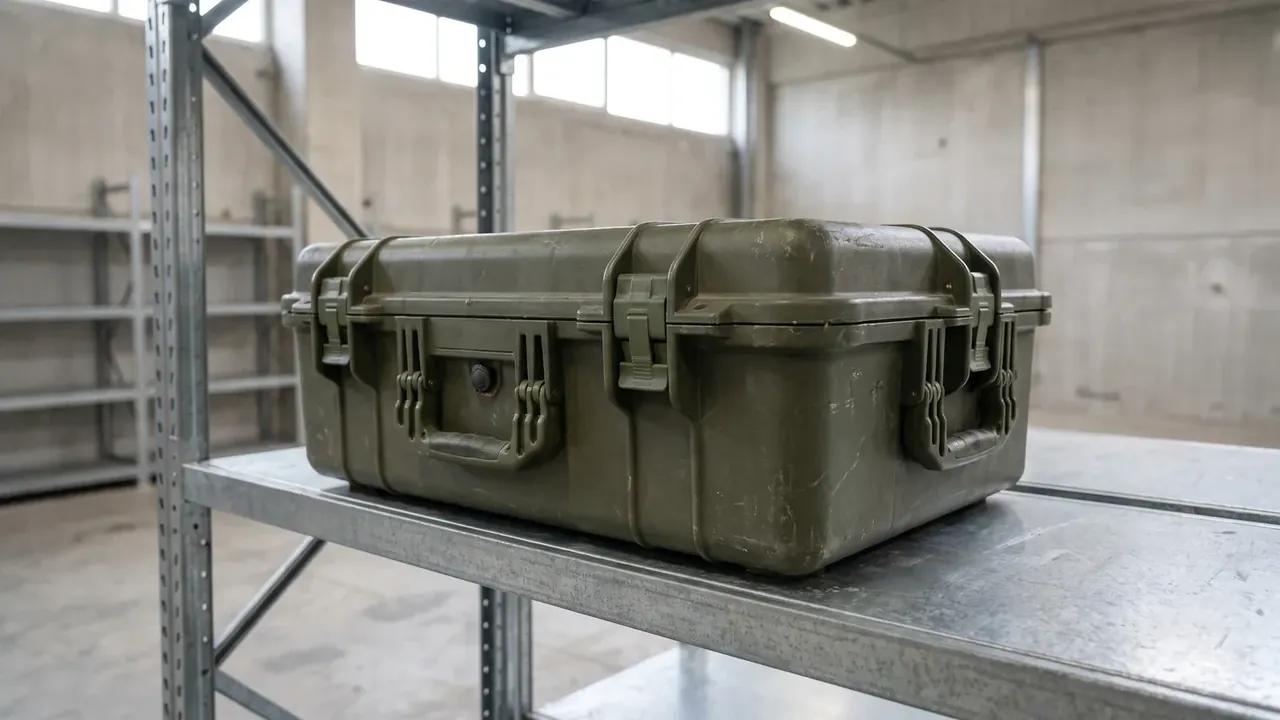
Quick answer: An Ophthalmic inspection equipment trolley hard box keeps divider shift to 0.7 mm after a 1.0 m drop and frame sink to 0.3 mm over 5000 cycles.
Table of contents
- Press-frame height in an Ophthalmic inspection equipment trolley hard box
- Allocating the partition limit gaps
- Step-slot readings after six-face drops
- Frame sink across open-close cycles
- Partition reject line for portable batches
- FAQ
1. Press-frame height in an Ophthalmic inspection equipment trolley hard box
Press-frame height is measured up from the stepped slots in the floor. An Ophthalmic inspection equipment trolley hard box builds an 11 mm frame inside the lid, bearing on 4 partitions at closure and holding them into their slots. A short frame leaves vertical play; a tall one jams the lid and keeps the catches from seating. The 430×300×140 mm cavity and 490×360×200 mm outer size fix the layer height the partitions may take, so 11 mm is read back from that allowance, with a reinforced ring at the frame root of the 3.5 mm shell.
Rig readings come from the net height with the lid shut, taken at four corners to 0.1 mm. Sample numbers run by shot and readings are logged against each number, never backfilled. Two catches at 330 N each lock the lid, and uneven force splits the four corner heights.
The 11 mm figure belongs to this portable run.
2. Allocating the partition limit gaps
Each partition edge keeps a 1.0 mm net gap to its step-slot wall in an Ophthalmic inspection equipment trolley hard box. Four partitions sit along the long edge, one per band, the gap split front and back: too much lets a partition slide sideways after a drop, too little wedges it against the wall so the frame cannot bottom out. The 1.0 mm gap and the 11 mm frame are coupled, and changing either pulls the other reading back onto the bench.
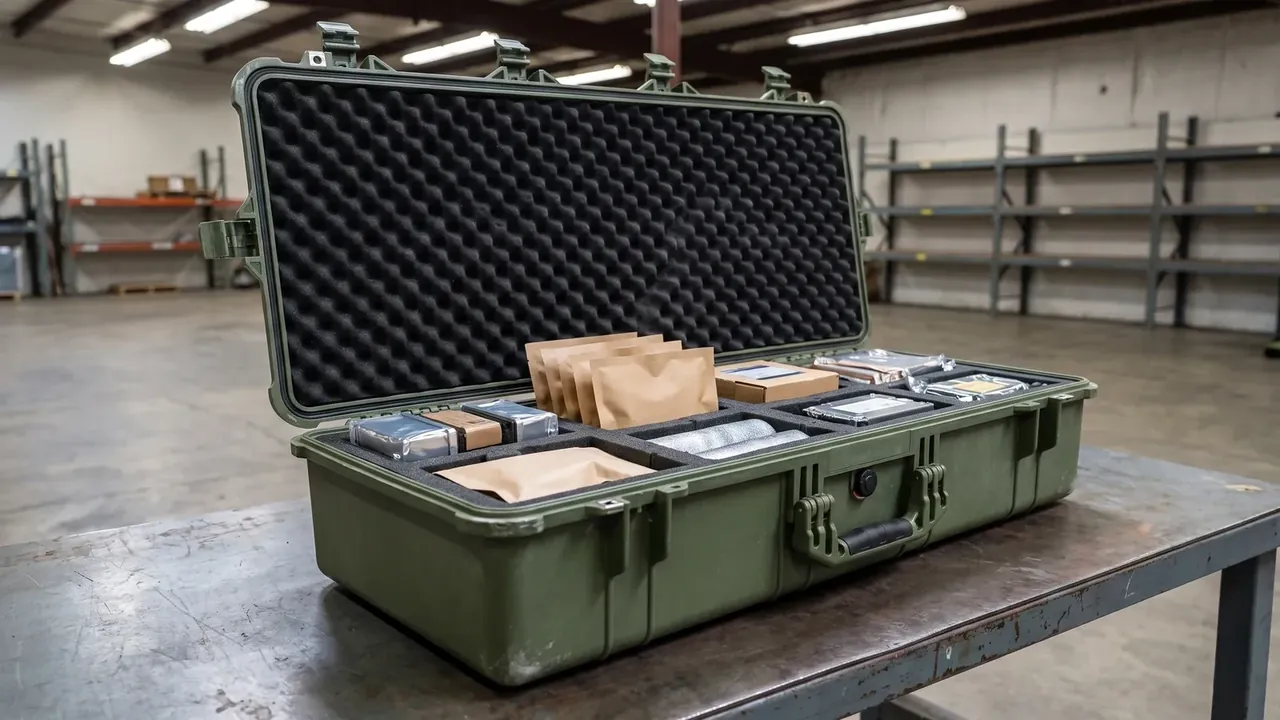
Allocation is logged below, with partition band in the first column.
| Partition band | Limit gap | Frame match |
|---|---|---|
| Band 1 | 1.0 mm | 11 mm net |
| Band 2 | 1.0 mm | 11 mm net |
| Band 3 | 1.0 mm | 11 mm net |
| Band 4 | 1.0 mm | Wall recheck |
If one band exceeds 1.0 mm, its slot width is remeasured, then the partition cut edge is checked for burrs. An 8 kg load is set on the partitions and the clearance read again. An empty 4.0 kg shell acts as control.
3. Step-slot readings after six-face drops
Six orientations each take one turn on the rig. An Ophthalmic inspection equipment trolley hard box is loaded to 8 kg, closed, and released from 1.0 m onto its base, its lid, the long walls on both sides and the short walls at both ends in turn. After each face the scribed floor datum gives the drift of the step-slot edge; divider shift must stay within 0.7 mm, with two levels read at upper edge and floor.
| Drop orientation | Step-slot upper edge | Divider shift |
|---|---|---|
| Face 1 bottom | Datum A | ≤0.7 mm |
| Face 2 lid | Datum A | ≤0.7 mm |
| Face 3 long left | Datum B | ≤0.7 mm |
| Face 4 long right | Datum B | ≤0.7 mm |
| Face 5 short front | Datum B | ≤0.7 mm |
| Face 6 short rear | Datum B | ≤0.7 mm |
Face numbers gather the readings, and one face over the line triggers a recheck of only its own partition and slot. The φ50 mm wheels and 2-section handle are removed before dropping so impact lands on the shell alone.
4. Frame sink across open-close cycles
The cycle rig accumulates 5000 lid closures at a fixed angle, and an Ophthalmic inspection equipment trolley hard box remeasures the four corner net heights every thousandth cycle. The verdict rests on sink: 11 mm frame loss after 5000 cycles must not pass 0.3 mm. Sink takes the largest corner value, not the mean, so one failing corner is not hidden.
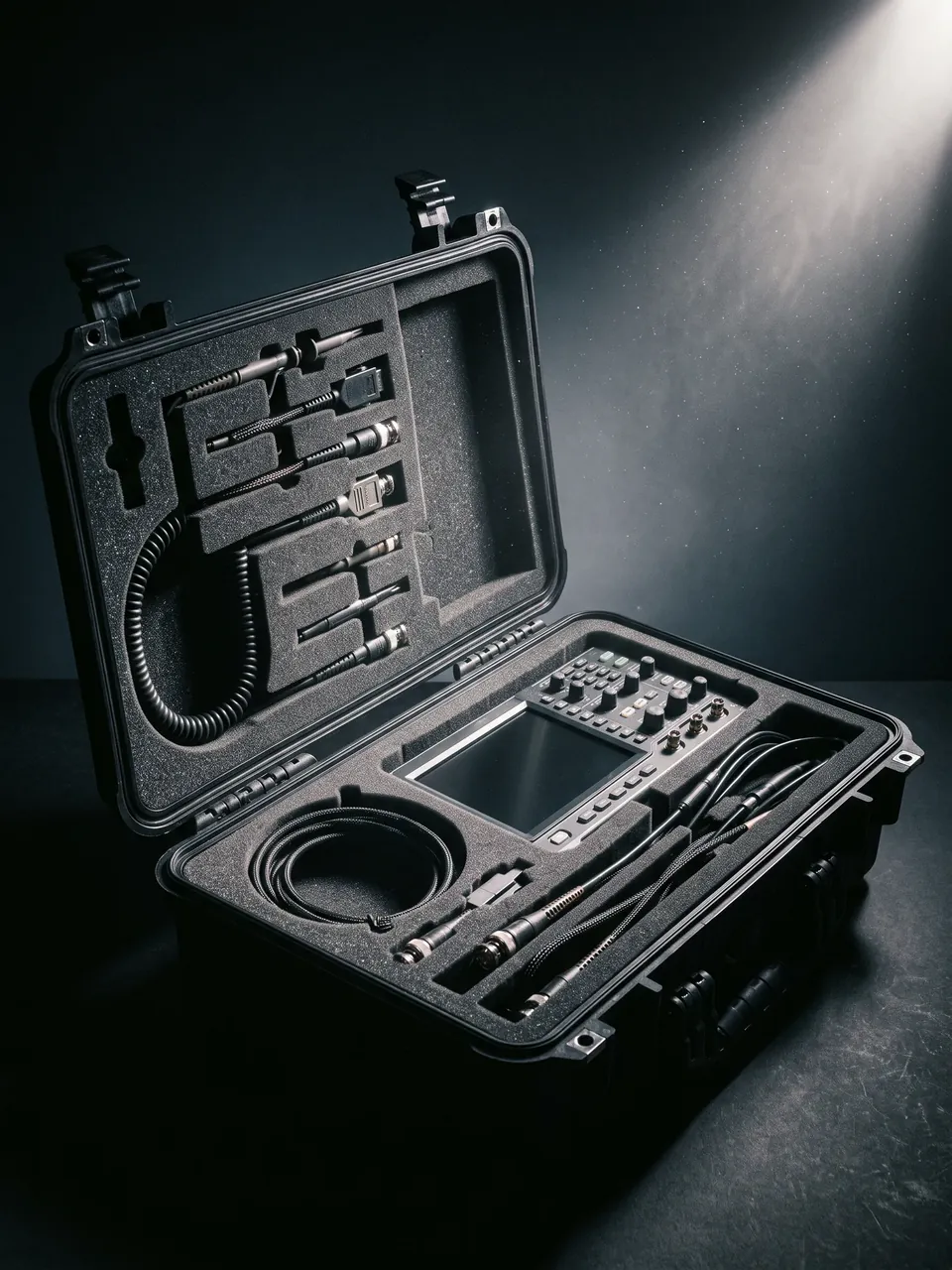
Two catches at 330 N each lose holding force with wear; the rig retakes that figure every thousandth cycle. Sealing is verified against the IP65 method by name only; this round reads shell, lid, partitions and frame.
5. Partition reject line for portable batches
Portable batches send one sample per shot onto the drop rig. An Ophthalmic inspection equipment trolley hard box draws its reject line on the band of divider shift, and the best single reading carries no weight. If one piece passes 0.7 mm, its limit gap is remeasured, then the width record is pulled; a mismatch sends the shot back.
| Displacement reading | Lot verdict | Action |
|---|---|---|
| 0.3 mm or less | Wide margin | Release |
| 0.3 to 0.5 mm | Normal | Log and file |
| 0.5 to 0.7 mm | Boundary | Retest clearance |
| Over 0.7 mm | Reject | Full shot recheck |
Drop 1.0 m, divider shift ≤0.7 mm and frame sink ≤0.3 mm after 5000 cycles share one sampling card, with the φ50 mm wheels and 2-section handle signed off as assembly checks.
Conclusion
An Ophthalmic inspection equipment trolley hard box ties an 11 mm lid frame to a 1.0 mm limit gap as one coupled pair, landing on ≤0.7 mm divider shift after a 1.0 m six-face drop. A 5000-cycle rig adds the ≤0.3 mm sink recheck. Two catches at 330 N each, φ50 mm wheels, a 2-section handle and sealing recorded against IP65 are reviewed together, and the 490×360×200 mm shell at 8 kg load is released shot by shot on its logged displacement band.
Related Reading
- Instrument box series specifications
- Instrument carrying case applications
- Heavy-duty rolling instrument case uses
- Case wheels and trolley handle design
Related Products
- 8 Series — Gun Cases; Military Equipment Cases; Camera Equipment Cases; Drone Cases; Watch Cases; Knife Cases; First Aid Cases; Electronics Equipment Cases
- WL8-2812 PP Gun Case — model WL8-2812
- All protective cases and toolboxes: 7 series, 158 models