

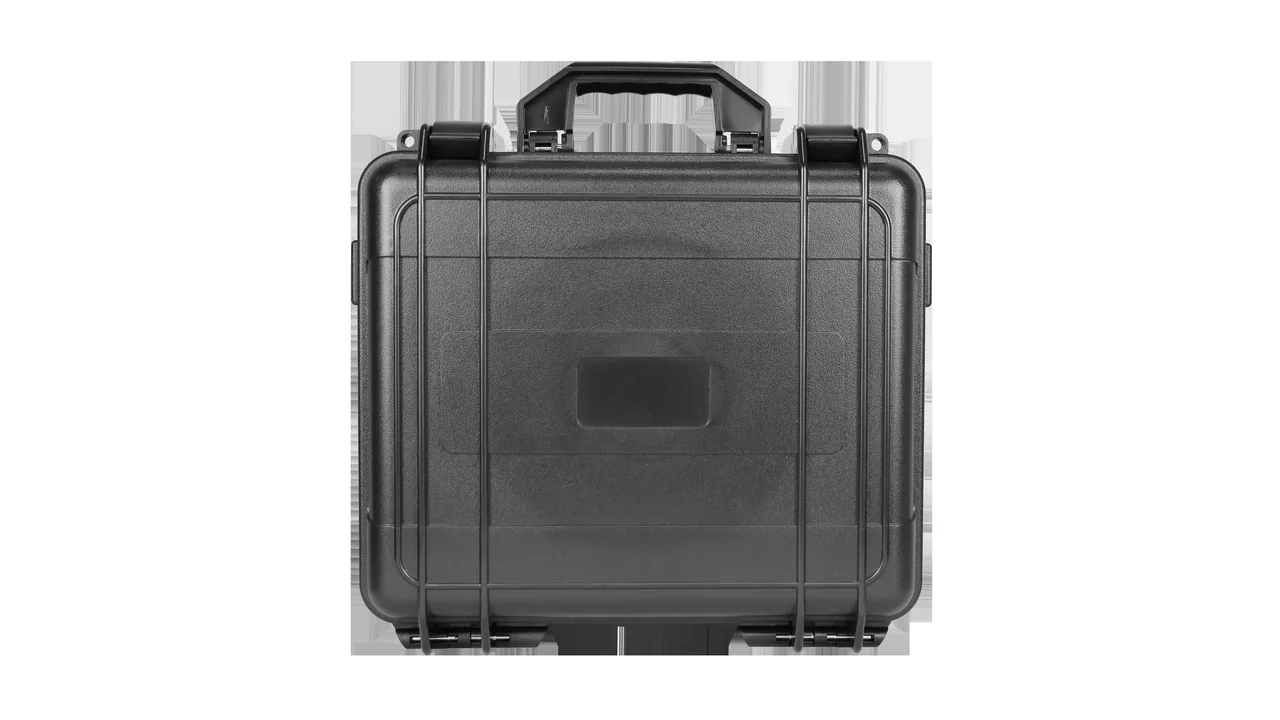
Orchard sprayers occupy a distinct niche in crop protection machinery. Unlike a flat-ground boom sprayer that sweeps a wide swath across an open field, an orchard sprayer drives a high-velocity air stream through the canopy so that droplets reach the inner branches and the undersides of leaves. Four component families make that possible: the air-assisted nozzle assemblies that atomise the liquid, the tank that holds and feeds it, the diaphragm pump that pressurises it, and the flow meter that proves the dose actually delivered. Each family fails differently in transit. Atomiser discs are ruined by a scratch. Tank welds crack under a bending load. Diaphragm membranes embrittle in a cold cargo hold. Flow meters drift out of calibration after sustained vibration. JUNZHIJIA, the protective case brand of manufacturer Kexin New Materials (Guangdong) Co., Ltd., builds custom cases for agricultural and industrial equipment, and this article works through those four failure modes from a manufacturer's standpoint and sets out the case architecture that prevents them.
The Four Failure Modes of Orchard Sprayer Components
A case is only as good as the failure analysis behind it. Before selecting a wall thickness or a liner density, the useful question is simpler: how does each part break? Orchard sprayer components fail along four distinct paths, and the paths interact in ways that make diagnosis unusually slow.
Corrosion is the first. Residual formulation left on a part after bench testing is aggressive. Copper-based fungicides attack aluminium and zinc plating. Sulphur-bearing products accelerate the ageing of many elastomers. Acidic formulations are unkind to ordinary carbon steel fasteners. A trace of residue sealed inside a case volatilises, condenses on cooler metal each night, and starts pitting within weeks. The second path is impact. An atomiser assembly is small and heavy for its size, so a drop concentrates a great deal of energy into a very small area. The third is distortion. Tanks, pump bodies and long assemblies lose their geometry when they spend a journey at the bottom of a stack. The fourth is cleanliness. An orchard nozzle that arrives with dust or dried formulation in its passages forces a full circuit flush before the machine can work at all, and in a busy season that flush costs more than the part.
These paths are not independent, which is precisely what makes transit damage so expensive to trace. Water enters a case, an atomiser disc corrodes, the corrosion sheds particulate, the particulate blocks the micro-orifices, and the machine is finally reported as delivering correct flow with poor atomisation. The workshop chases the spray pattern, the operator blames the formulation, and the real cause happened in a warehouse months earlier. A protective case earns its place by removing the initiating condition of all four paths during the transit window, not by covering the part.
Air-Assisted Nozzle Assemblies: Protecting Atomiser Discs and Air Rings
The air-assisted nozzle is the most delicate item on the whole machine. Its atomiser disc is a thin plate pierced with micro-orifices or machined with tangential slots, typically between 0.5 and 1.2 millimetres across. The chamfer on the edge of each orifice governs the droplet size distribution. A single scrape that raises a burr on that edge shifts the spray angle, which reduces deposition in the upper canopy, which the grower notices only as a poor spray season with no obvious cause.
The air-assisted architecture adds a second risk. Around the nozzle body there is usually a shroud or air ring, large in diameter, thin in wall, and asymmetric in form. A part like that will not sit stably on its own shape inside a case, and if it rolls it transfers load into the nozzle body. Worse, air shrouds often have walls only one to two millimetres thick, so a local point load leaves a permanent oval distortion. Once that happens the air field changes and the droplet penetration that justified buying an air-assisted machine in the first place is degraded.
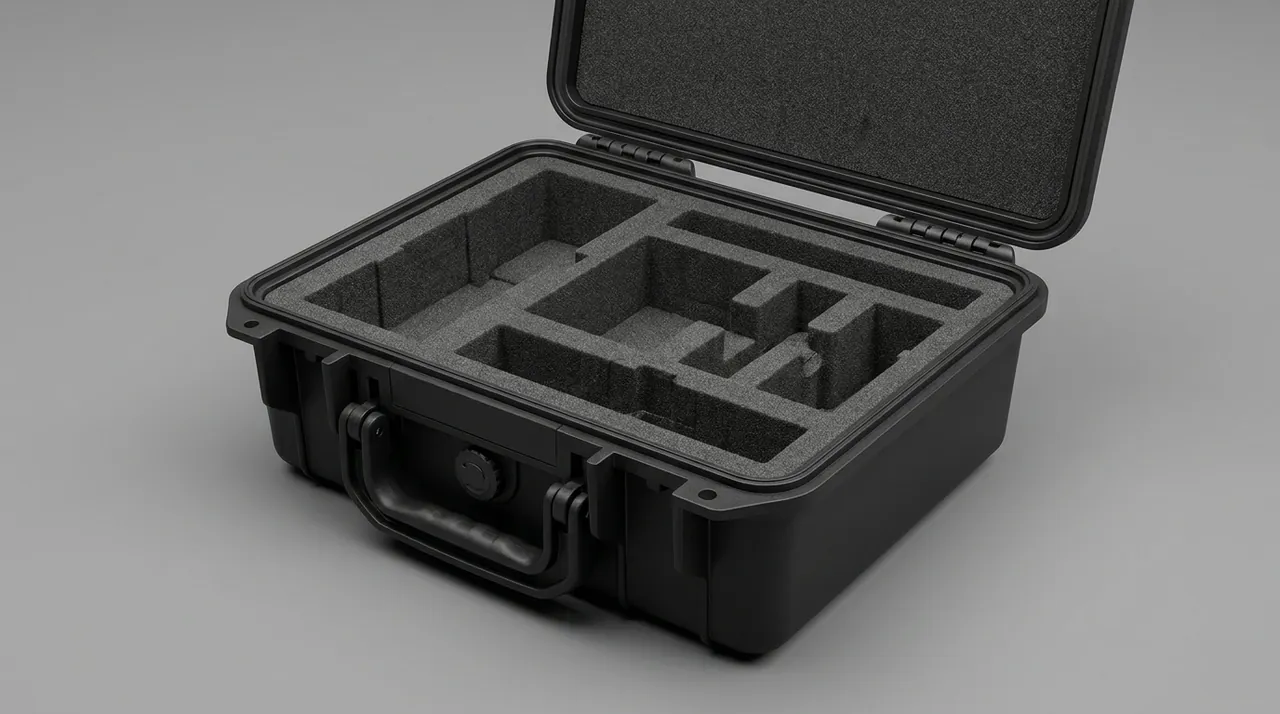
JUNZHIJIA handles this class through two-stage isolation. The first stage is a formed EVA liner, thermoformed against the disc diameter, that separates the disc from the nozzle body completely. The second is a compartment divider between assemblies so that assemblies cannot strike one another. The liner is cut with an interference of 0.3 to 0.5 millimetres against the disc diameter, which holds the part without play while avoiding the side loading a rigid clamp would apply to a thin plate.
For air shrouds we use a support ring rather than a surrounding fill. The liner is formed with a ring that contacts only the shroud flange, leaving the barrel of the shroud suspended and untouched. This constrains rolling without applying a distributed load to the thin wall. On a measured drop test at the same height, the ring approach retained roundness appreciably better than packing foam around the shroud, because the foam transmits the impact directly into the wall it is meant to protect. For anyone specifying such a case, we would make the stronger recommendation explicit: constrain the part, do not bury it.
Nozzle Quick-Change Mounts and Swivel Joints
To suit different canopy shapes, orchard nozzles commonly sit on adjustable quick-change mounts with an integrated swivel and an angle lock. This is a genuine multi-degree-of-freedom sub-assembly: many small parts, many mating faces, low stiffness in each member, and therefore the highest likelihood of hidden damage anywhere in the case.
Hidden damage is characterised by a sound appearance and a failed function. If the locking teeth of a quick-change mount take a light impression, the angle creeps under spray vibration once the machine is running, and the operator readjusts repeatedly without ever determining whether the cause is a design fault or transit damage. If the sealing face of a swivel takes a micro-scratch, the first symptom is an extremely slow weep that appears a week or two after the machine has passed acceptance.
For components like these we replace encapsulation with motion constraint. The liner is formed with a pocket that matches the mount body, and we leave roughly a millimetre of clearance on the locking-tooth side so that no load perpendicular to the tooth face is imposed during transport. Swivels are wrapped individually in a small sleeve so that they cannot slide against adjacent metal. This looks labour-intensive in a quotation, but for a part whose angular accuracy directly determines application quality, the avoided rework is worth far more than the incremental packaging cost.
Tanks and Bodies: Weld Roundness and Interior Protection
Tanks are usually rotomoulded polyethylene or hand-laid fibreglass. The body itself takes impact reasonably well, but the weak points are the welds and the fittings. The flange, the threaded insert at the outlet and the transition into the weld are all secondary operations. If the body is deformed in transit the resin around the insert develops fine cracks. Those cracks frequently do not weep at the factory leak test, and they begin to weep only after the machine has run under pressure, which means the customer's first symptom is an outlet leak on a brand-new sprayer.
There is a second, less discussed tank injury: interior scoring. A rotomoulded tank cures with a relatively dense skin on the inside face, and that skin is the layer with the best resistance to formulation permeation. If bolts, clamps or other hard items migrate inside the tank during a rough journey, they abrade the skin and expose the more porous structure beneath. Formulation soaks in, cleaning becomes difficult, and after a season or two the tank develops a retained odour that no amount of rinsing removes. For orchards where formulation cleanliness matters, that is a real functional loss rather than a cosmetic one.
Three protections matter most. The tank must be carried upright and never stacked on its side. The filler neck and the outlet need an independent strap or bracket so that load lands on the case structure rather than on the body. And the case needs a pressure equalisation valve, because otherwise the pressure differential of a mountain route or an air leg will push the filler seal open. Equipment cases from JUNZHIJIA place an adjustable saddle at the bottom of the tank bay, with the saddle curvature cut to the actual body diameter, so the tank sits rather than spans. We also specify a soft barrier between the tank bay and the metal-parts bay, so that no hard item can migrate into the tank interior.
Diaphragm Pumps: Cold Brittleness and Valve Seat Cleanliness
The diaphragm pump is the heart of an orchard sprayer. Reciprocating membranes pressurise the liquid on its way to the nozzles, and the membranes are typically fluoroelastomer or EPDM. A defining property of these elastomers is low-temperature embrittlement. Below roughly minus ten degrees Celsius, whether on an unheated warehouse floor or in an aircraft hold, flexibility drops sharply. If the membrane is then compressed or shocked, micro-cracks form without immediate failure, and the membrane ruptures suddenly after tens of hours of running, dropping system pressure and destroying dose accuracy. This is the classic buried-in-transit, detonated-in-service defect.
Pump packaging must therefore solve compression and condensation together. The pump goes into a dedicated shock-absorbing bay with closed-cell EPDM foam around it, which prevents plasticiser migration from the packaging into the rubber. The case carries desiccant together with VCI vapour-phase paper to stop the metal valve seat from condensing and rusting through temperature cycling. For orders shipping from northern China in winter or early spring, we normally recommend relocating the pump bay to the centre of the case so that the wall and liner act as a thermal buffer and reduce the rate of temperature change.
The pressure regulator and pressure switch on the pump are a second risk. Their housings are usually thin-wall die castings or mouldings with internal springs and a diaphragm linkage, in other words light, brittle and full of moving clearance. If pumps are simply stacked, the regulator housing of a lower pump carries the whole weight above it and cracks or deforms permanently. The answer is single-layer placement with divided bays, plus a guard plate on the regulator side to intercept lateral impact.
The inlet and outlet ports deserve the same attention. A threaded or clamped port that takes a lateral load in transit can crack the pump head casting it is screwed into. We supply a threaded protector for each port and add axial locating blocks inside the bay so the pump body cannot slide along the port axis. These low-cost items remove a disproportionate share of the pump-leaks-on-arrival cases we see.
Flow Meters and Pressure Gauges: Vibration Drift and Condensation
Flow meters and pressure gauges establish the dose, which makes them measuring instruments rather than accessories in any orchard where reduced-rate application is audited. A mechanical flow meter contains a turbine or gear element that is quite sensitive to vibration; sustained resonance wears the bearings and drifts the indicated value. The drift is worst at low flow rates, which is exactly the band an orchard sprayer works in most of the time because the target is a fine, well-distributed deposit rather than a high volume.
Electronic flow meters have an additional problem. Beyond vibration they are vulnerable to condensation: moisture entering the terminal chamber lowers insulation resistance, which produces a jumping reading at best and a short circuit at worst. JUNZHIJIA therefore uses two approaches. Mechanical meters sit in a fully conforming medium-density EVA liner that takes up the axial clearance of the turbine, with a damper pad beneath the case. Electronic meters go into an IP67 case fitted with a breathable waterproof vent, which blocks liquid water and spray while allowing internal vapour to escape slowly so that condensation does not accumulate through the day-night cycle. Calibration labels and factory certificates travel in a document pouch in the same bay, which avoids the familiar acceptance dispute in which a meter arrives with no traceable certificate.
Pressure gauges are subtler than flow meters. Most use a Bourdon tube, with a small clearance between the pointer and the dial. Under sustained vibration the movement gearing wears and the pointer fails to return to zero or lags the true reading. The error is most visible in the low range, and an orchard sprayer lives between roughly two and four megapascals. The gauge bay should therefore be damped, kept out of shared compartments with metal parts, and fitted with a soft protective film over the dial window so that scratching does not make the reading illegible.
Terminal blocks on electronic meters deserve a mention. If a terminal screw loosens in transit, contact resistance rises after installation, the signal jumps, and the problem worsens as the machine warms up. Our practice is to torque the terminals to specification at the factory and apply a witness mark. At goods-in inspection the mark either lines up or it does not, a far quicker check than re-torquing every screw and far more practical at an agricultural dealer with no torque wrench on the bench.
Lines, Quick Couplers and Seals: Managing the Small Parts
The plumbing of an orchard sprayer consists of suction, delivery and return lines plus a set of quick couplers. Individually these parts are cheap; in transit they are the single most common cause of expensive secondary damage. A loose O-ring or clamp ring rolling inside a case becomes a projectile on every turn, and it will eventually strike a precision part. Cleanliness matters too: a coupler contaminated with dust or grit scores its mating seal on first connection.
The answer is layered containment. Seals and O-rings are sorted by bore size into compartmented trays, and each tray sits in a recess in the liner whose depth slightly exceeds the tray height, so that even an inverted case cannot let small parts cross into a precision bay. Quick couplers are held on magnetic or snap-fit posts, giving every coupler one unique position in the case. That matters more than it sounds, because at an orchard repair site the light is poor and the ground is uneven; a dropped O-ring is effectively gone, and the job stops until a replacement is drawn from stores. Unique positioning also makes the case faster to check and faster to close, which shortens turnaround for co-operatives that share equipment across several growers.
For the lines themselves, coil diameter and bend radius should be fixed rather than left to the packer. A hydraulic or chemical line coiled too tightly retains a set, and a line that has taken a permanent set is difficult to route without kinking at the fitting. We specify a minimum coil diameter for each line type and provide a reel or a set of clips in the liner so that the coil is repeatable from shipment to shipment. Repeatability is what allows a technician to repack the case correctly in the field at the end of a season, which in turn is what makes the case reusable rather than single-trip.
Corrosion-Resistant Materials and Liner Selection for Agrochemistry
The corrosion spectrum of orchard formulations is wider than that of most industrial environments. Copper products attack aluminium and zinc. Sulphur-bearing products age certain elastomers. Acidic products are hostile to ordinary carbon steel fasteners. The case itself never touches the spray liquid directly, but the residue and vapour sealed inside it create a corrosive atmosphere all the same, and the damage accumulates over repeated trips rather than in a single shipment.
For this duty JUNZHIJIA normally specifies a modified PP or PC body with better chemical resistance, and avoids open-cell foam liners that can absorb organic solvents in favour of closed-cell EPE or cross-linked EVA. Fasteners are stainless throughout, and we add a solvent-resistant coating or film as a secondary barrier. For cases that will be cycled many times, we fit a replaceable absorbent mat in the base so that any liquid reaching the case floor is held rather than pooling, and can be swapped out as part of routine maintenance.
There is a trade-off here that is easy to miss: chemical resistance and impact toughness do not always move together. Some materials with excellent solvent resistance lose impact toughness sharply at low temperature, making them a poor choice for long winter road movements. Conversely, a material chosen for toughness may contain plasticisers that organic solvents can extract, leaving a tacky surface and reduced strength.
The liner should also not be glued to the body. A bonded liner cannot be removed for cleaning and cannot be replaced when one pocket is damaged. We prefer mechanical retention with a removable liner, which can be taken out, washed and replaced while the body continues in service for years.
The difference between cross-linked EVA and ordinary EVA matters to anyone writing a specification. Cross-linking produces a three-dimensional network, so at the same density the foam recovers better and takes a smaller permanent compression set. In practice this means the liner still grips correctly on the twentieth packing cycle rather than loosening. The difference only becomes apparent six to twelve months into service, which is precisely why it decides whether a case lasts its intended life.

What IP67 Actually Buys an Orchard Operation
For orchard sprayer components, IP67 is not about surviving submersion. Its value lies in keeping the interior dry across three real situations: washdown, rainfall and condensation. Machinery is routinely hosed down before it enters a store, and a case rated only IP54 will admit water along the gasket channel under a pressure jet. Orchards receive frequent rain, and temporary open-air storage is a sustained test of any seal. And overnight cooling creates a negative pressure inside the case that actively draws external moisture inward.
Achieving IP67 depends on three things holding at once: a gasket compound with a low compression set, even clamp pressure across the seal, and sufficient stiffness in the case body itself. All three are necessary. Many leak complaints are not gasket failures at all but stiffness failures, where the wall flexes enough that the gasket channel still has a gap after the latches are closed. JUNZHIJIA thickens the body at the gasket channel and fits a pressure equalisation valve, so the seal is maintained while the differential that would otherwise spring it open is relieved.
For an orchard, a further benefit is less obvious but real. A sealed, equalised case can be left closed overnight in a wash bay without the interior drawing damp air, which means the desiccant load lasts longer and the VCI concentration holds. Sealing and vapour-phase protection are therefore not alternative strategies to choose between; they are complementary, and a case with a good seal but no vapour-phase paper is only doing half the job for metal components.
Impact Packaging and Compartment Design from Drop Height Backward
Compartmentalisation exists to rob impact of a transmission path. In a case divided into five to seven separate bays, the energy of a drop propagates only within the bay where it originated, because there is no rigid common structure left to carry it to every component. That is the fundamental difference between an orchard sprayer parts case and an ordinary tote: a tote only has to fit the contents, whereas a parts case has to stop each impact inside the bay where it happens.
For that to work, a divider cannot merely separate; it must absorb. We place ribs between adjacent bays with a buffer layer behind them, so a wall can deform in a controlled way instead of passing load straight to the next bay. Rib thickness and pitch must be calculated against the heaviest item in the case, or the design fails unevenly, with the light bay intact and the heavy bay torn.
The starting point of the design is not a material but a drop height. Orchard sprayer parts generally move by road freight and then by an agricultural dealer's own delivery, where the realistic drop height falls between 60 and 90 centimetres, and the highest-damage step is manual loading onto a vehicle. We fix the target drop height and the mass distribution first, then derive wall thickness, liner density and rib position from them.
Atomiser discs and flow meters, the high-value small items, are checked to a 1.2-metre drop. Tanks and pump bodies are checked against stacking and sustained compression rather than drop. A single order often contains both classes, and in that situation we recommend splitting the shipment across two case sizes rather than mixing. A mixed case must be designed to the most severe duty in the load, which raises cost and still leaves the risk unresolved, because the design that suits a heavy tank is not the design that suits a delicate disc. Related selection guidance appears in Corrosion-resistant enclosures and Case salt spray corrosion testing.
Moisture, Rust Control and Desiccant Configuration
Residual formulation plus moisture is the mechanism behind the white rust that appears on orchard sprayer components after delivery. Surface white rust does not immediately prevent operation, but within about two months it develops into pitting, and pitting on a nozzle face degrades atomisation while pitting in a pump or valve degrades sealing. For a component whose whole purpose is repeatable fine droplet generation, that is a functional failure.
We normally deploy a three-layer configuration: a measured quantity of silica gel desiccant, sized from the internal air volume and the journey duration; VCI paper or a rust-preventive film on machined metal faces; and an aluminium-laminate bag as an outer barrier for the whole unit. One caution matters more than the rest. Desiccant should not be dropped loose in a corner. It should be fixed high in the bay so that the moisture path runs downward through the whole volume and every surface is covered by the air being dried.
Quantifying desiccant is frequently reduced to throwing in two sachets, and this is behind a large share of our return cases. The proper method is to estimate the net internal volume, multiply by the expected transit duration and a humidity factor for the route, derive the required absorption, then apply a safety margin. For humid routes or shipments transhipped in the open during a rainy season, the margin should be increased, and an indicating desiccant is worth the small premium because it lets the person opening the case see whether the absorption capacity was exhausted.
The mechanism of VCI paper is often misunderstood. It does not lay an oil film on the metal; it releases corrosion-inhibiting molecules continuously, forming a molecular-scale protective layer. That process needs a reasonably enclosed volume to reach effective concentration. In a case with poor sealing and continuous air exchange the VCI concentration never builds and protection is largely lost. This is exactly why we pair VCI paper with an IP67 sealed body rather than relying on either element alone.
Sea freight adds a further consideration. Journeys are long, the day-night temperature swing is large, and condensation inside a container is severe. For these orders we typically specify vacuum or semi-vacuum aluminium-laminate packing with desiccant, plus a humidity indicator card inside the case. Reading the indicator before opening provides an immediate, objective record of whether the transit segment allowed moisture ingress, which is useful evidence should a claim become necessary.
Labelling, Traceability and Field Check-Off
Orchard repairs happen between tree rows, in poor light, on uneven ground. If a parts case has to be searched through on site, a dropped seal is rarely recovered, and the job stops. Labelling is therefore not a finishing touch; it is part of the protection chain, because a part retrieved and refitted incorrectly is as much a loss as one damaged in transit.
The system we supply includes a bay map and part-number cross-reference on the inside of the lid, a QR asset label on each item, and a batch and inspection status colour code on the outside. The QR labels also carry traceability. If atomiser discs from one production batch show an atomisation fault in service, the labels identify the remainder of that batch immediately, limiting containment to a defined set of parts rather than all stock.
!large protective case with cushioned liner for transporting orchard sprayer — orchard sprayer For growers running several machines across blocks, the bay map also makes a technician's repack verifiable.

Acceptance Documents and Compliance Points
The documentation expected with a shipment differs sharply between an export order and a domestic supply to an original equipment manufacturer. Export orders generally need a bilingual packing list, material declarations and packaging performance test results, and where hazardous goods are involved the relevant transport regulations apply to the documentation as much as to the packing. Domestic OEM supply is more concerned with batch consistency and first-article approval.
When JUNZHIJIA delivers a custom case we provide three documents: a packing drawing, a liner material declaration, and drop and seal test reports. Their practical value is that they draw the boundary of responsibility. If damage occurs in transit, the documents allow a fast determination of whether the cause lies in the case design or in how the case was handled and stowed, preventing long disputes between OEM and component supplier.
Two points recur in audits. First, a test report is worthless without the parameters it was run to, so a report stating drop height, orientation, mass and number of drops is far more useful than one that says the case passed. Second, for cases carrying electronic components, an IP rating alone does not cover the effect of sustained vibration on measurement accuracy, so a vibration result appropriate to the instrument's accuracy class should be requested separately.
Working Alongside Machine Packaging: Dual-Track Shipping
Orchard sprayers are usually delivered on two tracks: the machine moves as heavy freight, while components move by ordinary parcel or through a dealer network. The machine is not dismantled in transit and mainly sees stacking and compression. Components are small-and-heavy or precise-and-fragile; their main risks are drop and vibration, and they frequently travel by a route where handling is far rougher than the machine's own logistics.
Two countermeasures are worth building into the commercial terms. Externally, the case should be marked plainly as precision parts, not to be thrown, and fitted with corner protectors. Contractually, the shipping and acceptance standard for components should be agreed separately rather than defaulting to the machine's packaging specification. A surprising share of damage disputes originates exactly there: components are judged against a machine-packaging standard, so a light scuff that has no functional consequence is classified as a defect, while the damage that actually matters is not assessed at all.
It is also worth aligning delivery sequencing. If components arrive ahead of the machine they may sit in a dealer's yard through a rain period, which loads the seal and the desiccant in ways the design brief assumed would not happen. Where the sequence cannot be controlled, the case specification should be raised accordingly: a larger desiccant allowance, sealed packing for the whole unit, and an instruction to store the case upright and under cover.
Field Case: From Three Damage Complaints to a Settled Specification
One orchard sprayer manufacturer in northern China saw a cluster of after-sales complaints described as uneven atomisation. Two rounds of investigation focused on the spray liquid and on operator technique. Only when a case was opened in front of the engineers did the pattern emerge: the atomiser discs had burrs on the orifice edges too fine to see without magnification, and some nozzle bodies carried white rust. Tracing the shipment showed that the batch had travelled through a dealer redistribution in the rainy season inside ordinary corrugated cartons, with the nozzles wrapped only in bubble film.
The redesign combined a compartmented EVA liner, individual positioning for every assembly, desiccant with VCI paper inside the case, and a fully sealed IP67 body. Over the two selling seasons that followed, the related complaints fell to zero and the customer's after-sales cost dropped measurably. The lesson generalises well beyond this customer. Packaging faults surface months after the factor that caused them, so tracing a field symptom back to a transit root cause is expensive and slow. Designing isolation into the chain in the first place is what removes the symptom before it can appear.
FAQ
Q: What kinds of damage do air-assisted nozzles suffer most in transit?
A: Burred atomiser orifices and white rust on the nozzle body. An atomiser disc is a thin plate with micro-orifices, and the edge chamfer that controls droplet size is measured in tens of microns, so a single hard contact with another metal item inside the case raises a burr. The machine then sprays at a shifted angle, deposition in the upper canopy falls, and the grower perceives only that the season's spray was poor, with no obvious cause. Air shrouds add a second risk, because their walls are thin enough that a point load leaves a permanent oval distortion, which changes the air field and reduces canopy penetration. White rust has a different mechanism: residual formulation volatilises inside a closed case and forms a corrosive atmosphere, while the day-night temperature cycle carries moisture to cool metal surfaces. Within two to three weeks white rust appears and begins developing into pitting. Individual positioning, a formed liner, desiccant and vapour-phase paper address these mechanisms together. The practical test is simple: hold the disc against the light and look for edge discontinuity before accepting a delivery.
Q: Why do sprayer tanks need dedicated transport protection if the body is strong?
A: Because the body is not the vulnerable element. The flange, the threaded insert at the outlet and the transition into the weld are secondary operations, and they carry the stress concentrations. If a tank is stacked on its side or loaded at the bottom of a stack, the body ovalises, the resin around the insert cracks, and those cracks typically do not weep at the factory leak test. They weep only after the machine runs under pressure, so the first symptom the customer sees is an outlet leak on a new sprayer. Because the weep point is hidden, the workshop usually replaces gaskets and valves first and consumes a set of good parts before finding the truth. There is also an interior risk: bolts or clamps migrating inside a tank abrade the dense inner skin that resists formulation permeation, and the tank then retains odour and becomes hard to clean. Vertical carriage, independent support at the filler neck and outlet, and a saddle formed to the body diameter keep the load in the case structure. A further precaution is to keep the tank bay separated from the metal bay by a soft barrier so nothing can migrate inside the body.
Q: Why are diaphragm pump membranes sensitive to cold, and how should they be protected?
A: Membranes are made from fluoroelastomer or EPDM, and these elastomers embrittle at low temperature. Below roughly minus ten degrees Celsius, whether in an unheated store or an aircraft hold, flexibility drops sharply. A membrane that is compressed or shocked in that state develops internal micro-cracks without failing immediately; it then ruptures after tens of hours of running, which drops system pressure and destroys dose accuracy. The defect is created in transit and detonated in service, which makes it one of the hardest to attribute. Protection means a dedicated damped bay with closed-cell EPDM foam to prevent plasticiser migration, plus desiccant and VCI paper to keep the metal valve seat from condensing. The regulator housing is a further concern, because it is a light, brittle casting that cracks if pumps are simply stacked, so single-layer placement with a guard plate is required. For winter shipments from northern regions, moving the pump bay to the case centre reduces the rate of temperature change. In practice, a case left in an unheated truck overnight in a northern winter can reach the brittle range even on a mild day.
Q: Why do flow meters lose accuracy in transit, and does protection differ between mechanical and electronic types?
A: Yes. A mechanical meter contains a turbine or gear element that responds to vibration, and sustained resonance wears the bearings and drifts the reading. The error shows up most clearly at low flow rates, which is the band an orchard sprayer uses most because the objective is a fine, well-distributed deposit rather than high volume. Electronic meters add a condensation risk: moisture entering the terminal chamber lowers insulation resistance, causing a jumping reading at best and a short circuit at worst. Protection therefore differs by type. Mechanical meters go into a fully conforming medium-density EVA liner that takes up axial clearance, with a damper pad under the case. Electronic meters go into an IP67 body with a breathable waterproof vent, which blocks liquid water while letting internal vapour escape. Gauges need the same treatment, since Bourdon-tube movements wear and stop returning to zero, and the error is most visible in the two-to-four megapascal band. Both should travel with their calibration certificates in the same bay. For either type, a witness mark on the terminal screws makes goods-in inspection a visual check rather than a torque audit.
Q: Why do small items such as couplers and seals need dedicated design attention?
A: Because small items amplify damage out of proportion to their value. A single O-ring costs almost nothing, but once it is loose inside a case it becomes a hard projectile on every turn, and it will eventually strike a precision part such as an atomiser disc, turning an ordinary journey into a scrapped component. Loose seals also destroy repack consistency: at an orchard repair site the light is poor and the ground uneven, so a dropped ring is effectively lost and the job stalls until a replacement is drawn from stores. There is a contamination angle as well, because a coupler carrying grit will score its mating seal at first connection. Layered containment solves these problems. Compartmented trays sorted by bore size sit in recesses whose depth exceeds the tray height, so even an inverted case cannot let small parts cross into a precision bay. Couplers on magnetic or snap-fit posts each occupy one unique position, which makes checking and closing the case fast. Providing a coil reel in the liner also fixes the minimum bend radius, which prevents a line from taking a permanent set in transit.
Q: What does agrochemical exposure demand from case and liner materials?
A: More than most industrial environments demand. Copper-based products attack aluminium and zinc plating, sulphur-bearing products age certain elastomers, and acidic products are hostile to ordinary carbon steel fasteners. The case never contacts the spray liquid directly, yet residue and vapour sealed inside create a corrosive atmosphere, and damage accumulates across repeated trips rather than appearing in one shipment. JUNZHIJIA normally specifies a modified PP or PC body with better chemical resistance, and replaces open-cell foam that absorbs organic solvents with closed-cell EPE or cross-linked EVA. Fasteners are stainless throughout. Cross-linked EVA matters because it takes a smaller permanent compression set, so a liner still grips on the twentieth packing cycle rather than loosening after six months. For cases cycled many times we add a replaceable absorbent mat so liquid reaching the case floor is held rather than pooling. Chemical resistance and low-temperature toughness do not always move together, so body and liner are selected separately against their respective duties. Where a fleet cycles cases several times a season, a removable liner that can be washed and replaced is the better long-term economy.
Q: Is an IP67 rating genuinely necessary for orchard sprayer components?
A: In most orchard settings it is worth the cost, because IP67 is not about submersion but about staying dry across washdown, rainfall and condensation. Machinery is routinely hosed down before storage, and a case rated only IP54 admits water along the gasket channel under a pressure jet. Orchards receive frequent rain, so temporary open-air storage becomes a sustained seal test. Overnight cooling then creates internal negative pressure that actively draws external moisture inward. Achieving IP67 requires three conditions simultaneously: a gasket compound with low compression set, even clamp pressure, and enough body stiffness that the gasket channel does not open. Many leak complaints are stiffness failures rather than gasket failures. A thickened gasket channel and a pressure equalisation valve address both the seal and the differential that would spring it open. Sealing also extends desiccant life and holds VCI concentration, so sealing and vapour-phase protection work together rather than as alternatives. Buyers should ask for the rating together with the test method and the ambient conditions it was run under, because a rating quoted without its parameters proves very little about a specific orchard route.
Q: Which tests should a buyer require to verify protection performance?
A: At minimum, seal, drop and stacking tests. For sealing, pressure decay testing finds small leaks and produces a quantified result, while immersion testing approximates the extreme case of a case going overboard, and both are worth running. Drop testing should be set from the actual component mass and the handling height observed in the supply chain, with the weakest corner, edge and face each dropped once. Orchard parts usually see 60 to 90 centimetres, and the highest-damage step is manual loading onto a vehicle, so the drop specification should reflect that rather than a generic figure. Stacking tests matter for tanks and pump bodies that will sit at the bottom of a stack, and should verify body roundness and fitting stability under sustained load. Vibration testing is separately important for flow meters and gauges, because it addresses measurement stability after a long journey rather than structural survival. JUNZHIJIA provides a packing drawing, liner material declaration and these test reports with every custom case, which together establish where responsibility sits if damage occurs. Requesting the test parameters alongside the report matters, since a case that passed at one mass and height may not pass at another.
Q: Why ship the machine and its components separately rather than in one case?
A: Because the two classes impose different packaging severities, and mixing them forces the design to the most severe duty in the load without eliminating the risk. The machine travels undismantled and mainly faces stacking and compression. Components are small-and-heavy or precise-and-fragile, mainly facing drop and vibration, and they often move through parcel or dealer networks where handling is far rougher than the machine's own freight. Putting both in one case means the body must carry a heavy tank and damp a delicate disc at once, so the liner fails unevenly, with the heavy bay torn while the light bay is intact. Splitting the shipment across two specifications costs less than a hybrid design, and it lets the component acceptance standard be agreed separately instead of defaulting to the machine's packaging specification. Delivery sequencing should also be planned, because components arriving early may sit in a yard through a rain period and load the seal beyond its design assumption.
Closing Notes and Related Reading
Protecting orchard sprayer components means solving at the transit stage the problems that would otherwise surface at the point of use. A burred atomiser orifice, a micro-crack around a tank insert, a cold-damaged membrane, a drifted flow meter: all share the same signature of delayed appearance and disputed responsibility.
Related Reading: Agricultural spray equipment cases, Greenhouse irrigation cases, Horticulture and nursery cases.