

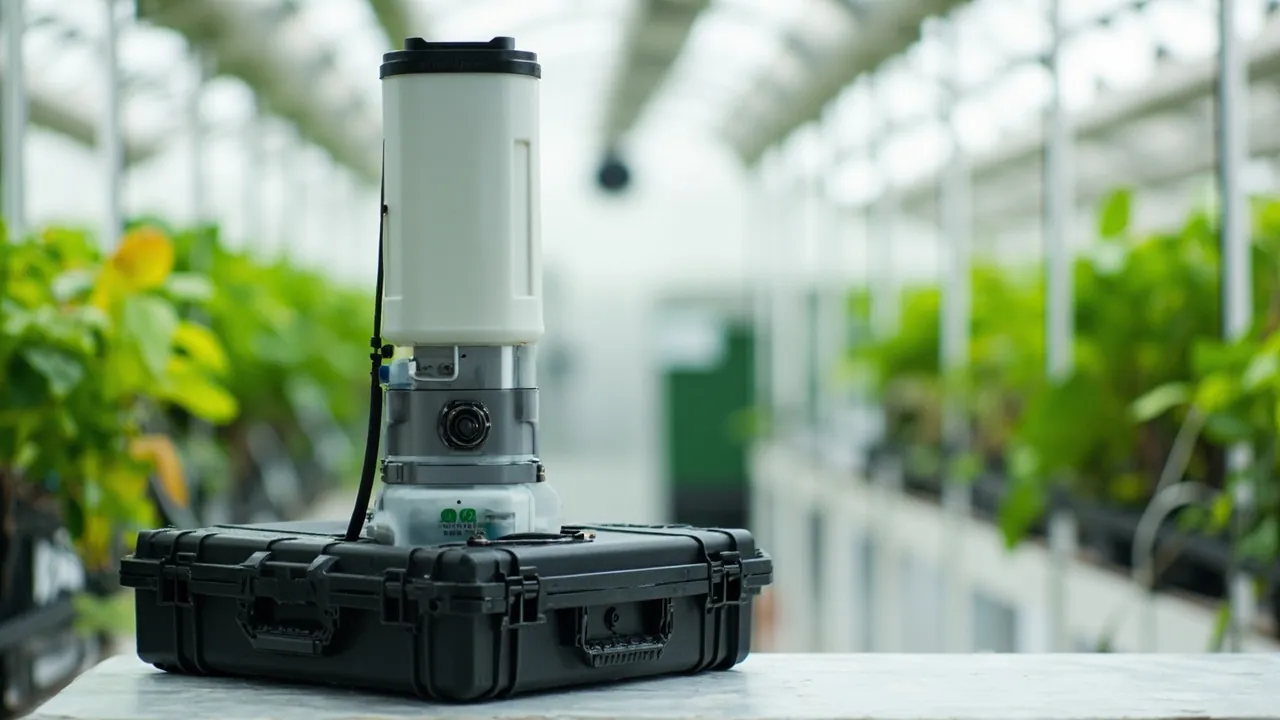
Greenhouse and irrigation equipment cases address a specific class of problem: precision electronics tightly coupled to a wet, corrosive environment. A fertigation unit, an irrigation controller, a solenoid valve bank, EC and pH probes, flow meters, and drip-irrigation head accessories all combine circuit boards and sensors that are sensitive to vibration and static discharge with metal and polymer parts that must survive fertilizer salts, high humidity, acids and bases, and ultraviolet exposure. Moving a fertigation unit safely from the factory to a greenhouse head station, and getting it calibrated and commissioned on the day it is unpacked, depends not on wall thickness but on four things working together: sealed moisture control, corrosion-resistant material selection, vibration-limiting inserts, and field calibration workflow support.
Irrigation contractors and greenhouse integrators report three recurring problems: probes losing calibration in transit, controllers drifting after moisture exposure, and pipe fittings loosening or deforming under vibration. The harder problem is on site. Head stations tend to be cramped, close to saturation humidity, and without a stable work surface, so if a case cannot deliver fast sorting and easy access to calibration items after opening, commissioning time multiplies. This article follows the path of equipment composition, failure mechanism, protective structure, standards basis, selection parameters, and acceptance management to lay out a complete case-based protection scheme for fertigation and irrigation equipment, with specification clauses, size-class tables, an IP comparison, and an inspection checklist.
Table of Contents
- 1. Protection Goals for Fertigation and Irrigation Equipment
- 2. Equipment Breakdown and Weak-Point Analysis
- 3. Choosing an Ingress Rating: IP65 and IP67 under IEC 60529 and GB/T 4208
- 4. Corrosion Resistance: Fertilizer Salts, Acids and Bases, and UV Aging
- 5. Vibration Resistance for Instruments and Sensors: Applying ISTA and GB/T 4857
- 6. Hydraulic and Piping Protection: Starting from ISO 4413
- 7. Precision Protection for EC/pH Probes, Flow Meters, and Control Boards
- 8. Insert Design: Compartmentalization, Restraint, and Fast Retrieval on Site
- 9. Pressure Equalization and Thermal Cycling: The Hidden Cross-Climate Risk
- 10. Size Classes and Selection: From the Drip Head Station to the Greenhouse Control Cabinet
- 11. Special Considerations for Drip and Micro-Sprinkler Spare Kits
- 12. Marking, Traceability, and Spare-Part Coding Integration
- 13. Reliability of Hinges, Latches, and Gaskets
- 14. OEM/ODM Customization and Sample Control
- 15. Acceptance, Inspection, and Life-Cycle Management
- 16. Purchasing Decision Checklist
- Frequently Asked Questions
- Conclusion and Related Reading
1. Protection Goals for Fertigation and Irrigation Equipment
The logistics path for irrigation and greenhouse equipment is often more demanding than for field machinery, because the endpoint is wetter and more corrosive. A typical route runs from the equipment maker or integrator warehouse (dry), over the road (vibration, temperature swings), to a project staging area (open air, possible rain), into a greenhouse head station (high humidity, fertilizer salts), and finally to commissioning. The hardest part is not the highway leg but the overlap of the last two stages, where equipment can arrive intact yet already have absorbed moisture and then degrade rapidly in the humid head station.
Translated into engineering requirements, a fertigation and irrigation equipment case must satisfy five categories at once.
The first is moisture control and insulation integrity. Irrigation controllers, variable-frequency drives, and control boards are highly moisture sensitive. Humidity causes terminal oxidation and rising contact resistance, and it drives electrochemical migration across PCB surfaces that forms dendrite shorts. For powered equipment, moisture management is directly tied to insulation performance and operating safety.
The second is corrosion resistance. Fertilizer solutions, especially sulfate, nitrate, and phosphate formulations, are corrosive, as are many cleaning agents. Greenhouse interiors stay humid, so an electrolyte film forms readily on metal surfaces and accelerates electrochemical corrosion. Stainless steel grade selection, coating systems, and seal material compatibility all have to be part of the design.
The third is vibration and impact resistance. Solenoid valves, sensors, glass rotameters, and plastic fittings all fail under vibration and shock. Random road vibration loosens fasteners and fittings, while drop impact can crack valve bodies or shatter probe glassware.
The fourth is dust and water protection. Greenhouse and open-field irrigation environments involve both dust, including organic substrate dust, and sprayed water. The IP rating defined by IEC 60529 and GB/T 4208 is the way to quantify this.
The fifth is field calibration workflow support. After installation, a fertigation unit requires EC and pH calibration, flow verification, and recipe parameter entry. The case must support layered retrieval, probe protection, separate storage of calibration and standard solutions, and rapid reset of spares and tools, all under humid, cramped conditions with no work surface.
Key judgement: a purchasing specification for irrigation equipment cases should separate factory packaging from project site turnaround cases. The former emphasizes one-time transport reliability and cost; the latter emphasizes repeated opening, field serviceability, and long-term corrosion resistance. The technical clauses are entirely different.
JUNZHJIA supplies the greenhouse engineering and irrigation equipment supply chain with configurations that treat a media-resistant gasket, a custom compartmented insert, a dedicated probe cavity, and a separate calibration-solution position as standard, so the same case can serve both as factory packaging and as a long-term spare-parts case kept in the head station.
2. Equipment Breakdown and Weak-Point Analysis
Effective protection design requires breaking a fertigation unit and irrigation system down to the component level and grouping by failure mechanism.
Group one: controllers and electronic control units. Irrigation controllers, fertigation main boards, variable-frequency drives, touch screens, communication modules such as 4G and LoRa, relays, and power supplies. The dominant mechanisms are moisture-driven electrochemical migration, terminal oxidation, ESD damage, and solder joint cracking from shock.
Group two: sensors and probes. EC and pH probes, soil moisture sensors, flow meters in electromagnetic, turbine, and rotor types, pressure sensors, level switches, and weather station sensors. Dominant mechanisms are electrode contamination and dry-out, glass bulb breakage, calibration drift, and loose wiring from vibration. EC and pH probes are especially fragile: once the glass bulb dries out or takes a mechanical impact, the calibration slope drifts or the probe fails outright.
Group three: valves and actuators. Solenoid valves, motorized ball valves, butterfly valves, pressure reducing valves, safety valves, and valve actuators. Dominant mechanisms are diaphragm aging, coil moisture ingress, foreign matter on sealing faces causing internal leakage, and thread damage at ports.
Group four: metering and injection components. Fertilizer pumps in diaphragm and peristaltic types, proportional injectors, Venturi injectors, check valves, and filters. Dominant mechanisms are metering accuracy degraded by contamination, tubing fatigue, and seal swelling from incompatibility with fertilizer chemistry.
Group five: piping and fittings. PVC and PE fittings, quick couplers, bypasses, and drip lines. Dominant mechanisms are deformed pipe ends, lost or flattened O-rings, and UV-induced embrittlement.
Group six: instruments and displays. Pressure gauges, glass rotameters, and transparent sight windows. The mechanism is glass breakage and surface scratching, purely physical, and solvable only through structural compartmentalization.
| Component group | Typical parts | Dominant failure mechanism | Key protective measure | Standards reference |
|---|---|---|---|---|
| --- | --- | --- | --- | --- |
| Controllers and ECUs | Controllers, fertigation main boards, VFDs | Moisture migration, terminal oxidation, ESD, solder cracking | High-barrier bags plus desiccant, ESD-safe insert, surface-contact restraint | IEC 60529, IEC 61340 (ESD context) |
| Sensors and probes | EC/pH probes, moisture sensors, flow meters | Electrode dry-out and contamination, glass breakage, calibration drift | Dedicated probe cavity, hydration cap, isolated damping | GB/T 4208, ISTA series |
| Valves and actuators | Solenoid valves, motorized ball valves, pressure regulators | Diaphragm aging, coil moisture, foreign matter leakage, thread damage | Port plugs, moisture-controlled insert, compartmental restraint | ISO 4413, IEC 60529 |
| Metering and injection | Fertilizer pumps, proportional injectors, Venturis | Contamination affecting metering, tubing fatigue, seal swelling | Media-compatible seals, dedicated compartments, no compression | ISO 4413, UL94 (material context) |
| Piping and fittings | Fittings, quick couplers, drip lines | Deformed pipe ends, lost O-rings, UV embrittlement | Large-radius coiling, shade protection, counted O-ring compartments | GB/T 4857, IEC 60529 |
| Instruments and displays | Pressure gauges, rotameters, sight windows | Glass breakage, surface scratching | Isolated cavities, soft wrap, never share with heavy parts | GB/T 4857 series |
This table leads to a key conclusion: a fertigation case is almost never a single case but a modular case set. Controllers and electronics need high-barrier moisture protection and ESD safety. Probes need hydration and damping. Valves and fittings need port protection and compartmentalization. Glass instruments need isolated cavities. Mixing all six groups in one cavity inevitably degrades protection for one of them.
3. Choosing an Ingress Rating: IP65 and IP67 under IEC 60529 and GB/T 4208
IEC 60529 and GB/T 4208 are the international and Chinese standards for enclosure protection ratings. The common targets for irrigation and greenhouse cases are IP54, IP65, and IP67, and the choice depends on whether washdown is used and whether standing water is possible.
IP54, dust protected with limited ingress plus splash resistance. Suitable for sheltered warehouse turnover, integrator shop-floor movement, and short-haul transport. Structural cost is lowest and opening resistance is low. For fittings and structural parts cases with no electronics, IP54 is often sufficient.
IP65, dust tight plus water jet resistant. This is the most common rating for irrigation equipment cases. Greenhouse floors and equipment exteriors are washed with low-pressure water, and open staging areas see rain and spray. IP65 keeps interiors dry under these conditions. For cases containing electronics, IP65 is the recommended baseline.
IP67, dust tight plus temporary immersion. Suitable where standing water on the ground, heavy rain, or full-case washdown is expected. Note that IP67 usually implies a near-airtight enclosure, which brings pressure differential issues, so a pressure equalization valve must be evaluated.
| Target rating | Dust capability | Water capability | Typical application | Structural cost and support |
|---|---|---|---|---|
| --- | --- | --- | --- | --- |
| IP54 | Dust protected, limited ingress | Splash resistant | Workshop movement, sheltered warehouse, short haul | Low; no equalization needed |
| IP65 | Dust tight | Water jet resistant | Greenhouse head station, open staging, equipment washdown | Medium; continuous gasket and rigid mating surface |
| IP67 | Dust tight | Temporary immersion | Standing water, heavy rain, full-case washdown | High; equalization and stricter gasket specs usually required |
Two engineering details are often overlooked. First, an IP rating is a one-time type test result, not a permanent property. Gaskets age faster in fertilizer salt and UV exposure, so real protection decays with service time. Second, spray direction and pressure affect actual sealing performance. If a motor or controller housing sealing face points directly into the wash stream, transient pressure can exceed the design value. Case sealing faces should be oriented away from the main wash direction, or the washable zone should be marked on the case.
Engineering note: treating IP67 as a quality badge without asking about structural cost is the most common error in irrigation projects. An IP67 case without pressure equalization can lift its lid, displace its gasket, or pop open when shipped from a lowland factory to a highland site, or when moved from winter outdoor air into a heated building.
The matching logic between gaskets, hinges, and latches is covered systematically in Toolbox Hinge, Latch, and Gasket Selection, and the practical differences between ratings are explained in Understanding Case IP Waterproof Ratings.
4. Corrosion Resistance: Fertilizer Salts, Acids and Bases, and UV Aging
The corrosion environment for irrigation cases differs from general industrial enclosures. It is not simple salt spray but a composite of high humidity, fertilizer salts, acid and base pH adjusters, and UV radiation. Material and gasket selection must therefore be driven by media resistance, not strength alone.
Media resistance ranking for case materials. Among common engineering plastics, polypropylene offers good resistance to acids, bases, and salt solutions and is the preferred choice for irrigation and greenhouse applications. Modified ABS has better surface quality but is weaker against strong bases and some solvents. PC-type materials offer excellent impact resistance but carry stress-cracking risk. Glass-fiber reinforced composites offer the best dimensional stability in long-term outdoor and humid exposure at higher cost.
Metal grade selection. Internal metal components such as restraint posts, hinge pins, and fasteners should use higher-corrosion-resistant stainless grades, or surface treatments such as zinc plating with passivation or powder coating. Note that stainless steel is not immune in every environment: some grades still pit in high-chloride conditions. Selection should verify the grade against the actual media composition rather than specifying "stainless steel" generically.
Seal material compatibility. This is the most frequently overlooked item. NBR performs well with mineral oils but has limited resistance to some highly polar media and to ozone. EPDM offers excellent weather and water vapor resistance and is a common choice for outdoor and high-humidity use. FKM provides outstanding temperature and chemical resistance for positions contacting varied fertilizer formulations at higher cost. Swell rate, hardness change, and compression set should be verified as selection criteria.
UV aging. Greenhouse coverings transmit substantial UV, and open staging areas are directly exposed. Polypropylene and ABS surfaces undergo chain scission under UV, showing as chalking, fading, and reduced impact strength. Countermeasures include UV stabilizers such as hindered amine light stabilizers and weather-resistant masterbatch on exterior surfaces. For cases kept in greenhouses or outdoors long term, specify a UV aging test requirement.
Galvanic corrosion. When dissimilar metals contact in a humid environment, a galvanic couple accelerates corrosion. Avoid long-term wet contact between copper, aluminum, and stainless steel, or introduce insulating pads or same-material designs.
Design considerations for long-term storage and environmental adaptability are covered in Protective Case Design for Extreme Temperatures.
5. Vibration Resistance for Instruments and Sensors: Applying ISTA and GB/T 4857
Instruments and sensors in irrigation equipment are the first casualties of vibration and shock. Transport vibration comes mainly from random road excitation and vehicle body resonance; shock comes from handling drops and load shifting in the vehicle.
The ISTA series, from the International Safe Transit Association, emphasizes reproduction of real distribution chains and suits packaging validation for shipments from equipment makers to project sites. The GB/T 4857 series covers basic test methods for transport packages in China, including drop, stacking, vibration, and impact, and is more common in domestic project acceptance and tendering. The two can be used in parallel without conflict.
For fertigation and irrigation equipment cases, the following test items should be covered at minimum.
Drop testing. Select worst-case attitudes, covering corners, edges, and faces. Inspect probe cavity displacement, glass instrument integrity, latch function, and permanent gasket flattening.
Random vibration testing. This simulates road transport. A specific concern for irrigation equipment is piping and fittings: vibration fatigues quick-coupler jaws and slowly backs out threaded connections. Insert restraint for pipe components should limit relative rotation, not just axial movement.
Stacking testing. Simulates warehouse and site staging. Greenhouse projects often stack cases outdoors, so validate static compression at the actual number of levels plus margin, checking sidewall bulging and gasket flattening on the bottom case.
Temperature and humidity preconditioning. Testing under hot, humid conditions better matches real greenhouse environments. Preconditioned cases that then undergo drop or vibration testing often reveal problems invisible at ambient conditions, such as gasket displacement caused by softening at elevated temperature.
| Test item | Simulated risk | Irrigation-specific inspection | System reference |
|---|---|---|---|
| --- | --- | --- | --- |
| Drop | Handling throws, vehicle drops | Probe displacement, glass integrity, latch function | ISTA series, GB/T 4857 series |
| Random vibration | Road vibration and resonance | Fitting loosening, pipe rotation, fastener back-out | ISTA series, GB/T 4857 series |
| Stacking | Long-term outdoor and warehouse load | Sidewall bulging, gasket flattening | GB/T 4857 series |
| Temp/humidity preconditioning | Greenhouse heat and humidity | Gasket softening and displacement, material swelling | GB/T 4857 series |
| Concentrated impact | Heavy items such as pumps and valve banks | Local load-bearing structure, insert integrity | ISTA series |
Test workflow and acceptance criteria are covered in Understanding the ISTA Transport Packaging Test Procedure and GB/T 4857 Transport Packaging Testing and Case Validation. In addition, the environmental test methods in MIL-STD-810H, covering temperature, humidity, vibration, and shock, can be used to build a test profile closer to real service conditions, for example a sequence of hot-humid preconditioning, then random vibration, then drop. It should be stated explicitly that this standard is referenced only as an environmental test method basis and does not imply military certification or any military qualification. For irrigation equipment makers, writing the test profile and acceptance criteria into the technical agreement prevents more delivery disputes than simply requiring compliance with a rating.
6. Hydraulic and Piping Protection: Starting from ISO 4413
Irrigation and hydraulic systems share the same contamination-control logic. The thinking on cleanliness, sealing, and port protection in ISO 4413, which covers general rules and safety requirements for hydraulic fluid power systems and components, transfers directly to spare-part packaging for fertigation systems.
Port capping comes first. Inlet and outlet ports on solenoid valves, pressure regulators, fertilizer pumps, and proportional injectors must be capped during transport and storage. There are two purposes: preventing particles from reaching sealing faces and causing internal leakage, and preventing fertilizer residue from absorbing moisture and crystallizing in air. After shutdown, fertilizer solution remains in piping and valve cavities; when water evaporates, crystals form, and crystals landing on a sealing face cause internal leakage or a stuck valve on restart.
Flushing and draining recommendations come second. Fertilizer pumps and valves intended for long-term storage should be flushed with clean water and blown dry before packaging. Residual fertilizer is the root of both corrosion and crystallization. This belongs in the outgoing work instruction.
Hose and pipe storage attitude comes third. PE pipe and hose stored in small-radius bends develops stress concentration and permanent deformation, and quick couplers under sustained load fatigue. Packaging should avoid forced bending, use large-radius coiling, and include support posts to limit movement.
Seal and O-ring storage comes fourth. Rubber seals under sustained compression take a permanent set and leak after installation. Store them loosely rather than compressed, away from light and heat. Different materials such as NBR, EPDM, FKM, and silicone should be stored in separate labeled compartments so the wrong material is not picked during a repair. This matters especially in irrigation, where fertilizer formulations differ significantly in seal compatibility.
Dedicated filter compartments come fifth. Screen, disc, and sand filters deform or break on impact, and a damaged element contaminates downstream drip lines, causing irreversible clogging. Filters need their own compartments with soft lining.
Field experience: the most frequent failure in irrigation spare kits is not the case but a lost fitting O-ring. Provide counted O-ring compartments in the insert and a parts reference table on the inside of the lid.
7. Precision Protection for EC/pH Probes, Flow Meters, and Control Boards
These three categories carry the highest unit cost in a fertigation unit and are the most likely to lose accuracy after transport.
EC and pH probes. Three risks dominate: glass bulb breakage under mechanical impact, electrode dry-out that destroys the sensitive membrane, and electrolyte change under thermal cycling. Engineering practice is to:
- Use a dedicated probe cavity with soft lining so the probe never contacts hard components.
- Retain the hydration cap or storage solution from the factory, and keep the probe cavity upright so solution does not leak out.
- Physically isolate the probe cavity from the main cavity so impact from heavy items is not transmitted.
- Mark the case "do not invert" and design attitude locking into the probe cavity.
Flow meters. Electromagnetic flow meter liners and electrodes, and turbine and rotor bearings, are sensitive to impact and contamination. Rotor-type meters wear their pivot tips under vibration, causing reading drift. Inserts should combine axial restraint with radial elastic support, limiting movement without over-clamping.
Control boards and modules. Three rules apply: ESD-safe packaging, surface-contact restraint, and isolated moisture control. PCB solder joints in controllers and drives can crack under high acceleration, so insert restraint should maximize contact area rather than using point contact, which concentrates stress. ESD design considerations are covered in ESD Shielding Case Solutions.
Calibration and standard solutions. This is an easily overlooked accessory class in irrigation projects. EC and pH calibration solutions have shelf lives and need protection from light and heat, plus prevention of cross-contamination. Provide a dedicated, sealed storage position for standard solutions so leakage cannot contaminate probes or electronics. Where a project requires food-contact-compliant materials, check the applicable clauses of GB 4806, the Chinese national food safety standard for food contact materials and articles.
8. Insert Design: Compartmentalization, Restraint, and Fast Retrieval on Site
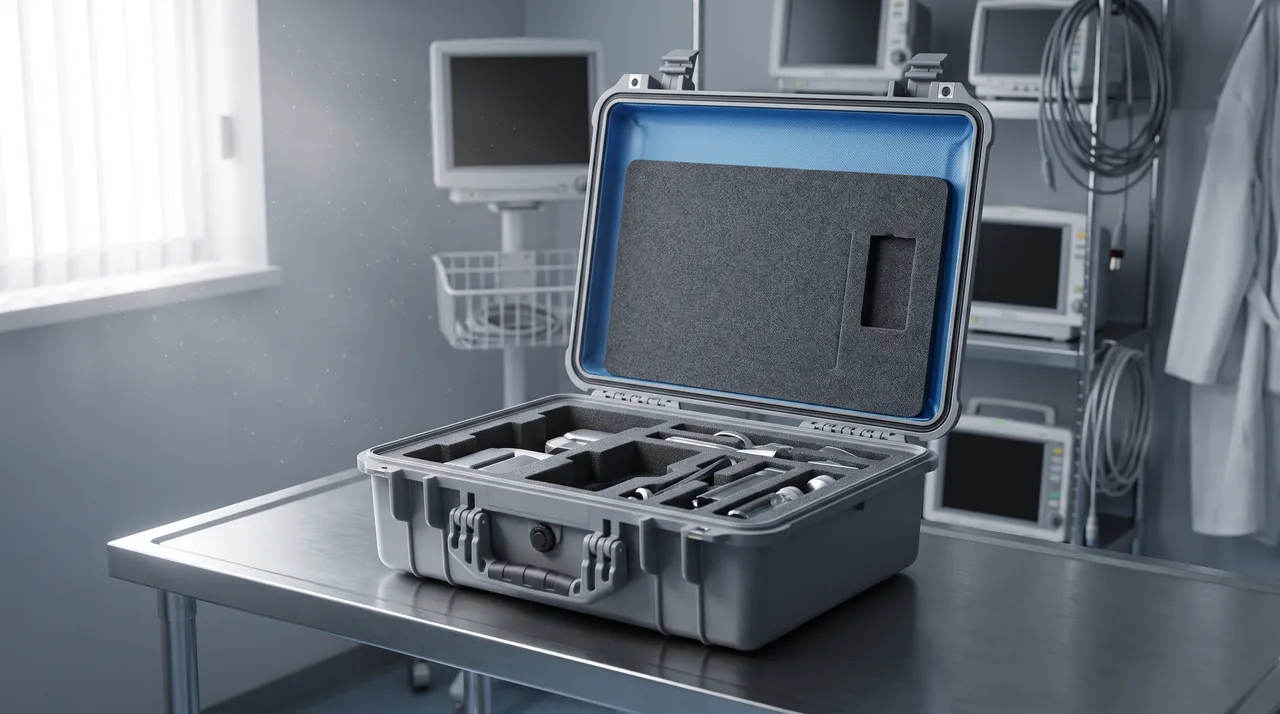
The insert is the highest-return component of an irrigation equipment case. Its job is not to fill space but to lock components into defined positions under vibration and impact while designing the retrieval path into the structure.
Material selection. EVA offers good rebound and precise cutting, suiting controllers, probes, precision valves, and other complex shapes. PE foam, including XPE and IXPE, costs less, offers higher compressive strength and better chemical resistance, and suits heavy items such as pump bodies and valve blocks plus geometrically simple parts. PU foam cushions well but is moisture sensitive and should be used cautiously in humid environments with desiccant.
Design workflow.
- Build a contents list with 3D data, covering all accessories, cables, manuals, calibration solutions, and spare seals.
- Zone by function: electronics zone requiring moisture and ESD control, probe zone requiring hydration and damping, valve zone with ports oriented upward, glass instrument zone with isolated cavities, and consumables zone with counted compartments.
- Determine center of gravity and lifting attitude, placing the heaviest items near the geometric center and ensuring one person can lift the assembly smoothly.
- Design the retrieval sequence: probes, calibration solutions, and common tools needed on commissioning day go to upper fast-access positions; low-frequency spares go to the base layer.
- Leave tolerance and compression allowance, sizing cutouts to part surface sensitivity and foam compression characteristics so the insert never becomes too tight to extract.
Structural approaches for fast retrieval. Common options include extractable compartment trays, hinged upper layers, and soft inner bags with handles. For irrigation projects where work happens in humid conditions, an inner liner bag that lifts out as a unit lets calibration preparation happen outside the head station or in a dry area, reducing the time electronics sit in humid air. Partitioning logic is covered in Removable Divider Systems for Protective Cases.
Dedicated probe cavity design. Use an upright isolated cavity with a cushioning pad at the base, a retaining claw at the opening, and enough headroom for the hydration cap. The cavity should be separated from the main insert so main-cavity impacts are not transmitted.
The full insert design process and sampling requirements are described in Custom Foam Insert Design Guide and EVA Foam Insert Customization Process.
9. Pressure Equalization and Thermal Cycling: The Hidden Cross-Climate Risk
A pressure equalization valve allows gas to pass slowly while blocking liquid water. For irrigation equipment cases, three scenarios make it necessary.
- Cross-altitude shipping. Shipping from a lowland factory to a highland greenhouse park drops external pressure, creating internal positive pressure that can lift the lid and push the gasket aside.
- Rapid thermal change. Moving from winter outdoor air into a heated building warms the case surface while the interior stays cold, producing internal negative pressure that draws moisture in. For irrigation cases, where humidity is the primary enemy, this is the most dangerous class of condition.
- Air and long-haul transport. Cargo hold pressure and temperature change rapidly, and repeated cycling accelerates gasket fatigue.
Mounting recommendations. Locate the valve away from direct rain exposure and away from washdown spray direction, typically on the upper side wall or in a non-load-bearing area of the lid. Confirm that the valve's own ingress rating matches the case rating, so it does not become the weak link.
Temperature and materials. Greenhouse heat accelerates gasket aging and permanent set. Specify the operating temperature range in the technical agreement and match seal material to it. If the case holds temperature-sensitive calibration solutions or electronics, evaluate whether insulation or a phase-change layer is needed.
The principle and selection criteria for equalization components are covered in How a Case Pressure Equalization Valve Works, and overall environmental design thinking in Case Sealing and Shock Protection Design.
10. Size Classes and Selection: From the Drip Head Station to the Greenhouse Control Cabinet
Selection should not start with "how big a case do I need" but from the downstream handling unit and working method. Irrigation equipment cases serve five main handling units: the equipment bench in a greenhouse head station, the contractor vehicle bed, standard pallets, racking shelves, and manual carrying.
Manual handling limits. For a case one person carries frequently, a loaded mass under roughly 25 kg is a reasonable target; above that range, switch to fixed installation or a trolley. Irrigation sites often have wet, slippery floors and narrow passages, which makes portability more important than in field machinery.
Head station space fit. Head stations are usually cramped, so cases should support vertical stacking or wall mounting and allow label reading without opening. For a spare-parts case kept permanently in the head station, choose a form with wall restraint and anti-tip features.
Coordination with piping layout. Keep cases away from direct washdown spray and from drip points, since sustained water exposure degrades seals and labels.
Pallet and racking fit. For 1200 x 1000 mm or 1200 x 800 mm standard pallets, base dimensions should divide evenly or follow a defined pattern to avoid voids and unstable stacking.
| Case class | Reference external length | Suggested loaded mass | Suitable components | Handling unit |
|---|---|---|---|---|
| --- | --- | --- | --- | --- |
| Hand-carried | 300 to 450 mm | 5 to 12 kg | EC/pH probes, O-rings, calibration solutions, small valves | Manual carry, head station wall mount |
| Portable mid-size | 450 to 650 mm | 12 to 25 kg | Controllers, solenoid valve banks, flow meters, tools | Manual carry, layered vehicle storage |
| Large project class | 650 to 1000 mm | 25 to 50 kg | Fertilizer pumps, proportional injectors, filter banks | Fixed vehicle position, pallet |
| Modular case set | Configured per project | Per design | Complete fertigation spare kits and valve banks | Head station bench, standard pallet |
Why modular sets matter. For equipment like a fertigation unit that mixes many component classes, use a modular case set in one size family: a controller case, a probe case, a valve case, and a consumables case, each independent but sharing a common base locating feature and labeling system so they can be stacked and combined. This allows flexible project configuration and lets a single damaged module be replaced on its own.
11. Special Considerations for Drip and Micro-Sprinkler Spare Kits
Drip and micro-sprinkler spares have distinctive characteristics: low unit cost, high quantity, very fine specification differences, and a high risk of mix-up.
Specification mix-up is the biggest risk. Emitter flow rates, pipe diameters, and fitting sizes differ only marginally between adjacent models and are hard to distinguish by eye. The solution is compartmentalization by specification plus clear labeling plus counting units. Use extractable small trays, label each with the flow code and diameter, and place a specification reference table inside the lid.
Pipe coiling radius. PE pipe, drip line, and hose should not be stored in small-radius bends. Use large-diameter coiling racks or divided channels so components retain a natural bend radius and do not take permanent creases.
UV protection. Drip lines and some fittings are themselves UV sensitive and embrittle in long outdoor storage. Cases should block light, or inserts should include a shade layer.
Separate compartments for O-rings and rubber parts. Irrigation systems use many O-ring sizes and materials. Use a two-dimensional grid of material and size with material codes marked in each compartment to prevent mixing.
Field repair scenario. The most common on-site task in a drip system is leak detection and fitting replacement. Retrieval logic should therefore prioritize fast identification and one-handed access rather than maximum capacity. This is similar to model-based zoning in agricultural machinery kits but places more emphasis on small-part management.
12. Marking, Traceability, and Spare-Part Coding Integration
Irrigation project spare management is tightly bound to project, system zone, and equipment model. A single fertigation spare case often serves multiple irrigation zones across a park, so the marking system has to support rapid location.
Six classes of marking should be designed in.
- Unique case number. For asset management and movement records.
- Equipment and project marking. State the applicable model, system zone, and project number.
- Contents QR code. Scanning displays the full list, quantities, and storage positions.
- Calibration item expiry marking. Calibration and standard solutions have shelf lives, so record the opening date and expiry.
- Ingress rating and washdown notes. State whether high-pressure washdown is permitted and which zones are washable.
- Material reference marking. Seal and insert material codes so field replacements use the correct part.
Marking durability is critical. Greenhouse humidity and fertilizer salt accelerate label peeling and legibility loss. Use in-mold labels, laser etching, or high-weathering polyester labels, and validate adhesion and media wipe resistance. For integration with engineering management systems, case numbers can map to project number, system zone, and equipment tag so a scan retrieves the contents list and spare consumption record. JUNZHJIA can pre-form nameplate recesses and reserved label faces to a customer's coding rules in OEM/ODM projects and support first-article approval for consistency through volume production.
13. Reliability of Hinges, Latches, and Gaskets
Irrigation equipment cases are opened more often than field machinery cases, because parts are accessed during both commissioning and operation. This places higher durability demands on hinges, latches, and gaskets.
Hinges. Avoid self-tapping screws driven directly into plastic. Prefer metal inserts, through-shafts, or integrally molded hinge bosses. In humid environments, pin material should resist corrosion so that rust does not cause binding. Hinge failure is usually gradual: play develops first, then the lid and body mating surfaces misalign, and sealing eventually fails.
Latches. Prefer forms with a clear operating force, one-handed operation, and an anti-accidental-opening feature. More importantly, tension should be adjustable, because gaskets take a permanent set under long compression and elevated temperature, and the latch must compensate for clamping force. For cases opened frequently in a head station, choose latches with a definite detent feel to prevent false locking.
Gaskets. The gasket is a consumable and must be replaceable. Selection criteria include material, where EPDM generally outperforms standard NBR outdoors and in high humidity, hardness, cross-section, and media resistance. In combined fertilizer salt and heat exposure, gasket aging accelerates noticeably, so shorten the inspection interval. Replacement specifications and recommended intervals belong in the technical agreement.
Purchasing recommendation: require the supplier to provide gasket replacement specifications, material codes, and a recommended replacement interval. This small clause determines whether the case still meets its nominal rating at year three or year five.
Matching relationships and common failure modes for hinges, latches, and gaskets are covered systematically in Toolbox Hinge, Latch, and Gasket Selection, and long-term decay of protection performance in Protective Case Service Life and Retirement Criteria.
14. OEM/ODM Customization and Sample Control
Customization of irrigation equipment cases comes from two sources: fertigation and irrigation equipment makers needing factory packaging or a supplied spare-parts case, and greenhouse contractors needing field turnaround cases that match a project management system.
Step one: requirements and constraints. Define the contents list, use scenario (factory packaging or field turnaround), target ingress rating, media resistance requirements, probe and calibration item protection needs, marking and coding rules, and volumes with delivery cadence.
Step two: structural concept. Produce case dimensions, material and media resistance scheme, rib layout, hinge and latch type, gasket material, whether pressure equalization is needed, and whether wall-mount or stacking features are required.
Step three: insert and dedicated cavity design. Build cutout geometry from component 3D data, with particular attention to isolation and restraint for the probe cavity, glass instrument cavity, and calibration solution position.
Step four: sampling and first-article approval. Samples must validate appearance and dimensions, opening feel, sealing test results, insert fit and access convenience, probe cavity attitude locking, and marking legibility. First-article approval should be documented as the batch acceptance baseline.
Step five: production and inspection. Apply the agreed sampling plan for appearance, dimensional, and functional checks; sample sealing performance at agreed frequency; and add full-case mist or immersion testing for cases claiming an IP rating.
Step six: packing, shipment, and documentation. Deliver test documentation, gasket specification sheets, use and maintenance instructions, and a spare-parts list template.
Cost structure and tooling investment logic are covered in Custom Case Mold Cost Analysis, and supplier evaluation criteria in How to Choose a Protective Case OEM Factory. JUNZHJIA, manufactured by Kexin New Materials (Guangdong) Co., Ltd., supports wholesale, distribution, OEM/ODM, and global supply programs, and provides ingress and environmental test documentation on request.
15. Acceptance, Inspection, and Life-Cycle Management
The protective capability of an irrigation equipment case is consumed by use, so an inspection regime matched to the working rhythm is essential.
Inbound acceptance, per case. Check for cracks and deformation, gasket seating, latch closing with a definite detent, hinge play, and legible markings. For cases rated IP65 or IP67, sample sealing tests at the agreed frequency.
Quarterly inspection. Check whether the gasket has hardened, swollen, cracked, or lost elasticity; whether hinge pins have corroded or loosened; desiccant condition; insert powdering or permanent deformation; hydration cap and storage solution condition in the probe cavity; and whether calibration solutions have expired.
Pre-commissioning check. Confirm probes are intact with adequate storage solution; confirm calibration solutions are within shelf life; confirm contents match the QR record; confirm valve port caps are present; and confirm retrieval order matches field practice.
Post-use reset. After a part is used, refill the position or install a placeholder module so remaining components cannot migrate and cause secondary impact. Pay particular attention to never returning wet components to the case. Valves and fittings removed on site usually carry residual fertilizer solution, which should be flushed and dried outside the case first, otherwise it creates a corrosive micro-environment inside.
End-of-life assessment. Base retirement decisions on sealing performance, structural rigidity, and latch function, plus media aging indicators such as insert swelling and gasket hardening or cracking. The sensible approach is periodic replacement of gaskets and inserts rather than whole-case scrapping. Cleaning and care methods are covered in How to Clean a Protective Case.
| Management stage | Inspection content | Acceptance criterion | Action |
|---|---|---|---|
| --- | --- | --- | --- |
| Inbound acceptance | Appearance, gasket, latches, hinges, markings | No cracks, gasket seated, latches engage | Reject or batch re-inspect |
| Quarterly check | Gasket elasticity and swelling, desiccant, insert, probe cavity | Good rebound, desiccant not saturated | Replace gasket or desiccant |
| Pre-commissioning check | Probes, solution expiry, port caps, contents match | Record matches, solutions valid | Complete before release |
| Post-use reset | Wet parts handled, vacant positions filled | No liquid-bearing parts, nothing loose | Flush and dry, refill or pad |
| Retirement review | Sealing, rigidity, latches, insert aging | Clear failure in any one | Replace gasket or insert, or retire |
16. Purchasing Decision Checklist
The engineering logic translates into purchasing actions as follows.
First, define the scenario before the rating. Clarify factory packaging versus field turnaround, sheltered versus open storage, and whether high-pressure washdown is used. Derive IP54, IP65, or IP67 from that, not the reverse.
Second, split the pack by component group. Controllers and electronics, probes and sensors, valves and actuators, piping and fittings, and glass instruments each need their own protection strategy. If a supplier can only offer a single general-purpose case, one group is usually carrying excess risk.
Third, write media resistance requirements explicitly. State the approximate fertilizer composition and concentration range and the cleaning agents used, and require the supplier to document seal and insert material compatibility.
Fourth, put probe and calibration item protection into the contract. Probe cavity structure, hydration caps, storage solution, and calibration solution positions with expiry management are baseline requirements in irrigation projects, not options.
Fifth, agree on testing and documentation. Specify drop, random vibration, and stacking test items and acceptance criteria referencing ISTA and the GB/T 4857 series, sealing test frequency, and ingress rating documentation where required.
Sixth, agree on replaceable parts and intervals. Gaskets, inserts, desiccant, and latch springs should all be listed as replaceable with recommended intervals. This clause determines life-cycle cost.
Seventh, agree on marking and traceability rules. Case number, project number, equipment tag, and contents QR coding should be confirmed at the sampling stage and locked by first-article approval.
Eighth, evaluate engineering capability rather than price alone. Differences in irrigation equipment cases show up in insert design, media-resistant material selection, and sealing structure, not in appearance. The evaluation framework in Instrument Case Selection Guide is a useful reference.
Frequently Asked Questions
Q: Does a fertigation unit's shipping case need to be IP67?
A: Usually not, and choosing IP67 without justification creates new problems. The transport and storage environment for a fertigation unit is mainly road transport, sheltered or partially sheltered warehouses, and greenhouse head stations, so true short-term immersion is uncommon. IP65, dust tight plus water jet resistant, already covers rain, spray, and low-pressure washdown, and offers the best value. The structural cost of IP67 is that it approaches airtight, which brings pressure differential problems: shipping from a lowland factory to a highland park, or moving from winter outdoor air into a heated building, can lift the lid, displace the gasket, or produce a lid pop on opening. If IP67 is genuinely required, for example where an open staging area may flood or where full-case high-pressure washdown is used, evaluate pressure equalization at the same time and confirm that the valve rating matches the case rating. Also note that ratings are not permanent. Gaskets age faster in humid fertilizer salt environments, so list the gasket as a replaceable item with a defined interval.
Q: What typically goes wrong with EC and pH probes in transit, and how does the case address it?
A: Three problems dominate. First, mechanical impact shatters the glass bulb, and a broken bulb ends the probe's life. Second, the electrode dries out, and after dehydration the sensitive membrane responds slowly and the slope drifts, requiring reactivation or replacement even without physical damage. Third, storage solution leaks out, which both removes hydration protection and can contaminate other components and electronics in the case. The solution is a dedicated probe cavity: an upright cavity with soft lining, a retaining claw at the opening to hold attitude, a cushioning pad at the base, and full headroom for the hydration cap. More importantly, this cavity should be physically isolated from the main cavity so impact from heavy items such as pump bodies and valve blocks is not transmitted. Mark the case "do not invert" and design attitude locking into the insert. In practice, mixing probes with valves and pumps in the same compartment is the most common error and should be avoided outright.
Q: How much does fertilizer salt exposure shorten gasket life, and how should the material be chosen?
A: The effect is significant, and it is one of the biggest differences between irrigation cases and general industrial enclosures. Fertilizer solutions typically contain nitrates, phosphates, sulfates, and potassium salts, which form an electrolyte film on case surfaces; combined with persistent greenhouse humidity and summer heat, this accelerates gasket aging. Observable effects include hardening, loss of rebound, cracking, and swelling under prolonged contact with concentrated fertilizer. On material selection, EPDM performs well in weather resistance, water vapor resistance, and aging resistance, making it a common first choice for outdoor and humid applications. NBR works well with mineral oils but is weaker against ozone and some highly polar media. FKM offers outstanding temperature and chemical resistance for positions contacting varied fertilizer formulations, at higher cost. Do not select on the word "rubber" alone. Require the supplier to state the material code, hardness, operating temperature range, and compatibility notes. For cases kept in humid head stations, shorten the gasket inspection interval and put replacement specifications and intervals into the technical agreement.
Q: Is EVA or PE better for the insert?
A: It depends on the components and the corrosive environment. EVA has good rebound and cuts precisely enough to conform to complex shapes, suiting controllers, EC and pH probes, precision valves, and flow meters. It is the most versatile choice for irrigation equipment cases. PE foam, including XPE and IXPE, costs less, offers higher compressive strength and better chemical resistance, and suits heavy items such as fertilizer pumps and valve blocks, geometrically simple parts, pipe compartments, O-ring and fastener trays, and base load-bearing layers. Pay particular attention to PU foam: it cushions well but can hydrolyze in long-term humid conditions, so in greenhouse projects it requires desiccant and shorter inspection intervals. Real projects usually combine materials: PE for the base and load paths, EVA around precision parts for conformance and restraint, and extractable compartment trays for high-frequency small parts. A workable rule of thumb is to decide by two questions: does the component have a complex contour requiring conformance, and will the zone be washed frequently? Complex plus dry points to EVA, simple plus washed points to PE. Material trade-offs are compared in Case Foam Material Comparison.
Q: Drip system spares differ only slightly in specification. How do we prevent picking the wrong one on site?
A: This is the core pain point in drip and micro-sprinkler spare management and the most common cause of rework. Emitter flow rates, pipe diameters, and fitting sizes between adjacent models often differ by a fraction of a millimeter or one flow grade and are nearly impossible to distinguish by eye. Three practices work. First, use a two-dimensional grid of specification and material, labeling each compartment with the flow code, diameter, and material code, and place a complete specification reference table inside the lid. Second, use extractable small trays so the whole tray can be carried into good light for verification instead of being searched inside the case. Third, establish counting units with a fixed quantity per compartment and replenish after use, preventing mixed stock from accumulating. Retrieval logic should also prioritize fast identification and one-handed access rather than maximum capacity. The most common on-site task is leak detection and fitting replacement, which requires getting the correct specification within seconds, not packing every specification into one case.
Q: What transport tests should an irrigation equipment case undergo, and to which standards?
A: Cover at least four items: worst-case drop, random vibration simulating road transport, stacking at the actual number of levels with margin, and concentrated-load impact from heavy components. Two systems can be used in parallel. The ISTA series emphasizes reproduction of real distribution chains and suits packaging validation for shipments from equipment makers to project sites. The GB/T 4857 series covers the basic test methods for transport packages in China, including drop, stacking, vibration, and impact, and is more common in domestic tendering and acceptance. One recommendation specific to irrigation equipment is to apply hot-humid preconditioning before drop or vibration testing. Gaskets in greenhouse environments soften as they absorb moisture and heat, so passing at ambient conditions does not prove reliability in service. Acceptance criteria should not stop at whether the case cracked. Check for probe cavity displacement, glass instrument integrity, loose quick couplers, permanent gasket flattening, and whether latches still close properly. Where a project reuses an existing case size, the same fixture and drop heights should be retained so results remain comparable between shipments.
Q: The head station is cramped and humid. How should spare-parts cases be positioned?
A: Address it at three levels. First, form factor: prefer cases that support vertical stacking or wall mounting and provide a labeling face so contents can be identified without opening. For cases kept permanently in the head station, add wall restraint and anti-tip features so narrow passages do not knock them over. Second, location: keep cases out of the direct washdown spray path and away from pipe drip points, since sustained water exposure significantly accelerates gasket and label aging, and avoid placing them directly under cold surfaces where condensation forms. Third, retrieval method: use an inner liner that lifts out as a unit so probes and calibration solutions can be prepared in a dry area outside the head station, reducing the time electronics spend in humid air. Also note that high humidity saturates desiccant faster, so shorten the replacement interval and post the replacement record inside the lid so it is actually followed. A wall bracket plus a lift-out liner together solve most of the space and humidity problem at relatively low cost.
Q: As a contractor, can I ask the factory to customize markings to our project coding system?
A: Yes, and the benefit is clear for irrigation projects with multiple zones and equipment tags. Typical content includes a unique case number, project number and system zone marking, equipment tag, contents QR code, calibration item expiry field, ingress rating and washdown notes, and a seal material code reference table. The critical requirement is durability, because greenhouse humidity and fertilizer salt accelerate peeling and legibility loss in ordinary printed labels. Use in-mold labels, laser etching, or high-weathering polyester labels and validate adhesion and media wipe resistance. For integration with engineering management systems, a mapping of case number, project, system zone, and equipment tag lets a scan retrieve the contents list and spare consumption record. JUNZHJIA can pre-form nameplate recesses and reserved label faces to a customer's coding rules in OEM/ODM projects and support first-article approval to keep volume production consistent. Confirm the full coding structure during sampling, and remember that a marking scheme must survive the rinse cycle, not just the warehouse.
Conclusion and Related Reading
The engineering difficulty of greenhouse and irrigation equipment cases comes from an easily underestimated fact: the service environment is harsher than the transport environment. A few hours of road vibration can be quantified and solved through insert design, but years of humidity, fertilizer salt, and repeated washdown in a head station are what actually determine whether spares are still usable three years later. The core of fertigation protection is therefore not making a stronger box but getting three things right at once: a sealing system that controls moisture and corrosion, media-resistant material selection, and a retrieval structure that supports field calibration.
The logic reduces to seven purchasing principles:
- Define the scenario before the IP rating to avoid unnecessary structural cost for IP67.
- Split the pack by component group so controllers, probes, valves, piping, and glass instruments each get suitable protection.
- Put media resistance requirements in the agreement and disclose fertilizer chemistry and cleaning agents to the supplier.
- Probes need a dedicated cavity with hydration, damping, and anti-inversion all in place.
- Calibration solutions must be stored separately and managed by expiry date.
- Airtight cases need pressure equalization, or altitude and temperature changes will cause problems.
- Gaskets and inserts are replaceable consumables, and this clause governs life-cycle cost.
JUNZHJIA, manufactured by Kexin New Materials (Guangdong) Co., Ltd., serves fertigation unit makers, irrigation equipment factories, greenhouse integrators, and agricultural facility supply chains with protective cases for wholesale, distribution, OEM/ODM, and global supply programs, offering model-specific custom inserts, probe cavities, and marking systems, plus ingress and environmental test documentation on request for inclusion in purchasing agreements.
Related Reading