

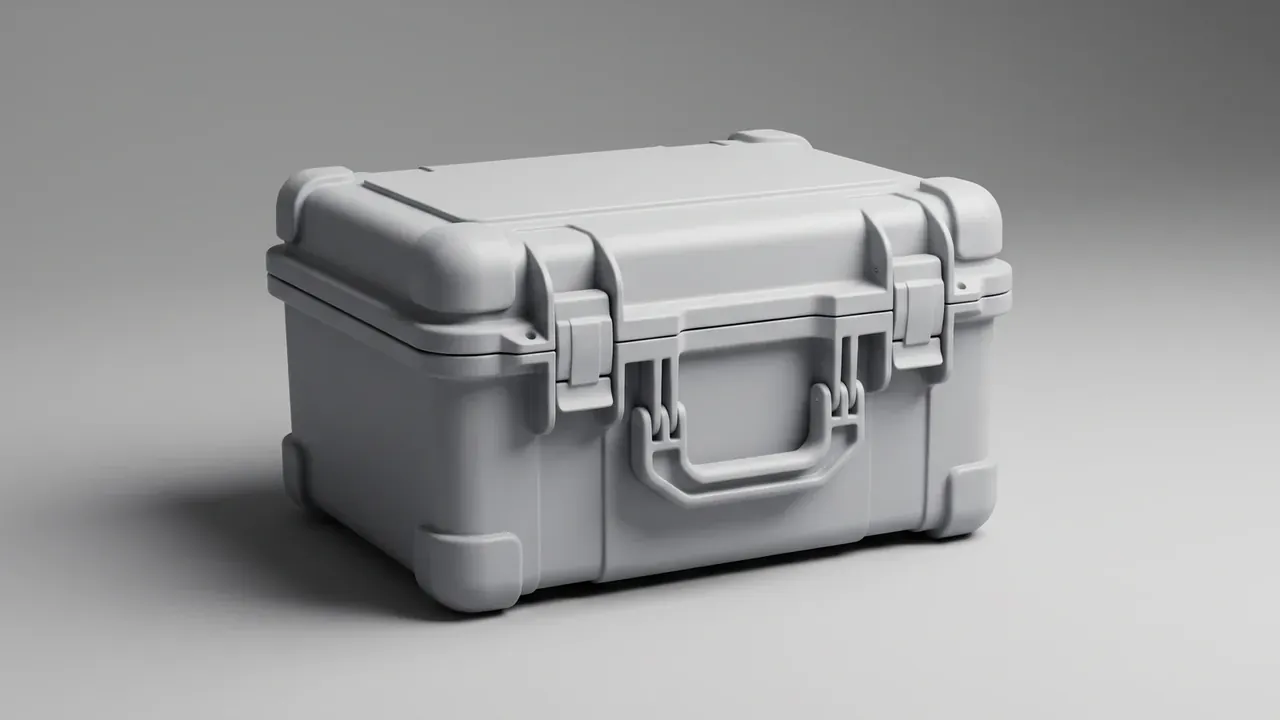
Quick answer: An Ordnance Packing Box is settled by five process points: rotomoulded walls with graded thickness, an insert on moulded lugs, a groove with set cord compression, over-centre latches, and a seal hole in the latch seat.
Table of contents
- Where the Ordnance Packing Box Gets Its Shell
- Insert Fit and How It Is Held
- Gasket, Valve and Moisture Control
- Latches, Hinge Pin and Strap Channels
- Marking Pads and Seal Holes
- FAQ
1. Where the Ordnance Packing Box Gets Its Shell
The shell of an Ordnance Packing Box is rotationally moulded, so thickness is graded, not welded: 6.5 mm walls, 9 mm corners. Powder at 35 mesh swings at 280 °C for twelve minutes, then water cools it for eight, holding thickness within 0.8 mm.
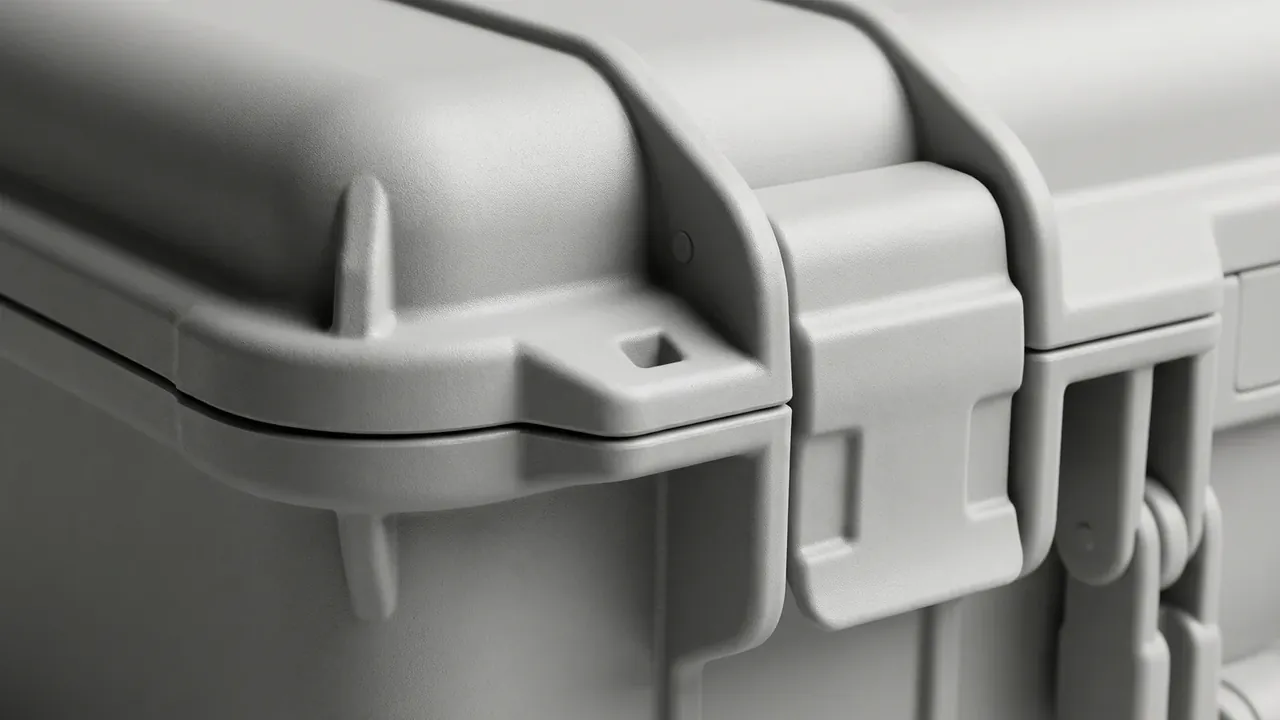
Load gathers in the four corners and two bottom edges, never at mid-base, so the tool is built up 2.5 mm there, with recesses 1.5 mm deep for the insert lugs. The rim flange goes to 10 mm, since every latch load passes through it.
| Zone | Wall | Made by | Does |
|---|---|---|---|
| Corner | 9 mm | tool build-up | resists drop cracking |
| Rim flange | 10 mm | extra water line | carries latch load |
| Base | 7.5 mm | thickened floor | resists stacking |
Past 9 mm a corner buys 5 cm of drop height for three more minutes of cooling.
2. Insert Fit and How It Is Held
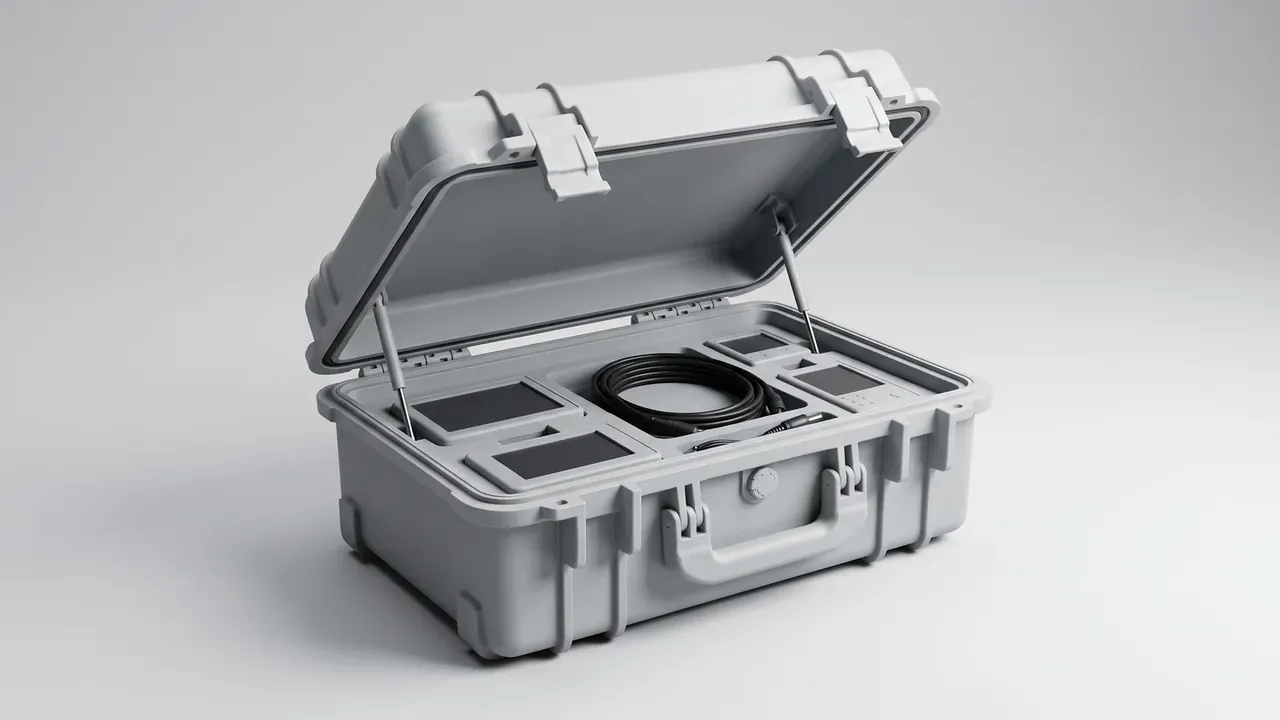
An insert is a matched pair of cavities, not a foam sheet: the lower one is routed, the upper carries a press rib that squeezes the item 3 mm on closing. Moulded EVA at 38 kg/m³ returns 0.18 MPa at 25 per cent compression; PE foam at 30 kg/m³ takes a permanent set.
It must not be rigidly fixed. A drop bows the wall 2 mm, and a screwed-down insert tears at the seam, so four M5 screws per square metre plus six nylon clips leave 1 mm of float under a rim-set edge.
3. Gasket, Valve and Moisture Control
Sealing is a groove in the rim and a hollow EPDM cord of 9.5 mm, closing from a 5.5 mm deep groove to 7.4 mm, which is 22 per cent compression. Under 15 per cent water seeps through in half an hour; over 30 per cent the closing force passes 200 N.
Three layers do the moisture work: cord for liquid water, 250 g of molecular sieve per 0.1 m³ for vapour, holding 35 per cent internal humidity at 25 °C, and a purge valve cracking at 0.12 bar against temperature swings. The groove is moulded, never milled, since a Ra3.2 burr nicks the cord and leaks after 480 hours of salt spray.
4. Latches, Hinge Pin and Strap Channels
Over-centre latches lock themselves: 6 mm lever travel, 0.5 mm of spring-back past dead centre, 900 N each. Two put 1800 N on a 1.2 m rim, about 150 N per 100 mm; the count follows length.
Strap channels are separate, 3 mm deep and 30 mm wide, set between the latches, not across them. At 800 N the wall moves 0.6 mm in a channel and 1.2 mm over a latch seat. A 5 mm stainless hinge pin in an HDPE bush stays within 0.4 mm after 5,000 cycles.
5. Marking Pads and Seal Holes
Marking needs a flat pad: 130 by 90 mm, sunk 0.3 mm, laser cut 0.15 mm deep and still legible after 0.05 mm wears away.
The seal hole is missed most often. A 4 mm hole is cut through the latch seat and the lid, coaxial within 0.3 mm, taking a 1.8 mm wire and a 6 mm crimp. In the seat, the box cannot open without breaking the wire; in the lid-to-body lap, a gap is pried and the wire left whole.
| Marking | Position | Process |
|---|---|---|
| Name and lot | lid pad | laser, 0.15 mm deep |
| Seal hole | latch seat and lid | 4 mm, coaxial 0.3 mm |
Conclusion
Graded walls absorb the drop, a matched insert stops movement, a moulded groove and sized desiccant hold the interior dry, over-centre latches survive vibration, and a seal hole in the seat makes tampering visible. Each pulls against another: thicker walls cool slower, higher compression closes harder. Settle those numbers on the drawing and an Ordnance Packing Box passes its first sample.
This article discusses only the container (case body) side of specifications and design intent, and does not cover any handling, loading or use of the contents.
Related Reading
- Comparing materials for an ordnance packing box
- Marking and transport rules for an ordnance packing box
- Structure of ammunition and nuclear ordnance boxes
- Acceptance of ammunition and nuclear boxes
Related Products
- 8 Series — Gun Cases; Military Equipment Cases; Camera Equipment Cases; Drone Cases; Watch Cases; Knife Cases; First Aid Cases; Electronics Equipment Cases
- WL8-2812 PP Gun Case — model WL8-2812
- All protective cases and toolboxes: 7 series, 158 models