

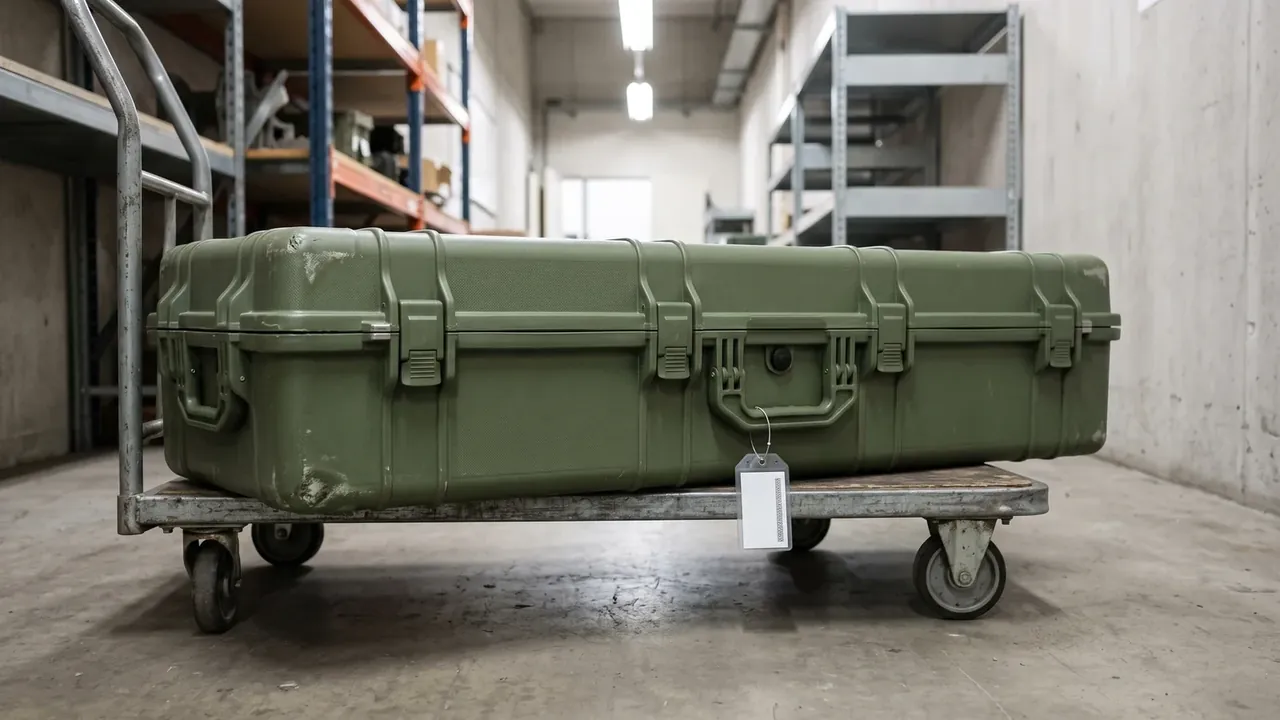
Quick answer: An Ordnance Packing Box price is five blocks: material, tooling, insert, packaging and freight. MOQ follows how far the tooling is spread; lead time starts at drawing freeze.
Table of contents
- What an Ordnance Packing Box Quote Is Made Of
- MOQ and How Tooling Cost Is Amortised
- Sampling and Mass Production Lead Times
- Inspection Gates: First Article, In-Process, Pre-Shipment
- Payment Milestones and Risk Allocation
- FAQ
1. What an Ordnance Packing Box Quote Is Made Of
Quotes usually arrive as one total. Split an Ordnance Packing Box into five blocks and the differences become checkable. An 800×520×340 mm rotomolded case at 800 units costs RMB 412: material 138, tooling 60, insert 74, carton and pallet 26, freight 18.
| Cost block | Priced on | Check this |
|---|---|---|
| Material | Net weight times resin, 8% regrind | Wall thickness and weight |
| Tooling | One-off over committed volume | Basis and mould ownership |
| Insert | Sheet, die, labour | In unit price or not |
| Packaging | Carton, pallet, film | Pallet quoted or not |
| Freight | Volumetric against actual | Which basis applies |
Material is where discounts do damage. The shell is 9.6 kg at a 4.0 mm wall; at 5.0 mm it reaches 11.8 kg and costs RMB 25 more. A supplier who accepts the thicker wall without repricing recovers it through regrind ratio.
Tooling is one-off, so the argument is the amortisation basis. The same RMB 48,000 mould costs RMB 160 per unit over 300 pieces and RMB 60 over 800.
2. MOQ and How Tooling Cost Is Amortised
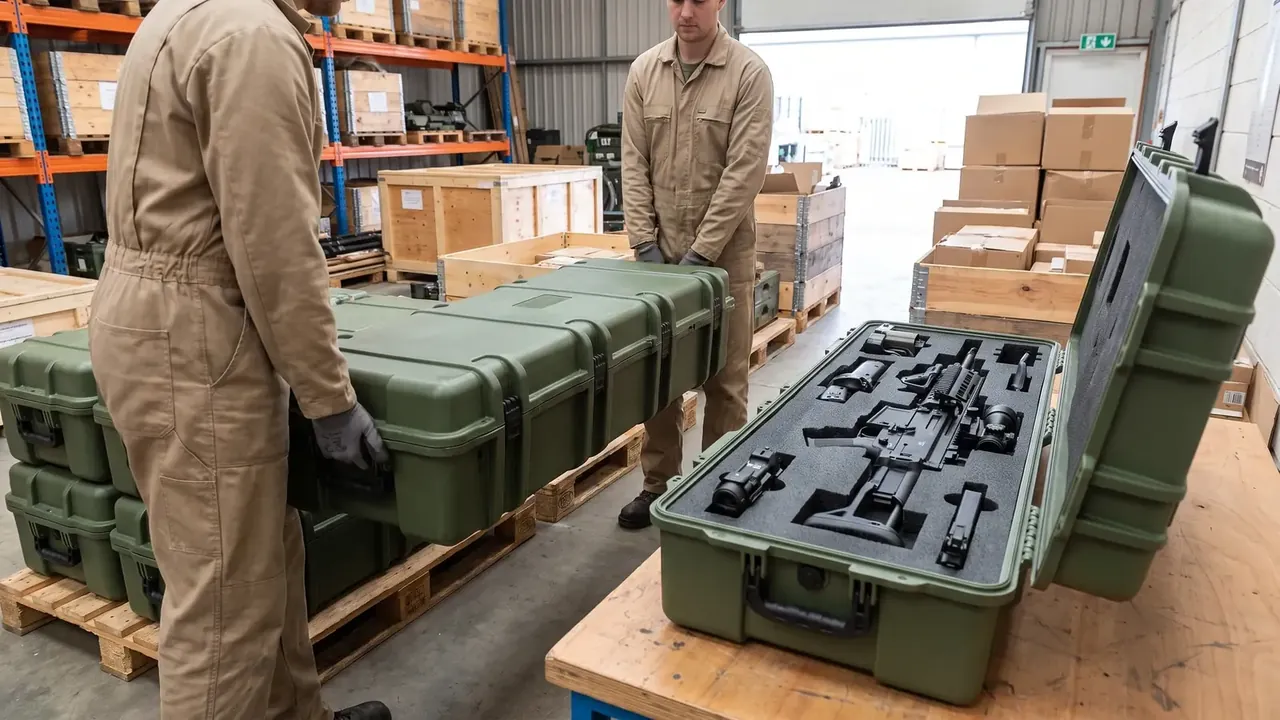
MOQ is not a capacity limit but a cost-sharing result: mould change, material change and purging take fixed time a short run cannot absorb.
| Tier | Quantity | Effect on unit price |
|---|---|---|
| Trial, existing mould | 200 units | Tooling over 800, rebate on reorder |
| Colour change | 400 units | 40 minutes purging, plus RMB 12 |
| New mould | 800 units | Full amortisation, lowest price |
Colour changes set a higher floor than buyers expect. Rotomolding needs 40 minutes of purging and the first three shots are transition material; injection needs over 20 shots to stabilise. Below 400 units plants add a surcharge or blend those shots into the order, the usual origin of colour drift.
3. Sampling and Mass Production Lead Times
Lead time starts at drawing freeze. A printed mock-up ships in 8 days and proves outline and insert layout only, not wall thickness, latch force or sealing. A moulded sample waits for the tool: 26 days, then 3 days of T1 trials, and those 26 days belong in the plan when sealing has to be proven.
Mass production runs 32 days: material 5, rotomolding 8, trimming and assembly 6, inserts 6, packing 2, inspection and loading 5. Inserts run in parallel if the die is released after T1, saving about 7 days.
4. Inspection Gates: First Article, In-Process, Pre-Shipment
Three gates cover an order, and skipping one pushes the problem past loading: the first article covers dimensions, in-process covers consistency, pre-shipment covers deliverability.
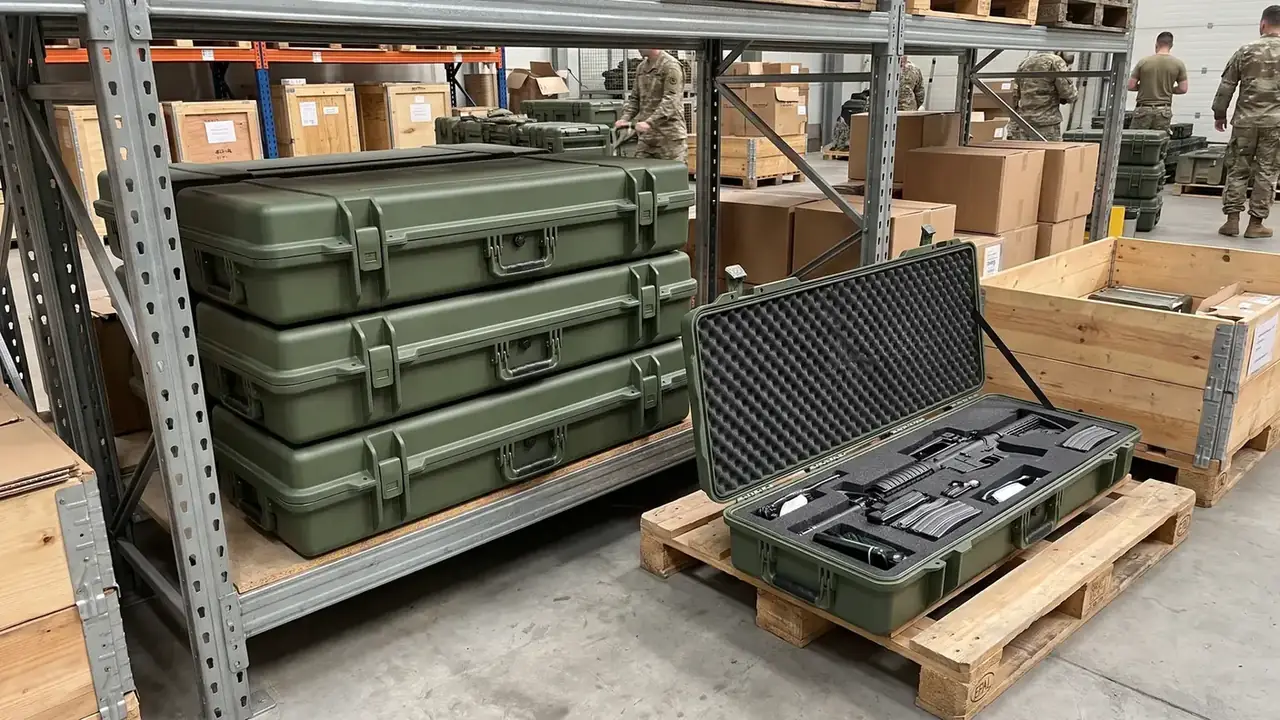
The first article takes 3 units and 11 dimensions: cavity and outer length, width and height, lid step height, wall thickness at three points, latch spacing.
In-process inspection pulls 2 units per 50 for wall drift and latch force, which should sit between 180 and 220 N; below that the seat has deformed or the gasket is too thick. Pre-shipment uses AQL 2.5 and 0.65, or 13 units out of 800, with sealing, latches and hinges critical.
5. Payment Milestones and Risk Allocation
Payment ratios allocate risk. An Ordnance Packing Box order runs long, tooling first, so each milestone sits on an inspection gate: 30% against signed drawings, 60% against a passed pre-shipment check and a bill of lading copy, 10% retention 30 days after acceptance.
Tooling ownership transfers at 60% paid, and the plant may not cut it for a third party. Price review reopens only beyond an 8% resin move. Delay liability is 0.3% a week, capped at 5%, deductible from retention.
Conclusion
Negotiation over an Ordnance Packing Box comes down to three sheets: a quote split into five blocks, a tooling clause naming the amortisation quantity, and a payment table aligned with inspection gates. When they disagree, a low price is repaid in lead time. Normalise wall thickness, net weight and insert thickness first; the remaining gap is the only real difference on an Ordnance Packing Box.
This article discusses only the container (case body) side of specifications and design intent, and does not cover any handling, loading or use of the contents.
Related Reading
- Marking and transport requirements for ordnance packing boxes
- Material comparison for ordnance packing boxes
- How to answer an inquiry with a usable quotation
- A working checklist for supplier qualification
Related Products
- 8 Series — Gun Cases; Military Equipment Cases; Camera Equipment Cases; Drone Cases; Watch Cases; Knife Cases; First Aid Cases; Electronics Equipment Cases
- WL8-2812 PP Gun Case — model WL8-2812
- All protective cases and toolboxes: 7 series, 158 models