

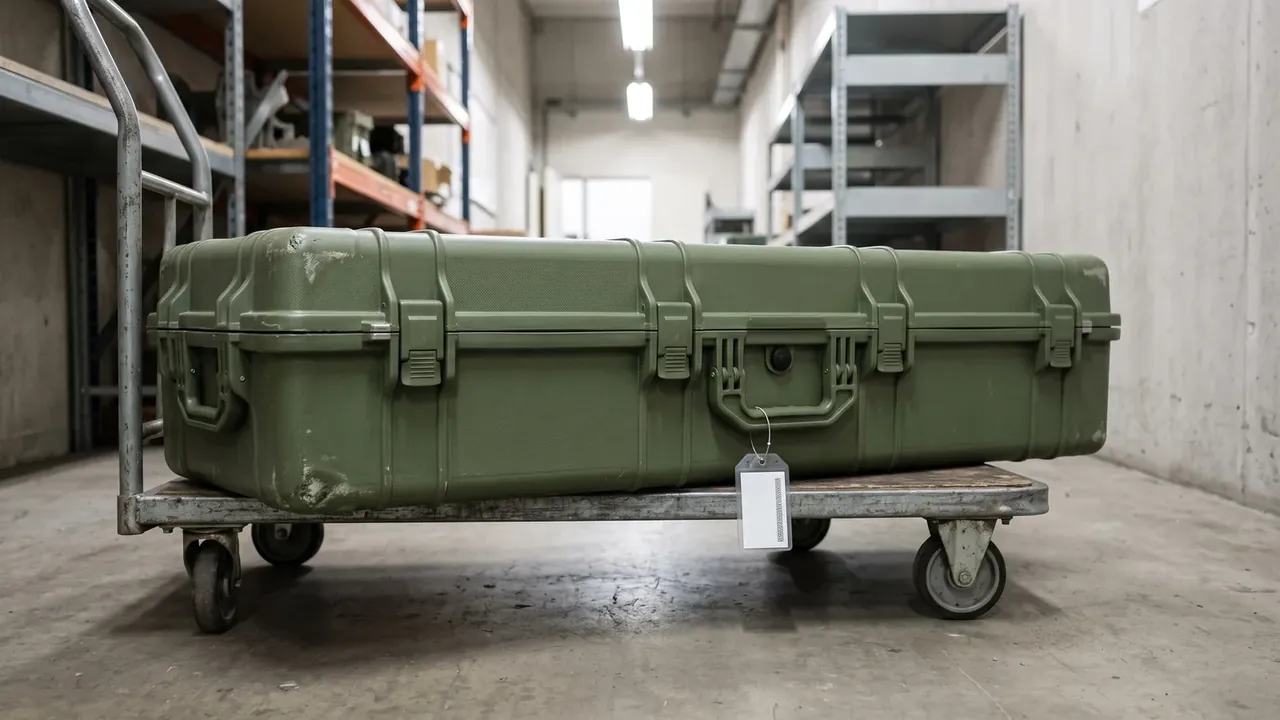
Quick answer: An ordnance packing box is specified from the cavity outwards: payload envelope plus 5 mm a side, an outside that closes the wall-and-rib chain, walls from 5 mm with 8 mm corners, and load checked as stack weight times 1.5.
Table of contents
- How an Ordnance Packing Box Specification Is Built
- Wall Thickness by Moulding Process
- Load Stacking and Safety Factor
- Tolerances and Sealing Class
- Four Lines the Sheet Usually Misses
- FAQ
1. How an Ordnance Packing Box Specification Is Built
A specification sheet usually starts at the outside. The cavity is the origin: measure the payload envelope, add 5 mm a side for gloved handling, then add wall and rib back.
| Item | Value | Basis |
|---|---|---|
| Cavity | 780×480×360 mm | Payload plus 5 mm a side |
| Wall and rib | 5 + 8 mm | Minimum section, load path |
| Outside | 806×506×386 mm | Cavity plus 2×(wall + rib) |
The chain has to close: taking the wall from 5 to 6 mm grows the outside 2 mm per face and breaks a two-across pallet pattern. Keep 10 mm between the payload top and the lid liner, or the foam compresses hard and the clamp load lands on the latches.
2. Wall Thickness by Moulding Process
Wall thickness is the first item squeezed because it maps onto weight and price. The cost of thinning does not appear in the new box; it appears two years later, in the stack.
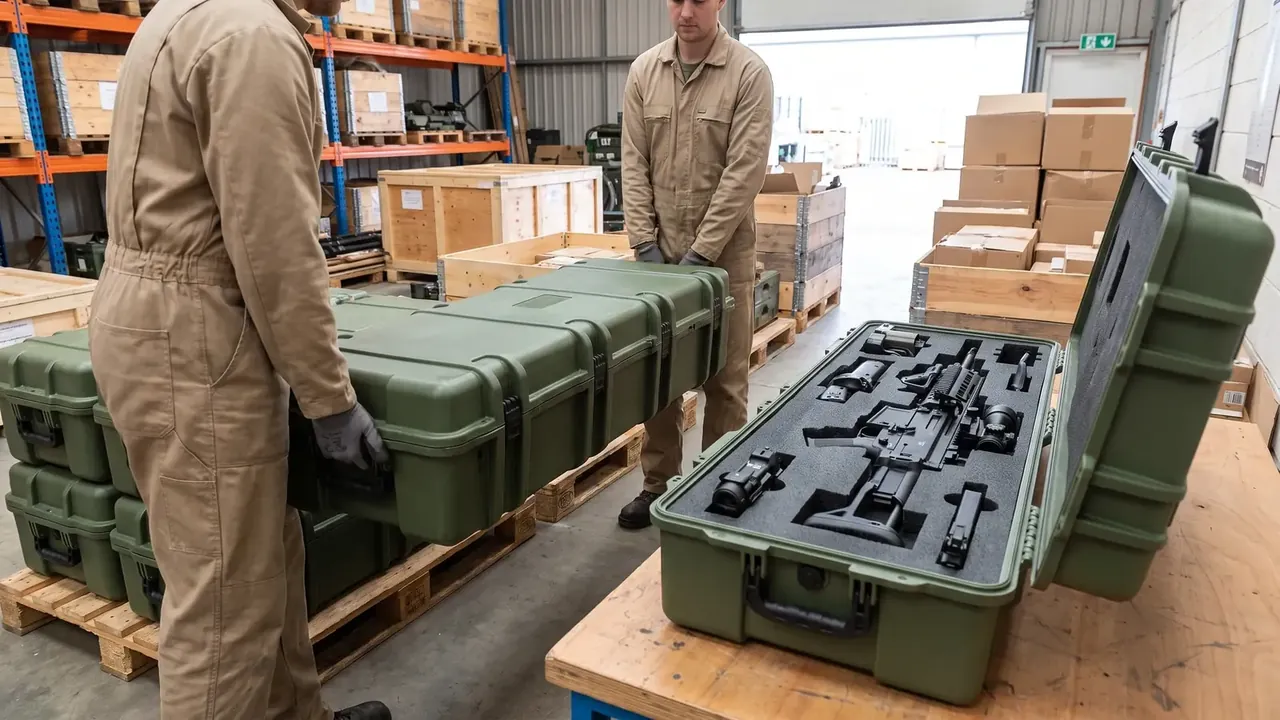
Rotomoulding runs 5–6 mm with 8 mm corners and 13.5 kg; injection runs 3–4 mm with ribs and 6.8 kg under 60 L; blow moulding runs 6–8 mm at 11 kg for long shapes. Rotomoulded wall follows powder charge and dwell, so one box varies 0.6 mm: write "5 mm, nowhere below 4.5 mm", not 5±0.1. Injection ribs run 0.6 times the wall, thicker and the outer face sinks.
3. Load Stacking and Safety Factor
Load is three numbers, not one: static floor load, stack load and transport impact. At 45 kg gross and four high the bottom box carries 135 kg; a 1.5 factor gives 202 kg with 1.5 mm of base deflection over 24 hours at 25 °C, nearly double that at 50 °C.
| Stack | Bottom load | Checked value | Deflection |
|---|---|---|---|
| 3 high | 90 kg | 135 kg | ≤1.2 mm |
| 4 high | 135 kg | 202 kg | ≤1.5 mm |
| 5 high | 180 kg | 270 kg | ≤2 mm with board |
Transport is two lines: a 0.8 m six-face drop at full load with no crack and no latch release, then two hours of random vibration from 5 to 200 Hz with fasteners tight.
4. Tolerances and Sealing Class
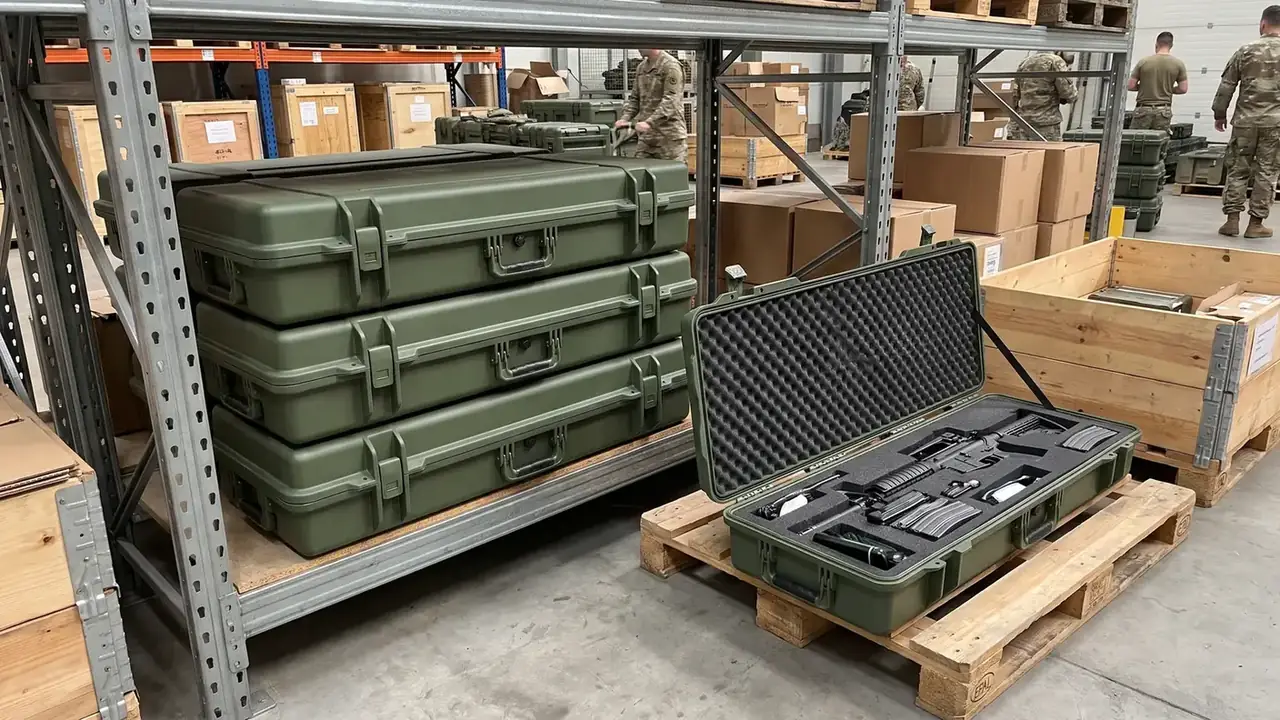
Tolerances decide whether two batches can be swapped, so they are measured after 24 hours of cooling; shrinkage of 2%–3% pulls large mouldings off size.
| Item | Tolerance | Check |
|---|---|---|
| Cavity under 800 mm | ±2 mm | Tape and gauge |
| Cavity over 800 mm | ±3 mm | Tape and gauge |
| Wall | ±0.4 mm | Ultrasonic gauge |
| Hole centres | ±0.3 mm | CMM |
IP67 covers the sealing class, plus one line for the factory test at 20 kPa held 60 seconds: 1 m of water for 30 minutes, short immersion rather than flooding.
5. Four Lines the Sheet Usually Misses
A sheet can carry size, wall and load for a page and still omit four lines that decide whether acceptance passes.
- Service temperature, -40 to 71 °C: rotomoulded polyethylene softens from 71 °C, and a closed trailer passes 65 °C.
- Hardware coating, 240 h neutral salt spray with no red rust.
- Stack mark, short side, 300 mm up, or the crew guesses the layers.
- Regrind ratio, 20% at most and never in load ribs, since 20% costs about 15% of impact strength.
Each is cheap to write and costly to argue about, so they belong beside the dimensions on the ordnance packing box drawing.
Conclusion
An ordnance packing box specification is calculated: the cavity comes from the payload envelope plus 5 mm, the outside closes the chain, walls follow the process floor, load is stack weight times 1.5, and tolerances and sealing need a test method. What holds the design up at drawing stage is that closed chain from cavity to outside on the ordnance packing box.
This article discusses only the container (case body) side of specifications and design intent, and does not cover any handling, loading or use of the contents.
Related Reading
- Packing standards and marking rules for military packing boxes
- Marking and transport requirements for an ordnance packing box
- How an ammunition packing box is built
- Specification points for small-arms ammunition boxes
Related Products
- 8 Series — Gun Cases; Military Equipment Cases; Camera Equipment Cases; Drone Cases; Watch Cases; Knife Cases; First Aid Cases; Electronics Equipment Cases
- WL8-2812 PP Gun Case — model WL8-2812
- All protective cases and toolboxes: 7 series, 158 models