

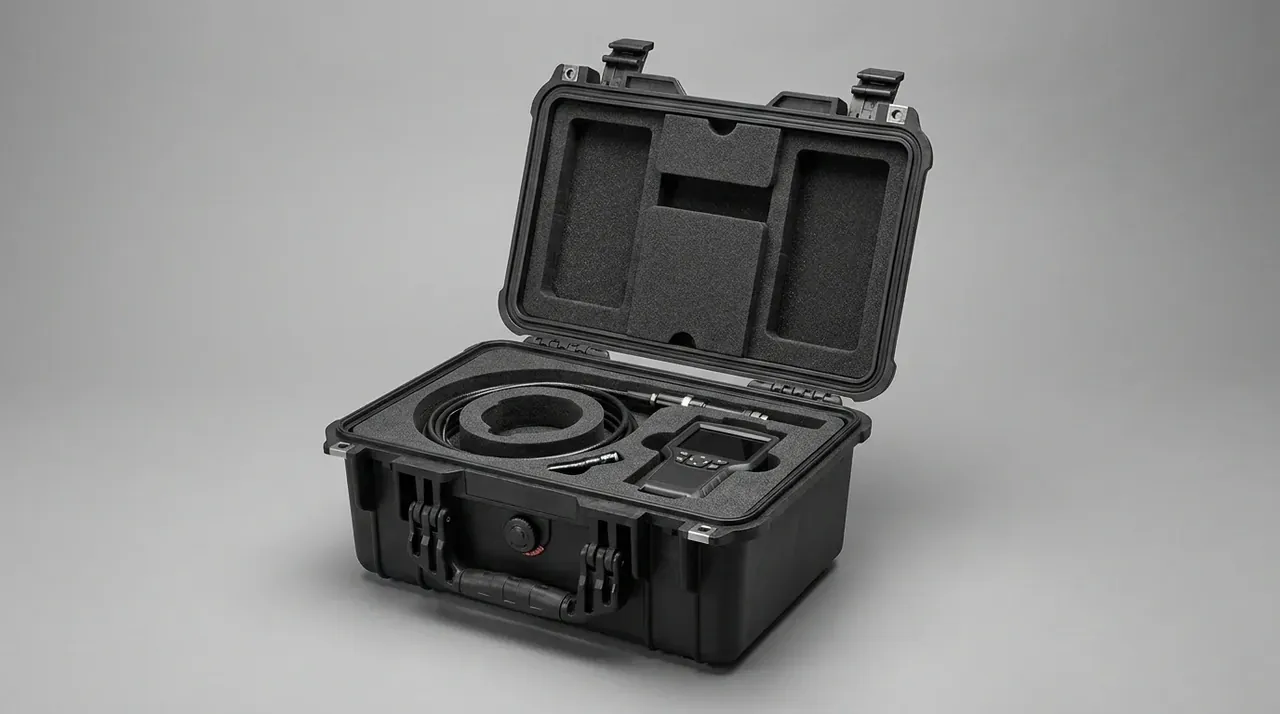
Quick answer: An Outdoor adventure gear pressure-proof safety case takes 150 kg on the lid for 24 hours with 2 mm of sag, and a 10 kPa valve clear of 6.5 kPa.
Table of contents
- Why an Outdoor adventure gear pressure-proof safety case is a static design
- A 150 kg load for 24 hours: where 2 mm of sag comes from
- Four-high stacking and a 3.8 mm wall: the load path
- 3500 m and 6.5 kPa: why the valve opens at 10 kPa
- 400 N latches and a 420 N handle: the second kind of load
- FAQ
1. Why an Outdoor adventure gear pressure-proof safety case is a static design
Squash and drop resistance are different problems. A drop lasts milliseconds, shared between shell and foam. A crush lasts tens of hours, with the lid held still by the case above and the material creeping. An Outdoor adventure gear pressure-proof safety case is designed for the second.
The static acceptance line reads: 150 kg on the lid for 24 hours, mid-span sag no more than 2 mm. The 24 hours is not arbitrary: a creep curve is steep early and flattens later, so a full day inside 2 mm spends most of the deformation.
A crushed lid rarely looks damaged. It springs back, and the rim behind it no longer sits flat.
2. A 150 kg load for 24 hours: where 2 mm of sag comes from
Spread 150 kg across the 520×360 mm opening and it is under 1 N per square centimetre, trivial until it stays a day. A 3.8 mm PP lid carries that briefly; creep keeps adding deflection. Two millimetres is where the gasket still meets the rim.
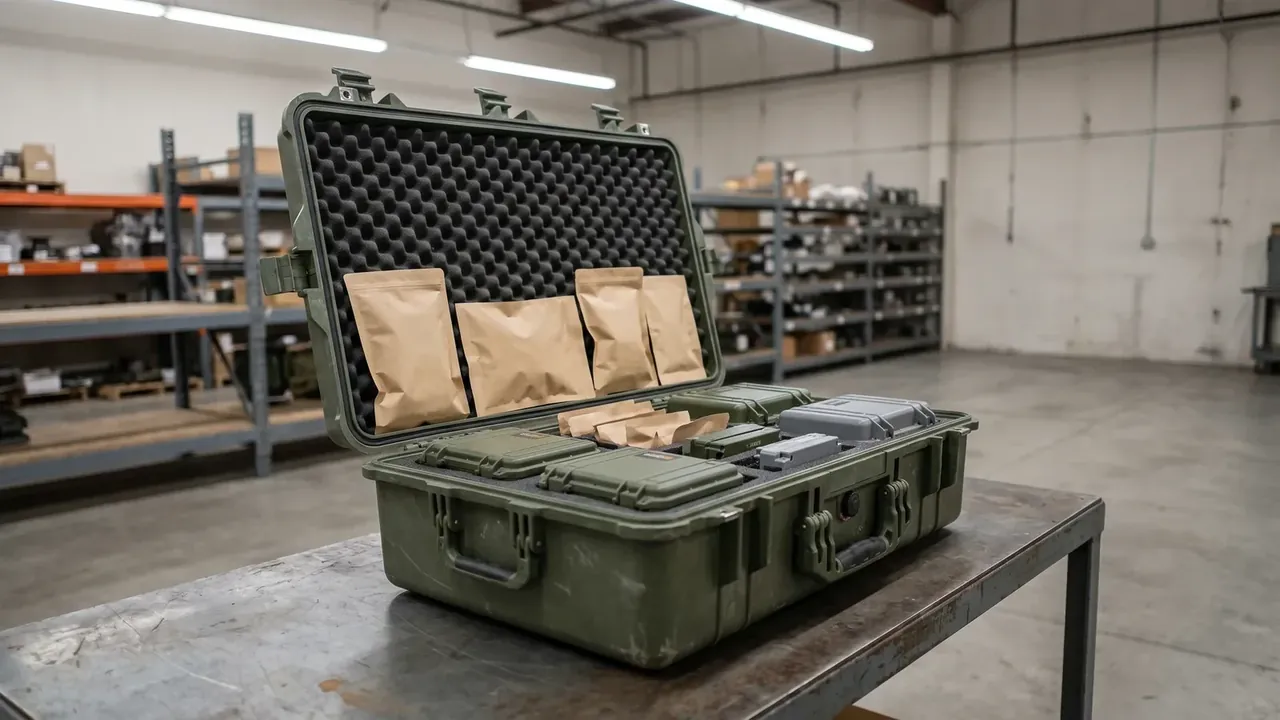
The lid section sets how sag is distributed. A flat lid deflects at mid-span and barely at the corners, so an Outdoor adventure gear pressure-proof safety case uses two 12 mm ribs aligned with the latches to cut the span into three bays of about 170 mm, pulling sag under 2 mm. Two millimetres also costs 2 mm of gasket compression, which is where IP67 gives way first.
| Load source | Where it acts | Design value |
|---|---|---|
| Case stacked above | Corner rebates on the lid | 4 high, 62.4 kg on the bottom case |
| Acceptance load | Lid mid-span | 150 kg for 24 h, sag ≤2 mm |
| Altitude pressure | Lid inner face and rim seal | 6.5 kPa, valve set at 10 kPa |
3. Four-high stacking and a 3.8 mm wall: the load path
At 6.8 kg empty and 14 kg of load, a case weighs 20.8 kg, so the bottom unit of a four-high stack carries the three above it, 62.4 kg. That is under half the 150 kg acceptance load, and the margin covers pallets, straps and ageing.
The load runs down through the corner rebates of the lid, not through the latches. Each rebate is an 8 mm step the base above drops into, with a corner post below it. The middle of the wall only holds shape on that path, which is why an Outdoor adventure gear pressure-proof safety case stays at 3.8 mm.
What breaks the path is a worn rebate: the step edge crushes, the upper case shifts, four bearing points become two, and sag doubles. Four high is the limit in the specification; a fifth layer pushes the bottom unit past 150 kg.
4. 3500 m and 6.5 kPa: why the valve opens at 10 kPa
Climb and outside pressure falls while the inside keeps the pressure it was closed at, so the difference presses on the lid. An Outdoor adventure gear pressure-proof safety case is rated at the 6.5 kPa of 3500 m, and its valve opens at 10 kPa, 3.5 kPa higher.
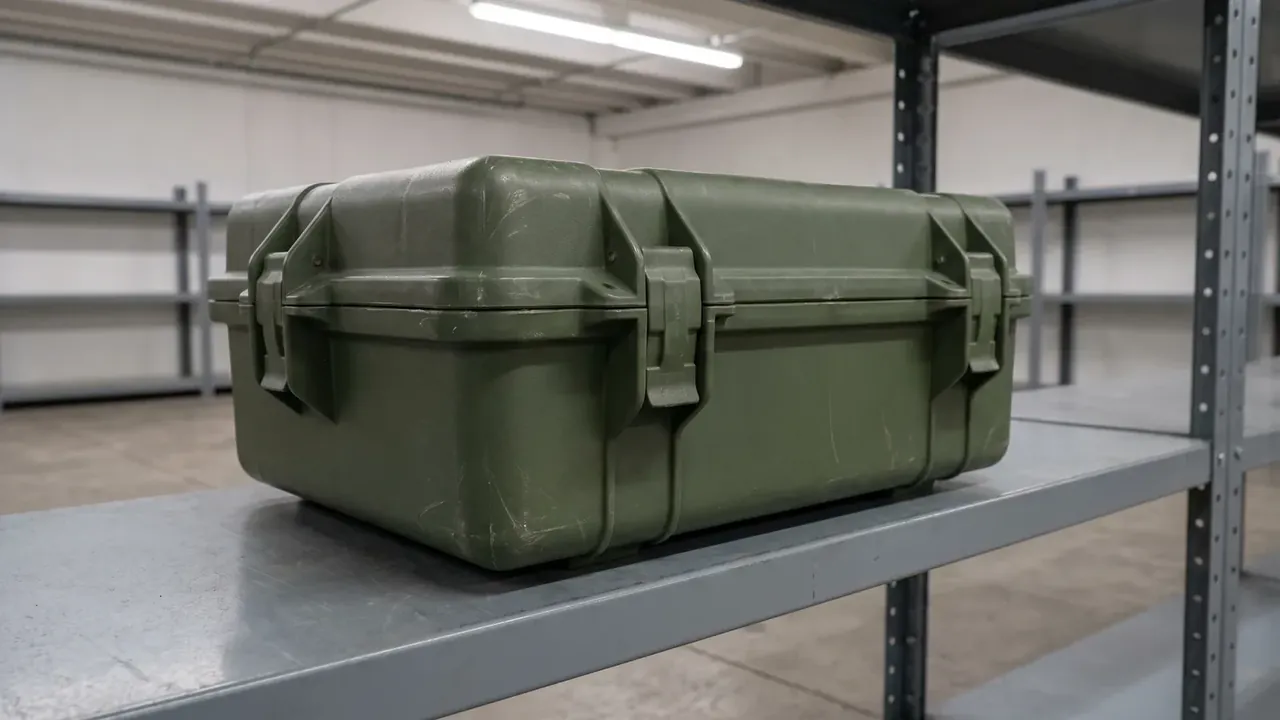
The extra 3.5 kPa covers temperature and handling: a case in the sun passes 40 ℃ and pressure rises, and a knock flexes it. Set the valve at 6.5 kPa and it cycles through a normal trip, polishing a groove into the sealing face.
Higher is no better: ten kilopascals is the ceiling, beyond it the lid carries more differential, part of the 800 N from two 400 N latches goes to it, and rim compression falls again.
| Where it acts | Form of load | Value |
|---|---|---|
| Lid inner face | 6.5 kPa spread over the opening | Valve at 10 kPa, 3.5 kPa margin |
| Lid mid-span | Bending under the 150 kg test | Sag ≤2 mm |
5. 400 N latches and a 420 N handle: the second kind of load
Two 400 N latches give 800 N against the 1470 N that 150 kg of test load represents. The structure keeps them apart: latches hold the gasket against pressure and impact, while stack load runs through the corner rebates.
The handle is rated 420 N against the 204 N weight of a 20.8 kg case, about twice. The factor is modest: a one-hand lift is offset, and the outer mount takes load first.
Temperature pulls every number above down a step. Between −25 ℃ and 60 ℃, PP turns brittle at the cold end and soft at the warm end, so an Outdoor adventure gear pressure-proof safety case is easier to push past 2 mm at 60 ℃ and more likely to snap a latch tongue at −25 ℃.
| Design value | What sets it | End-of-life sign |
|---|---|---|
| 150 kg lid test | 62.4 kg stack load plus margin | Mid-span sag over 2 mm |
| 400 N latches, two | Pressure and gasket rebound | Tongue wears a step |
| 10 kPa valve | 6.5 kPa differential plus 3.5 kPa | Stiff valve, lid sucks down |
Conclusion
An Outdoor adventure gear pressure-proof safety case answers one static question: 150 kg on the lid for 24 hours, 2 mm of sag, and 62.4 kg on the bottom unit of a four-high stack. Altitude is covered by the 6.5 kPa differential against a 10 kPa valve, and the drop only checks corners. Keep permanent and one-off loads apart and the wall and rebates make sense.
Related Reading
- Choosing a case for outdoor adventure and camping gear
- Cases for climbing, rafting, diving and ski gear
- What a pressure equalisation valve does
- Keeping equipment safe in transit
Related Products
- 8 Series — Gun Cases; Military Equipment Cases; Camera Equipment Cases; Drone Cases; Watch Cases; Knife Cases; First Aid Cases; Electronics Equipment Cases
- WL8-2812 PP Gun Case — model WL8-2812
- All protective cases and toolboxes: 7 series, 158 models