

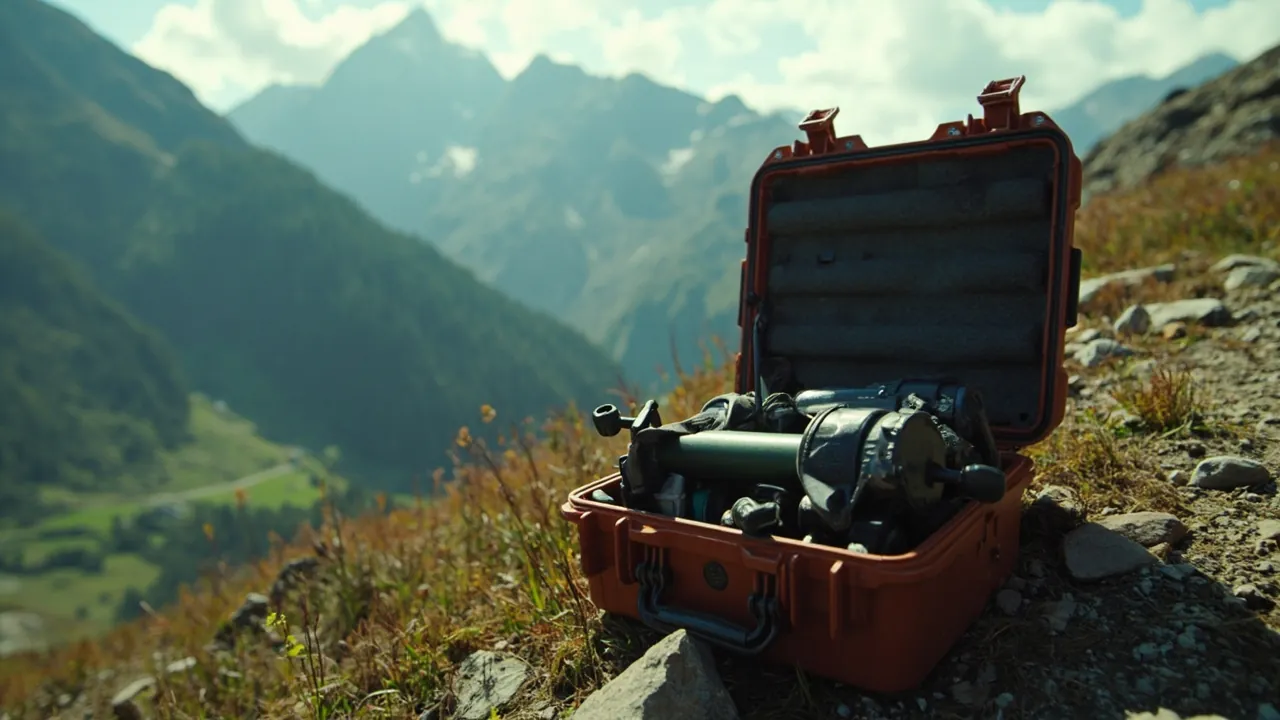
Choosing an outdoor adventure and camping gear case comes down to one sentence: first work out how much protection value each gram of weight buys you, and bring shell weight, insert weight and gear weight into the same weight budget; then lock the protection rating and structure against four non-negotiable baselines, drop, water, dust and crush; finally decide the case format, volume and tie-down method according to how you travel, backpacking, vehicle-based camping, bike touring or paddling. The most common mistake in outdoor circles is to read lightweight as making the shell thinner and pulling the foam out, and then pay far more than the few hundred grams saved on the one occasion protection actually mattered: a capsize, rockfall on an approach, or a hard brake with a roof box. Lightweight has never been simple weight reduction; it is weight optimization above a defined protection floor. Decide what cannot be sacrificed, then cut what can. Below we work through real conditions, the balance method, packing by gear type, materials and structure, scenario configuration, loading and care, and mistakes.
Table of Contents
- What Outdoor Gear Actually Faces: Why Lighter Is Not Always Better
- Balancing Light Weight and Protection: Three Dimensions You Can Calculate
- Packing by Gear Type: Cooking, Electronics, First Aid, Technical Kit and Imaging
- Shell Material and Structural Design: Where Light Weight Comes From
- Four Scenarios: Backpacking, Vehicle Camping, Bike Touring and Paddling
- Loading, Tie-Down and Camp Maintenance
- Frequently Asked Questions (FAQ)
- Conclusion
- Further Reading
What Outdoor Gear Actually Faces: Why Lighter Is Not Always Better
Start by being clear about what outdoor gear actually endures. Unlike commuting or a fixed workstation, outdoor gear faces unpredictable mechanical and environmental loads, and when something fails the cost of rescue is very high.
Shock: Drops and Rockfall
Scrambling across talus, walking an approach to a climb, rolling a kayak, or coming off a bike all load a case from an arbitrary direction. Shock damages gear in two ways: single high-energy impact (a drop or a strike) and low-amplitude repeated impact (bike buzz, vibration in panniers). The first tests shell toughness and the cushioning travel of the insert; the second tests foam damping and the ability to hold things still.
Water: Rain, Wading and Capsize
Water is the hardest thing to avoid outdoors. Rain is routine, and wading a river, walking through waterfall spray, or capsizing a kayak submerges the case completely. For a sleeping bag, a down jacket, electronics, first-aid medication and fire-starting kit, soaking does not mean dry it out later; it means the trip ends right there. That is why outdoor use is the most sensitive to sealing grade.
Dust and Sand: Wear and Blocking
Fine particles in deserts, dry riverbeds, gravel plains and coastal sand find their way into stove valves, zippers, zoom ring threads, charging ports and carabiner gates. The harm is cumulative: one dose of sand does not destroy anything, but it keeps grinding precision parts for the rest of the trip.
Pressure: Backpack Squeeze and Roof-Box Stacking
This is the most overlooked load. A hard case inside a backpack is squeezed by everything else in the pack, and several cases in a roof box sit in a stack and are reloaded on every bump and brake application. A case without crush resistance deforms inside a pack and collapses in a roof box, and deformation directly kills the seal.
Temperature: Diurnal Swing and Cold
At altitude and in desert regions the day-night swing is extreme. In direct sun the inside of a case can reach well above air temperature, and at night the temperature drops sharply. Cold reduces lithium battery capacity, stiffens rubber gaskets and makes some plastics brittle. Outdoor case materials therefore need low-temperature toughness and heat stability together.
Balancing Light Weight and Protection: Three Dimensions You Can Calculate
Lightweight work has to be measurable to be actionable. Three dimensions are the most practical.
Dimension One: Empty-Case Weight Share
The first calculable metric is empty case weight divided by loaded total weight. The lower the ratio, the less of your load budget the shell consumes. The practical rule outdoors: for backpacking, keep the empty case below about 20 percent of the loaded total; for vehicle-based trips the constraint can relax to 25 to 30 percent, because the vehicle carries the load.
Empty weight must not be judged in isolation. A very light case with too little volume may force you to carry two, which weighs more. The correct comparison across sizes is empty case weight per liter of usable volume.
Dimension Two: The Protection Floor Cannot Move
Weight can be optimized, but four baselines cannot:
| Protection dimension | Baseline requirement | Consequence of failure | Can it be traded for weight? |
|---|---|---|---|
| --- | --- | --- | --- |
| Drop cushioning | Enough cushioning around the gear so impact is not transmitted directly | Internal damage to precision gear, failure mid-trip | No |
| Water sealing | Full-perimeter elastic gasket plus latch compression, no ingress when submerged or wading | Sleeping bag, electronics, medication and fire kit fail | No |
| Dust resistance | Sealed structure keeps fine particles out | Continuous wear of precision parts | No |
| Crush resistance | Empty case does not deform under pack squeeze or roof stacking | Deformation breaks the seal and crushes contents | No |
What you can optimize is wall thickness (using ribs instead of thicker walls), insert thickness (graded by fragility), case count (fewer standard sizes, less redundancy) and accessories (drop modules you never use).
Dimension Three: Grade Protection by Fragility
Not everything needs equal protection. Grading gear by fragility is the single most effective lightweight step:
| Fragility | Typical gear | Strategy | Insert advice |
|---|---|---|---|
| --- | --- | --- | --- |
| Very high | Camera lenses, drones, satellite communicators, drives | Hard shell plus custom cushioning plus desiccant | Custom tray or pre-cut, fully surrounded |
| High | Headlamp, GPS, power bank, medication, fire kit | Hard shell plus basic cushioning plus individual dry bag | Thin foam wrap, individual bays |
| Medium | Stove, water filter, multi-tool | Hard or semi-rigid shell plus dividers | Dividers are enough |
| Low | Spare clothing, food, rope, stakes | Compression sack | No foam needed, compress to save volume |
Concentrating protection resources on the gear whose failure ends the trip is the core idea of lightweight packing. A crushed shell jacket still works; a flooded satellite communicator can mean losing the ability to call for help.
A Weight Budget Process You Can Apply Directly
String the three dimensions together and you get a repeatable method:
- Set the total budget: Decide what total weight the trip can carry. For backpacking a common rule of thumb is to keep the loaded pack under about 20 percent of body weight, then subtract the incompressible consumables, water, food and fuel, to arrive at the budget for gear and cases.
- List and grade: Sort every item into very high, high, medium and low fragility. Only the top two grades get hard cases; the rest use divider cases or compression sacks.
- Derive volume: Compute the bounding volume of everything needing a hard case, add them up and multiply by a margin factor of 1.3 to 1.6. Outdoors the factor can be lower than for industrial transport because insert thickness is graded by fragility rather than fully wrapping everything.
- Pick the size and check: Choose the next standard size up, then recheck empty-case weight per liter of usable volume and the empty-to-loaded ratio. Only pass if both sit inside budget. If over budget, reduce the size and split the load further rather than trimming the insert.
Packing by Gear Type: Cooking, Electronics, First Aid, Technical Kit and Imaging
Outdoor packing differs from urban storage: sort along two axes, consequence of failure and access frequency, rather than simply by category.
| Case group | Contents | Main risks | Protection priority | Access frequency |
|---|---|---|---|---|
| --- | --- | --- | --- | --- |
| Electronics and power | Headlamp, GPS, satellite communicator, power bank, cables, spare cells | Water, dust, cold discharge, short circuit | Sealing plus desiccant plus isolated battery bay plus body-warm storage | Medium to high |
| Imaging | Camera, lenses, drone, memory cards | Impact, water, condensation | Custom tray plus cushioning plus desiccant | High |
| Cooking and fuel | Stove, gas canisters, pots, fire starters | Fuel leakage, heat, crush deformation | Ventilated storage, upright canisters, separate from food | High |
| First aid and medication | Dressings, medication, tools | Damp, crushing, not findable | Crush-proof shell plus high-visibility marking plus layered fixation | Low but critical |
| Technical gear | Ascenders, nuts, harness hardware, rope hardware | Sand ingress, deformation from knocks | Individual bays plus rinseable design | Medium |
| Food and misc | Freeze-dried meals, seasoning, trash bags | Odor escape, animal damage | Odor-tight sealing plus hard shell against chewing | Medium |
Electronics and Power: Cold Is the Main Enemy
The number one problem for electronics outdoors is not dropping, it is cold discharge. Lithium cells lose noticeable discharge capability at low temperature, so spare batteries belong close to the body or inside the sleeping bag rather than in an outer case pocket. Give batteries their own bay and insulate the terminals so they cannot short against metal tools. Keep power banks and cables together in a mesh or zip bag so ports do not wear against loose hardware.
Cooking and Fuel: Ventilation and Separation
Gas canisters are pressure vessels, and the core storage rule is avoid heat and confinement. Store them upright and secured, away from flame and heat sources, in a ventilated space, and put a divider between the canister and the stove so they cannot strike each other in transit. Pots and utensils can share the case with the stove, but sharp edges should be kept away from other gear. Fire starters should be stored separately and kept dry, because the basic rule outdoors is fire redundancy: carry at least two independent ways to make fire.
First Aid and Medication: Location Matters More Than Rating
The first requirement of a first-aid case is not the highest protection rating, it is that anyone, in any condition, can find it and open it at once. That means high-contrast external marking, a fixed storage location, and latches that do not need complicated handling. Inside, use layered fixation so dressings, medication and tools each have a place, and keep medication in original packaging with instructions, protected from moisture.
Imaging: Condensation Is the Invisible Killer
Coming from cold outdoors into a warm tent or vehicle, the gear in the case is below the ambient dew point, and opening the case immediately condenses water onto glass and circuit boards. The correct move is to let the closed case acclimatize until the internal temperature approaches ambient, then open it. Keeping desiccant in the case lowers the risk substantially.
Shell Material and Structural Design: Where Light Weight Comes From
Trade-Offs Among Three Mainstream Shell Materials
| Material | Density character | Mechanical character | Outdoor advantage | Watch points |
|---|---|---|---|---|
| --- | --- | --- | --- | --- |
| PP (polypropylene) | Lowest density among common shell materials | Tough, low-temperature resistant, impact resistant, fatigue resistant | Lightest for a given volume, does not embrittle in cold | Surface hardness and rigidity below ABS, needs rib reinforcement |
| ABS | Denser than PP | Rigid, hard surface, dimensionally stable | Crisp shape, good finish, stable stacking | Less low-temperature toughness than PP, slightly heavier |
| PC | Highest density | Outstanding impact strength, high transparency | Extreme strength needs and see-through windows | Higher cost, rarely the main material of a whole case |
Backpacking generally favors PP systems for a direct reason: low density brings a self-weight advantage, low-temperature toughness means it does not embrittle at altitude or in winter, and fatigue resistance suits repeated opening and long spells of vibration. When vehicle camping makes weight less critical, the crisp feel and dimensional stability of ABS gain an edge.
Four Ways to Make a Structure Light
- Ribs instead of thicker walls: A network of ribs on walls and lid raises bending stiffness substantially without adding wall thickness. This is the classic lightweighting move in plastic parts.
- Uniform wall thickness: Uneven walls cause local sink marks and internal stress. Designing for uniform thickness reduces weight and improves consistency.
- Radiused corners: Radiusing the eight corners spreads stress concentration so the case does not crack from a corner on impact, which allows thinner walls overall at equal strength.
- Local metal inserts: Embed metal only at high-load points such as latch seats and hinge seats, avoiding overall thickening and buying local reliability for minimal weight.
Sealing and Weight Reduction Do Not Conflict
Some worry that sealing adds weight. In reality the weight of sealing is small: one elastomer gasket plus a groove weighs far less than adding one millimeter to every wall. What really adds weight is an oversized case and an over-thick insert. So the correct order for saving weight is: match the volume precisely first, optimize insert thickness second, consider material last.
Four Scenarios: Backpacking, Vehicle Camping, Bike Touring and Paddling
| Scenario | Main loads | Weight sensitivity | Protection priority | Case and tie-down advice |
|---|---|---|---|---|
| --- | --- | --- | --- | --- |
| Backpacking | Drops, pack squeeze, rain, diurnal swing | Very high | Weight per liter, sealing, crush resistance | Small to medium PP case, carried close to the back, heavy items high |
| Vehicle camping | Stacking load, sliding under braking, dust | Low | Stacking locators, uniform sizes, dust sealing | Uniform medium and large cases, stacked and strapped |
| Bike touring | Continuous vibration, crash impact, mud | High | Damping, water and mud resistance, rack mounting | Medium case with rack mounting points, no sway |
| Kayaking and rafting | Immersion, capsize, hitting rocks | Medium | High sealing grade, tie-down points, rinsable | IP67 sealed case plus tie-down points plus added flotation |
Backpacking: Position Matters More Than the Case
Where the case sits has a large effect on perceived weight: heavy items should sit close to the back, between the shoulder blades and the waist, which puts the center of gravity near the body axis and noticeably reduces effort. Case shapes should be regular, because irregular protrusions become pressure points inside the pack. With several cases, the heaviest goes against the back and the lightest to the outside.
Vehicle Camping: Uniform Sizes Buy Space Efficiency
Weight is not the constraint here; space utilization and access speed are. Cases in one size system stack like bricks and leave fewer gaps; stacking locators stop them sliding under braking; external label holders mean you do not open every case to find something. For roof boxes, also remember heat and sun: do not leave gas canisters or chocolate in a hot enclosed box.
Bike Touring: Vibration Is the Most Insidious Wear
Bike touring is characterized by long-duration, low-amplitude, high-frequency vibration. This kind of vibration works cumulatively on electronic connectors, screw fastenings and lens retaining rings. The answer is an insert with enough damping, closed-cell foam rather than hard plastic dividers, rigid mounting to the rack so nothing sways, and periodic checks that screws have not loosened.
Paddling: Beyond Sealing You Need Tie-Down
On water there are two extra requirements. First, the case must have reliable tie-down points so it can be lashed firmly to the hull, because gear that floats away cannot be recovered. Second, a sealed case is not a flotation device: sealing keeps water out, it does not guarantee the case floats, so critical gear needs additional flotation. Rinse the outside of the case and the latches with fresh water after every outing, especially in salt water, so salt does not remain and corrode.
Four Reference Tiers: Mapping Gear to Standard Sizes
Mapping gear onto four tiers makes planning much faster:
| Tier | What goes in | Typical user | Tie-down and carry |
|---|---|---|---|
| --- | --- | --- | --- |
| Small | Headlamp, GPS, medication, fire kit, spare cells | Day hikes, fast and light | Straight into the main pack compartment, close to the back |
| Medium | Camera with two lenses, drone, stove kit | Two to three day trips, photo trips | Compression straps inside the pack, or a pannier side pocket |
| Large | Spare clothing, food, group cooking kit, technical gear | Multi-day backpacking, vehicle camping | Stacked in a roof box or trunk, strapped as a load |
| Extra large | Group equipment, shared supplies, long-stay provisions | Commercial teams, expeditions, film crews | Uniform stacking with labels and inventory control |
The practical value of tiering is standardizing case count and size. When a whole team uses one size system, vehicle and boat space can be calculated in advance, any damaged case can be swapped instantly, and spares and inserts are interchangeable. That is why commercial teams working outdoors long-term would rather spend a little more to buy one standard size system than to buy assorted sizes trip by trip.
Loading, Tie-Down and Camp Maintenance
Five Steps for Loading
- Sort before packing: Group gear of similar fragility together so one hard object cannot ruin a case of precision items.
- Heavy items low, center of gravity central: Reduces tip-over risk and helps both carrying and stacking.
- High-frequency items on top or outside: Headlamp, rain shell and first-aid kit should never be buried at the bottom.
- Leave access space: Do not cut bays too tight; provide finger notches so nobody has to dig foam out with bare hands in the cold.
- Confirm nothing shifts before closing: Shake gently; nothing inside should visibly move. Movement means the bay is too large or needs filler.
Tie-Down Methods
- Inside a pack: Use compression straps to pull the case tight against the pack wall so it cannot sway while walking.
- Roof box or trunk: Strap the whole stack down, padding contact points so straps do not crush the shell.
- On a rack: Use mounting points matched to the rack; never rely on a simple rope loop that lets the case swing.
- On a hull: Use at least two independent tie-down points, and leave enough slack in the lashing for a fast emergency release.
Camp Maintenance Checklist
- Daily check: Before breaking camp, confirm latches are closed, the gasket is free of grit, and no new cracks appeared.
- Drying: Never store wet clothing or wet gear with dry gear; hang wet items out or isolate them in a waterproof bag.
- Desiccant management: Dry or replace it as soon as it changes color, and shorten the interval in damp conditions.
- Cleaning: After sand or coastal trips, rinse the outside and latches with fresh water and dry before closing for storage.
- Gasket care: Wipe with clean water periodically and avoid strong solvents; replace once elasticity is lost or cracks appear.
- Long-term storage: Empty and dry the case, store with latches released so the gasket is not under permanent compression, and keep it out of sun and heat.
Common Mistakes
- Mistake one: remove the insert to save weight. The insert is what performs cushioning; removing it passes every impact straight to the gear. Grade it instead of deleting it.
- Mistake two: watch empty weight but ignore volume efficiency. A light but small case forces you to carry two, which is heavier overall.
- Mistake three: substitute a soft bag for a hard case. Soft bags have no crush resistance and cannot protect precision gear or medication under pack squeeze or roof stacking.
- Mistake four: store gas canisters with food and electronics. Canisters are pressure vessels and belong ventilated and separated; food odors should be sealed separately.
- Mistake five: assume a sealed case floats. Sealing prevents ingress, not sinking; critical gear needs added flotation.
- Mistake six: open the case the moment you get into a warm tent. Condensation will wet glass and boards; let the case acclimatize first.
- Mistake seven: ignore latches and hinges in cold conditions. In winter, with gloves on, choose latch designs that open one-handed and with gloves.
Frequently Asked Questions (FAQ)
Q: Outdoors, should I choose a hard protective case or a soft storage bag? A: It depends on fragility and the load environment. A hard case delivers crush resistance, drop resistance, sealed waterproofing and dust resistance, which suits camera lenses, drones, satellite communicators, first-aid medication and fire kit, the items whose failure ends the trip. Soft bags are lighter and compressible, suiting spare clothing, sleeping bags and food, items that do not mind pressure but do mind water. In practice the answer is a combination: hard cases for critical items, soft bags and compression sacks for bulky items, and a waterproof bag to isolate wet gear.
Q: What share of loaded weight should the empty case be? A: For backpacking, keep the empty case below about 20 percent of the loaded total, because your body carries every gram. For vehicle-based trips the vehicle carries the load, so the constraint can relax to 25 to 30 percent. The more accurate cross-size comparison is empty case weight per liter of usable volume, because a light but small case may force you to take two, which is heavier overall.
Q: Can light weight and a high protection rating be satisfied at once? A: Yes, but keep the order right. First fix the four non-negotiable baselines, drop cushioning, water sealing, dust resistance and crush resistance, then optimize weight above them. Practical optimization directions are ribs instead of thicker walls, insert thickness graded by fragility, precise volume matching to avoid redundancy, and dropping modules you never use. The weight of a gasket and latches is small, so never save weight there.
Q: PP or ABS for an outdoor protective case? A: It depends on the scenario and temperature. PP has the lowest density among common shell materials, with good toughness, low-temperature resistance, impact resistance and fatigue resistance, so it is the lightest for a given volume and suits backpacking, altitude and winter. ABS offers rigidity, a hard surface, dimensional stability and a crisp shape with good stacking stability, suiting vehicle camping where weight matters less. PC stands out for impact strength but has the highest density and cost, and is usually reserved for extreme strength needs or see-through windows rather than as the main material of a whole case.
Q: How should gas canisters and lithium batteries be stored in an outdoor case? A: Both need separation, for different reasons. Canisters are pressure vessels: store them upright and secured, away from heat and flame, in a ventilated space, and never with food. Lithium cells fear cold and short circuits: cold noticeably reduces discharge capability, so spare cells belong close to the body or inside the sleeping bag, and in transit they go in an isolated bay with terminals insulated so they cannot touch metal tools.
Q: Will a sealed protective case float if it falls in the water? A: Do not assume so. An IP rating describes the ability to keep water out, not the ability to float; whether the case actually floats depends on the average density of the case and its contents and on whether an air void remains inside. Sealing guarantees the gear inside stays dry, not that the case stays on the surface. For paddling, give critical gear additional flotation and lash the case firmly to the hull through its tie-down points.
Q: Can the weight of the foam insert be cut? A: Cut it by grade, not altogether. Cushioning stretches out the deceleration of an impact and lowers peak acceleration on the gear; removing foam passes the impact straight through. The sensible approach is grading: custom trays fully surrounding very high-fragility imaging and communications gear, dividers for medium-fragility stoves and tools, compression sacks for low-fragility clothing and food, with no foam at all.
Conclusion
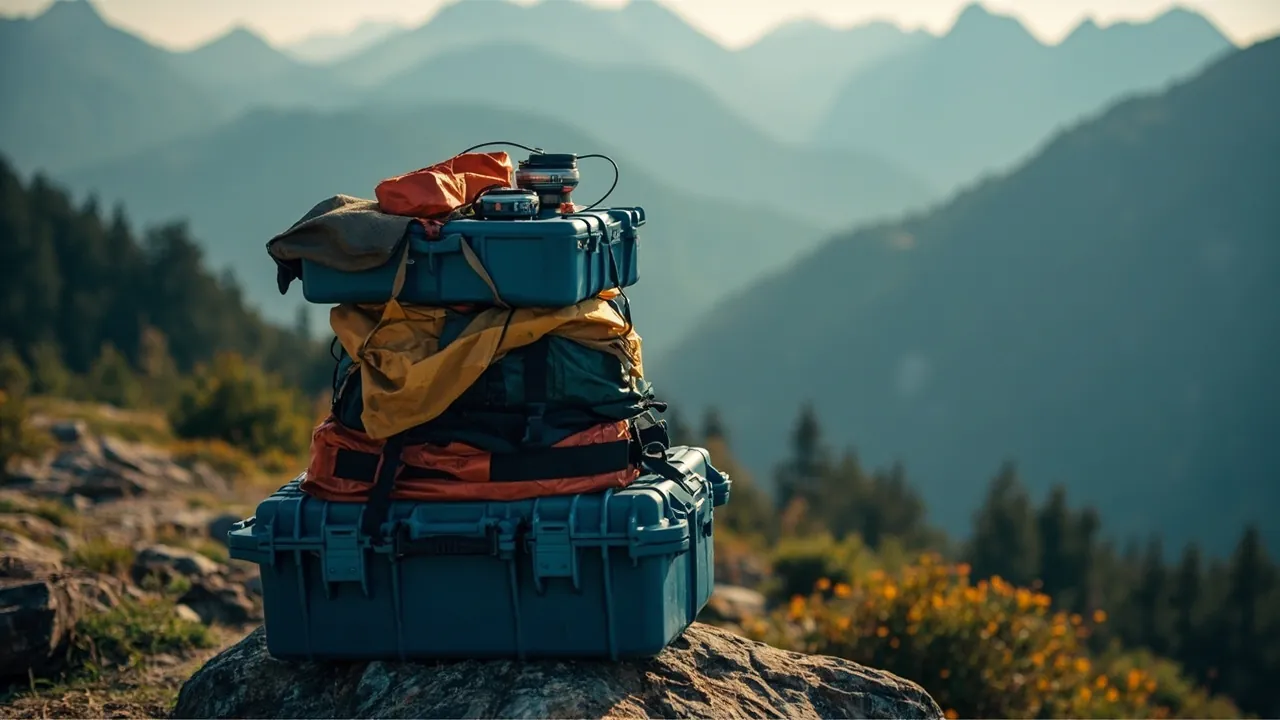
Choosing an outdoor adventure and camping gear case is not about buying a lighter box, it is about spending weight in the right places. The order should be: grade the gear by consequence of failure and fragility, and concentrate limited protection resources on the items whose failure ends the trip; then work the weight budget, keeping the empty case under about 20 percent of loaded weight for backpacking and comparing sizes by empty-case weight per liter, relaxing to 25 to 30 percent for vehicle-based trips; then hold the four baselines of drop cushioning, water sealing, dust resistance and crush resistance, and cut only where cutting is safe, ribs instead of thicker walls, insert thickness graded by fragility, precise volume matching, no redundant modules; finally choose format and tie-down by travel mode, a light PP case carried close to the back for backpacking, uniform sizes stacked and strapped for vehicles, damping and rigid mounting for bikes, and tie-down points plus added flotation on water. The usage side matters just as much: store fuel canisters ventilated and separated, keep batteries warm against the body, let the case acclimatize before opening after cold exposure, rinse with fresh water after every outing, replace desiccant as soon as it changes color, and store long-term with latches released so the gasket is not under permanent compression. KeXin New Materials (Guangdong) Co., Ltd. was founded in 2014 and is located in Zhongshan City, Guangdong Province, with a factory of about 18,000 square meters, more than 80 machines and over 100 staff. Its protective-case line is marketed globally under the brand kexinMaterials and under the JUNZHJIA product-line brand, covering more than 150 specifications, offering IP67 capability and environmental suitability validation against MIL-STD-810H. The company operates under ISO9001 and meets REACH, California Prop 65 and RoHS requirements, holds more than 20 utility model and design patents, and provides one-stop OEM and ODM customization from product design, mold manufacturing and injection molding to logo printing and tray and liner production. For bulk quotations, specification sheets or customization, please reach us through the contact page or inquiry form on this site.
Further Reading
- What Is an Outdoor Protective Case and Where Is It Used?
- How Is an Outdoor Protective Case Different from an Ordinary Storage Box?
- Why Do Outdoor Protective Cases Usually Use High-Strength Engineering Plastics?
- What Are the Advantages of a PP Outdoor Protective Case?
- How Does Protective Case Design Balance Weight and Strength?
- How Do Outdoor Protective Cases Handle Rain and Humid Environments?
- How Do Outdoor Protective Cases Handle High and Low Temperature Environments?
- How to Choose the Right Internal Cushioning Material for an Outdoor Protective Case?