

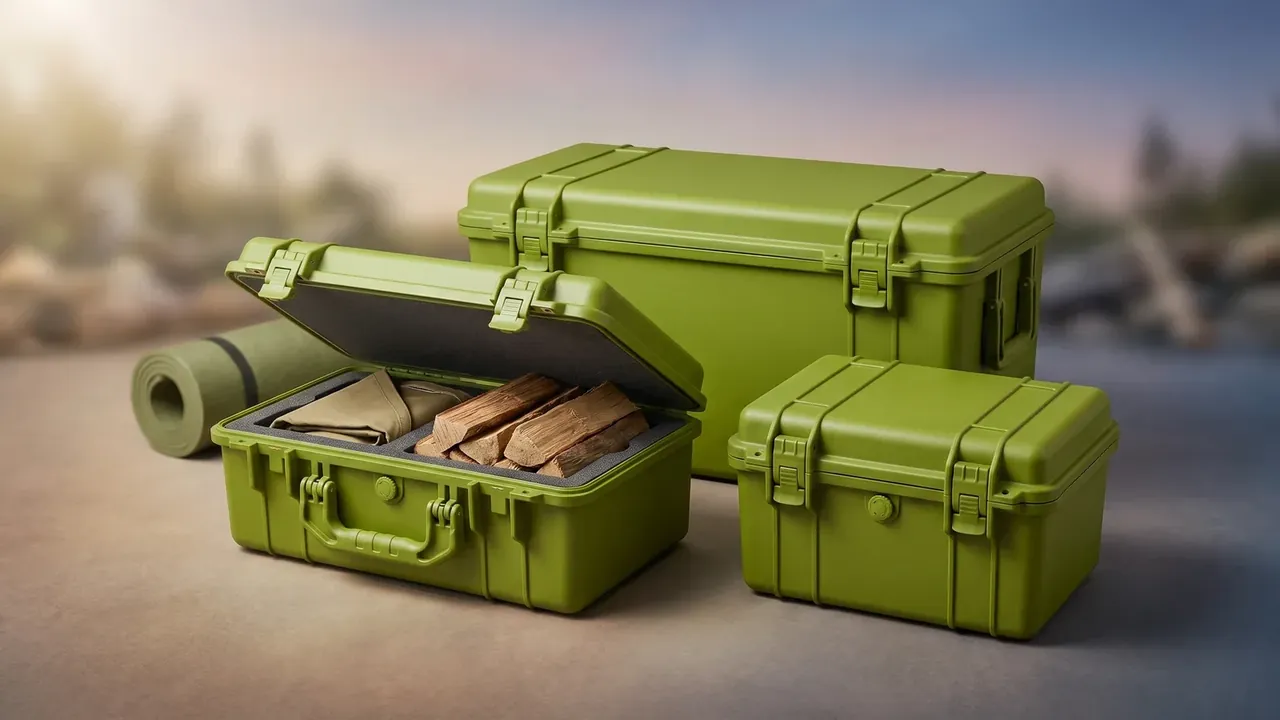
Quick answer: Protective Case Outdoors needs shade and a lift: a reflector with 70% netting cuts the lid from 70 °C to 45 °C, with 100 mm off the ground on a 3° fall.
Table of contents
- Why shade comes first
- How high the riser has to be
- Drainage slope and water under the base
- Air gaps and wall clearance
- Backing the latches off one notch
- Inspection cycle and stacking limit
- FAQ
1. Why shade comes first
At 35 °C ambient, the sun-facing wall of a dark case hits 70 °C while a white case reads 52 °C. That 18 °C gap rewrites polypropylene creep and sets how much rebound the gasket loses each year, so shade comes before site selection.
Shading needs two layers. A white reflector 80 mm above the lid pulls the surface from 70 °C to 45 °C; a 70% net alone leaves 56 °C, since scattered light is absorbed anyway. Running both does not go lower.
Ultraviolet light is a second track. Under a 2000 h cycle to ISO 4892-3, unstabilised homopolymer PP keeps 55% of its impact strength while a hindered-amine grade holds above 70%. A reflector stops overhead sun but not low morning light, so the skirt hangs 200 mm below mid-height.
2. How high the riser has to be
The ground is the most underrated heat and moisture source outdoors. A concrete pad reaches 45 °C and still holds a water film two hours after rain, so a base in contact is heated and soaked at once. The riser floor is 100 mm, enough to break capillary rise.
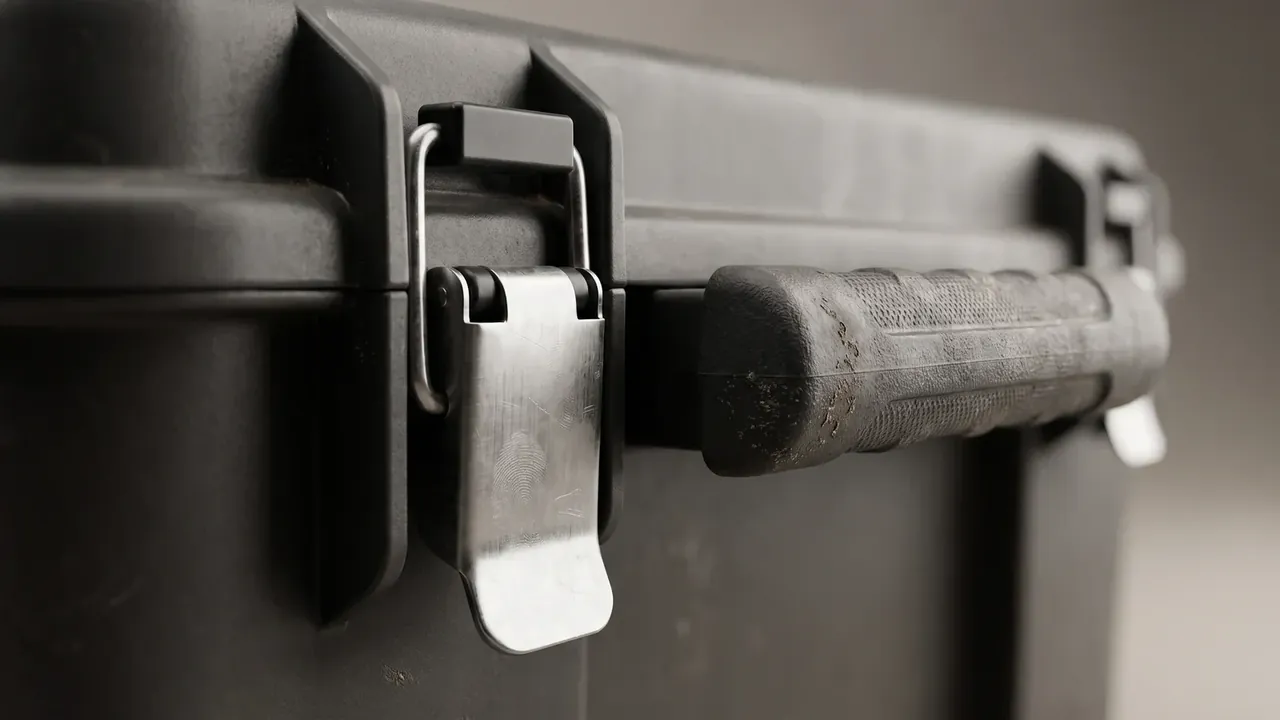
A plastic pallet at 120 mm takes a 1000 kg dynamic load, far above four stacked empties. Concrete piers at 150 mm need mortar bedding when doubled, each under 800 kg. Precast strips 100 mm high suit long yards, spaced 300 mm apart.
Level the riser itself. Run a 2 mm feeler gauge around a pallet's corners; if it slides in, the pad has settled. Piers heave in freeze-thaw ground, and spring thaw can leave a 15–20 mm difference that loads two corners harder and loosens the latch keepers.
Level matters more than height.
3. Drainage slope and water under the base
A 3° fall is 30 mm per metre, invisible yet enough to clear rain off a Protective Case Outdoors pad in 10 minutes. A flat pad traps water between base and riser all year.
Drainage must run away from the lid opening. That gasket ages first on the whole perimeter, and water reaching the 25 mm sill soaks it continuously. A 100 mm channel with its invert 50 mm below the pad beats slope alone.
Ribbed bases form channels 8–12 mm deep where water collects; flat bases need full riser coverage. Water in a rib channel grows mould within three days in summer.
4. Air gaps and wall clearance
Keep 50 mm between cases and 300 mm to a wall. The first lets heat leave the shaded face, the second leaves room to inspect and move units. Yards compress these to 10 mm and 50 mm, which lifts the shaded face 6–8 °C.
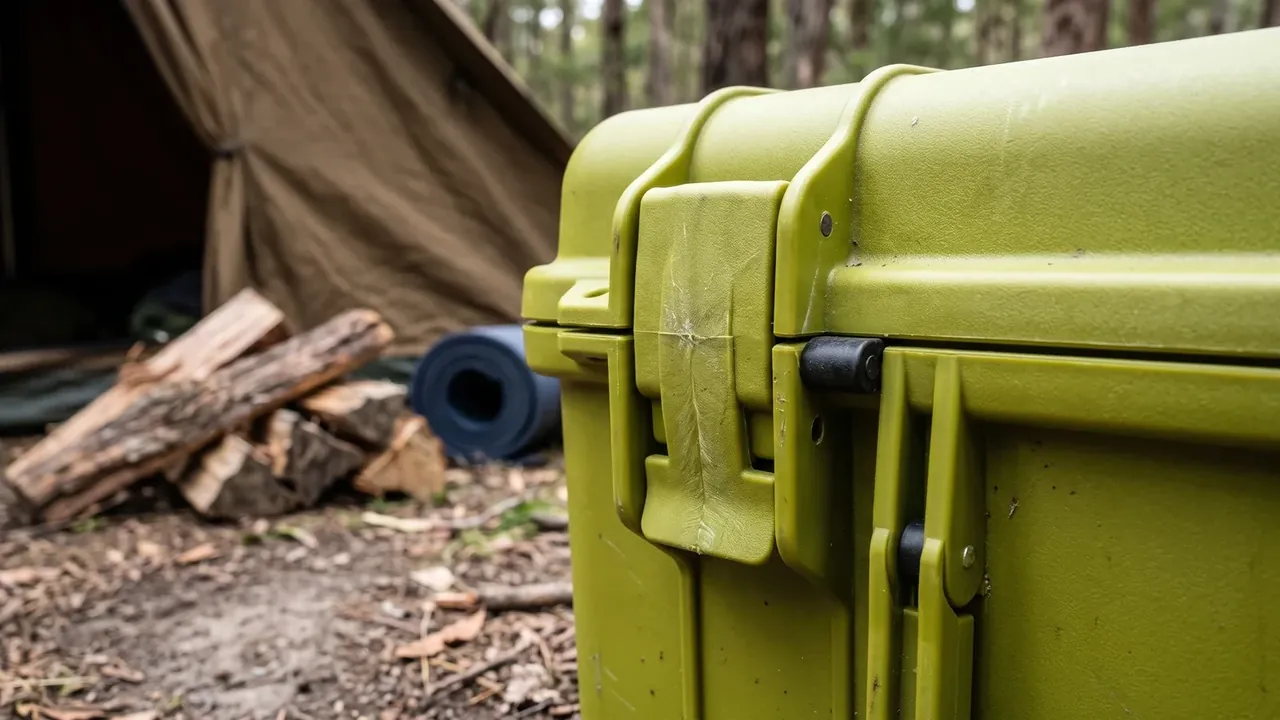
Ventilation is not wind exposure. In a gap between buildings where air moves at 3 m/s year round, the lid lifts a few millimetres again and again and the hinge pin wears twice as fast. The 50 mm gap lets still air turn over; it does not make the case a windbreak.
Leave aisles 600 mm wide so a person can walk in.
5. Backing the latches off one notch
Back the latches off one notch and gasket compression drops from 30% to 10%. Compression is the most sensitive variable in gasket life: EPDM foam at 30% for five years loses about 35% of its rebound, while five years at 10% costs 18%. Service life moves from five years to eight.
One notch is not an open lid. The cover stays down, the latch stops short of full over-centre travel, rain and leaves stay out, and the seal is no longer under constant load. Keep travel near one third, 4–6 mm.
6. Inspection cycle and stacking limit
Inspect Protective Case Outdoors units every six months and open 5% of them. Four items stay on the list: gasket flattening, water staining in base channels, rust on latch springs, and whitening on the walls. Whitening precedes stress cracking by 3–6 months.
| Season | Focus | Criterion | Action |
|---|---|---|---|
| Spring thaw | Riser height and level | Corner gap ≤2 mm | Re-sand or swap piers |
| Wet season | Water in base channels | No film in channel | Cut channel, restore 3° |
| Midsummer | Sun-facing wall heat | ≤45 °C | Add reflector or netting |
| Dry autumn | Rust on latch springs | No visible spots | Clean and grease |
| Before winter | Gasket set | Rebound ≥80% | Latch off one notch |
| Windy season | Stack height and plumb | ≤4 high, ≤10 mm lean | Drop a layer or tie down |
Stack empties no more than four high. An empty runs 6–12 kg, so four layers reach 1.6 m and load the bottom unit with 30–50 kg, well inside its stacking strength; stability sets the limit, not strength. Above three layers a force 6 wind can topple a column.
Loaded cases are another matter: at 25–40 kg each, two layers need a pallet and strapping, which belongs to transport rather than static storage.
Conclusion
Four measures decide whether a Protective Case Outdoors is workable: shade holding the lid under 45 °C, a riser above 100 mm, a 3° fall that moves water off the pad, and gaps of 50 mm and 300 mm that let air turn over. Drop one and the rest lose part of their effect; losing the riser hurts most, because the base is the face nobody sees. Written into a six-month checklist with a 5% sample, eight years outdoors becomes an expectation.
This article discusses only the container (case body) side of specifications and design intent, and does not cover any handling, loading or use of the contents.
Related Reading
- How UV exposure ages a case and why colour matters
- Stacking corners and how they carry load
- Pallet planning for case stacks
- When a gasket has aged past replacement
Related Products
- 8 Series — Gun Cases; Military Equipment Cases; Camera Equipment Cases; Drone Cases; Watch Cases; Knife Cases; First Aid Cases; Electronics Equipment Cases
- WL8-2812 PP Gun Case — model WL8-2812
- All protective cases and toolboxes: 7 series, 158 models