

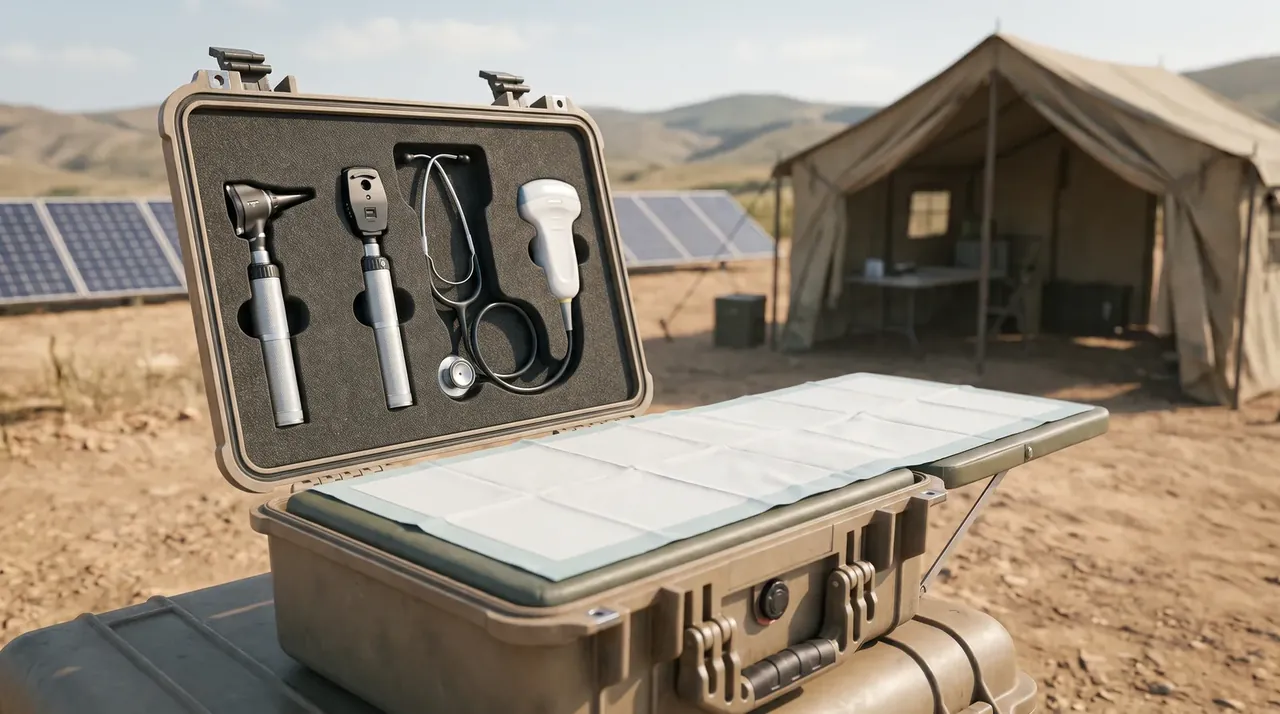
Quick answer: Outdoor emergency survival gear safety box: 620×440×300 mm shell, 18.4 kg loaded, nine cells, three small lids, lid at 105 degrees, 400 N per handle.
Table of contents
- Blind retrieval is the first test for an outdoor emergency survival gear safety box
- How nine cells and three separate lids divide the work
- Why the lid stops at 105 degrees
- Why an 18.4 kg box needs two people
- Sealing and stacking checks once the lid is shut
- FAQ
1. Blind retrieval is the first test for an outdoor emergency survival gear safety box
When a case leaves fixed storage, the first change is not impact resistance but whether a hand can land on the right cell in one move. The Outdoor emergency survival gear safety box calls this retrieval by feel: lip heights and lid edges guide the hand without light. The test sits in layout, lid count and angle.
Outside it is 620×440×300 mm, inside 560×380×250 mm, wall 4.0 mm, and the Outdoor emergency survival gear safety box weighs 7.4 kg empty before 11 kg of payload brings it to 18.4 kg. Nine cells must fit the 560×380 mm cavity, fixing each width, while 18.4 kg fixes the carry.
Cell lips carry a height difference, three separate lids cover the cells found first, and the lid opens to 105 degrees without rebound. Inspection measures cells, lids and hinges only.
2. How nine cells and three separate lids divide the work
Nine cells in the 560×380×250 mm cavity are not equal: those near the rim are shallow with tall lips, those near the hinge deeper. Each of the three separate lids covers one group, so lifting one leaves the others covered and the hand cannot stray. The Outdoor emergency survival gear safety box turns those differences into a one-move locate.
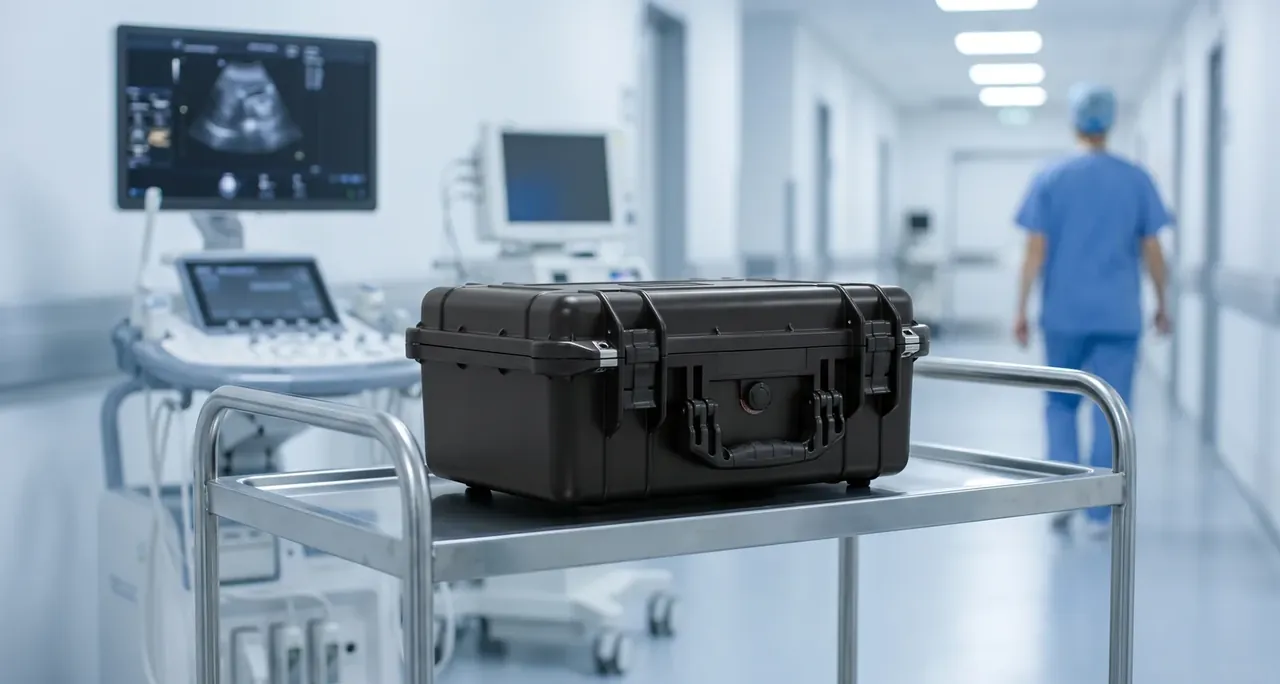
All three lids hinge on the lid side and stay half open on their damping, clear of the rim. One lid spans two or three cells and its edge is the guide; nine cells and three lids line up on that edge.
| Emergency stage | Clue from the box | Structure |
|---|---|---|
| Lid opens | Holds at 105 degrees | Limit hinge |
| Hand reaches the rim | Lip heights differ | Nine cells |
| Locating one cell | Lid edge as a guide | Three separate lids |
3. Why the lid stops at 105 degrees
A limit hinge fixes the lid at 105 degrees. Smaller angles press back and the rim edge blocks the hand; larger ones tip the box backward past the pivot. At 105 degrees the rim is fully clear and each of the three separate lids lifts one-handed.
For the Outdoor emergency survival gear safety box, hinge and seal are read together. A continuous gasket is verified to the IP67 method and four latches spread clamp force when closed; at 105 degrees the gasket leaves the rebate and takes no twist. The −25 °C to 60 °C range belongs to hinge and shell: the pin must not turn brittle at −25 °C, nor the lid sag at 60 °C, or the clear rim changes.
| Retrieval action | Rim state needed | Box configuration |
|---|---|---|
| Feeling a cell lip | Rim fully clear | Lid at 105 degrees |
| Lifting a small lid | Lid stays half open | Damped hinge |
| Closing and sealing | Gasket back on rebate | Four latches, 420 N each |
4. Why an 18.4 kg box needs two people
The 7.4 kg shell plus 11 kg of payload gives 18.4 kg, which sets the carrying method. A single grip takes the whole weight plus the jolt; two people, one per side, split the load. The Outdoor emergency survival gear safety box therefore fits two symmetric handles, each root marked 400 N.
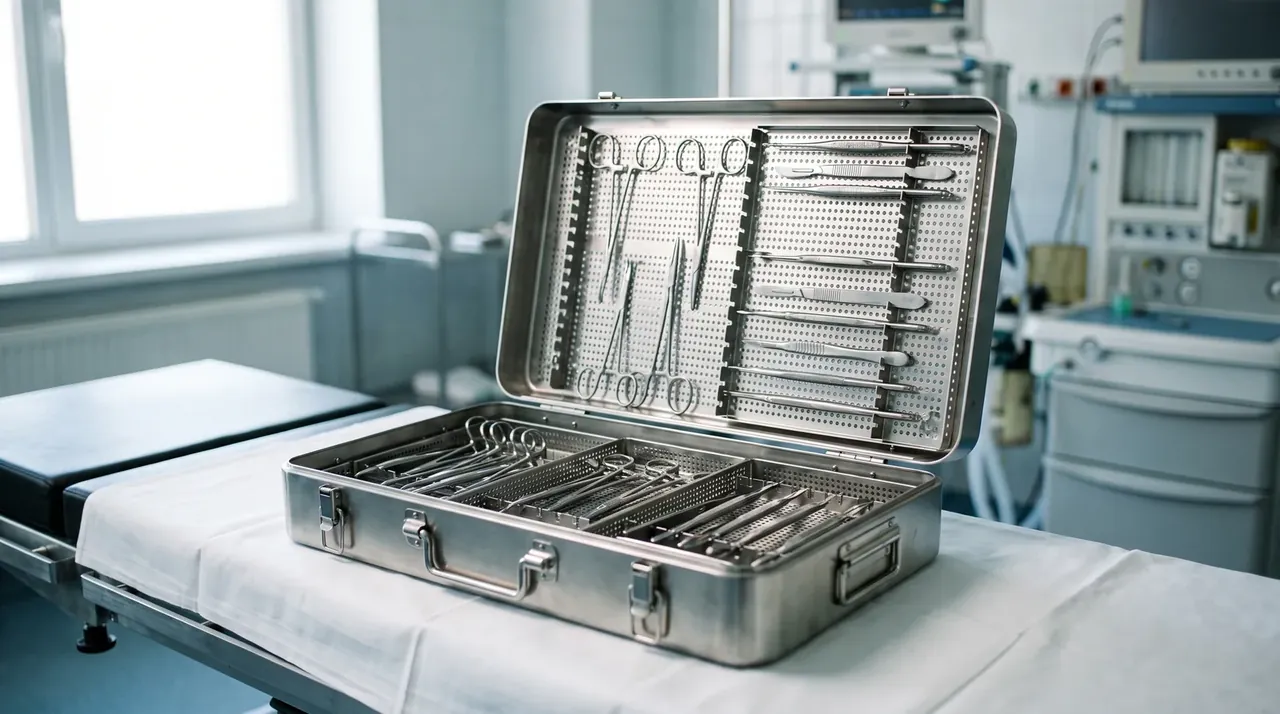
Across two handles, 18.4 kg leaves roughly half on each, and 400 N covers the shock of setting down. Both handles must load together; lifting one side first turns the box off-centre.
Both 400 N marks come as a pair, and inspection never pulls just one.
5. Sealing and stacking checks once the lid is shut
With the Outdoor emergency survival gear safety box closed, inspection reads the box side only: latches seated, rebate aligned, gasket in its groove. A 1.2 m drop at 18.4 kg looks at corners, latches and hinges; four-high stacking checks the bottom lid for permanent set. Both follow the 1.2 m drop and four-high static methods, recorded without a certification conclusion.
| Box configuration | Measurement | Pass |
|---|---|---|
| Lid at 105 degrees | Limit stop | No rebound, no tip |
| Nine cells | Lip height difference | Distinct by touch |
| Two handles, 400 N each | Static pull | No root crack |
| Four latches, 420 N each | Closed and pulled | No spring open |
The 620×440×300 mm outline and 560×380×250 mm cavity underpin every reading; the 4.0 mm wall decides whether the rim holds the gasket down. The 7.4 kg shell and 11 kg payload make 18.4 kg, feeding both the 1.2 m drop and four-high stacking. IP67 and −25 °C to 60 °C bound the recheck. Nine cells, three separate lids and the 105 degree angle carry no load when closed, yet the hand must still find one cell on opening, so both sets of readings form the full specification of the Outdoor emergency survival gear safety box.
Conclusion
The Outdoor emergency survival gear safety box trades an impact grade for retrieval by feel. Its footprint is 620×440×300 mm with a 560×380×250 mm cavity, a 4.0 mm wall and 7.4 kg empty; 11 kg of payload reaches 18.4 kg and fixes two-person carrying. Nine cells and three separate lids make the one-move locate, the 105 degree angle clears the rim, two 400 N handles and four 420 N latches keep separate paths, and a 1.2 m drop, four-high stacking and IP67 close the edge. Checked by method, the box-side design is complete.
Related Reading
- Cases for climbing, rafting, diving and ski gear
- Selecting expedition and camping gear cases
- Outdoor case transport safety at the box side
- How a tactical survival box is specified for loading
Related Products
- 8 Series — Gun Cases; Military Equipment Cases; Camera Equipment Cases; Drone Cases; Watch Cases; Knife Cases; First Aid Cases; Electronics Equipment Cases
- WL8-2812 PP Gun Case — model WL8-2812
- All protective cases and toolboxes: 7 series, 158 models