

Quick answer: The gap sits in three measurable places, latch material and cycle life, gasket cross-section and compression, and wall spread inside a batch, and those numbers decide whether a domestic case holds the rating of the bay it replaces.
Table of contents
- Align cavity size and buying terms first
- Hardware: latches, hinge pins, pressure valves
- Sealing: cross-section, hardness, compression
- Consistency: wall tolerance, colour shift, acceptance clauses
- FAQ
1. Align cavity size and buying terms first
Domestic cases and Pelican differ in hardware, sealing and batch consistency; the shell outline is what matches most easily. Pelican is a trademark held by its owner, this site does not sell that brand, and the comparison below stays on published specifications.
Fix the convention first: net cavity figures, no lid recess or rib footprint, wall thickness as the mean of three mid-wall readings. Without it, two cases both sold as 45 L differ by 8% in usable volume.
| Size | Internal cavity | Usable volume | Side wall |
|---|---|---|---|
| Small | 300 × 225 × 132 mm | 8.9 L | 2.8–3.2 mm |
| Medium | 445 × 345 × 205 mm | 31.5 L | 3.0–3.4 mm |
| Large | 580 × 440 × 330 mm | 84 L | 3.4–4.0 mm |
Minimum order follows the mould. Domestic cases run 300 pieces for a standard colour, 500 for a colour or liner change, with 18–25 days from release, while stocked imported models ship singly on a 6–10 week cycle.
Price tracks size: 180–260 CNY small, 320–460 medium, 620–880 large, against 2.4–3.1 times those figures for imported models.
Align those three and the fitting question becomes answerable.
2. Hardware: latches, hinge pins, pressure valves
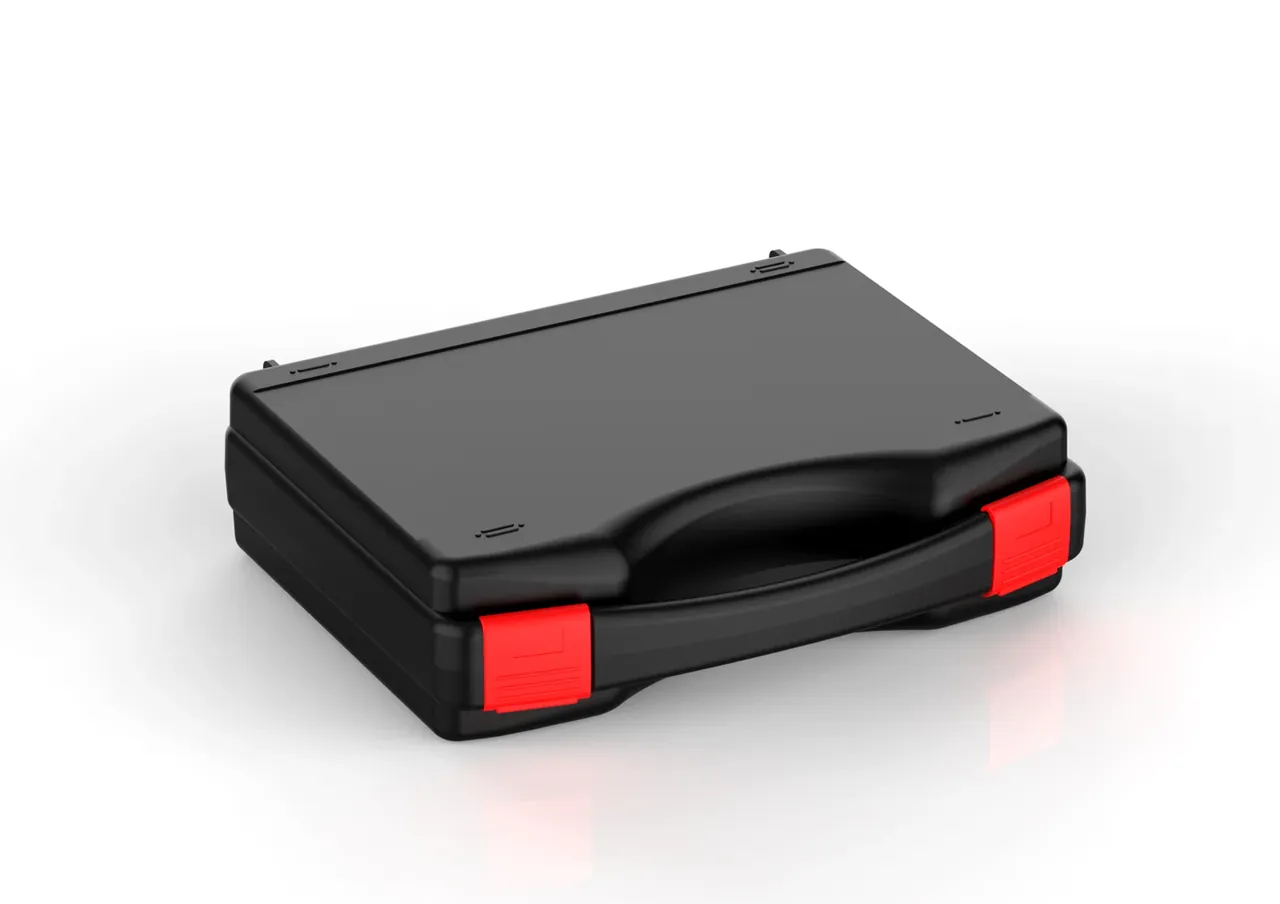
The latch is the first part anyone touches. Domestic cases use PA66 with 30% glass fibre at 18–24 g per latch, imported models often die-cast zinc at 45–60 g. The difference is the force curve rather than peak strength: moulded latches open at 40–60 N and lose 12%–18% of that by cycle 20,000, while zinc bodies run to 50,000 cycles with a harder snap.
Hinge pins are the second saving. Domestic cases run a 4 mm 304 stainless pin, knurled and pressed into the body, where many imported models use plated carbon steel near 10 μm. Stainless forms no galvanic couple against the plastic, and 30 refits grow the bore by under 0.05 mm; a plated pin pits at a scratch after six months at 85% RH and the swelling opens that bore 0.1–0.2 mm.
The pressure valve is an accessory. A 0.8 mm silicone diaphragm that cracks at 3–5 kPa passes 0.4 L per minute and keeps the gasket out of its groove when a case moves from a 40 °C container to a 5 °C store.
| Item | Moulded option | Die-cast option | Acceptance check |
|---|---|---|---|
| Latch | PA66+GF30, 18–24 g | Zinc alloy, 45–60 g | 20,000 cycles, no cracking |
| Hinge pin | 304 stainless, 4 mm | Plated steel, 10 μm | Mill certificate, 200–250 HV |
| Pressure valve | Silicone, 0.8 mm | Silicone, 1.0 mm | 50 presses at -20 °C |
Acceptance closes on cycle count, pin certificate with hardness, and diaphragm rebound at -20 °C.
3. Sealing: cross-section, hardness, compression
Sealing rests on cord diameter, hardness and compression. Domestic cases carry a dual-lip silicone gasket at 3.5 mm cord in a 2.45 mm groove, 50–60 Shore A; imported models pair a 4.0 mm cord with 2.80 mm. Both sit near 30%, so the difference is groove tolerance and corner work.
Under 20% compression a 1 m column of water finds the corners in 30 minutes; over 40% the rubber takes a set, rebound falls to 70% after 500 closures and the second immersion leaks. Cord size is a statement about groove capability: hold depth to ±0.08 mm and 3.5 mm domestic cases work without a heavier gasket.
Hardness keeps the cord seated. Below 45 Shore A it creeps out of the groove at 60 °C and the closed lid shows a 0.5 mm bulge at the edge; above 65 Shore A the 40–60 N latch force cannot reach design compression.
Corners show the process. A moulded gasket has no splice, while a glued one passes three times the water of a flat run after 24 hours of immersion.
- Measure the cord at three points, holding ±0.10 mm.
- Read hardness on a Shore A gauge, spread no more than 3 points.
- Divide groove depth by cord diameter, expecting 25%–35%.
- Inspect the four corners for splice lines, flash and flat spots.
Those four steps take 10 minutes, faster than filling the case with water.
4. Consistency: wall tolerance, colour shift, acceptance clauses
Consistency is what a sample cannot show. Domestic cases hold walls to ±0.15 mm where imported models publish ±0.30 mm; colour shift is quoted as ΔE, 1.5 within a lot and 2.5 across lots; 20 cases weighed from one lot should spread under 1.5%.
Tolerance is amplified at the latch seat: a wall 0.3 mm thin drops compression from 30% to 26%, and the leaking units in a lot usually come from one corner of the mould.
| Clause | Sample | Limit | Method |
|---|---|---|---|
| Wall | 3 cases × 5 points | 3.0 mm ±0.15 mm | Ultrasonic gauge |
| Colour | 5 cases per lot | ΔE ≤1.5 | Spectrophotometer, D65 |
| Weight | 20 cases per lot | Range/mean ≤1.5% | Scale, 10 g resolution |
| Sealing | 3 cases per lot | No ingress, 1 m/30 min | Immersion or pressure decay |
Colour only compares in ΔE: a shell without UV stabiliser climbs 3–5 points after 12 months outdoors, so two deliveries read as two colours.
Weight spread is the cheapest screen: under 1.5% the shot weight is controlled, over 2.5% the walls have drifted and the process log answers faster than more sampling.
Written this way, the clauses make a supplier switch cheap.
Conclusion
Domestic cases sit at a measurable distance from the imported models they are judged against, reducing to three figures: a latch rated to 20,000 cycles, a 3.5 mm gasket held at 30% compression, and walls at ±0.15 mm with weight spread under 1.5% in a lot. Meet all three and the case lands in the same protection band, leaving lead time, minimum order and unit price as commercial differences rather than technical ones. Miss any one and the failure appears in immersion or drop testing, always in the same place. Scoring domestic cases on that three-row sheet answers the fit question without leaning on brand reputation.
This article discusses only the container (case body) side of specifications and design intent, and does not cover any handling, loading or use of the contents.
Related Reading
- Choosing a plastic case over a flight case
- ABS and PP case bodies compared
- Gasket and O-ring material selection
- IP67 waterproof case standards and test conditions
Related Products
- 8 Series — Gun Cases; Military Equipment Cases; Camera Equipment Cases; Drone Cases; Watch Cases; Knife Cases; First Aid Cases; Electronics Equipment Cases
- WL8-2812 PP Gun Case — model WL8-2812
- All protective cases and toolboxes: 7 series, 158 models