

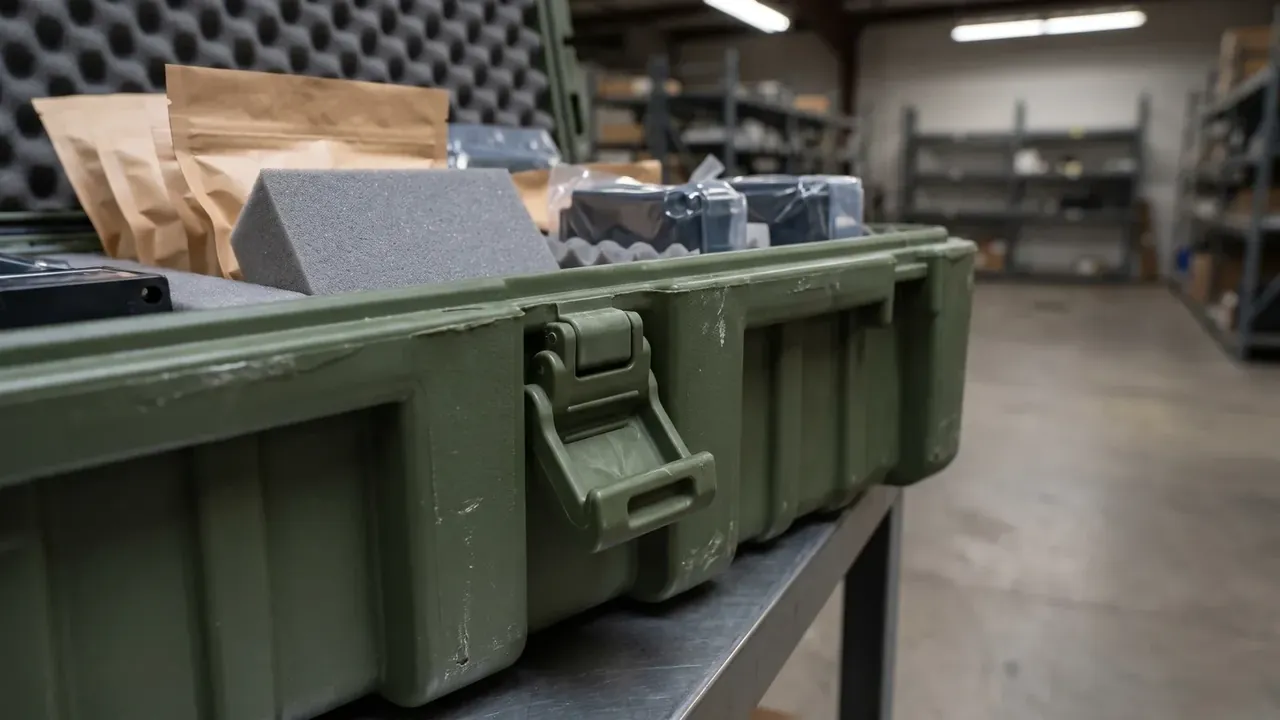
Quick answer: Photography hard drive anti-static protective box holds liner resistance at 10^6–10^9 ohms; four 2.2 N springs keep static decay under 1.8 s.
Table of contents
- Surface resistance band of the Photography hard drive anti-static protective box
- Contact pressure of the grounding springs
- Reading the static decay time
- Contact resistance after cycling
- Batch resistance reject line
- FAQ
1. Surface resistance band of the Photography hard drive anti-static protective box
The liner of a Photography hard drive anti-static protective box is closed-cell foam with conductive filler, not plain cushioning. A surface resistance of 10^6–10^9 ohms drains charge slowly instead of at once, and it does not trap a local potential as an insulating face does. The lower edge limits a discharge that is too fast; the upper edge limits charge that lingers.
Two parallel electrodes are pressed on the liner and read after settling. On the inspection sheet, at least five points are marked on one liner, and both extremes must stay inside 10^6–10^9 ohms, since a single averaged figure is no pass.
JUNZHIJIA records volume and surface resistance apart. The Photography hard drive anti-static protective box releases on surface resistance, which governs the contact path, while volume resistance only guides the compound.
| Band | Ohms | Note |
|---|---|---|
| A | 10^6 | filler |
| B | 10^7 | target |
| C | 10^9 | edge |
| Over | above 10^9 | reject |
The shell is 500×370×200 mm outside and 440×310×145 mm inside, with a 3.7 mm wall, 4.4 kg empty and 9 kg loaded. These sizes fix the liner area and the electrode spacing; inspectors log the spacing so only the centre patch is not sampled.
2. Contact pressure of the grounding springs
As the lid shuts, a Photography hard drive anti-static protective box joins the liner to the shell metal path through four grounding springs. Each is set to 2.2 N: a lighter force leaves the contact intermittent, a heavier one crushes the foam and leaves a dent.
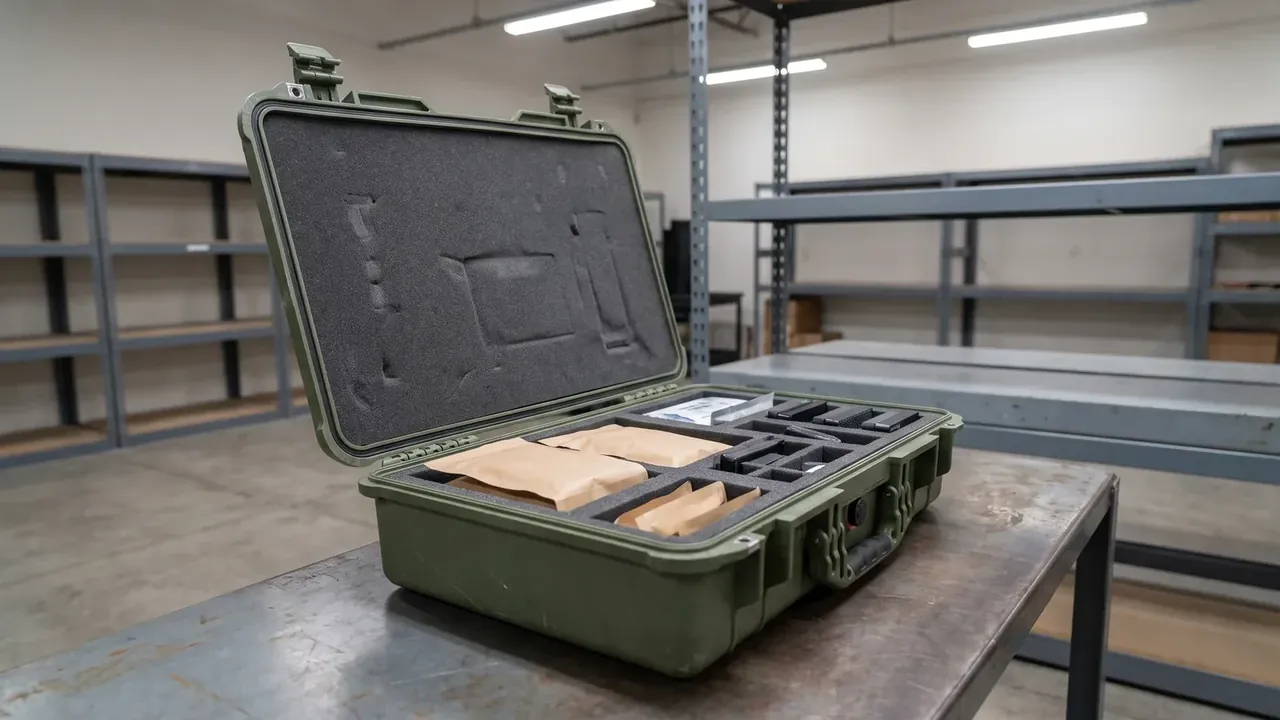
The springs sit on the four rim edges, clear of catch and hinge seats. Each is numbered, and the recheck logs contact resistance by number, so a degraded spring points to its own stretch of the rim.
Contact resistance must hold at or below 0.45 ohms, far below the surface figure because it measures the metal-to-metal step. An oxide film or foam crumbs lift the reading, so faces are wiped before assembly.
| Spring | Pressure N | Ohms |
|---|---|---|
| 1 | 2.2 | ≤0.45 |
| 2 | 2.2 | ≤0.45 |
| 3 | 2.2 | ≤0.45 |
| 4 | 2.2 | ≤0.45 |
Two catches, each at 335 N, press the mouth shut so springs cannot loosen in vibration. Catch seats and spring seats are laid out apart, so loading a catch does not push a nearby spring out of line.
3. Reading the static decay time
Static decay is the time to fall from a set potential to a chosen fraction, and a Photography hard drive anti-static protective box sets it at or below 1.8 s. A longer time means a weak conductive path; a shorter one drifts back to a discharge that is too fast.
Readings run on a bench with controlled heat and humidity, the probe held at a fixed gap. For one batch, three liners are taken and each measured twice; all six readings must fall within 1.8 s before the batch is released.
| Decay | Potential | Note |
|---|---|---|
| 1.2 s | 1000 V | margin |
| 1.6 s | 1000 V | target |
| 1.8 s | 1000 V | reject edge |
| 2.1 s | 1000 V | recompound |
An IP65 seal keeps the mouth compressed so the gasket stays dry and surface resistance does not drift with humidity. The station checks the seal before taking any electrical figure.
A 1.0 m drop is repeated once on each of the six faces, then surface resistance and decay are measured again. A drop cannot be closed out on looks alone, because the liner-to-shell contact may already have shifted.
4. Contact resistance after cycling
A rig opens and shuts the lid repeatedly, and a Photography hard drive anti-static protective box is set to 4500 cycles. With no part swapped and no adjustment made, the four springs are measured in place against 0.45 ohms.
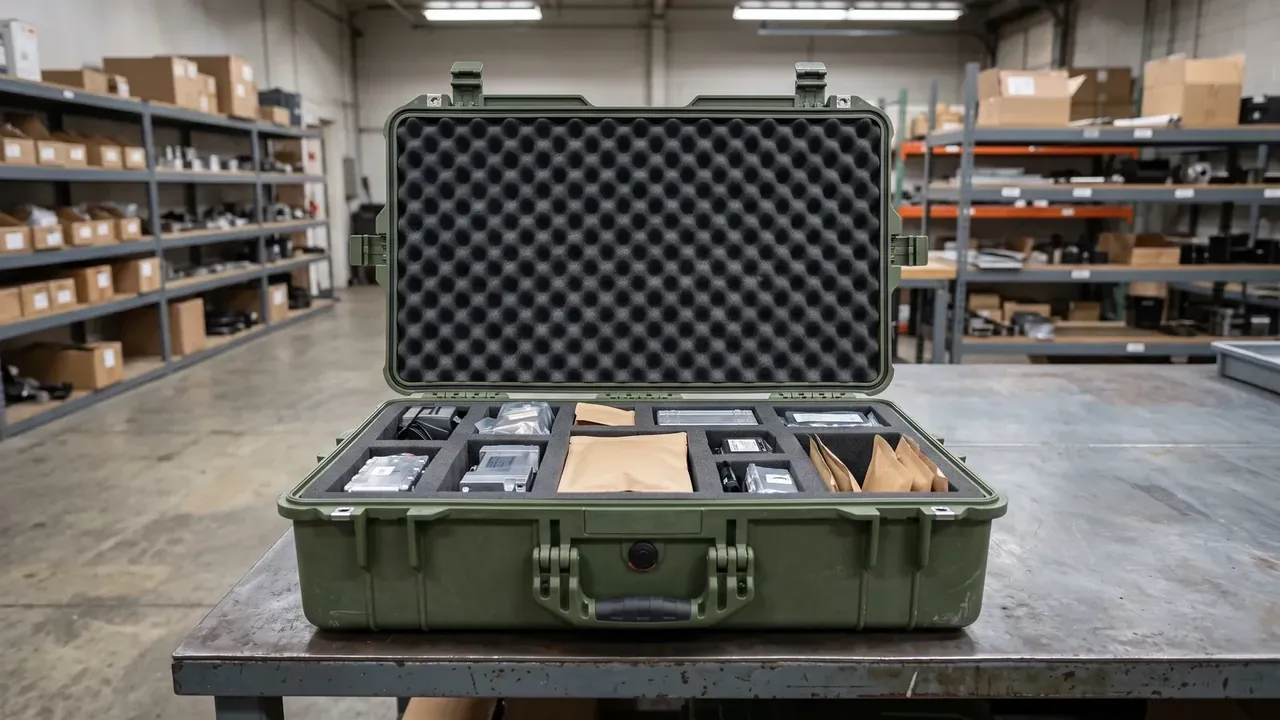
Wear starts at the spring nearest the handle, which carries most load when the lid is opened. Before and after readings are logged side by side, and the spring is judged by the difference rather than a single number.
If one spring climbs above 0.45 ohms, rebound is checked first, then the rim for a slight warp from stacking. The recheck record names the spring number, not just pass or fail.
The gasket is checked for rebound after 4500 cycles too, since a collapsed lip admits damp air and pulls surface resistance off target. Catches, springs and gasket act as one linked set, so replacing any one means rerunning the electrical readings.
5. Batch resistance reject line
For a batch of Photography hard drive anti-static protective box units, the reject line sits at surface resistance, contact resistance and decay time. A value outside 10^6–10^9 ohms, above 0.45 ohms, or beyond 1.8 s sends that shell back to the assembly line.
Sampling is split by batch size, and every unit carries its liner point log and spring number log. A whole run is not cleared on the average; one unit over the line sends the inspector back to that mould run.
The JUNZHIJIA release card puts dimensions, wall thickness, empty and loaded mass, and the electrical readings on one page. A Photography hard drive anti-static protective box is logged this way so size and static criteria match, and a later recheck need not guess which liner batch was fitted.
The maker, Kexin New Materials (Guangdong) Co., Ltd., reports structural and inspection terms only and makes no judgement on anything placed inside. The specification ends there; what remains is to retest by the stated method.
Conclusion
The three criteria of a Photography hard drive anti-static protective box sit on liner surface resistance, spring contact pressure and static decay time; 10^6–10^9 ohms, 2.2 N and 1.8 s restrain one another. Read the test conditions before comparing, since a bare figure without conditions cannot be compared. JUNZHIJIA puts structural size and electrical readings on one release card so a recheck has a basis.
Related Reading
- Antistatic protective cases in EPA areas
- ESD case surface resistivity
- Case ESD resistance and decay time
- Archival storage case selection
Related Products
- 8 Series — Gun Cases; Military Equipment Cases; Camera Equipment Cases; Drone Cases; Watch Cases; Knife Cases; First Aid Cases; Electronics Equipment Cases
- WL8-2812 PP Gun Case — model WL8-2812
- All protective cases and toolboxes: 7 series, 158 models