

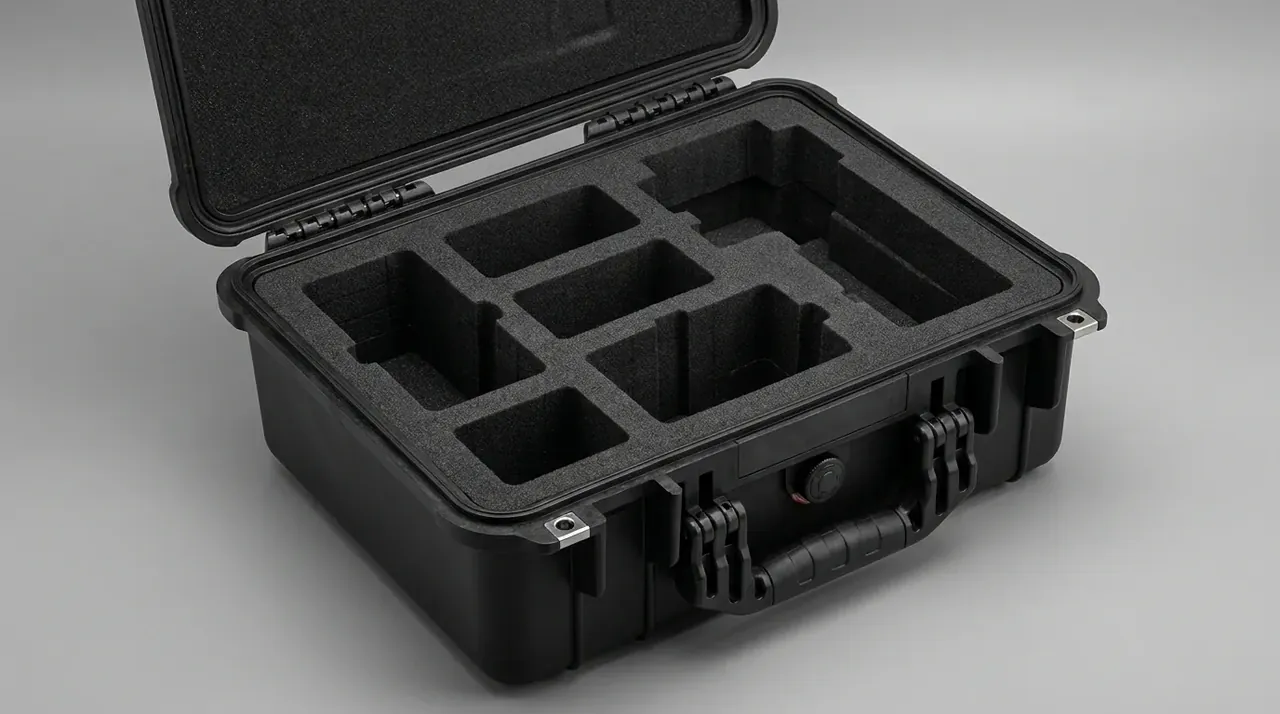
Quick answer: Case esd test needs two numbers: one box reads 2.1×10⁷ Ω and decays 1000 V to 100 V in 0.8 s at 50% RH, then 3.4×10¹¹ Ω and 6.4 s at 12% RH.
Table of contents
- Two electrical numbers
- Surface resistance at 25 mm and 100 V
- Decay time and the 2 s line
- 12% RH against 50% RH
- Surface and volume resistivity
- FAQ
1. Two electrical numbers
One black box, measured in two rooms. At 50% relative humidity its surface resistance is 2.1×10⁷ Ω and the voltage falls from 1000 V to 100 V in 0.8 s. After 24 h at 12% RH the same electrodes on the same spot read 3.4×10¹¹ Ω and 6.4 s; nothing changed but the air.
Case esd test acceptance has two thresholds: surface resistance between 10⁶ Ω and 10⁹ Ω, and decay from 1000 V to 100 V inside 2 s. The first asks whether charge can leave, the second how fast it goes.
Both must hold: a box with low resistance and slow decay still holds parts at high potential for tens of seconds.
A case is not one flat plate: outer wall, inner wall, divider and rib can differ by a decade on the same moulding, so every reading needs a named face and point.
2. Surface resistance at 25 mm and 100 V
Measurement uses two weighted electrodes of 2.27 kg each, pressed parallel onto the surface 25 mm apart. An electrode that does not seat reads about ten times high, and moving the gap from 25 mm to 50 mm roughly doubles the number.
Test voltage follows the range: 10 V below 10⁶ Ω, 100 V at or above it. Using the wrong one costs 0.3 of a decade near 10⁶ Ω, which is enough to push a failing box into the pass column.
Read at 15 s after energising. The first seconds are polarisation, and a 3 s reading sits 0.5 of a decade above a 15 s reading, so a report that prints one number must print the timing too.
| Parameter | Value | Why it is fixed |
|---|---|---|
| Electrode gap | 25 mm | Doubling the gap doubles the reading |
| Electrode load | 2.27 kg each | Poor seating reads ten times high |
| Test voltage | 10 V or 100 V | Split at 10⁶ Ω, wrong band costs 0.3 decade |
| Reading time | 15 s after energising | 3 s against 15 s differs by 0.5 decade |
| Points | 5 per face | Max and min on one face differ tenfold |
Take the median of five points, never the mean, because a spot of release residue can sit two decades high and drag a mean with it. Record value, voltage band and humidity together, since without humidity the gap between 10⁷ Ω and 10¹¹ Ω has no explanation.
3. Decay time and the 2 s line
Decay measures how quickly charge leaves. The surface is charged to 1000 V, the charger is withdrawn, a field probe watches the curve, and the seconds from 1000 V down to 100 V are recorded. The 2 s line exists because residual voltage below that sits under most damage thresholds.
Two seconds is a ceiling, not a target. A box reading 0.8 s at 50% RH reads 1.9 s at 30% RH, right on the line, and slightly drier air takes it over. An acceptance clause that says under 2 s without naming humidity says nothing.
Slow boxes share a habit: surface resistance near the top of the dissipative band. At 10⁹ Ω charge moves but moves slowly, and decay usually lands between 1.5 s and 3 s. Such boxes suit slow handling, not repeated opening.
Probe height matters as much: a gap of 2 mm against 10 mm changes the reading by more than 1 s, so reports carry both probe height and charging voltage.
4. 12% RH against 50% RH
Humidity moves the two numbers unevenly. Dropping from 50% to 12% RH lifts surface resistance four decades and stretches decay only eightfold, a logarithmic jump against a linear one.

The cause is the surface water film. Adsorbed water forms a thin conductive path, continuous at 50% RH and broken into islands at 12%, so charge falls back on ionic movement through the polymer.
| Relative humidity | Surface resistance | Decay 1000 V to 100 V | Verdict |
|---|---|---|---|
| 12% | 3.4×10¹¹ Ω | 6.4 s | Fail |
| 30% | 8.6×10⁸ Ω | 1.9 s | Marginal |
| 50% | 2.1×10⁷ Ω | 0.8 s | Pass |
Winter workshops, high-altitude stores and sealed rooms with desiccant all land near 12% RH, so a box that passes in a humid season fails when opened in a dry warehouse. The fix is a written humidity band: where the floor sits below 20% RH all year, accept at 20%, and where acceptance ran at 50%, state the lower limit in the contract.
Temperature joins in, since 23 ℃ against 35 ℃ moves resistance by 0.6 decade and decay by 0.4 s, so both conditions belong in the specification.
5. Surface and volume resistivity
Surface resistance is what the electrode pair reads, in Ω. Surface resistivity folds it into a square, in Ω/sq: with 63 mm electrodes 25 mm apart the ratio is 2.5, so 2.1×10⁷ Ω becomes 5.3×10⁷ Ω/sq.
Volume resistivity, in Ω·cm, uses a three-electrode setup with current driven through the wall. It describes the compound: at 3 mm and 2 mm the resistivity matches while the resistance differs by 1.5 times.
The split is clean. Surface resistivity asks whether the surface collects charge; volume resistivity asks whether the material counts as dissipative. Case esd test acceptance reads surface resistance and decay, material development reads volume resistivity, and a report carrying both is safest.
Surface resistivity also shows uniformity: five points within a tenfold spread count as even, while a hundredfold spread points to bloom or contamination.
Conclusion
Run case esd test acceptance on two gates, both of which must close: surface resistance inside 10⁶ Ω to 10⁹ Ω, and decay from 1000 V to 100 V inside 2 s. Put three things on the sheet: the setup of 25 mm gap, 10 V or 100 V and a 15 s reading; the room at 23 ℃ with 12% or 50% RH after 24 h; and five points per face on inner wall, outer wall and divider, judged by median. Change any of them and the numbers stop being comparable, so the gap between 2.1×10⁷ Ω and 3.4×10¹¹ Ω reads as a quality swing rather than a humidity effect. The rule stays short: two numbers, one humidity, one voltage band, anything else counts as a fail.
This article discusses container-side specifications and design implications only, and does not cover any handling, loading or use of the contents.
Related Reading
- Antistatic case materials and structure
- ESD lining treatment inside cases
- Standards and classes for ESD boxes
- Where shielding cases apply
Related Products
- 8 Series — Gun Cases; Military Equipment Cases; Camera Equipment Cases; Drone Cases; Watch Cases; Knife Cases; First Aid Cases; Electronics Equipment Cases
- WL8-2812 PP Gun Case — model WL8-2812
- All protective cases and toolboxes: 7 series, 158 models