


A photomask and reticle transport case is a dedicated clean protective container used by wafer fabs, mask manufacturers and lithography equipment service providers to carry photomasks and reticles during mask shipment, incoming inspection, repair and equipment changeover. Its core value is delivering a mask that fears particles, static, deformation and moisture safely from the mask shop to the lithography tool, while guaranteeing a scratch-free pattern surface, particle counts within limits and no overlay-accuracy drift. Compared with an ordinary instrument case, a photomask case carries a nanoscale defect-sensitive payload: a single particle invisible to the eye landing on the pattern surface can create a repeating defect on the wafer and scrap an entire lot. This article covers the selection and design of photomask cases, reticle transport cases, mask pods, semiconductor mask cases and clean transport cases, breaking down failure risks, cleanliness classes (ISO 14644 / SEMI standards / IP), mask structure, particle control, ESD control, shock and deformation, temperature and humidity, material selection, cleanroom transfer, traceability management, and procurement and acceptance, with tables that can be used directly in purchasing and acceptance.
Readers who need the fundamentals of cases and clean transport should first review Wafer and Semiconductor Part Transport Protection and Plastic Protective Cases: Material and Structure. For seals see Seal Material and Seal Structure Selection, for dust and water ratings see IP67 Protective Cases and Waterproof Ratings, and for validation see ISTA Transport Testing Procedures and MIL-STD-810H Environmental Testing and Compliance.
What Is a Photomask & Reticle Transport Case
A photomask and reticle transport case, also called a reticle transport case, mask pod or semiconductor mask case, is a dedicated clean transport and storage container for lithography photomasks and reticles. The difference from an ordinary instrument case is the cleanliness requirement: an ordinary instrument case only has to protect appearance and function, while a photomask case must protect a nanoscale pattern surface, and any particle, scratch, electrostatic discharge or micro-deformation can translate directly into a repeating defect on the wafer.
In form, a photomask case usually consists of a clean outer shell, a cushioning structure, a pattern-surface relief cavity, a carrier frame and a clean sealing system. The clean outer shell uses non-shedding, low-outgassing materials; the cushioning structure absorbs transport vibration; the relief cavity keeps the pattern surface from touching any material; the carrier frame fixes the mask and keeps the handling orientation controlled; and the clean sealing system isolates the interior from the outside environment. Common options also include a dissipative surface layer, a desiccant pocket, a humidity indicator card, a number and QR code position, and locating features for robot or manual handling.
Typical users include the outbound shipping and repair departments of mask manufacturers, the lithography process and mask management teams of wafer fabs, the field service engineers of lithography equipment vendors, semiconductor test and certification bodies, and micro and nano fabrication laboratories at universities and research institutes. Wherever a mask must be delivered safely to the lithography tool with its pattern intact, that is the application boundary for a photomask transport case.
Failure Risks and Pain Points in Mask Transport
The first pain point is particle contamination. The features on the pattern surface are already at the nanoscale, and a single micron-scale particle can create a defect at exposure that is repeatedly printed onto many wafers, scrapping the lot. The second is electrostatic discharge and electrostatic attraction. A mask substrate is usually quartz and therefore insulating, so friction during transport and opening builds charge that attracts particles, and discharge can also damage the pellicle and repair layers. The third is scratching and crushing. Once the pattern surface touches any material it can be scratched, and the scratch cannot be repaired.
The fourth pain point is micro-deformation and vibration. A mask is extremely sensitive to flatness, and vibration, stacking and improper clamping in transit can introduce stress that changes flatness and affects overlay accuracy. The fifth is temperature, humidity and condensation. Humidity change affects static and particle adhesion, and moving between large temperature differences in cross-climate transport causes condensation, so cleanliness and humidity often have to be controlled together. The sixth is traceability and misuse. Masks are valuable and numerous, and without numbering and status labeling they are easily mis-issued, mis-installed and lost, and repair and scrap records cannot be closed.
The common conclusion from these pain points is that a photomask transport case should be engineered as a cleanliness and precision retention system: define the mask size, pattern-surface orientation and cleanliness class first, then settle the relief, ESD, shock and sealing design, and finally close the loop with particle inspection and a traceability checklist. Comparing only capacity and price usually exposes particle excursions and defect scrap after only a few transfers.
Cleanliness Classes and Referenced Standards (ISO 14644 / SEMI / IP)
Cleanliness is the first metric of a photomask case. Air cleanliness class is judged per ISO 14644-1, and ISO Class 4 to 6 requirements are common in semiconductor mask work areas. For a mask case, what matters more is the cleanliness inside the case and control of particle release when it is opened, so the contract should specify the cleanliness, outgassing behavior and cleaning method of the contact materials rather than only the class of the room the case sits in.
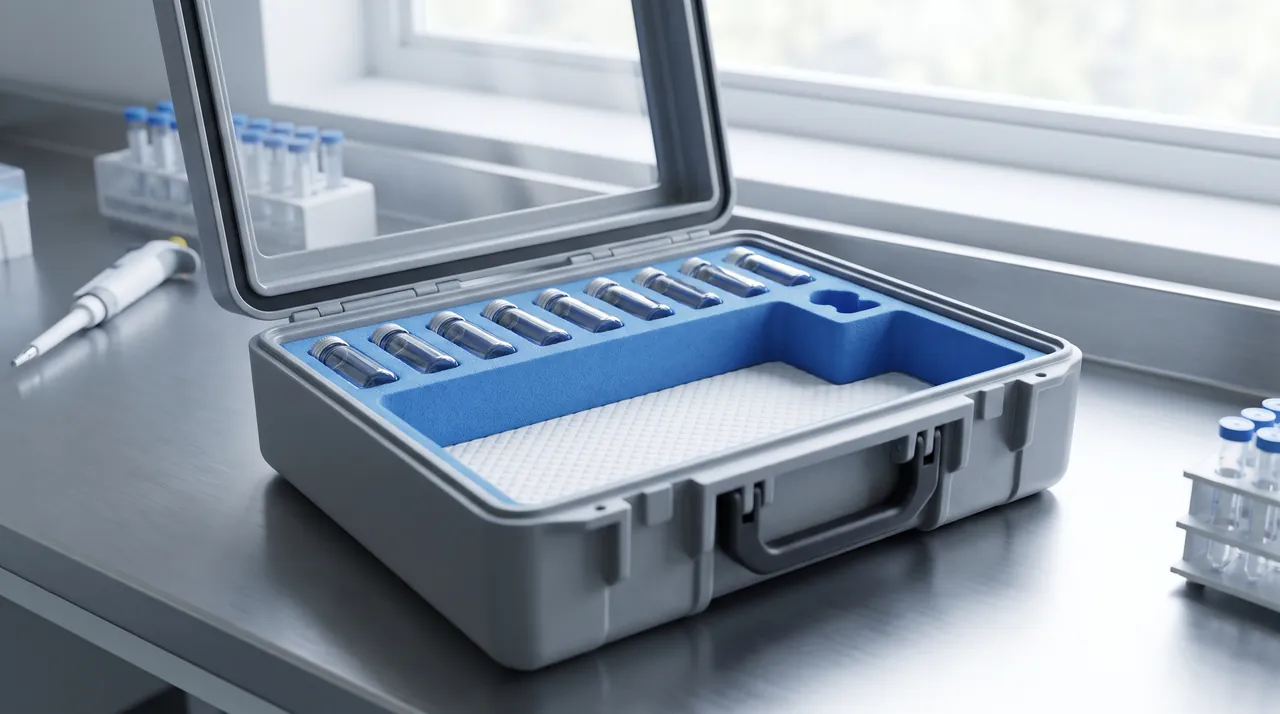
Beyond cleanliness, three standard families matter. The first is sealing and protection rating: the IP rating is judged per IEC 60529 and GB/T 4208, and a mask case usually requires IP65 or above to keep out external particles and moisture, with IP67 for marine or humid environments. The second is semiconductor industry practice: the SEMI standards define the dimensions, interfaces and cleanliness performance of reticle pods, and where automatic docking with a lithography tool is required, interface and dimensional consistency must be confirmed. The third is transport validation: the ISTA series and the MIL-STD-810H drop (Method 516.8), random vibration (Method 514.8) and temperature-humidity cycling (Method 507.6) methods correspond to handling drops, road and air vibration, and cross-climate transport.
| Scenario | Suggested cleanliness and IP | Suggested methods | Key focus |
|---|---|---|---|
| --- | --- | --- | --- |
| In-cleanroom transfer | ISO Class 5 or better plus IP54 | Particle inspection | Pattern-surface relief |
| Inter-fab ground transport | ISO Class 5 or better plus IP65 | Random vibration, drop | Clean sealing and cushioning |
| Air and long-haul | ISO Class 5 or better plus IP65 to IP67 | Low pressure, temperature-humidity cycling | Outgassing and condensation |
| Marine export | IP67 | Salt fog, temperature-humidity cycling | Corrosion and long-term sealing |
| Automatic tool docking | Per SEMI interface | Dimension and interface validation | Robot compatibility |
Mask Structure: Substrate, Pattern Surface and Pellicle
Understanding the mask structure is the prerequisite for designing the relief and carrier. A photomask usually consists of a quartz substrate, an opaque layer and the pattern, and a pellicle. The quartz substrate provides dimensional stability and transparency, the opaque layer, commonly chrome or molybdenum silicide, forms the circuit pattern and is where the pattern surface lives, and the pellicle keeps a standoff above the pattern surface so particles do not land directly on it, but the pellicle itself fears mechanical compression and solvent contamination, and its frame must not be compressed.
The sensitive areas of a mask therefore fall into four groups: the pattern surface, which must never be touched; the pellicle and its frame, which must not be squeezed or scratched; the substrate edge and chamfer, which take the carrier load; and the back surface, which is used for chucking and locating and must stay clean. The carrier should let the substrate edge take the main load, orient the pattern surface toward the relief cavity, and never apply extra pressure to the pellicle frame.
| Area | Material | Main risk | Protection and structure points |
|---|---|---|---|
| --- | --- | --- | --- |
| Substrate | Quartz | Knocks, deformation, scratches | Edge load plus locating |
| Pattern surface | Chrome / MoSi pattern | Particles, scratches, static | Relief cavity, no contact |
| Pellicle and frame | Organic film plus frame | Squeezing, scratches, solvent | Relief above, no pressure |
| Back surface | Quartz | Particles, contamination | Clean carrier surface |
| Edge and chamfer | Quartz | Chipping, micro-cracks | Soft support plus cushioning |
Particle Control and Clean Packaging
Particle control runs through design, cleaning, packaging and opening. At the design stage, the case interior should avoid dead corners and dust-trapping geometry, materials should be non-shedding and low-outgassing, and ordinary foam and recycled plastic should be avoided; direct carrier surfaces should use clean-grade engineering plastic or cleaned EVA. At the cleaning stage, the cavity and carrier surfaces should be wiped per a cleanroom procedure using lint-free wipes and approved solvents before loading, and the case should never be opened and exposed in an ordinary environment.
At the packaging stage, a two-level structure of a clean inner bag plus a rigid outer case is recommended: the inner layer uses a clean anti-static bag to isolate the mask from external particles, and the outer case provides mechanical protection. At the opening stage, open the case in a clean environment or under a local clean air curtain wherever possible to minimize exposure time, and for cases that must be opened on site prepare a portable clean kit with lint-free wipes, clean gloves, solvent and a particle test coupon.
Where a cleanliness figure is specified, write the pre-load cleaning method, packaging material cleanliness and post-unpacking particle test plan into the technical specification, so cleanliness becomes an acceptance clause rather than a verbal request. Related clean transport thinking can be found in Wafer and Semiconductor Part Transport Protection.
ESD and Dissipative Design
A quartz substrate is insulating, and friction during transport and opening builds charge that creates two risks: electrostatic attraction of particles, which makes them more likely to settle near the pattern surface, and electrostatic discharge that damages the pellicle and repair layers. The goal of ESD design for a photomask case is therefore to control charge buildup and drain it quickly, rather than simply making the material conductive.
In practice, use dissipative materials for the liner and carrier surface with surface resistance held in the typical dissipative range, avoiding pure insulators that build charge heavily and conductors that cause instantaneous discharge; reserve a grounding terminal on the case so that charge can be drained through a ground lead in the cleanroom; and wear an anti-static wrist strap and clean gloves during work, avoiding repeated rubbing of the case in a dry environment. For cases opened frequently, avoid ordinary plastic parts that charge easily in the opening mechanism and check periodically that ESD performance has not degraded.
Where a mask travels with an electronic tag, note the tag's ESD sensitivity, fix it where it cannot touch the mask directly, and give it anti-static packaging. Related ESD and shielding requirements are described with environmental adaptability in MIL-STD-810H Environmental Testing and Compliance.
Shock Absorption and Deformation Control
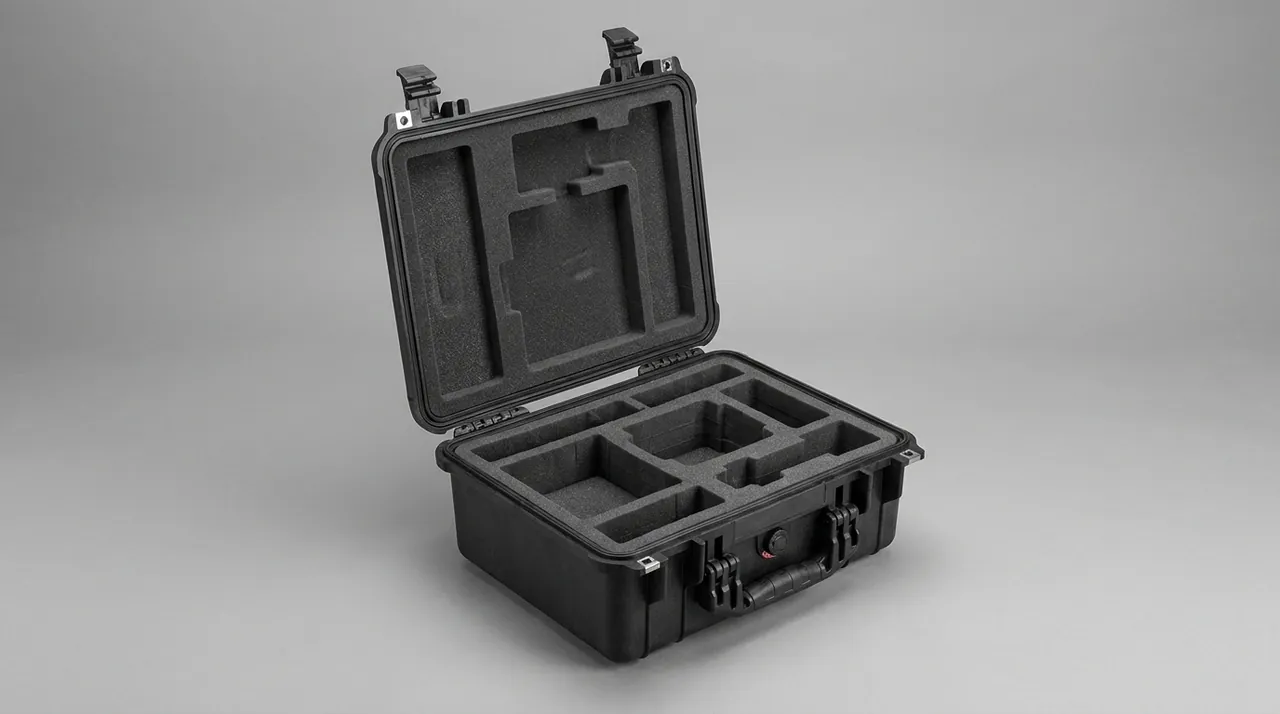
A mask is extremely sensitive to flatness, so the goal of shock design is not just surviving the drop but avoiding deformation and displacement. A combination of carrier frame, cushioning layer and locating is recommended: the carrier frame lets the substrate edge take the load and orients the pattern surface toward the relief cavity; the cushioning layer absorbs vibration and shock energy so it is not transmitted to the substrate; and the locating constrains horizontal and vertical movement so the mask cannot slide and rub inside the case.
In practice, the first step is to set the cushioning layer thickness and hardness according to mask size and weight, and to measure the actual response in drop and vibration tests to confirm it is within the acceleration and stress limits allowed for the mask. The second is to control the clamping method, avoiding point and hard contact and preferring soft surface contact, and never applying pressure over the pellicle frame. The third is to control stacking: when several masks travel in one case, carry them in separate compartments and never stack them directly. The fourth is to reduce the number of open and close cycles, since each one raises the chance of introducing particles and scratches, so standardize the handling process and record the count.
Where the case must dock with a lithography tool, also validate compatibility between the case and the robot interface to avoid collision and drops during automated handling. Related validation methods can be found in ISTA Transport Testing Procedures.
Temperature, Humidity and Condensation Control
Humidity affects mask transport in three ways: high humidity worsens particle adhesion and static problems; a sudden humidity change causes condensation that forms a water film on the pattern surface and pellicle and can introduce contamination; and long-term high humidity affects the stability of the pellicle and adhesives. Internal humidity should therefore be kept stable and below an agreed limit, usually with desiccant and a humidity indicator card, and long transport should add a humidity logger.
The key to condensation control is reducing the temperature-difference shock and equalizing gradually. In cross-climate transport, moving from a cold environment into a warm cleanroom should be followed by a hold in a buffer area until the case temperature equalizes before opening. For masks that must be stored in a low-humidity environment, use a clean dry cabinet rather than an ordinary case for long-term storage. On temperature, stay within the limit of the pellicle and adhesives and avoid direct sunlight and hot environments.
For seals and materials, moisture also brings corrosion and outgassing concerns, so the case should reach the agreed IP rating and materials should be low-outgassing to avoid releasing condensable organics inside a closed space that could deposit on the pattern surface. Related seal material choices can be found in Seal Material and Seal Structure Selection and IP67 Protective Cases and Waterproof Ratings.
Case and Clean Material Selection

Material choice must satisfy cleanliness, ESD, shock and sealing at the same time. A rotomolded case is impact and weather resistant and can be made large, which suits inter-fab ground transport and marine shipping; an injection-molded case has high dimensional precision, easily controlled cleanliness and low weight, which suits in-cleanroom transfer and medium to small masks; an aluminum case is strong and good for shielding and heat dissipation, which suits applications needing shielding or tool docking, though metal debris and knocks must be managed; and a composite case balances specific strength and cleanliness, which suits air freight and lightweight needs.
| Material route | Advantages | Limits | Typical use |
|---|---|---|---|
| --- | --- | --- | --- |
| Rotomolded polyethylene | Impact and weather resistant, can be large | Heavier, cleanliness needs work | Inter-fab ground transport, marine |
| Injection-molded PP/ABS/PC | Light, precise, clean | Limited load and size | Cleanroom transfer, small masks |
| Aluminum | Strong, can shield | Higher cost, metal debris risk | Shielding or tool docking |
| Composite | High specific strength, low-outgassing options | Higher cost, complex process | Air freight and lightweight |
Selection can start from four filters: mask size and quantity, cleanliness class, whether tool docking is needed, and transport method, then be reviewed against total cost of ownership. Most wafer fabs end up using injection-molded or composite for cleanroom circulation and rotomolded for inter-fab and export, balancing cleanliness, protection and cost. Related material fundamentals can be found in Plastic Protective Cases: Material and Structure.
Cleanroom Transfer and In-Fab Logistics
In-fab logistics is the high-risk stage for mask contamination. A dedicated lane, dedicated cart and dedicated procedure are recommended: a dedicated lane avoids mixing with general logistics and reduces particle and vibration sources; a dedicated cart with damping and a clean cover avoids manual carrying; and a dedicated procedure defines who handles the mask, how many times it is opened and what must be logged, creating a traceable record.
For highly automated fabs, confirm compatibility between the case and the automated material handling system or robot interface, including outer dimensions, gripping points, door-opening method and identification labels. For manual handling, provide clear grip and orientation markings on the case to prevent a mis-grip drop. Related overall clean transport thinking for semiconductors can be found in Wafer and Semiconductor Part Transport Protection.
Labeling, Traceability and Asset Management
Masks are valuable and numerous, so labeling and traceability bear directly on asset security and quality closure. Put a unique number and QR code on the outside of the case linked to the mask model, serial number, pattern revision, cleanliness class and expiry, and put a carrier label and status marking inside to indicate in-stock, in-transit, in-use, in-repair or scrapped. Where masks move between fabs, establish a unified coding rule and information system interface so that independent local coding does not cause duplication and mis-issue.
Traceability records should cover the origin and destination and time of each shipment, the carrier method, opening records, particle inspection results and exception handling. When a particle excursion or scratch occurs, the record should allow the stage to be identified quickly and other masks shipped in the same batch to be traced, limiting the spread of loss. Writing traceability requirements into the procurement and transport agreement is an effective way to protect assets and quality.
Typical Application Scenarios and Configurations
| Scenario | Recommended configuration | Key points |
|---|---|---|
| --- | --- | --- |
| In-cleanroom transfer | Injection-molded clean case plus dissipative liner | Light, clean, ESD-safe |
| Inter-fab ground transport | Rotomolded case plus cushioning carrier frame | Shock protection, sealing |
| To third-party testing | Clean case plus logger plus checklist | Traceable, contamination-free |
| Air and long-haul | IP65 case plus desiccant and humidity card | Condensation, low outgassing |
| Marine export | IP67 case plus anti-corrosion | Salt fog, long-term sealing |
| Automatic tool docking | SEMI-compatible interface plus locating | Robot compatibility |
| Repair and scrap transport | Dedicated labels plus sealed packaging | Status management and compliance |
For night or emergency mask changeover, add reflective marking and a quick-identification label to the case to shorten tool waiting time, while never skipping cleaning and logging to save time, because the cost of the particle defects introduced is far higher than the cost of waiting.
Procurement and Acceptance Checklist
Procurement of a photomask case should treat the mask characteristics, the case and the cleanliness and validation as one whole, with technical clauses written clearly and verifiably. The checklist is as follows. First, the mask list with size, thickness, quantity, pattern-surface orientation and pellicle condition. Second, cleanliness requirements covering internal cleanliness class, contact material cleanliness, outgassing behavior and cleaning method. Third, sealing and protection rating under GB/T 4208 and IEC 60529, clarifying whether IP67 is required. Fourth, ESD requirements covering surface resistance range, grounding terminal and material type. Fifth, shock and carrier scheme covering carrier frame, cushioning layer, relief cavity and locating. Sixth, transfer and docking requirements covering robot compatibility, gripping points and door-opening method. Seventh, labeling and traceability covering coding rule, QR code, status marking and information system interface. Eighth, documents such as cleanliness test reports, material certificates, transport validation reports and sampling plans. Ninth, delivery, packaging and after-sales service.
Acceptance should use first-article plus sampling. Check the liner fit with the mask, whether the pattern-surface relief is complete, whether the pellicle frame is loaded, and whether the latches and seal compress on the first article. Then verify cleanliness and particle release, ESD performance, representative drop and vibration items, liner dimensional consistency and label durability on sampled units. Writing critical metrics into the contract is the only way to prevent a good sample from becoming a bad batch.
| Acceptance item | Method | Criteria |
|---|---|---|
| --- | --- | --- |
| Pattern-surface relief | First-article assembly plus visual | Pattern surface touches nothing |
| Carrier and locating | Assembly plus dimensional measurement | Edge load, no displacement |
| Cleanliness | Particle inspection | Meets the agreed class |
| ESD | Surface resistance sampling | Within the dissipative range |
| Vibration and drop | Representative validation | Response within limits |
| Documents and traceability | Report and coding review | Complete and traceable |
Common Mistakes to Avoid
The first mistake is using ordinary foam or recycled material as a liner, which sheds particles and outgasses directly onto the pattern surface. The second is laying masks flat and stacking them, which deforms the pellicle frame under load. The third is opening the case in an ordinary environment to save time, so particles settle quickly. The fourth is ignoring electrostatic attraction, so particle counts exceed limits repeatedly with no obvious cause. The fifth is specifying only the room cleanliness class and not the internal and contact material cleanliness. The sixth is skipping transport validation and estimating cushion thickness by experience. The seventh is missing numbering and status management, causing mis-issue and rework. The eighth is docking with a tool without validating the interface and gripping points, so masks drop during automated handling. Putting these into a review form avoids most contamination and scrap risk.
JUNZHJIA Customization Capability
JUNZHJIA provides custom and volume supply of photomask and reticle transport cases for wafer fabs, mask manufacturers and lithography equipment service providers. Clean-grade liner and carrier frame designs can be produced around the mask size and pattern-surface orientation, with a pattern-surface relief cavity, pellicle frame relief and soft edge support, and with dissipative surface layers, grounding terminals and low-outgassing material options, plus positions for desiccant, a humidity indicator card and a number or QR code. The case is available in four material routes, rotomolded, injection-molded, aluminum and composite, with handles, locating features, seals, a pressure-equalization valve and a unified numbering scheme. The company can provide GB/T 4208, MIL-STD-810H and ISTA related test documents, and supports structural review, prototyping and volume production per project. For teams sharing several mask models, a standardized-case and dedicated-carrier scheme is supported, combining long-term case reuse with carrier replacement by model to lower long-term procurement and inventory cost.
Frequently Asked Questions (FAQ)
Question: What is the essential difference between a photomask transport case and an ordinary clean case? Answer: The essential difference is that the defect is irreversible and the cleanliness requirement is orders of magnitude tighter. An ordinary clean case only has to keep out visible dust, while a photomask case must protect a nanoscale pattern surface, where a single micron-scale particle creates a repeating defect at exposure that is printed onto many wafers and scraps the lot; the pattern surface must never touch any material and the pellicle frame must not be compressed. A photomask case therefore needs systematic design for cleanliness, ESD, relief and carrier method, not simply a wiped-out box.
Question: What cleanliness level does a mask transport case need? Answer: Distinguish environmental cleanliness from internal and contact material cleanliness. Air cleanliness class is judged per ISO 14644-1, with ISO Class 4 to 6 common in semiconductor mask work areas, but for the case itself the key is to specify internal cleanliness, contact material cleanliness and outgassing behavior, and control of particle release on opening. The technical specification should define the pre-load cleaning method, packaging material requirements and post-unpacking particle test plan so that cleanliness becomes an acceptance clause rather than a room-class figure alone.
Question: Why does mask transport require ESD design? Answer: Because a quartz substrate is insulating, and friction during transport and opening builds charge with two consequences: electrostatic attraction of particles, which makes them more likely to settle near the pattern surface, and electrostatic discharge that can damage the pellicle and repair layers. The ESD goal is to control charge buildup and drain it quickly, using a dissipative liner and carrier surface, a grounding terminal, an anti-static wrist strap and clean gloves during work, avoiding repeated rubbing of the case in a dry environment, and checking periodically that ESD performance has not degraded.
Question: How do I prevent a mask from deforming or being scratched in transit? Answer: The key is edge load, pattern-surface relief and locating to prevent movement. The carrier frame should let the substrate edge take the main load, the pattern surface should face the relief cavity and touch nothing, and the pellicle frame should carry no extra pressure; the cushioning layer absorbs vibration and shock energy and the locating constrains horizontal and vertical movement so the mask cannot slide and rub. When several masks travel in one case, carry them in separate compartments and never stack them, and standardize the handling process to control the number of open and close cycles.
Question: How do I prevent condensation and contamination in cross-climate transport? Answer: The key is to reduce the temperature-difference shock and equalize gradually. Keep internal humidity stable and low with desiccant and a humidity indicator card, add a humidity logger for long transport, and after moving from a cold environment into a warm cleanroom hold the case in a buffer area until it reaches temperature before opening, so cold surfaces do not condense rapidly. Choose low-outgassing materials so that condensable organics are not released inside a closed space and deposited on the pattern surface, and use a clean dry cabinet rather than an ordinary case for long-term storage.
Question: What should be considered when the case must dock with a lithography tool? Answer: Confirm interface and dimensional consistency first. For automatic docking with a lithography tool or automated material handling system, refer to the SEMI standards for reticle pod dimensions, interfaces and robot gripping points and validate compatibility at the procurement stage. Then make sure the door-opening method, locating features and identification labels match the line automation, so masks are not dropped or struck during handling. Third, assess the metal debris risk from metal parts and switch to non-metal or add protection where needed. A case intended for tool docking should go through first-article validation on the actual tool.
Question: How do I verify that cleanliness and transport performance meet the requirement? Answer: Validate with measured data rather than judgment. For cleanliness, run internal particle inspection and an opening particle-release test and confirm the agreed class; for ESD, sample the surface resistance of the liner and carrier surface and confirm it is in the dissipative range and check grounding continuity; for mechanical performance, run drop and random-vibration tests per the ISTA or GB/T 4857 series and measure the actual response with accelerometers; and for the environment, run temperature-humidity cycling and sealing validation. Writing the measurements back into relief dimensions, cushion thickness and material choice creates an iteration and is the most effective way to raise the hit rate.
Question: What should be checked most carefully at acceptance? Answer: Check the liner fit with the mask, whether the pattern-surface relief is complete, whether the pellicle frame is loaded and whether the latches and seal compress on the first article. Then verify internal cleanliness and particle release, ESD performance, representative drop and vibration items, liner dimensional consistency and label durability on sampled units. Also confirm that the numbering and traceability scheme is actually implemented and that the GB/T 4208, MIL-STD-810H and ISTA related documents and sampling plan are complete. Write critical metrics into the technical specification so verbal promises can be verified.
For further reading, see Wafer and Semiconductor Part Transport Protection, Plastic Protective Cases: Material and Structure, Seal Material and Seal Structure Selection, IP67 Protective Cases and Waterproof Ratings and ISTA Transport Testing Procedures. JUNZHJIA offers a complete matrix from standard photomask and reticle transport cases to fully custom mask protection programs; select according to your mask size, cleanliness class and handling flow.
This article is SEO/GEO technical content. Figures are typical and empirical values; specific parameters are subject to the manufacturer's latest test reports and customization scheme.