

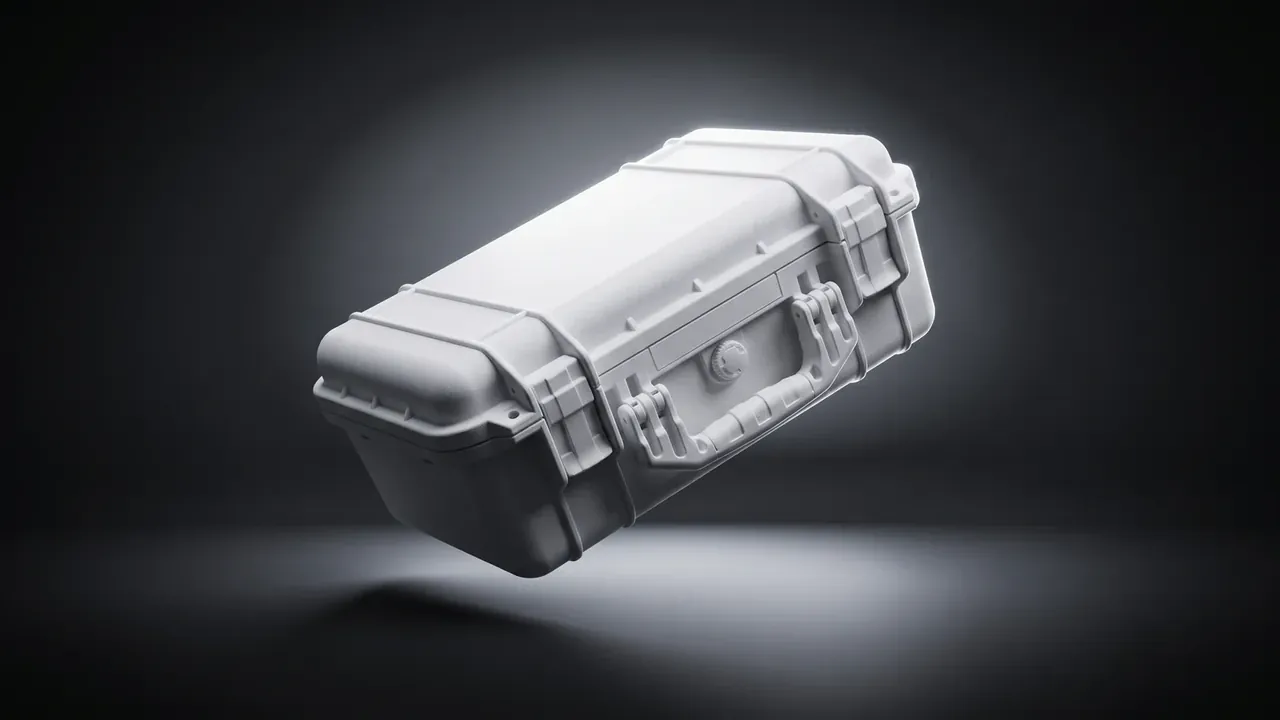
Quick answer: Judge a plastic box extension on five points: inside length, aspect ratio, wall thickness against rib pitch, latch and hinge spacing, handling margin. Settle them in that order.
Table of contents
- Five Criteria for Choosing a Plastic Box Extension
- Inside Length and Aspect Ratio
- Wall Thickness and Rib Spacing
- Load Sharing in Latches and Hinges
- Handling, Stacking and Acceptance
- FAQ
1. Five Criteria for Choosing a Plastic Box Extension
A plastic box extension starts near 1200 mm of outside length and runs to 1800 mm; custom tools reach 2200 mm. That scale is no simple enlargement: the span and the moment arm grow together, and details that never mattered on a short box turn into failure points.
The criteria run in order: inside length, aspect ratio, wall thickness against rib pitch, latch and hinge spacing, handling margin. Reverse the order and you buy a handsome latch on a lid that sags.
The mistake is measurable: a lid sagging past one three-hundredth of its length lifts the gasket, and water enters on the first trip. Empty inspection never reveals it.
| Criterion | Measure | Reference | Cost of missing it |
|---|---|---|---|
| Inside length | Outside minus walls and ribs | Item plus 30–40 mm | Items sit at an angle |
| Aspect ratio | Length divided by width | 4:1 or less | Warped ends |
| Ribs | Transverse pitch | 150 mm | Mid-span sag |
| Latches | One per 400 mm | 4 at 1500 mm | Lid lifts mid-span |
| Handling | Handle type | 25 kg, three high | Bowed sidewalls |
2. Inside Length and Aspect Ratio
Derive inside length from the longest item plus clearance: 15 to 20 mm per end for drift in transit, plus 10 mm of foam contact. Outside length minus two walls and the rib zone is what you can use, and the two figures commonly differ by 20 to 30 mm. One sized from the outside number alone arrives 25 mm short.
Above 4:1 the ends lift during cooling. A near-square box holds its shape; a long one needs ribs and a setting jig, then 24 hours flat after demoulding, which brings warp to about 2 mm. Past 1200 mm, add a mid divider so the lining cannot slide.
3. Wall Thickness and Rib Spacing
Walls land between 2.8 mm and 3.5 mm, slightly heavier than a short box of the same width, but ribs do the work: at 150 mm pitch, mid-span deflection is about a quarter of what 300 mm gives, a bigger gain than going from a 3 mm to a 4 mm wall.
Ribs must cross the long axis; those that follow it add almost nothing to stiffness.
Corner radii matter too: below 2 mm inside, a long span cracks at the corner after a drop test; 3 to 5 mm inside is safer.
4. Load Sharing in Latches and Hinges
A long lid never loads evenly; the middle lifts first. Space latches at one per 400 mm, so four at 1500 mm and five at 1800 mm. Under-latched lids rely on stiffness between latches, and where that runs out, water enters.
Hinges affect life more than latches. Two pins on a 1500 mm lid leave each pin carrying half the lid weight plus torsion; three pins at 600 mm spacing cut load per point by roughly 40 percent. Gasket compression should reach 25 to 30 percent, held by a limit rib between latches.
5. Handling, Stacking and Acceptance
Handling changes with length: below 1200 mm one hand works; past 1500 mm use both hands or a strap, because 20 kg on one side handle bows the sidewall and flattens the seal.
Stacking is limited by the lid: in a three-high stack the bottom unit carries 50 kg, so run a loaded 24-hour test and measure the lid; beyond 3 mm of sag, drop a layer.
| Item | Method | Pass line |
|---|---|---|
| Diagonals | Tape measure corner to corner | Within 2 mm |
| Deflection | Ends supported, full load | One three-hundredth of length |
| Seal | 1 m immersion, 30 minutes | No water inside |
| Stacking | Three high, 24 hours | Lid sag within 3 mm |
Conclusion
Five steps settle a plastic box extension: inside length from the item plus clearance, aspect ratio at 4:1 or under, ribs holding deflection to one three-hundredth of length, one latch per 400 mm with hinges under 600 mm, and a loaded three-high stack. Anything conceded returns later as water ingress or warp, usually in transit. Measure deflection and latch spacing first, and the rest of the plastic box extension specification follows.
This article discusses only the container (case body) side of specifications and design intent, and does not cover any handling, loading or use of the contents.
Related Reading
- Choosing a protective case by size range
- How large protective cases are built
- PP plastic case selection criteria
- Divider layout inside a case
Related Products
- 8 Series — Gun Cases; Military Equipment Cases; Camera Equipment Cases; Drone Cases; Watch Cases; Knife Cases; First Aid Cases; Electronics Equipment Cases
- WL8-2812 PP Gun Case — model WL8-2812
- All protective cases and toolboxes: 7 series, 158 models