

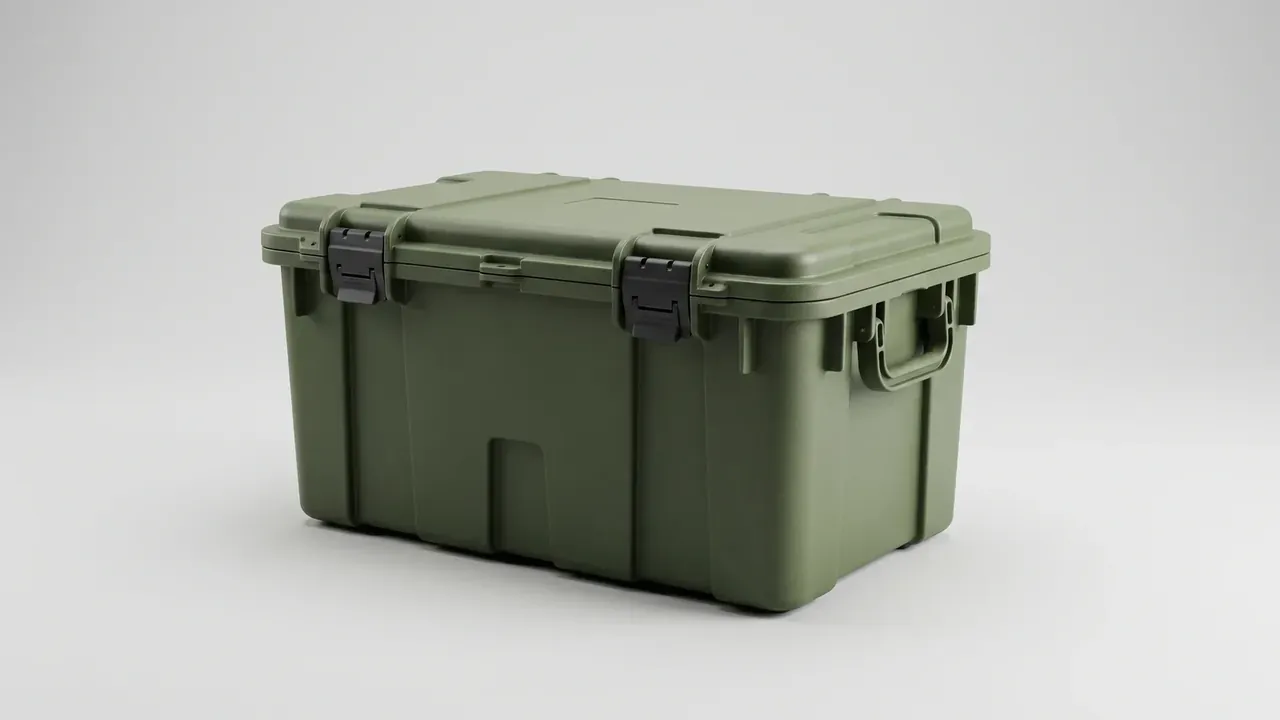
Quick answer: Most of a plastic box storage decision can be settled in front of the shelf with a tape, a kitchen scale and a bottle of water — diagonals show whether the mould is square, weight divided by surface area exposes thin walls, a 24 hour load shows whether a stack will creep, and 200 ml of water on the lid shows whether the seam closes.
Table of contents
- Two Diagonals Before Anything Else
- Weigh It: Grammage Exposes Wall Thickness
- Load It for 24 Hours
- A Sheet of Paper, a Bottle, One Finger
- Resin, Regrind and Gate Marks
- FAQ
1. Two Diagonals Before Anything Else
The first measurement is not the capacity label. Close the lid, then measure both diagonals. On a 600 by 400 mm plastic box storage unit the nominal diagonal is 721 mm; within 2 mm of each other the mould is square, and past 3 mm the body is already a slight diamond that will lean once stacked three high.
Internal volume always trails the label. With 2 mm walls and 3 mm ribs, a 600 by 400 case measures about 588 by 386 inside, some 8 to 12 mm short. A nominal 30 litre body holds 26 to 27 litres once walls and lid bosses are subtracted, and that gap belongs in your planning.
Height carries a second trap. Closed height equals body height plus 3 mm of lid crown, so a four-high stack loads the bottom lid with the height of three boxes above it. Shelving that looked deep enough at the shop turns out one box short at home.
| What to measure | How | Pass line | If it fails |
|---|---|---|---|
| Both diagonals | Lid closed, corner to corner | Within 2 mm | Stack leans, lid sits off-centre |
| Internal length and width | Wall to wall | 8 to 12 mm under outside | Capacity maths runs over |
| Closed height at four corners | Lid on, four readings | Within 1.5 mm | Upper boxes tilt |
| Base feet on a flat slab | Sight across the four corners | No rocking | Empty box wobbles, worse when full |
2. Weigh It: Grammage Exposes Wall Thickness
No calipers on the shop floor, but a scale is usually within reach. A 600 by 400 by 220 mm body has roughly 0.42 m² of developed surface; at a PP density of 0.91 g/cm³ and 2 mm walls that predicts about 0.76 kg. A reading of 0.62 kg points to an average wall nearer 1.6 mm, and that number is more honest than anything printed on the carton.
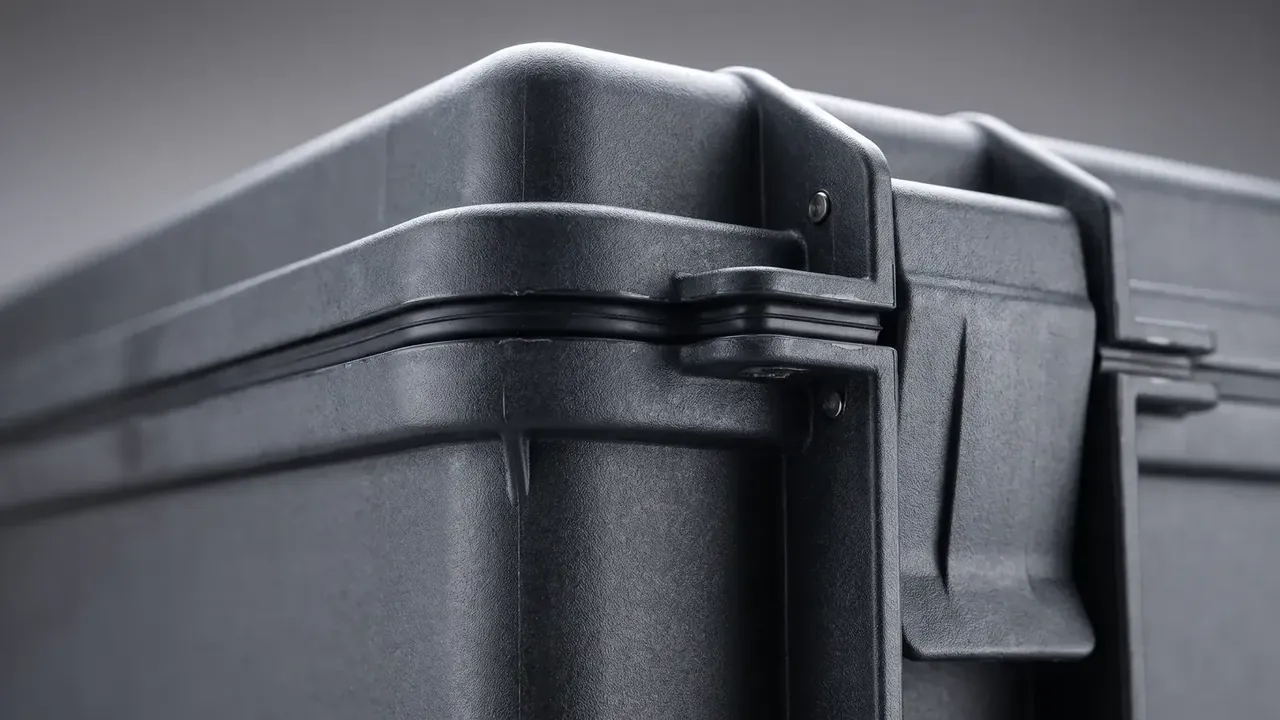
Comparing two units of the same size is quicker still. More than 8 percent difference in weight means uneven walls or regrind in the mix, and neither belongs under a heavy load stacked long term.
Choose the caliper point with care. Rib roots read 3.2 mm against 1.8 mm at the side wall, a 1.4 mm spread on the same plastic box storage body, and measuring the root will convince you the wall is fine when it is not. Mid-wall, 20 mm clear of any rib, is the reading that represents the resin actually used.
| Nominal volume | Developed area | Predicted weight at 2 mm | Suspicious below |
|---|---|---|---|
| 15 L | 0.24 m² | 0.44 kg | 0.38 kg |
| 30 L | 0.42 m² | 0.76 kg | 0.66 kg |
| 50 L | 0.58 m² | 1.06 kg | 0.92 kg |
| 80 L | 0.78 m² | 1.42 kg | 1.24 kg |
3. Load It for 24 Hours
Stacking empty boxes proves nothing. Load them to 80 percent with sand or water to the nominal weight, build three high, and leave it a full day. Up to 2 mm of lid deflection is acceptable; past 3 mm the stack will settle towards one corner over a season.
Heat multiplies the figure. A week in a 35 °C warehouse takes a 2 mm result to 5 mm without any change in load, so judge both numbers — 24 hours at room temperature and a week at the top of the working range.
Layer limits follow wall thickness. A 600 by 400 plastic box storage body with 1.8 mm walls stacks five empty and three loaded; the same footprint at 1.4 mm starts bulging at two loaded layers.
Rib direction matters here as well. Ribs spanning the short side resist bending better because the span is shorter, and boxes with ribs only at the rim and a wide flat centre dish in the middle first.
4. A Sheet of Paper, a Bottle, One Finger
Sealing takes three motions and no instruments.
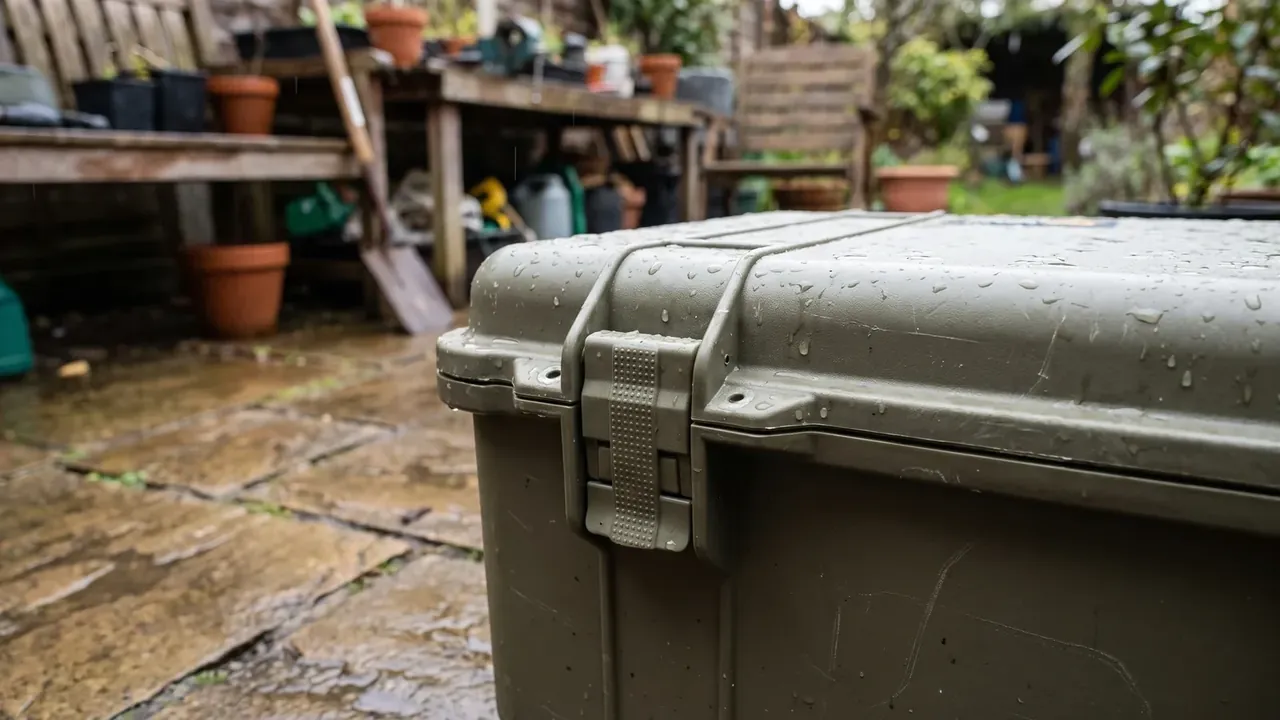
- Paper: an A4 sheet is 0.1 mm thick. Trap it in the lid seam and pull along the perimeter; steady resistance means the gasket is loaded, and any section that releases the paper easily is a leak.
- Water: pour 200 ml onto the closed lid, wait 30 minutes, then open. A trace of water on the inner face means the seam is not closing, which clothing survives and paper files do not.
- Finger: latch and release. Twenty to forty newtons is the limit for one-handed working; above that daily access annoys, below 20 N the lid pops open while being carried.
Test the hinge the same way. Three hundred cycles approximates retail life; work it a few dozen times, and a click or a loosening pin tells you the hinge is a push-in part rather than a moulded living detail.
Seam width can be measured with paper. Two sheets that still slide out freely put the gap above 0.2 mm; a properly latched box closes to 0.5 mm or less, evenly on all four sides.
5. Resin, Regrind and Gate Marks
Resin decides what a plastic box storage unit can hold and for how long. PP is translucent and tough until about minus 10 °C; HDPE feels waxy, stays opaque and holds to minus 25 °C; ABS is glossy and hard, rings when tapped, and chips at a corner after one drop.
Heavy regrind shows up visually. Grey, dull surfaces, dark specks or flow lines point to a high regrind share; virgin mouldings match across a batch and show no cloudy variation when held to the light.
Sound separates them too. Virgin PP gives a short, bright note, while regrind-loaded walls sound flat, like tapping heavy card. In a noisy shop, knuckle the middle of a wall and listen for decay rather than volume.
Gate position is visible on the back or base. A white, glossy halo around the gate is locked-in stress and cracks first under load; a gate placed outside the bottom corner with a radius around it signals a more considered tool.
Smell closes the argument. Virgin resin is near odourless, regrind carries a sour or scorched note, and a strong smell rules the box out for bedding and clothing.
| Resin | Look and feel | Tap | Heat, indicative | Fits |
|---|---|---|---|---|
| PP | Translucent, tough | Short and bright | 100 °C short term | Clothing, toys, sundries |
| HDPE | Waxy, opaque | Dull | Holds at minus 25 °C | Garage, outdoor, heavy parts |
| ABS | Glossy, stiff | Rings | Around 80 °C | Electronics, display |
| Regrind blend | Grey, speckled | Flat | Inconsistent | Not for long stacking |
Conclusion
Judging a plastic box storage unit comes down to four numbers you can write down: diagonals within 2 mm, weight at least 90 percent of the calculated figure, 24 hour deflection under 3 mm, and a seam that holds a sheet of paper. Pass those and the rest — resin, gate, colour — is detail. Ten minutes with a tape in the aisle beats discovering a collapse at the third layer.
This article discusses only the container (box body) side of specifications and design intent, and does not cover any handling, loading or use of the contents.
Related Reading
- Choosing a lockable storage box
- Stackable box specifications at a glance
- Where small plastic cases stop working
- How moisture-proof cases seal
Related Products
- 8 Series — Gun Cases; Military Equipment Cases; Camera Equipment Cases; Drone Cases; Watch Cases; Knife Cases; First Aid Cases; Electronics Equipment Cases
- WL8-2812 PP Gun Case — model WL8-2812
- All protective cases and toolboxes: 7 series, 158 models