

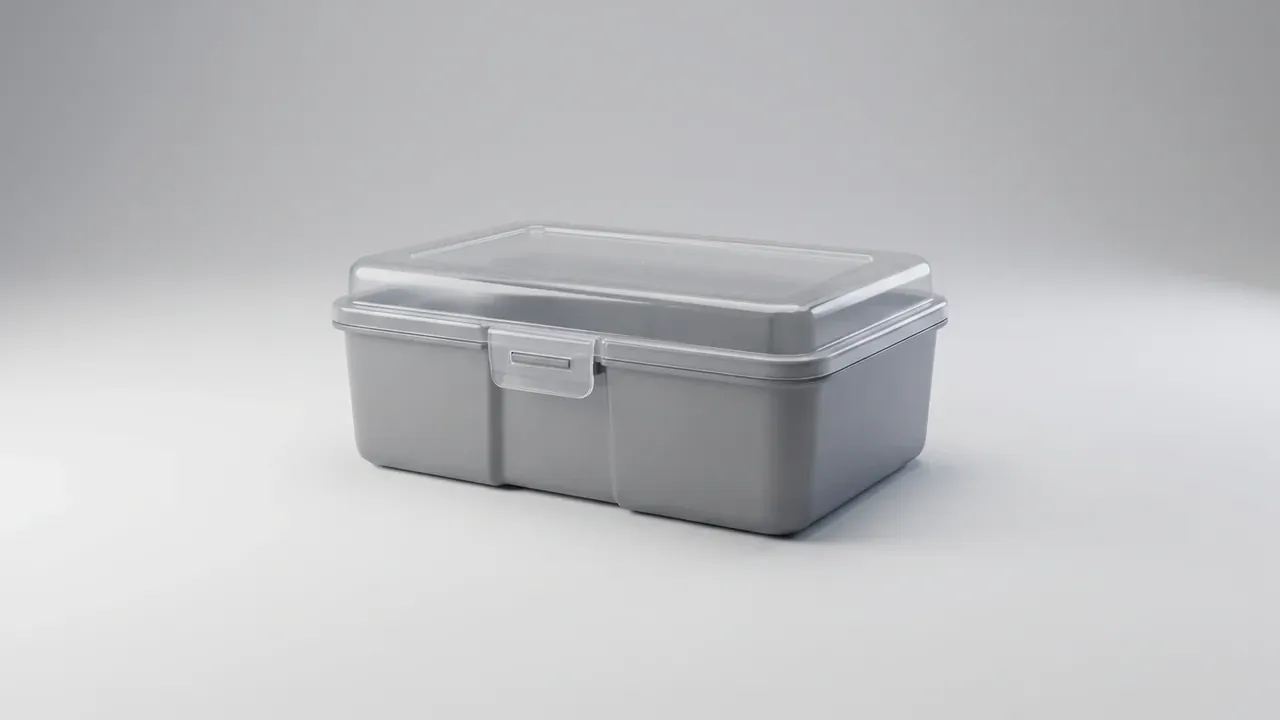
Quick answer: A plastic box with lid leaks or seals on seam fit and gasket compression, not on latch count. Four returned samples failed at four different places: a warped corner, a crushed gasket, a shallow labyrinth rib and a lid too thin to hold pressure.
Table of contents
- Four Leaking Samples, None Caused by Latches
- Mounting Inside the Lid Against Lid Thickness
- Three Lid Types and Their Seam Fit
- Stacking, Temperature and Immersion
- FAQ
1. Four Leaking Samples, None Caused by Latches
Four returned samples of one plastic box with lid sat side by side, latches running from two to six, all wet inside. Stripped down, no two had failed in the same place.
We spent two hours at the immersion tank on site. Each was loaded, sunk 50 mm, left 24 hours, dried and opened. A showed a 15 mm line of water at one lid corner. B carried a band across the whole rear seam, as if wiped with a wet cloth. C had three drops on the side, exactly at a gap in the labyrinth rib. D was wet almost everywhere, through the middle of the lid face. Four symptoms, four separate process chains, and not one of them a latch problem.
| Sample | Latches | Symptom | Root cause |
|---|---|---|---|
| A | 2 | water at one lid corner | corner warped 1.8 mm |
| B | 3 | slow lid recovery | gasket at 45 per cent, permanently set |
| C | 4 | droplets on one side | labyrinth rib only 2 mm deep |
| D | 6 | leaks more as latches increase | lid wall 2.2 mm, centre bows inward |
Sample D makes the point. Six latches pulled the rim down hard, the unsupported centre of the lid bowed, and the gasket lost contact along the middle.
Sealing on a plastic box with lid is a continuous line, not a row of points. Latches press that line, and a line already broken cannot be pressed shut.
2. Mounting Inside the Lid Against Lid Thickness
Plenty of plastic box with lid designs carry fixings inside the lid: a circuit board, a document sleeve, a checklist clip. How it is fixed decides the wall thickness you have to buy.
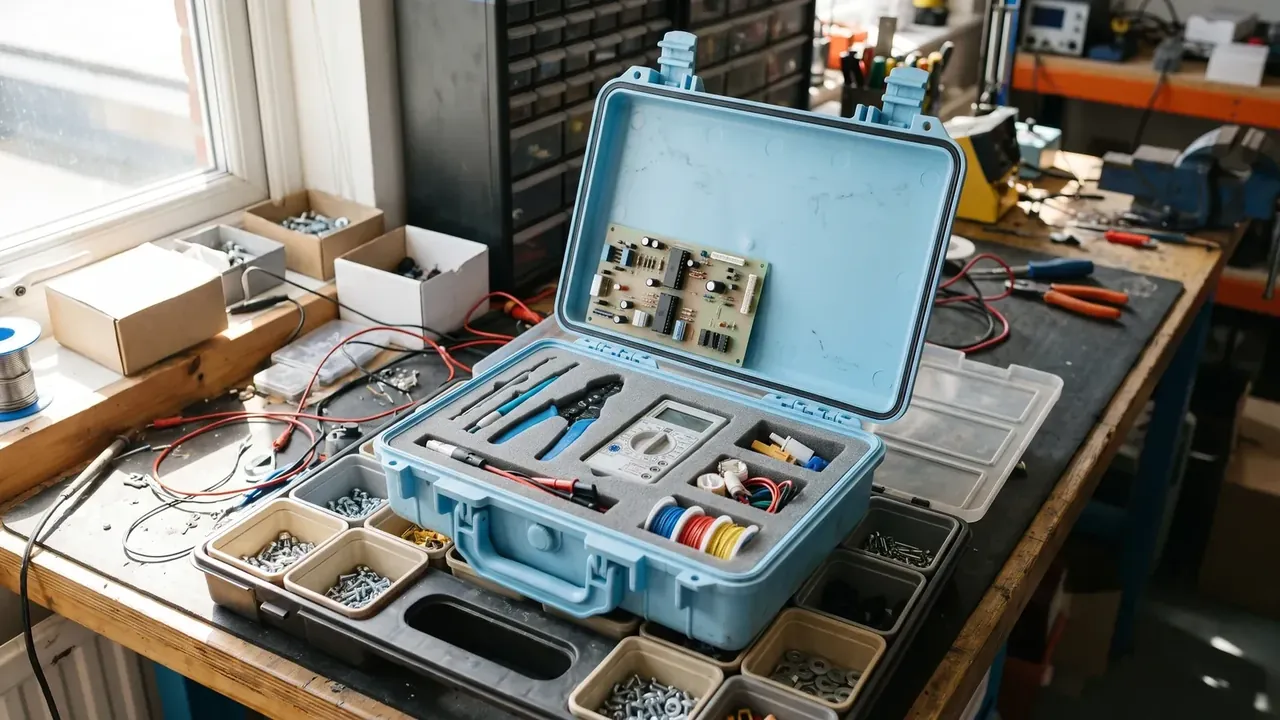
At 2.5 mm the lid takes adhesive only; 3.0 mm allows snap clips; 3.5 mm is where M4 bosses survive. The criteria:
- Adhesive: lid from 2.5 mm, bond area no smaller than 30 mm by 30 mm;
- Clips: lid from 3.0 mm, 0.6 mm interference, 500 fit cycles without slack;
- Screws: lid from 3.5 mm, 8 mm boss diameter, R1 fillet at the root;
- Depth: keep 22 mm of usable depth inside the lid, or change the lid type.
Flatness is what most people miss: glue a 60 mm square plate on and the lid face pulls in 0.4 mm, then the adhesive cures and opens a gap.
Degrease before mounting: low surface energy lets mould release peel a whole adhesive film off within 48 hours, and no sample photo shows it.
3. Three Lid Types and Their Seam Fit
On a plastic box with lid the type sets the seam gap you can hold, and that sets where it can be used.
| Lid type | Seam gap | Gasket compression | Environment |
|---|---|---|---|
| Flat lid | 0.6 mm | none | dry indoor, dust only |
| Mating lid | 0.4 mm | 25 to 30 per cent | general dust and splash |
| Labyrinth lid | 0.3 mm | 30 to 35 per cent | immersion and washdown |
A labyrinth lid usually runs a 6 mm rib with a 3 mm drain notch. Water must cross two ribs, and a path that long breaks capillary action.
The 0.4 mm mating fit is common, but leans hard on tool venting: poor venting leaves 0.1 mm of flash along the rim, and flash under pressure becomes a leak path.
4. Stacking, Temperature and Immersion
Stacking, temperature and immersion decide whether a plastic box with lid survives a warehouse season.
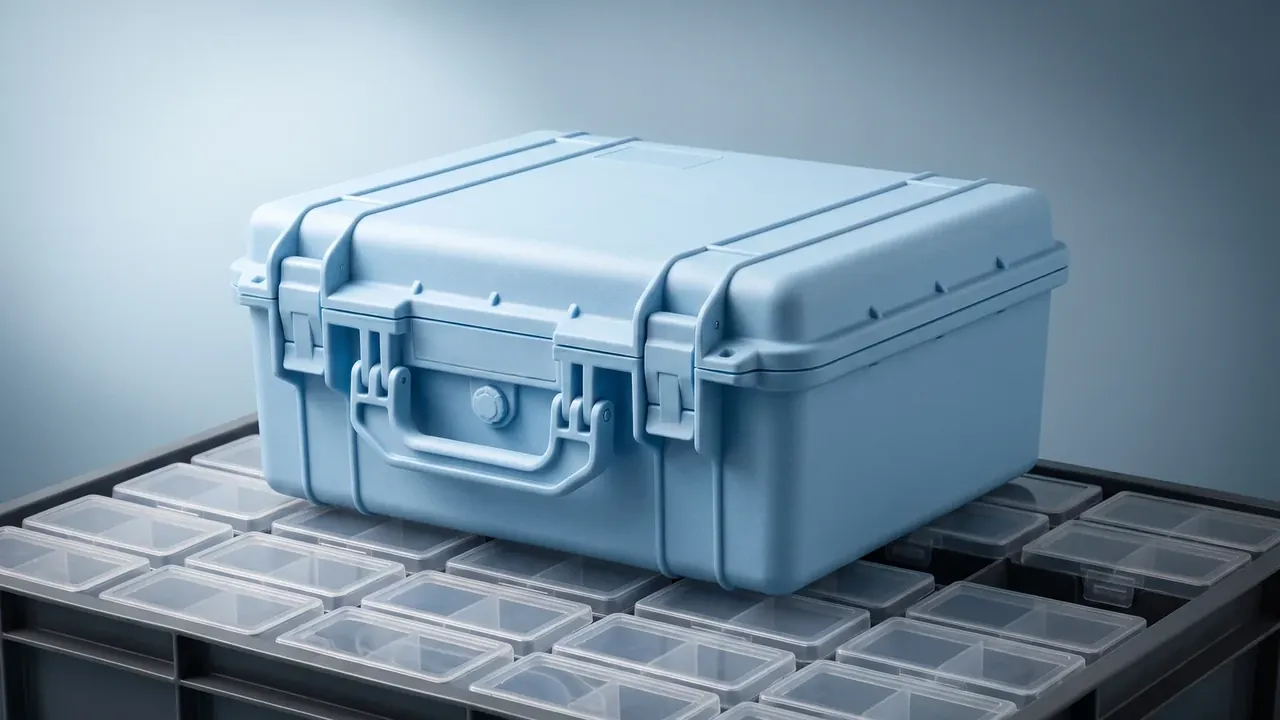
The three lines for a plastic box with lid read: three loaded boxes stacked with 50 kg spread over the top, 48 hours at 50 °C, no collapse at the bottom; four hours at minus 25 °C, then three open-close cycles at once, no cracking at the rim; filled and sunk under 50 mm of water for 24 hours, dry inside.
Drop counts separately. From 1.0 m onto a bottom corner, no latch may spring and the lid may not shift.
Past the three lines sits one more number people skip: contact area. A plain slab lid puts everything on four corners and fails at three high; two cross ribs carry the same 50 kg at a cost of 3 mm of usable depth.
Immersion is the easiest of the set to pass and stacking the easiest to lose.
Conclusion
Sealing a plastic box with lid is a line problem, and latches are only the hand pressing on that line. The line has to stay continuous: corners flat, walls stiff enough, ribs deep enough, gasket free to recover. Four samples showed that latch count was never the variable.
This article discusses only the container (case body) side of specifications and design intent, and does not cover any handling, loading or use of the contents.
Related Reading
- Why a lid warps: two lines of cause in structure and process
- Tracing a lid that will not close or keeps seeping
- Laying out inserts by item position in a weapons tool kit
Related Products
- 8 Series — Gun Cases; Military Equipment Cases; Camera Equipment Cases; Drone Cases; Watch Cases; Knife Cases; First Aid Cases; Electronics Equipment Cases
- WL8-2812 PP Gun Case — model WL8-2812
- All protective cases and toolboxes: 7 series, 158 models