


Quick answer: Lead time is not set by how many moulding machines a plant owns. It is set by whether tonnage and cavity count match your case, how many spare moulds sit on the rack, and whether peak-season capacity is in the contract. Put six criteria in the RFQ and you save more time than visiting three factories.
Table of contents
- Why Lead Time Detaches from Capacity
- Tonnage and Cavities Set the Real Cycle
- Mould Ownership and Peak-Season Clauses
- Three Plant Checks and Batch Traceability
- FAQ
1. Why Lead Time Detaches from Capacity
Capacity is monthly tonnage; lead time is a slot on a schedule. A 1000 t machine may turn out tens of tonnes a month while two big accounts own every week on its plan. The 25 days quoted is an optimistic gap, not a board slot.
Ask the plastic storage and transport case manufacturer for planning granularity: which machine, which mould, which week. A supplier that names all three is worth a second call.
| Evaluation item | Weight | Deal breaker |
|---|---|---|
| Tonnage matched to case size | 25% | 650 t press on a large case, flash over 0.3 mm |
| Cavity count matched to monthly volume | 20% | Four-cavity mould for a 200-unit order |
| Spare moulds on the rack | 15% | Single mould, line stops for repairs |
| Peak-season reservation | 20% | Refuses a 30% reservation clause |
| Batch traceability | 10% | No batch code, traceable to a month |
| Mould ownership | 10% | Mould cost buried in unit price, title unclear |
A capacity figure means something only in an empty slot.
2. Tonnage and Cavities Set the Real Cycle
Tonnage sets the projected area a machine can fill. Cavity count sets how many parts leave each shot. Together they set the cycle. A 1000 t machine on a two-cavity mould cycles at 95 seconds and yields 1800 units over two shifts. Switch to four cavities and the cycle stretches to 130 seconds while daily output doubles. When a plastic storage and transport case manufacturer quotes 25 days, ask for cavity count first.
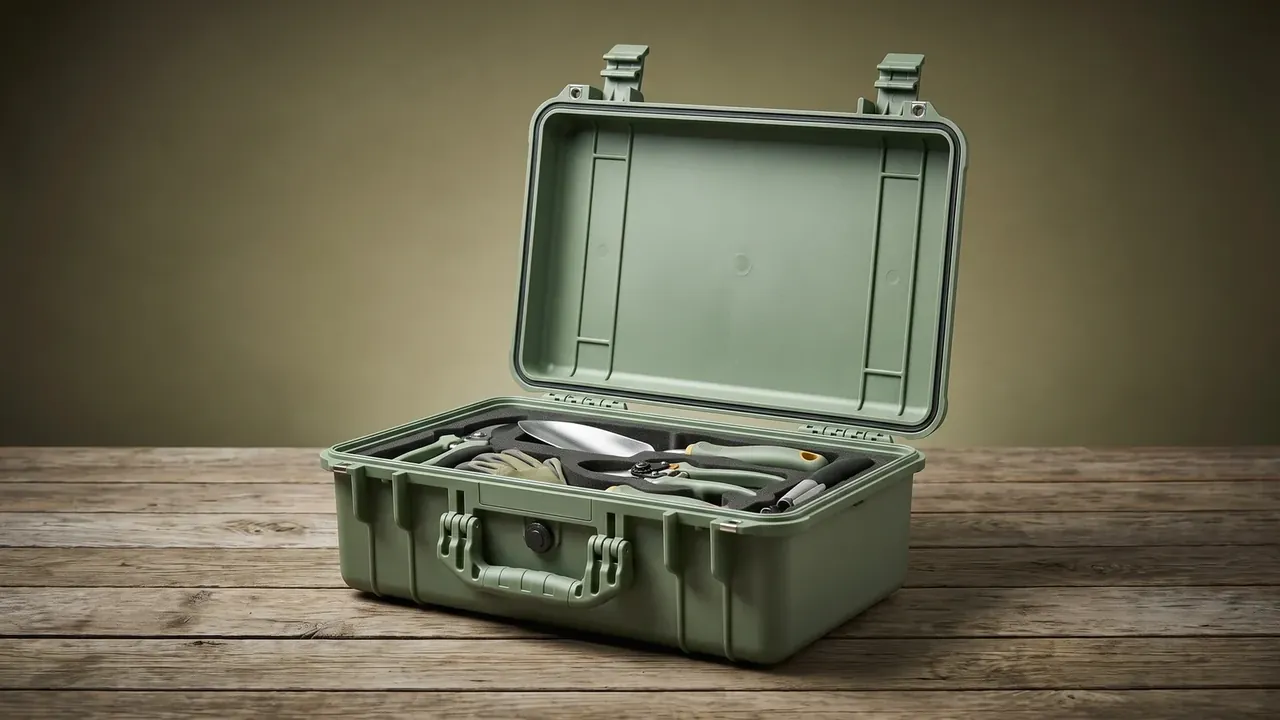
| Machine tonnage | Typical cavities | Cycle per part | Case size |
|---|---|---|---|
| 650 t | 1–2 | 110 s | Small and medium equipment cases |
| 1000 t | 2 | 95 s | Medium storage and transport cases |
| 1600 t | 1–2 | 150 s | Large single cases |
Changeover is the hidden cost. Stripping a mould, purging, setting up and confirming the first article takes four hours, so a plant manages three changes a day. Small batches in several colours fragment the plan; 25 days becomes 45.
Spare moulds separate serious plants. With one mould a repair stops the line; with two, output moves to the spare. Mould life runs to 300,000 shots, and 1800 units a day works through a cavity cycle in 83 days, so expect two or three repairs. A plant without a spare will always have a shaky date.
3. Mould Ownership and Peak-Season Clauses
For a plastic storage and transport case manufacturer, list mould cost separately and keep title with the buyer. Folding it into the unit price leaves ownership at the plant: the tool cannot follow you, and a second tool means paying twice. Record mould number, cavity count, host machine, and the right to collect the tool within three years.
A peak-season clause is worth more than a price clause. Reserve 30% of monthly capacity in the annual framework: months named, a daily penalty for overrun, and the right to move the order after ten days. A plastic storage and transport case manufacturer that signs this line trusts its own schedule.
Longer payment terms are not better: ninety days carries a 3–5% premium, more than 30 days plus a 2% discount.
4. Three Plant Checks and Batch Traceability
Skip the showroom when auditing a plastic storage and transport case manufacturer. Walk three places: machines, material, inspection. If all three line up, traceability means something.

- Machines: match nameplate tonnage to the mould in the press; check spares are racked and numbered
- Material: read hopper tags, keep PP and HDPE apart, put regrind ratio on the process card
- Inspection: confirm the drop rig height scale and caliper calibration labels are in date
- Batch: keep three sample cases per batch, marked with date, machine, shift, for three years
- First article: sign off within 24 hours of start-up
- Traceability: stamp the cavity number on the base, linked to batch and operator
Traceability lives in that cavity number, not in software. Without it a failure traces to a month, which is no trace at all. With it, a cracked case points to one machine, one mould, one shift.
Conclusion
Before comparing capacity figures, look at planning granularity, cavity count and spare moulds. Whether a date holds depends on tonnage matching the case, 30% of peak capacity in the contract, and the mould belonging to you. Put the six criteria on one RFQ page and the answers sort themselves. A plastic storage and transport case manufacturer that can sign all six ships on time.
This article discusses only the container (case body) side of specifications and design intent, and does not cover any handling, loading or use of the contents.
Related Reading
- Storage and care standards for case moulds
- Custom OEM cooperation for military firearm storage boxes
- How to build a case supplier scorecard
Related Products
- 8 Series — Gun Cases; Military Equipment Cases; Camera Equipment Cases; Drone Cases; Watch Cases; Knife Cases; First Aid Cases; Electronics Equipment Cases
- WL8-2812 PP Gun Case — model WL8-2812
- All protective cases and toolboxes: 7 series, 158 models