

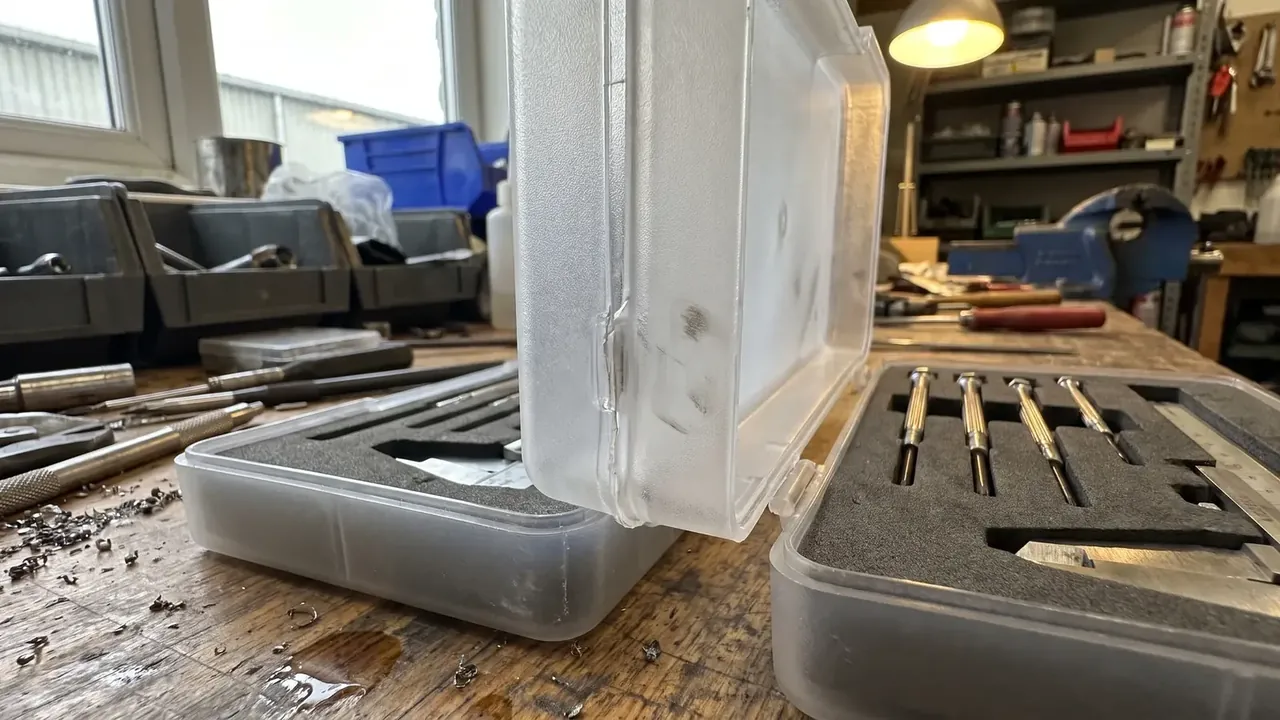
Quick answer: Set the same usable volume and the gaps turn into numbers: 78 percent usable volume against 88, six seconds of access against twelve, 0.085 yuan per trip against 0.14. Which gap decides depends on how often the case moves.
Table of contents
- Fix the Measuring Basis First
- Usable Volume Ratio
- Opening Geometry and Access Time
- Cost per Trip, Not Purchase Price
- Where Each Alternative Still Wins
- FAQ
1. Fix the Measuring Basis First
A plastic tool box, portable or fixed, cannot be compared before the basis is fixed. A case of 460 by 330 by 175 mm holds 26.6 litres by outside dimensions, 22 litres inside the walls, and 17 litres once 20 mm foam and two dividers are in place. Folded 1.2 mm steel loses only 0.6 litre to walls; an 18 mm plywood box loses five, so its nominal 26 litres measures 17.5.
The fourth basis is tool sets per trip. A 34-piece kit fits the 22-litre moulded case whole; the plywood box of the same label leaves six pieces out.
2. Usable Volume Ratio
Divide usable litres by nominal litres and the cost of walls, ribs and stacking steps appears at once: 78 percent for the moulded case, 88 for folded steel, 74 for rotomoulding, 69 for 18 mm plywood, all at the same 26-litre label.
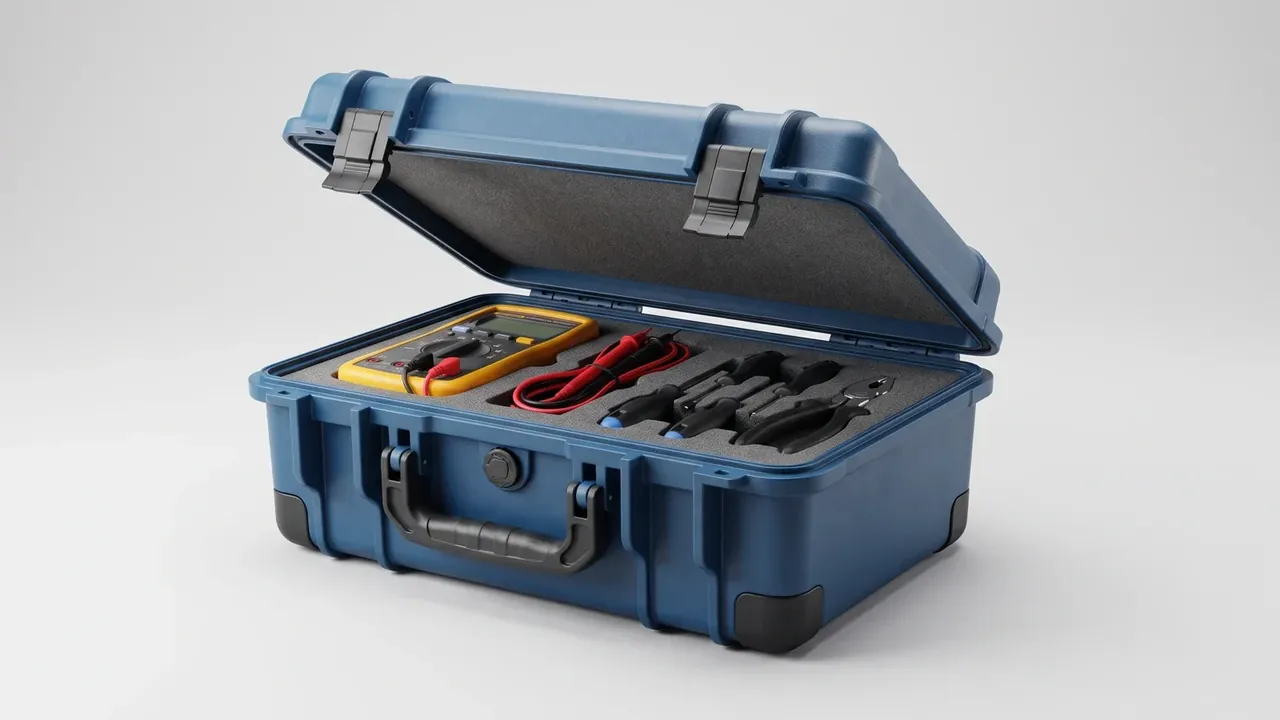
The moulded case loses on wall and rib, but loses carefully. A 2.8 mm wall carries 1.0 mm ribs at 5 mm height, all placed outside, so the cavity stays smooth and 78 percent is the ceiling; move the ribs inward and four points vanish while tools start catching on them. Rotomoulding cannot mould ribs at all, so a uniform 6 mm wall does the work on a body weighing 4.8 kg against 1.9 kg. Steel earns 88 percent with a fold every 300 mm, at the cost of two continuous right angles.
Ten points on a 22-litre case is 2.2 litres, roughly one 300 mm adjustable wrench plus a 25 mm bit box. With a fixed kit, settle that figure before price.
3. Opening Geometry and Access Time
The lid exposes 92 percent of the top face, and a moulded hinge holds at 105 degrees, so one hand steadies it. Timed from catch release to closing, the moulded case takes 6 seconds, steel 12, plywood 15. At 120 cycles a day over 250 working days, the spread reaches 50 to 75 hours a year.
The opening is bounded too: a 400 by 280 mm cavity opens to 372 by 252 mm, a 14 mm flange for catches and seal.
4. Cost per Trip, Not Purchase Price
Price alone ranks the moulded case above plywood and below rotomoulding. Divide 68, 145 and 210 yuan by expected trips, and the order reverses to 0.085, 0.12 and 0.14 yuan.
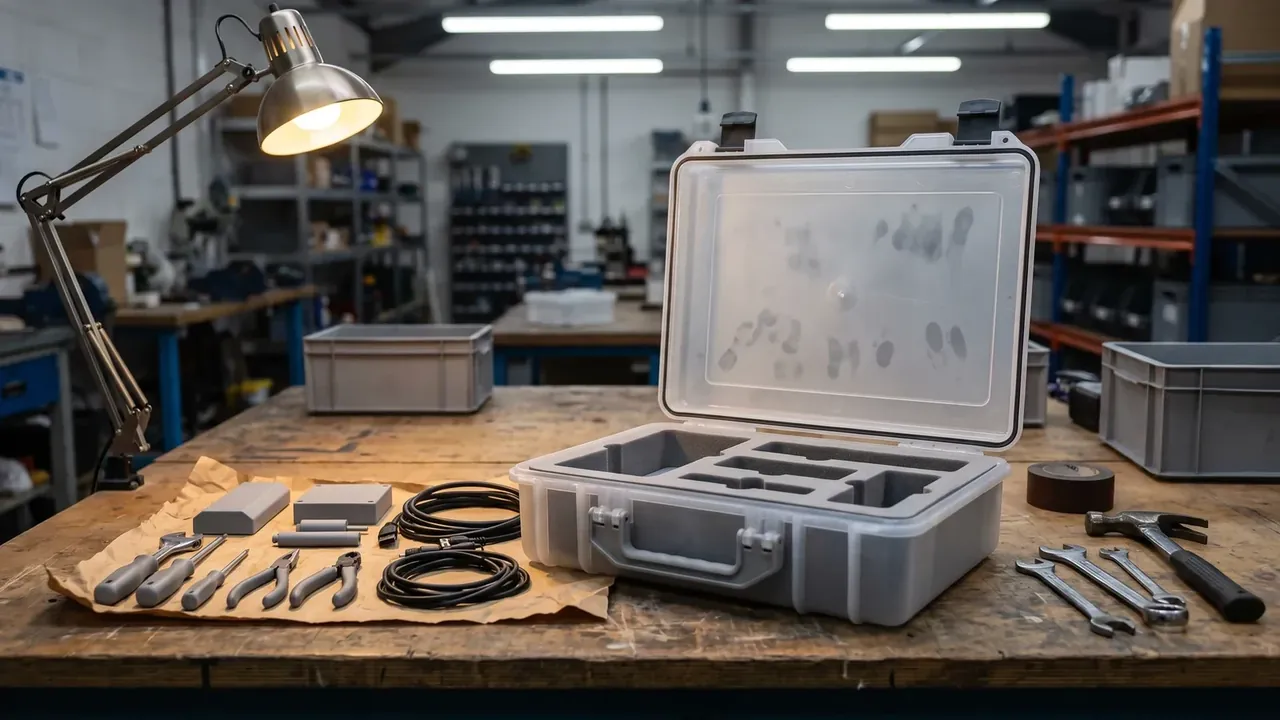
Repair and downtime widen the spread. A crack is hot-air welded for 25 yuan in half an hour; steel needs 15 yuan of paint and four hours of drying; plywood gets a new panel. At 180 yuan per stopped hour, one failed catch outweighs the price gap between three cases.
| Cost item | Moulded case | Folded steel | Rotomoulded case |
|---|---|---|---|
| Purchase price | 68 yuan | 145 yuan | 210 yuan |
| Expected trips | 800 | 1200 | 1500 |
| Cost per trip | 0.085 yuan | 0.12 yuan | 0.14 yuan |
| Typical repair | 25 yuan weld | 15 yuan paint | 40 yuan rod weld |
5. Where Each Alternative Still Wins
Read by row, not by column: each format keeps one job.
| Format | Strength | Gap at 22 litres | Right choice when |
|---|---|---|---|
| Moulded case | 1.9 kg, 6-second access | 78 percent, stacks three loaded | Frequent moves, one-hand carry |
| Folded steel | 88 percent, lid as bench | 4.6 kg, 12-second access | Fixed station, hammering |
| Rotomoulded | Survives a 1.5 m drop | 4.8 kg, 74 percent | Vehicle mounting, cold sites |
| Plywood | 32 yuan | Swells, 69 percent | One-way shipment, storage |
Tooling never reaches such a table: a steel mould runs 80,000 to 120,000 yuan at a 500-piece minimum, folded steel starts at 50, plywood at 10. Below 300 units, tooling decides the order, not the box.
Conclusion
At equal usable volume the gaps are measurable in litres, seconds and fen: 78 percent against 88, six seconds against twelve, 0.085 against 0.12 yuan per trip. None leads everywhere: load pattern, lid parking and order size each decide a row. With your own figures in those rows, the plastic tool box, portable by design, lands where it belongs.
This article discusses only the container (case body) side of specifications and design intent, and does not cover any handling, loading or use of the contents.
Related Reading
- Plastic tool box versus metal cases, item by item
- Material comparison for portable plastic tool boxes
- Selection points for portable tool boxes
- Choosing between tool boxes and alternatives
Related Products
- 8 Series — Gun Cases; Military Equipment Cases; Camera Equipment Cases; Drone Cases; Watch Cases; Knife Cases; First Aid Cases; Electronics Equipment Cases
- WL8-2812 PP Gun Case — model WL8-2812
- All protective cases and toolboxes: 7 series, 158 models