

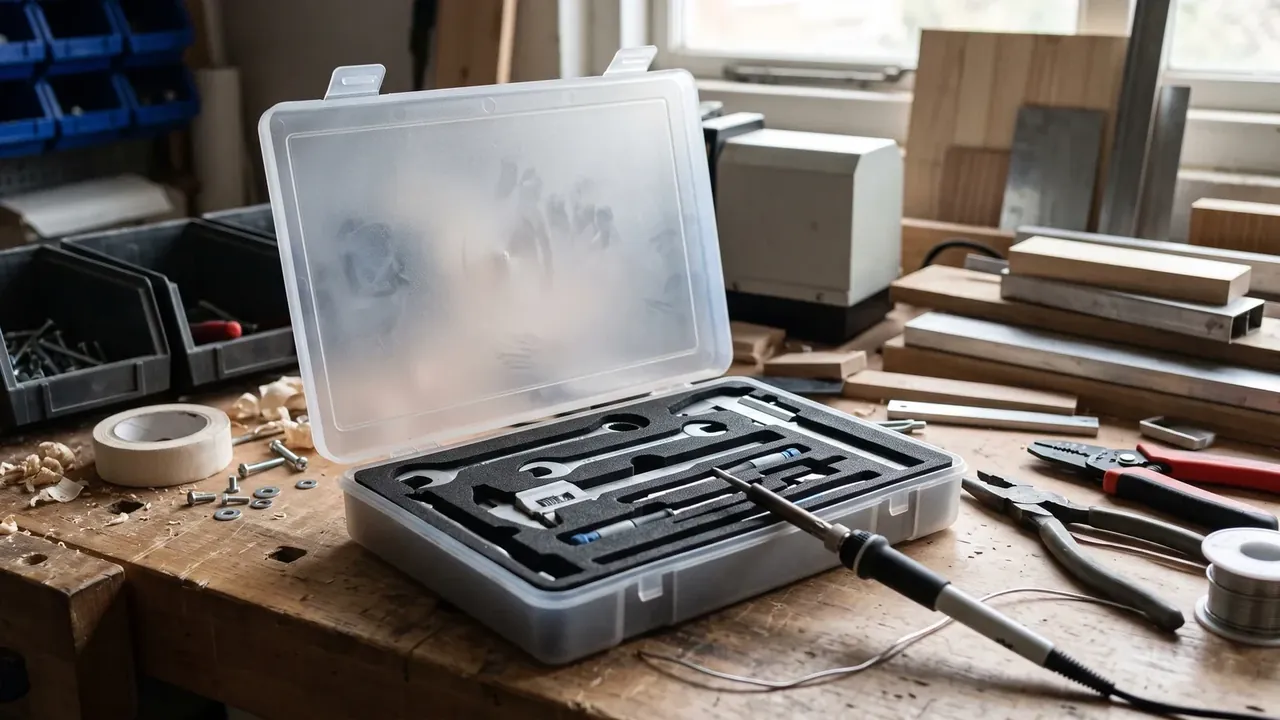
Quick answer: Three thresholds replace guesswork: a catch at 150 N goes into watch, under 118 N is replaced, and a crack past 15 mm puts the case out of service. Inspect by closure count.
Table of contents
- Three Lines Before Any Repair
- Catches and Hinges Fail First
- Reading Cracks and White Marks
- Cleaning and Storage That Slow Ageing
- Inspection Cycle and Replacement Calls
- FAQ
1. Three Lines Before Any Repair
A plastic tool box, portable by nature, is mistreated at both extremes: nothing until it breaks, or a teardown monthly. Push each reading onto one of three lines, so two people seeing the same number act alike.
Watch means usable but tracked, handle means repairable then retested, replace means withdrawn. A catch shows the spacing: 175 N when new, 150 N into watch, 118 N at replacement.
| Line | Trigger (catch) | Action | Record |
|---|---|---|---|
| Watch | 150 to 175 N | Retest monthly | Log, mark yellow |
| Handle | 118 to 150 N | Shift seat or swap clip, retest in two hours | Repairer and date |
| Replace | Under 118 N | Withdraw, keep a sample | Reason and batch |
The line comes from one loaded trial: 18 kg of tools pushed 10 metres over concrete, watching whether the catch releases by itself.
2. Catches and Hinges Fail First
Catches and hinges reach their limits first, because every closure passes through them. A moulded hinge rated at 50,000 cycles works out to 13 years at 300 closures a month, but temperature halves that: at -10 °C the same hinge whitens at the bend after about 12,000 cycles.
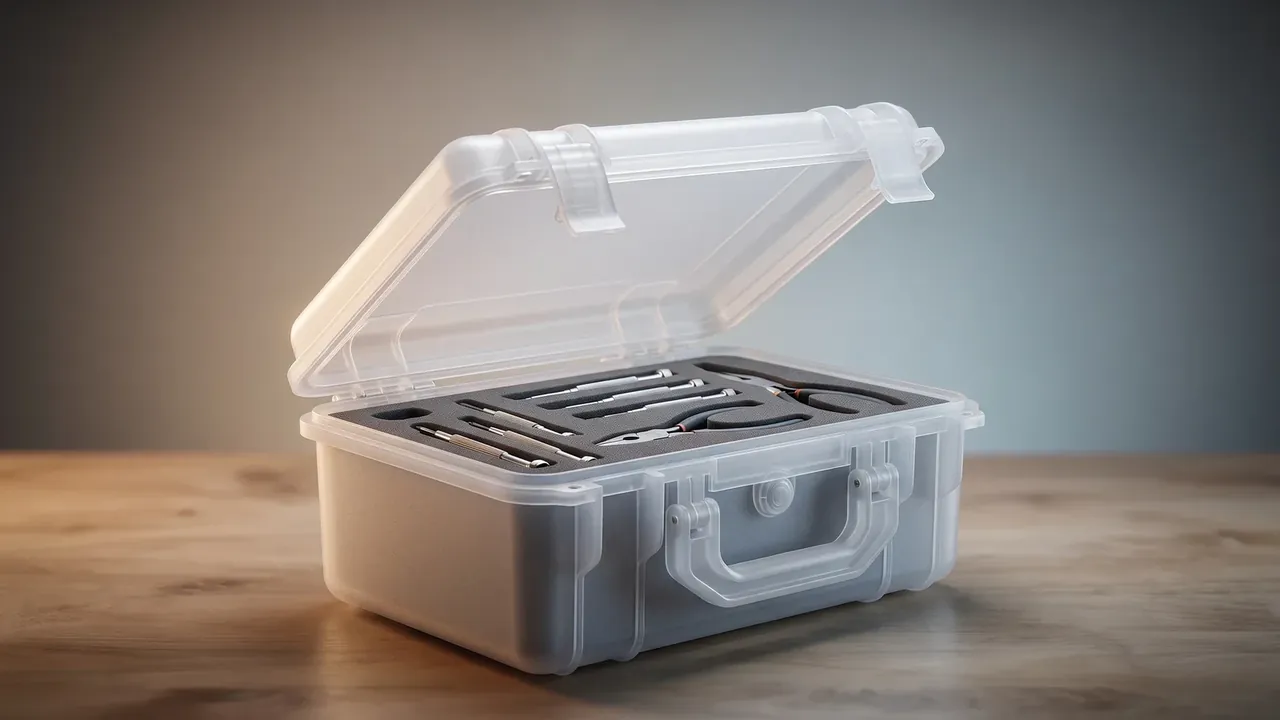
Catch decay is quieter. After 2,000 closures the holding force falls from 175 N to 148 N, 15 percent gone, with almost no visible change. Moving the seat 2 mm inward restores the interference and brings it back to 165 N; if it will not move, the clip has yielded.
Two signs decide a hinge: whitening joining into a line along the bend, and a click from a worn pin bore. Past 0.5 mm of play the lid rocks and the seal stops seating.
3. Reading Cracks and White Marks
Cracks start at corners and hinge roots, where stress concentrates. Length is the measure: under 15 mm and off the radius, hot-air welding is acceptable; beyond 15 mm, or running along the radius, the case is withdrawn; a weld keeps about 70 percent of parent strength.
White marks arrive earlier. A haze of 30 by 10 mm at a lid corner means that spot took an impact or repeated flexing and has yielded. It harms nothing, but it flags where the crack will start, so it belongs on the sheet.
A light at 45 degrees makes a crack read as a bright line; a crackle under thumb pressure means separated layers. One shift covers thirty cases.
4. Cleaning and Storage That Slow Ageing
Ageing has two drivers: ultraviolet light and chemical residue. Wash below 40 °C with a neutral cleaner at pH 6 to 8, dry at once, and wait 30 minutes before closing; water left inside condenses, and damp foam against the wall starts stress cracking.
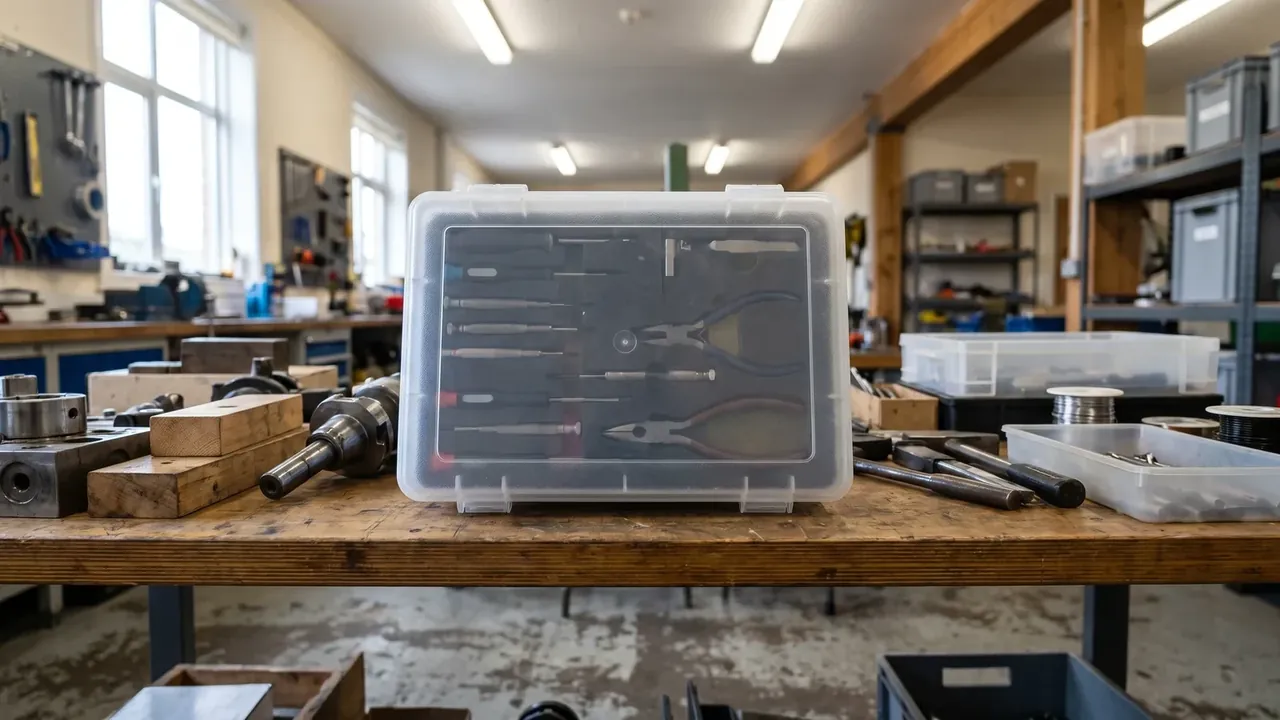
Acetone, chlorinated solvents and thinner stay off the surface; they swell polypropylene and leave a dull patch within minutes. Alcohol is fine for a wipe under 30 seconds, rinsed after. Store between -20 and 60 °C and stack no more than three high, away from south-facing glass, where a sunlit lid reaches 72 °C and sinks 2 mm under load in a month.
5. Inspection Cycle and Replacement Calls
Set the cycle by closure count: quarterly for daily use, twice a year for occasional, annually for stored cases.
| Item | Cycle | Method | Line |
|---|---|---|---|
| Catch force | 3 months or 800 closures | Pull gauge | Under 150 N, handle |
| Hinge whitening | Monthly | Side light on the bend | Continuous line, replace |
| Body cracks | Quarterly | Side light and thumb | Over 15 mm, withdraw |
| Seal strip | Half-yearly | Measure thickness | 30 percent set, renew |
An economic line runs alongside: when one repair costs over 40 percent of a new case, replace it. On a 72 yuan body that is 29 yuan, keeping a 28 yuan weld inside and a 38 yuan hinge outside. Three cases cracking alike point to tooling.
Conclusion
Maintenance swaps the word fine for three numbers: watch at 150 N, replace at 118 N, withdraw at 15 mm. Catches arrive first, cracks follow, storage sets the pace. A year of logs turns replacement into bought-out downtime, and a plastic tool box, portable in service, earns a calculable life.
This article discusses only the container (case body) side of specifications and design intent, and does not cover any handling, loading or use of the contents.
Related Reading
- Common tool box lid and catch problems
- Common portable tool box problems and fixes
- Maintenance points for rotomoulded cases
- Storage and damage prevention for case bodies
Related Products
- 8 Series — Gun Cases; Military Equipment Cases; Camera Equipment Cases; Drone Cases; Watch Cases; Knife Cases; First Aid Cases; Electronics Equipment Cases
- WL8-2812 PP Gun Case — model WL8-2812
- All protective cases and toolboxes: 7 series, 158 models