

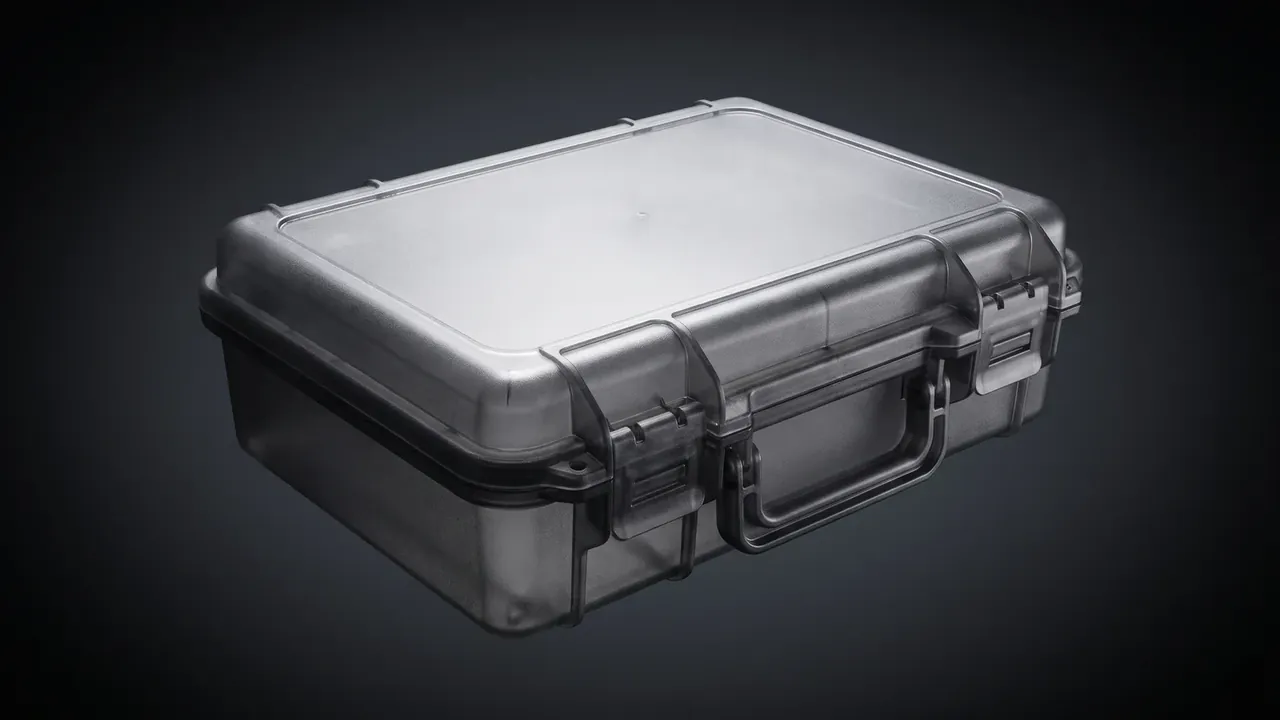
Quick answer: Acceptance of a Plastic Tool Box, Portable runs in three steps: fix the sampling plan, fix a numeric limit for each item, then decide what happens to a failed lot. Eighty units cover latch, handle, dimension and appearance, and any major defect above Ac fails the batch.
Table of contents
- Start With a Sampling Plan
- Appearance and Dimension Limits
- Latch, Handle and Hinge Cycling
- Drop, Stack and Temperature
- Batch Verdict and Nonconformance
- FAQ
1. Start With a Sampling Plan
Acceptance of a Plastic Tool Box, Portable starts with a plan, not full inspection: 800 units at inspection level II gives a sample of 80, with AQL 2.5 for major defects, Ac 5 and Re 6, and AQL 4.0 for minor ones, Ac 7 and Re 8. Without it, two inspectors judge a delivery differently.
Lots split before sampling: one mould, one shift, one colour; a resin or press change starts a new lot. Otherwise the sample averages two machines.
| Defect class | Typical items | AQL | Verdict at 80 pieces |
|---|---|---|---|
| Major | latch springs open, handle crack, hinge break | 2.5 | Ac 5 / Re 6 |
| Minor | sink, colour shift, flash, parting offset | 4.0 | Ac 7 / Re 8 |
Dimension gets its own sample, since it does not fit defect counting: one oversize part in five doubles the sample to 13, a second failure sends the lot to full inspection.
2. Appearance and Dimension Limits
Appearance limits are numbers, not adjectives: colour shift within delta E 1.5 of the signed sample under D65 light, sink under 0.15 mm so a fingernail does not catch, flash under 0.2 mm, parting offset under 0.3 mm. Written this way, an argument about looks becomes a measurement.
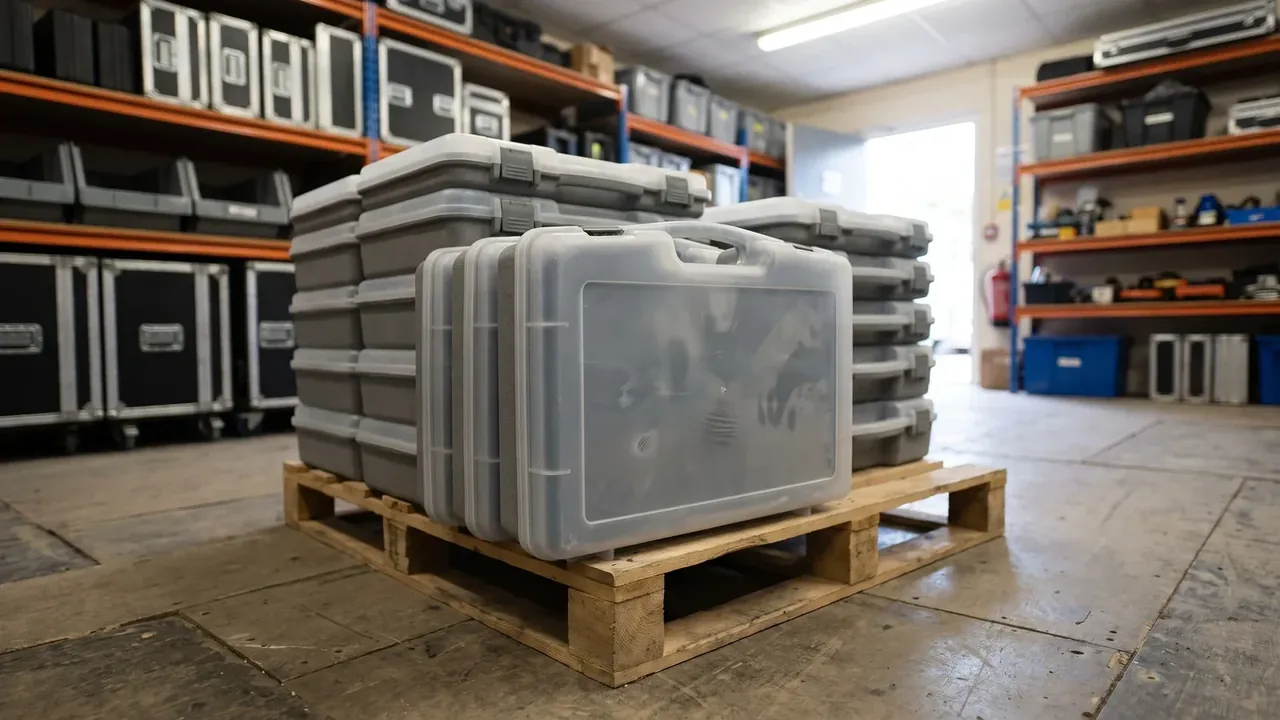
Dimensions come off a caliper with 0.02 mm resolution: cavity long side within plus or minus 1.0 mm, envelope within 1.2 mm, stack gap within 1.5 mm between units of one lot, measured 10 mm below the rim and 15 mm above the base corner.
Out-of-tolerance parts that still assemble need a concession with written scope and expiry. Rework covers flash and parting lines; sink and colour shift cannot be reworked.
3. Latch, Handle and Hinge Cycling
The latch runs 8000 cycles and must then hold 70 percent of its initial force. The handle takes 250 N for 5000 cycles and may set 2 mm or less an hour after release. The living hinge runs 15,000 cycles without crack or whitening. Keep that order, or a racked body spoils the verdict.
| Test | Condition | Cycles or time | Verdict |
|---|---|---|---|
| Latch | room temperature, empty | 8000 cycles | holding force at least 70 percent |
| Handle | 250 N | 5000 cycles | set 2 mm or less |
| Metal parts | neutral salt spray | 48 hours | rating 9 or better, no red rust |
Metal parts get the salt spray, as latch springs and hinge pins are the only steel here; polymer parts take temperature cycling instead.
4. Drop, Stack and Temperature
Drop tests run from 1.2 m onto six faces, three edges and one corner, with an 18 kg sand bag inside. Two criteria only: the latch stays closed and the body shows no through crack. Paint loss at a corner is acceptable; say so, or a scuff stalls a delivery.
Stacking applies 60 kg for 48 hours: the bottom unit may deform 2.0 mm and must recover 80 percent within an hour. Temperature cycling holds -25°C and 60°C for four hours each, three cycles, with a drop within two hours of removal. A latch that snaps brittle in the cold voids every earlier result.
5. Batch Verdict and Nonconformance
Verdicts are item by item: major defects above Ac fail the lot, and strong minor results cannot offset them. Dimensions and cycling stand on their own lines. A weighted score looks tidy and is the first thing overturned.
Nonconformance has three routes: full screening with records, rework limited to flash and parting lines, or rejection with a defect code. Concessions need written scope and expiry, never above 15 kg per unit.
Conclusion
An acceptance standard for a Plastic Tool Box, Portable is a set of measurable lines, not an opinion: a sampling plan, numeric limits, cycle counts for life, drop and stack for the boundary, and item by item judgement. Write one item as an adjective and the standard fails in practice. With the lines fixed, a Plastic Tool Box, Portable is accepted twice with the same result.
This article discusses only the container (case body) side of specifications and design intent, and does not cover any handling, loading or use of the contents.
Related Reading
- Portable plastic tool boxes against the alternatives
- Selection points for hardware tool boxes
- Tool box lid problems and how to solve them
- Configuring a vehicle tool case
Related Products
- 8 Series — Gun Cases; Military Equipment Cases; Camera Equipment Cases; Drone Cases; Watch Cases; Knife Cases; First Aid Cases; Electronics Equipment Cases
- WL8-2812 PP Gun Case — model WL8-2812
- All protective cases and toolboxes: 7 series, 158 models