

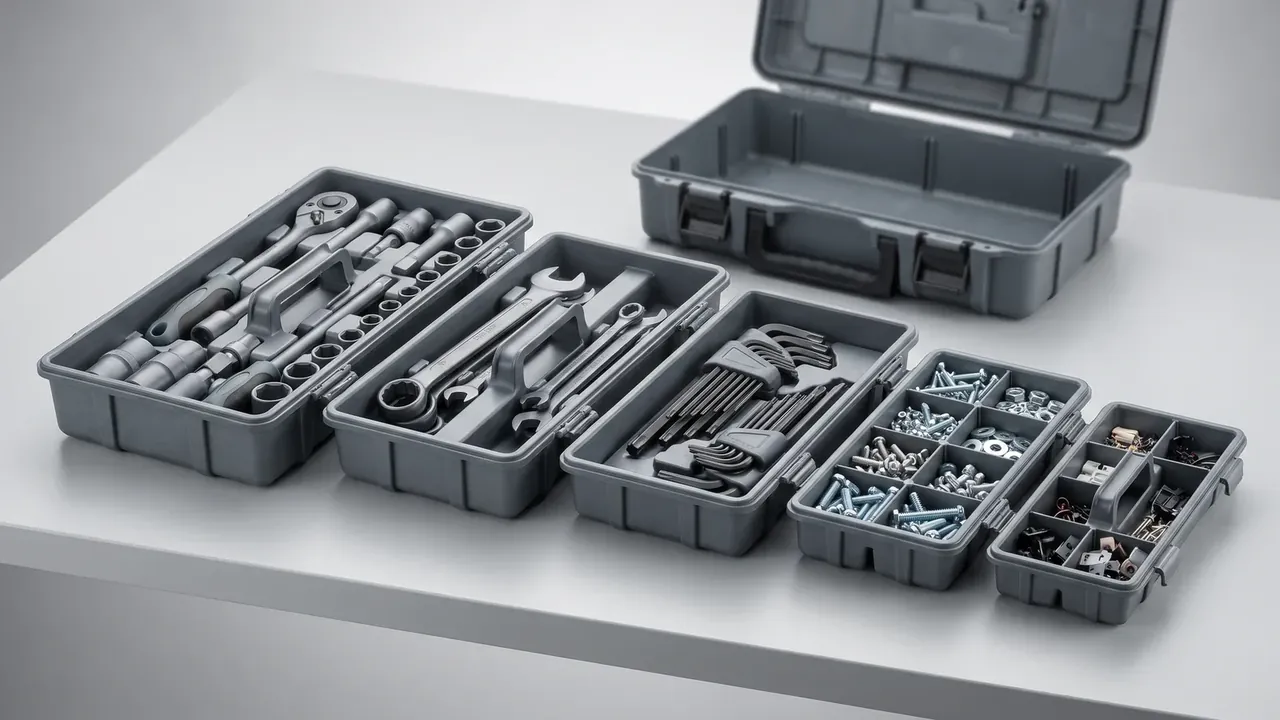
Quick answer: A plastic tool box with removable tray earns its keep on two points: whether the tray comes out with one hand, and whether it works as a parts tray once out. This piece follows that two-level cycle in order.
Table of contents
- Two levels, two rhythms
- Where the tray goes when it comes out
- Tray load and the four clips
- Packing order: heavy first or light first
- Three failures and five checks
- FAQ
1. Two levels, two rhythms
Two levels are two rhythms, not two stores: the top takes one motion, the bay two.
What belongs where follows picks per day. A plastic tool box with removable tray should hold anything lifted 20 times a day upstairs, anything under 3 times downstairs. Split by size and it is easy to draw, slow to use.
| Level | Clear height | Motion | Suits | Test |
|---|---|---|---|---|
| Tray cells | 42 mm deep | One-hand pull | Screws, terminals, bits | 20 picks a day or more |
| Lid pocket | 20 mm | Lift lid | Papers, labels | Once a shift |
| Lower bay | 98 mm | Tray out, two hands | Drill, spanners, cable | 3 picks a day or less |
The mistake that ruins the split is dropping a frequent part into the bay: once it lands, the tray comes out every time.
2. Where the tray goes when it comes out
The tray keeps a 9 mm lip at each corner, so it stands on a bench without tipping.
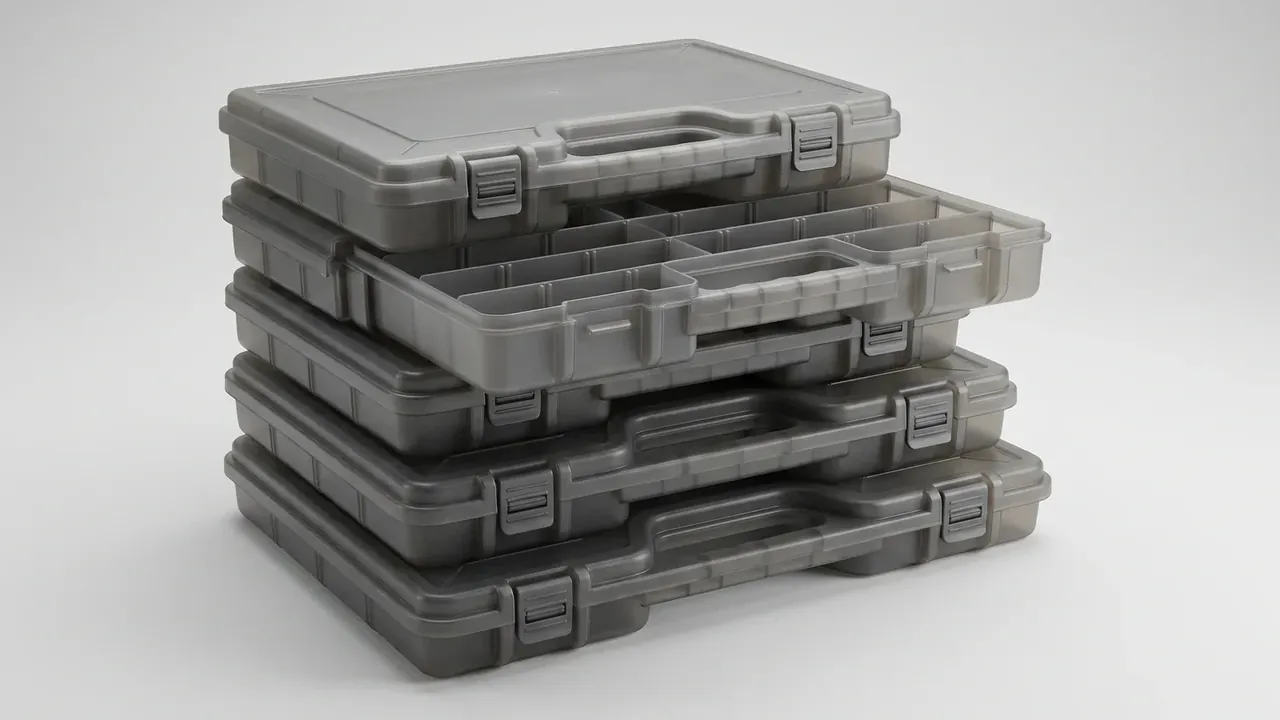
Its footprint is 430 by 310 mm, half a worktop. On a bench 500 mm deep it has to lean against the body.
Two edges make it a parts tray: the base turns up 2 mm so it does not slide off, and cell walls run 1.8 mm so screws do not bow them.
A plastic tool box with removable tray that cannot double as a parts tray is one more thing to carry.
3. Tray load and the four clips
A plastic tool box with removable tray hangs the tray on two clips per side, 2.5 mm tall, with a click at the bottom of travel. At 4.2 kg each clip carries about a kilo.
Clip depth is a trade: under 2 mm a 1.1 m drop walks the tray out, over 3 mm a glove cannot pull it free.
| Clip layout | Height | Pull force | Suits | Risk |
|---|---|---|---|---|
| Two shallow | 2.0 mm | 11 N | Light indoor loads | Pops out on a drop |
| Two standard | 2.5 mm | 16 N | General use | Wants two hands |
| Four deep | 3.2 mm | 24 N | Heavy, vehicle mounted | Hard with gloves |
| One long side | 2.5 mm | 14 N | Narrow bodies | Tray rocks |
Sixteen newtons is the feel to aim for: under 12 N the tray slides out when the box tilts, over 22 N a one-hand pull borrows body weight.
4. Packing order: heavy first or light first
Heavy first, and heavy against the hinge side, so an open box does not tip backwards.
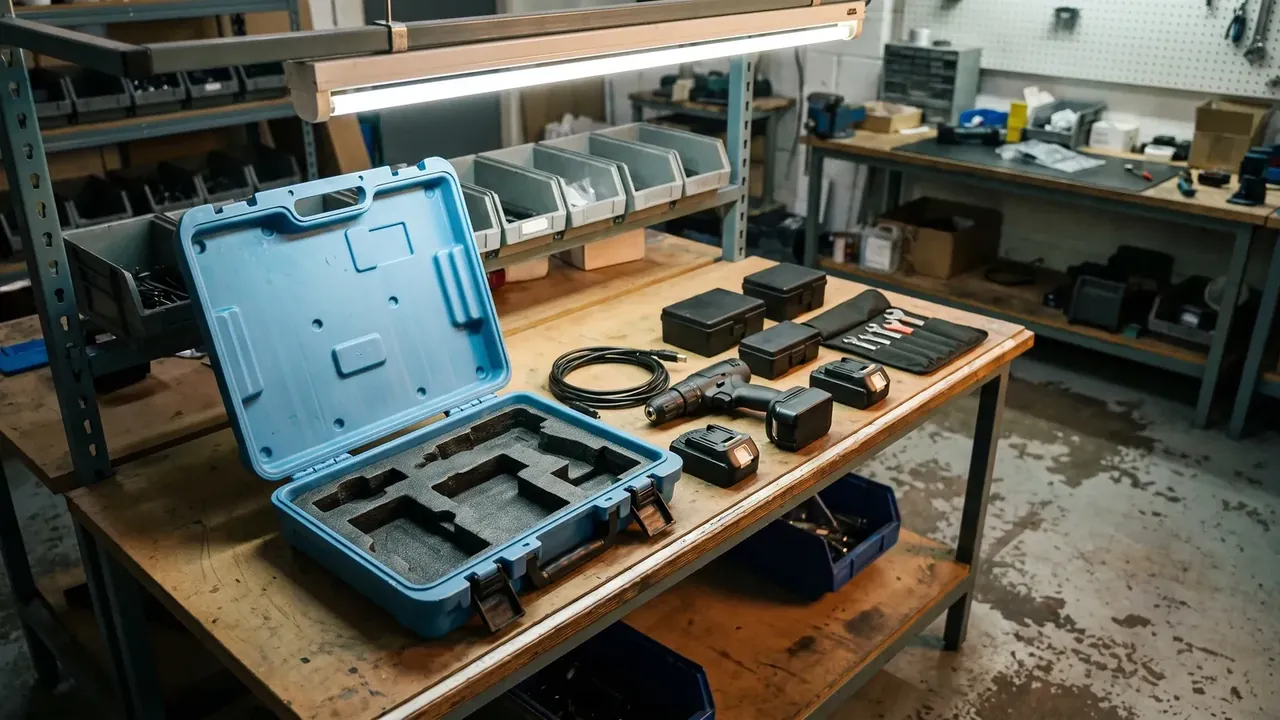
Four steps, in order:
- Lay the body flat, undo both latches, lift the tray out.
- Load heavy parts against the hinge side, long tools along the long axis.
- Drop the tray straight onto both clip pairs and press each corner until it clicks.
- Fill the cells, then press the lid rim once with a palm.
Packed that way, a plastic tool box with removable tray takes 68 seconds; tray first averages 96.
The hidden cost is clip wear: a tray that clicked at month one rattles by month six.
5. Three failures and five checks
The first is a tray that will not seat: one side in its slot, the other on the slot edge, latch open. Usually a 2 mm limit rib was never moulded.
The second is the lid pressing the tray: the rim stands 12 mm, so a part more than 8 mm proud takes a mark and bends a cell wall.
The third is a bay nobody can reach: under 62 mm of opening once the tray is out, a drill has to be poured out.
All three show up by hand in sampling. Seat the tray and watch it drop square; if it stops high, the rib is in the way. Press the lid rim with a palm; a hard stop means a part is proud. Pull the tray slowly; if one side lifts while the other still hangs, the clips are not on one height. Tilt the loaded box 30 degrees, and the tray should stay put. Leave it at 4.2 kg for two hours, measure the diagonals, and 1.6 mm of difference says the floor is soft. Five checks settle whether a plastic tool box with removable tray needs a mould change.
Conclusion
A plastic tool box with removable tray is worth its extra layer because the tray brings the work surface to the hand. Split by pick frequency, clip by load path, pack heavy first, and two levels stay a rhythm instead of a ritual. When choosing a plastic tool box with removable tray, pull the tray once with one hand, then set it on the bench and pour in screws.
This article discusses only the container (case body) side of specifications and design intent and does not cover any handling, loading or use of the contents.
Related Reading
- Hardware tool box layouts on site
- Fixing a tool case inside a vehicle
- Chest formats, lid height and door swing
- Satchels against rigid bodies
Related Products
- 8 Series — Gun Cases; Military Equipment Cases; Camera Equipment Cases; Drone Cases; Watch Cases; Knife Cases; First Aid Cases; Electronics Equipment Cases
- WL8-2812 PP Gun Case — model WL8-2812
- All protective cases and toolboxes: 7 series, 158 models