

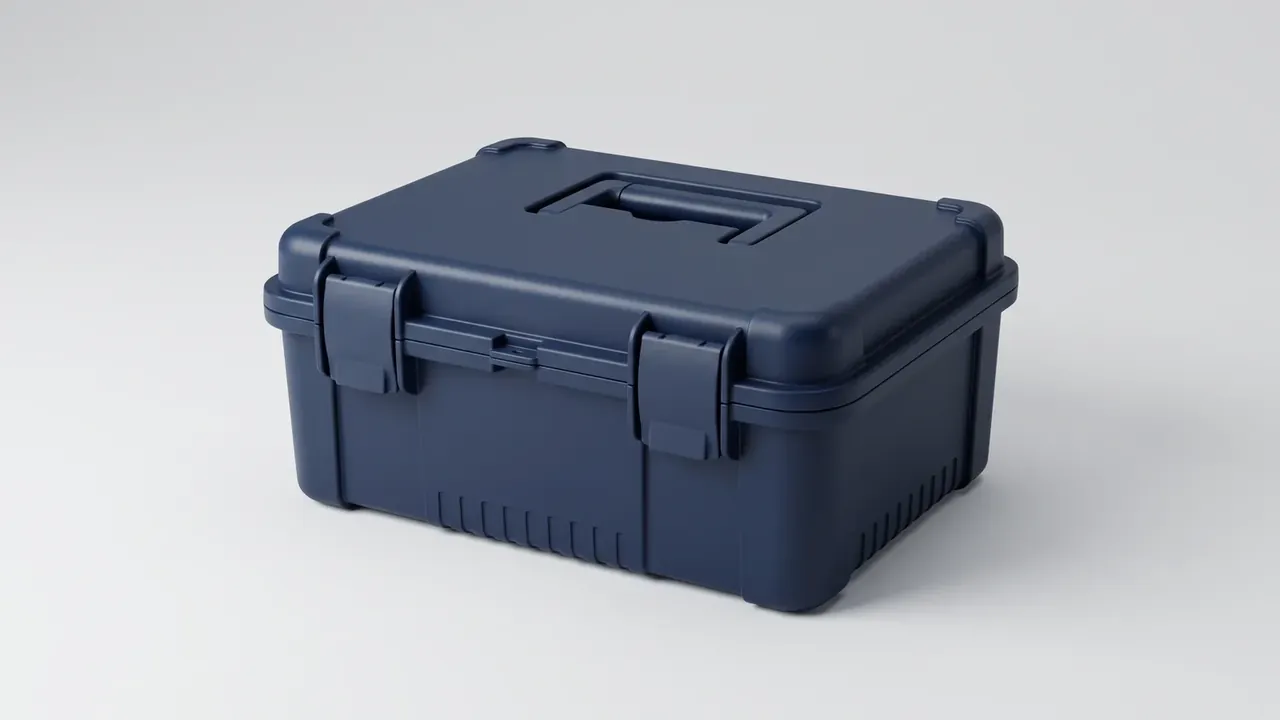
Quick answer: On the same internal volume, a plastic tool box costs CNY 68 against CNY 112 for a powder-coated steel one, and after repainting, hinge swaps and scrap value the five-year figure is CNY 77 against CNY 170. Above 25 kg per box, or in a bay that runs over 70 °C, the arithmetic reverses.
Table of contents
- The Five-Year Ledger
- Wall Thickness Against Lid Stiffness
- Where the Rust Starts
- Sparks, Static and Cutting Fluid
- Three Ways to Depreciate the Same Box
- FAQ
1. The Five-Year Ledger
A line stocked with 1,000 tool boxes shows three numbers: purchasing sees CNY 44,000 against CNY 112,000, maintenance two repainting rounds a year, safety a chipped corner that cut a wrist.
The plastic tool box is a copolymer PP moulding, 2.2 to 2.8 mm wall, 1.6 kg, CNY 68 for 1,000 pieces. The steel box reaches the same 470 × 250 × 220 mm interior from 0.8 mm sheet folded 12 mm, at CNY 112 and 2.9 kg. The CNY 44 buys lid stiffness; the extra 1.3 kg is what an operator lifts forty times a shift.
| Item | Plastic tool box (PP) | Metal tool box (0.8 mm sheet) |
|---|---|---|
| Unit price, 1,000 pcs | CNY 68 | CNY 112 |
| Empty weight | 1.6 kg | 2.9 kg |
| Replacement over 5 years | 12% (8-year life) | 5% |
| Repainting, 5 years | none | 2 rounds × CNY 38 |
| Hardware renewal | latches 8%, CNY 4 | hinges 35%, CNY 22 |
| Five-year amortised cost | CNY 77 | CNY 134 |
Repaint labour is the line most quotes omit: sanding, primer, 4 hours of flash-off, topcoat, 8 more, at CNY 45 an hour. The steel box lands at CNY 170, CNY 93 clear.
Across 1,000 units that gap is CNY 93,000. Purchasing compares the first row only, so the plastic tool box wins every tender; maintenance then files repaint orders that are equally real.
2. Wall Thickness Against Lid Stiffness
Lid stiffness decides whether a tool box can be stood on. Plastic uses wall and ribs, steel uses folded edges, and a 120 kg load separates them.
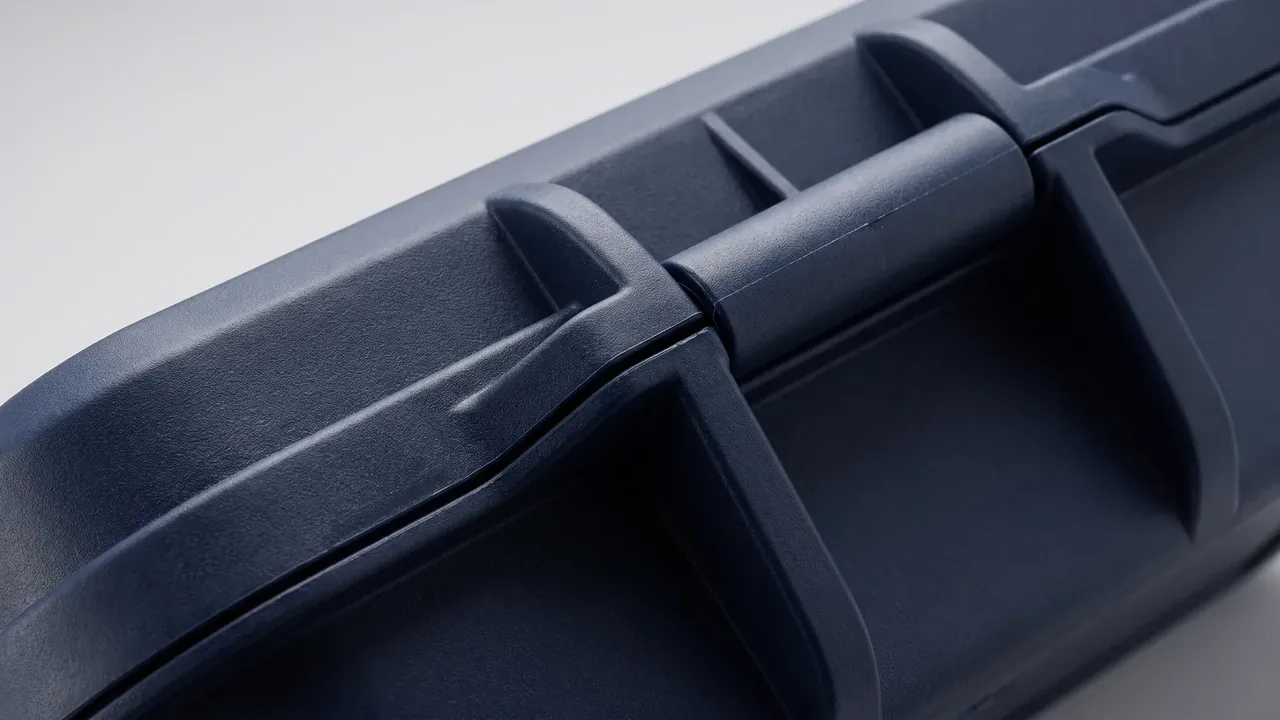
A 120 kg sandbag on the lid for 24 hours deflects a 2.5 mm PP cover with four 6 mm ribs by 1.8 mm; the steel lid with a 12 mm fold deflects 0.6 mm and keeps 0.4 mm of set. Steel wins the number, plastic the recovery.
| Parameter | Plastic tool box | Metal tool box |
|---|---|---|
| Wall | 2.2 to 2.8 mm | 0.8 mm sheet, 12 mm fold |
| Deflection at 120 kg | 1.8 mm | 0.6 mm |
| 1.2 m drop at −10 °C | corner crack 8 mm | corner dent 3 mm |
| 48 h salt spray | no change | blistering at scratches |
| Surface resistance | 10^14 ohm | 10^4 ohm earthed |
Lifting 25 kg, a moulded handle root sees 12 MPa against a PP yield of 28 MPa, a factor of 2.3; a steel handle in 1.2 mm sheet carries 380 N of shear per weld. PP whitens before it lets go, while a poor weld fails without warning. Hinges invert the ranking: 20,000 cycles to 0.6 mm of play for a moulded pin, 12,000 for steel.
3. Where the Rust Starts
A steel tool box never rusts evenly. It starts in four places.
- The folded seam: a 0.8 mm sheet folded 12 mm leaves a 0.3 mm gap that traps rinse water, showing rust in six months
- The welds: incomplete pickling blisters the weld toe within 48 hours of salt spray
- Hinge pins: 8 µm of zinc on a carbon pin wears through in 10,000 cycles, and rust runs down the wall as a yellow line
- Scratches: exposed area over 5 mm² rusts in 24 hours
Repainting is a process, not a touch-up: rust removed to St2, primer at 25 µm, 4 hours of flash-off, topcoat at 40 µm, 8 hours more. In a bay above 65% RH that cycle runs twice a year.
The plastic tool box has no entry here: PP ignores water, and its enemy is ultraviolet. Three years in an open yard yellows the surface and drops falling-ball impact from 60 to 42 kJ/m², while HALS holds the loss to 12%.
4. Sparks, Static and Cutting Fluid
A grinder throws sparks at 1,200 °C and PP melts at 160 to 170 °C, so one spark leaves a 2 to 3 mm crater that cracks in three days; on steel it leaves an ash mark.
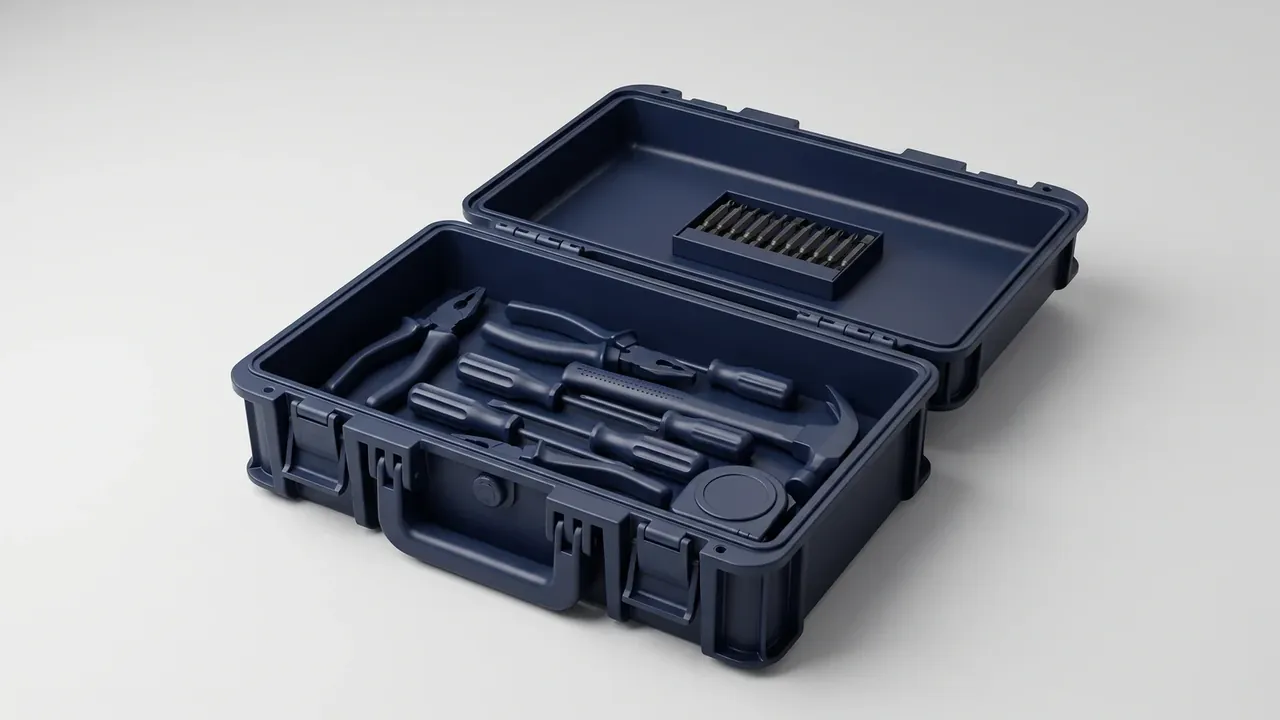
Plain PP sits at 10^14 ohm, enough to bite through a glove on a dry day. An electronics line wants below 10^9 ohm, so the box needs antistatic masterbatch at CNY 9; earthed steel reads 10^4 ohm and passes untouched. Cleaning runs the other way: steel takes a pH 12 alkaline wash, while PP needs a neutral cleaner above pH 12.
| Bay | Recommended | Governing figure | Verdict |
|---|---|---|---|
| Electronics assembly | Antistatic plastic tool box | 10^6 to 10^9 ohm | Plastic; steel needs an earth strap |
| Welding and grinding | Metal tool box | sparks at 1,200 °C | Metal; PP craters crack at 2 mm |
| Chemical patrol | Plastic tool box | pH 2 to 12 | Plastic; acid mist rusts steel in 6 months |
| Loads above 30 kg | Metal tool box | 0.6 mm lid deflection | Metal; PP lids sag 4 mm |
5. Three Ways to Depreciate the Same Box
The same box gives three answers depending on whether labour is counted.
- Price only: CNY 68 against CNY 112, plastic ahead by CNY 44
- Price plus labour: CNY 77 against CNY 170, a gap of CNY 93
- Price, labour and losses: two hex keys lost per box in five years at CNY 18 adds CNY 36 to both, so the gap holds
Order size moves the numbers: at 300 pieces the plastic tool box is CNY 78 and the steel one CNY 126, at 3,000 CNY 64 and CNY 106. Scrap value is booked at zero and is not: steel returns CNY 4.9, regrind CNY 1.4.
Conclusion
The choice comes down to two figures: load per box and bay temperature. Under 20 kg at room temperature, the plastic tool box costs CNY 77 over five years; above 25 kg or near sparks, the metal box at CNY 170 wins because it never needs a new lid.
This article discusses only the container (case body) side of specification and design, and does not cover any handling, loading or use of the contents.
Related Reading
- Tool box lid materials and forming methods
- Derusting and repainting a metal tool chest
- Rotomoulded case bodies and wall distribution
Related Products
- 8 Series — Gun Cases; Military Equipment Cases; Camera Equipment Cases; Drone Cases; Watch Cases; Knife Cases; First Aid Cases; Electronics Equipment Cases
- WL8-2812 PP Gun Case — model WL8-2812
- All protective cases and toolboxes: 7 series, 158 models