

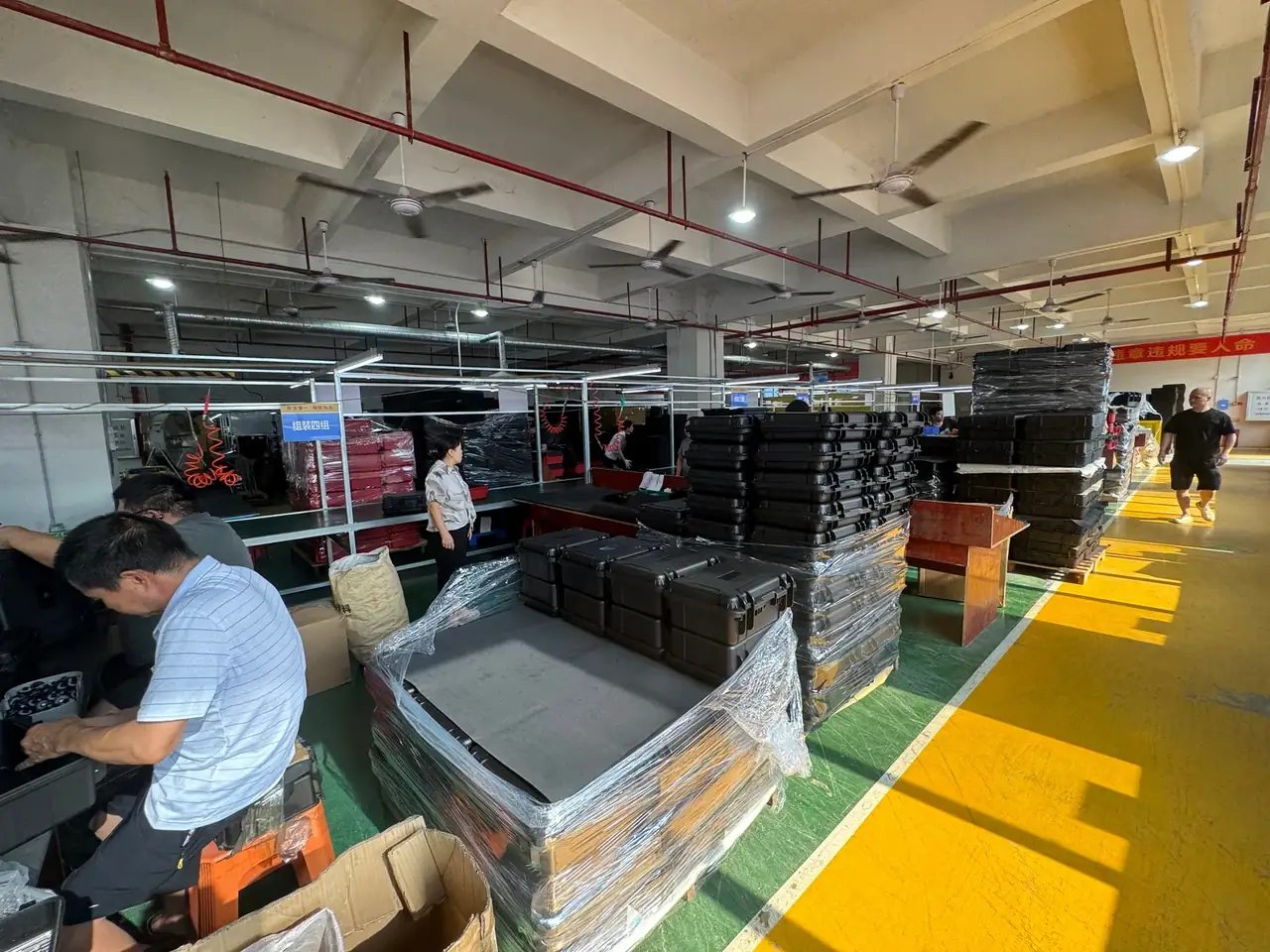
Quick answer: A Police forensic investigation equipment hard case keeps vibration under 3 g across 5–200 Hz and lid diagonal drift within 2 mm after a 1.2 m drop.
Table of contents
- Seal-aperture and lid reinforcement of the Police forensic investigation equipment hard case
- EVA density and vibration isolation values
- Transmitted acceleration across the sweep band
- Diagonal deviation measurement after drop
- Aperture re-check after cycling
- FAQ
1. Seal-aperture and lid reinforcement of the Police forensic investigation equipment hard case
A Police forensic investigation equipment hard case carries two 8 mm seal apertures in the lid, sited in a non-primary-load zone so the opening does not cut the main ribs. A reinforcement collar is moulded around each rim from the same material, leaving the bore wall thicker than the panel. The shell measures 580×420×250 mm outside and 515×355×190 mm inside at a 4.2 mm wall, 6.0 kg empty and 10 kg rated; lid deflection under load is shared by the panel ribs and the collar. Aperture and rib positions are fixed in the tool, so batch units are not re-laid out one by one. Incoming inspection measures bore diameter and rim thickness only, and both must sit inside their bands before the lid moves to closing. Once closed the collar stays clear of the seal edge, which keeps its own compression bead.
Seal zones, rib relations and reinforcement methods are paired in the table below, one reading per row.
| Seal zone | Rib relation | Reinforcement |
|---|---|---|
| Aperture rim | Clear of main ribs | Moulded collar |
| Lid panel | Net gap between ribs | Ribbed panel shares deflection |
| Seal edge | No interference with collar | Independent bead keeps compression |
2. EVA density and vibration isolation values
The Police forensic investigation equipment hard case lines its body with 50 kg/m³ EVA, and the density sets how much acceleration reaches the case floor across the sweep band. Base pad and lid foam are cut from one density, and the liner must sit flat against the floor once the lid closes, since a loose fit adds stray peaks during sweeping. JUNZHIJIA records density, pad thickness and the 10 kg rating on one batch sheet; a change to any of the three sends the unit back for a fresh acceleration read.
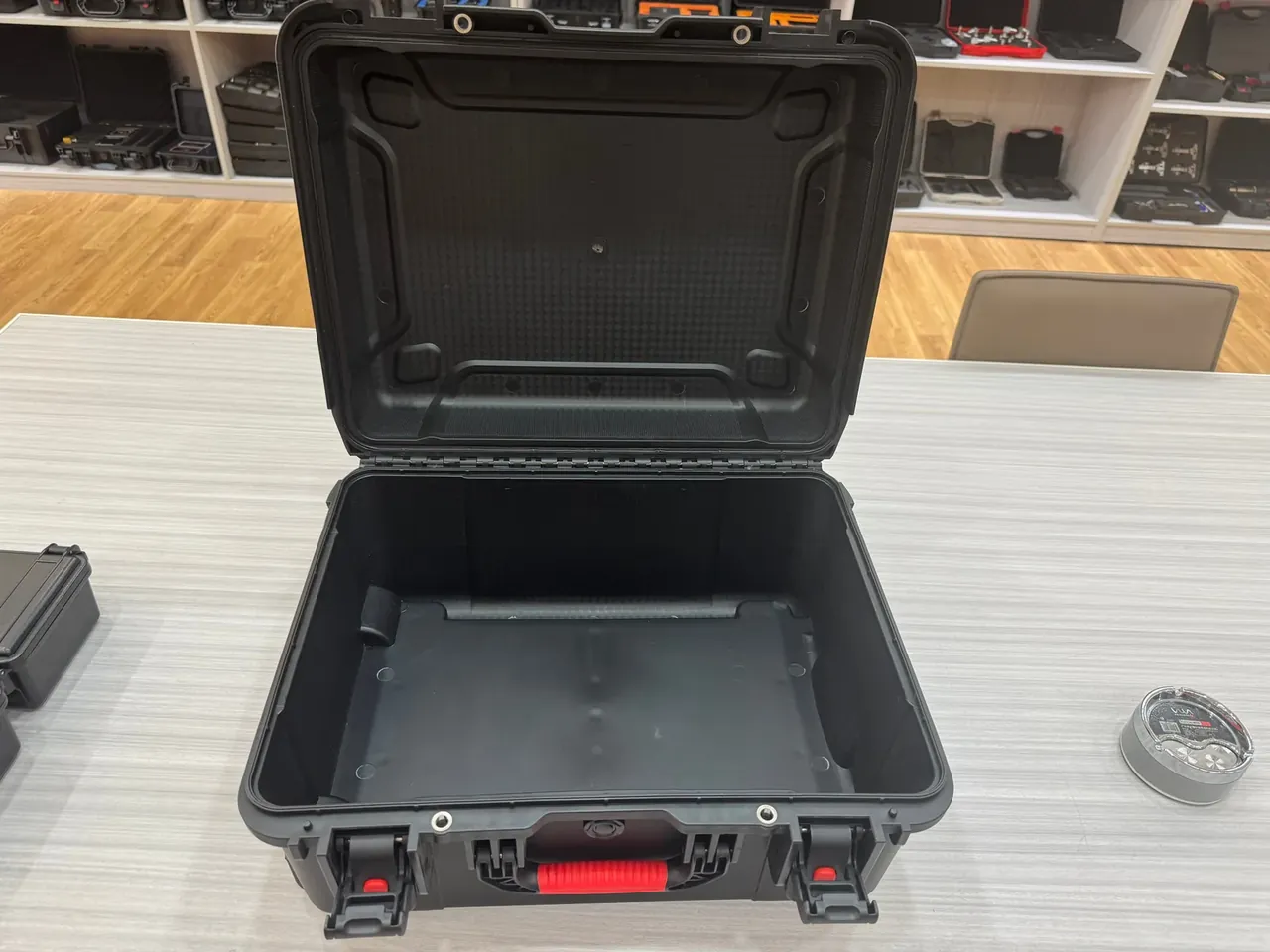
Higher density raises stiffness and narrows the isolation margin. Lower density grows permanent compression set under long-term load.
Assembly checks the fit gap at four liner edges with a feeler gauge; the largest value goes into the first-article file rather than one point standing in for the whole edge.
3. Transmitted acceleration across the sweep band
The sweep rig of the Police forensic investigation equipment hard case runs continuously from 5 to 200 Hz, with an accelerometer on the case floor sampling alongside a table reference channel; transmitted acceleration is the amplitude ratio of the two. Acceptance uses the upper ratio against the 3 g limit, with resonance peaks logged apart. Curves at 50 kg/m³ are filed apart from off-density units, and lid-bead compression is re-read before and after the sweep.
Sampling and reading order are split by the table below; only the full-band row feeds the decision.
| Sweep stage | Sampling | Reading use |
|---|---|---|
| From 5 Hz | Point-by-point ratio | Low-frequency stiffness |
| To 200 Hz | Mark resonance peaks | High-frequency isolation |
| Full 5–200 Hz | Upper amplitude ratio | Compare with the 3 g limit |
4. Diagonal deviation measurement after drop
After a 1.2 m drop of the Police forensic investigation equipment hard case, the difference between the two lid diagonals is the measure of lid deformation: a calliper reads once between each pair of corner marks, and the two readings are subtracted. The limit is 2 mm; excess is checked at the collar and aperture rim before the latch seats, and the whole lid is not rejected outright. The four latches, each at 430 N, are re-read before and after the drop, with force drift logged apart from diagonal deviation.
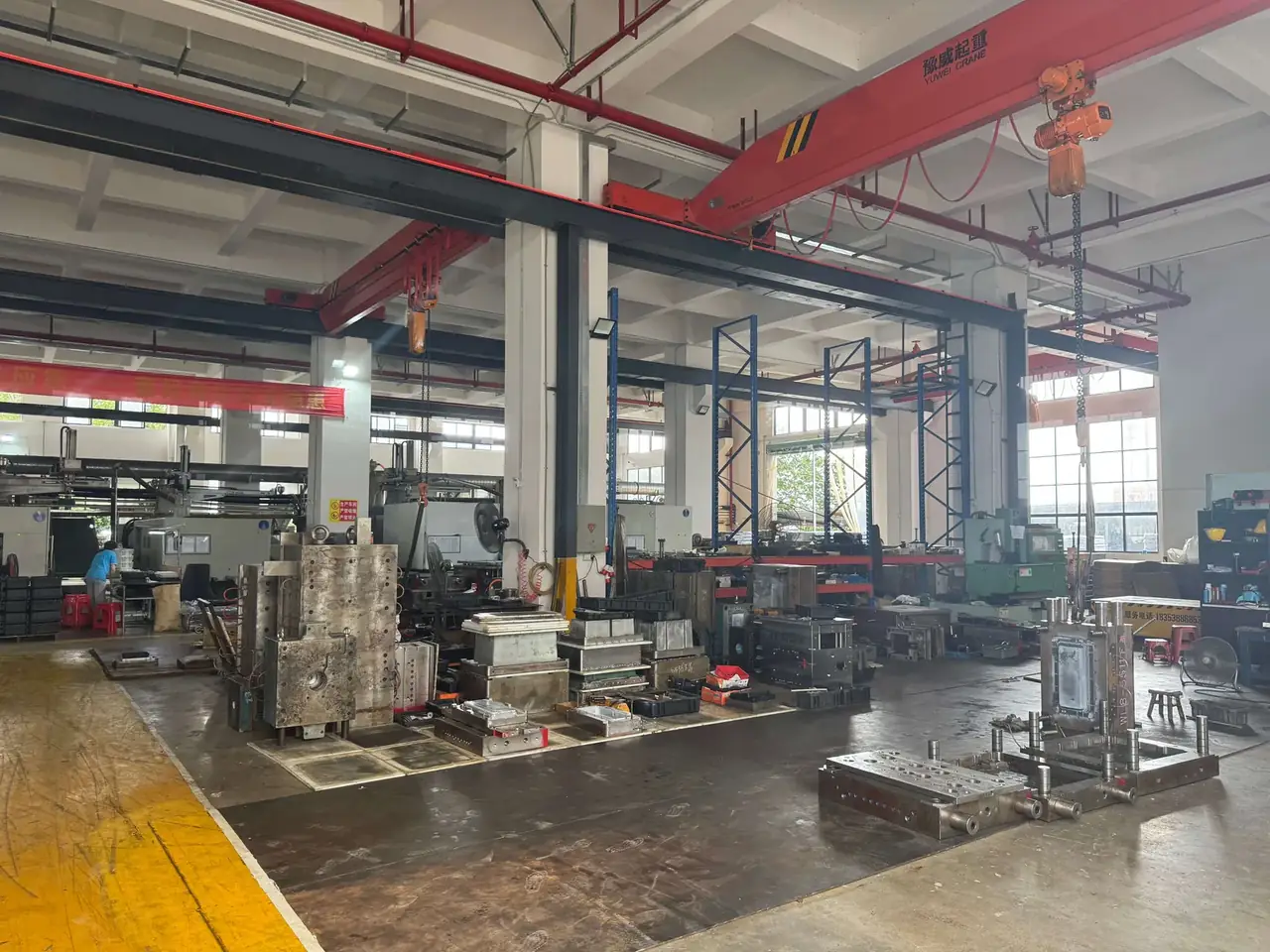
For the Police forensic investigation equipment hard case the IP67 immersion test follows the deformation reading, and the same corner marks are reused rather than re-scribed.
The table below gives the deviation readings by measuring point, with the initial row as a baseline only.
| Deviation reading | Measuring point | Use |
|---|---|---|
| Initial | Two diagonals before drop | Baseline |
| Post-drop | Two diagonals after drop | Compare with baseline |
| Within 2 mm | Difference of the two | Outgoing decision |
5. Aperture re-check after cycling
After 4000 open-close cycles, re-check on the Police forensic investigation equipment hard case centres on the apertures: bore diameter of 8 mm, collar thickness and the net gap to the main ribs, measured with the same gauges used before the drop. A second rim reading follows a 72 h salt spray, where the collar should show no visible crack or peeling and the bore still reads inside its band. Cycling leaves the lid ribs untouched, so re-check accepts aperture geometry and seal-edge compression only, without repeating the sweep curve.
JUNZHIJIA files the Police forensic investigation equipment hard case post-4000-cycle aperture readings beside the first article, while the other dimensions — 580×420×250 mm outside, 515×355×190 mm inside, 4.2 mm wall — stay unchanged. The initial lid-diagonal baseline carries over from that first article, and replacement is limited to the removable seal edge and liner layer.
Conclusion
A Police forensic investigation equipment hard case links four shell-side readings — 8 mm aperture reinforcement, 50 kg/m³ EVA isolation, transmitted acceleration within 3 g across 5–200 Hz and diagonal deviation within 2 mm after a 1.2 m drop — across the lid, liner, sweep rig and deformation check. JUNZHIJIA keeps each figure by benchmark method, and the post-4000-cycle and 72 h spray aperture re-check reuses the first-article baseline, covering shell structure and inspection only.
Related Reading
- Custom foam liner density and thickness values
- Protective case seal materials and compression data
- ESD component case liner surface resistance
- Protective case outgoing inspection checklist
Related Products
- 8 Series — Gun Cases; Military Equipment Cases; Camera Equipment Cases; Drone Cases; Watch Cases; Knife Cases; First Aid Cases; Electronics Equipment Cases
- WL8-2812 PP Gun Case — model WL8-2812
- All protective cases and toolboxes: 7 series, 158 models