

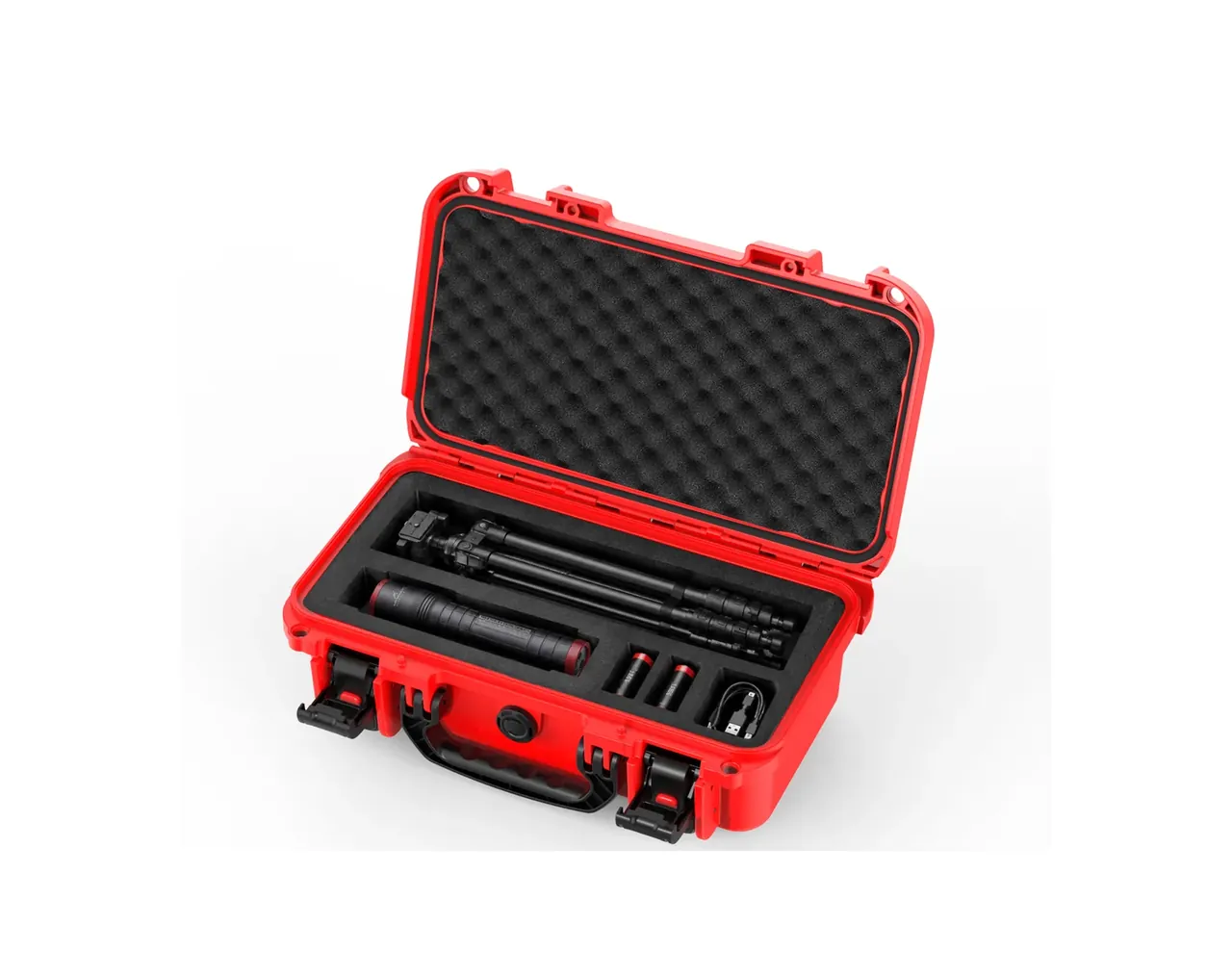
Quick answer: A port tally case fails at the hardware, not the shell: after 7 months at 80 m from the quay, 13 of 16 lifting lugs showed red rust while the plastic only lost gloss, so 480 h and 1000 h salt spray follow coating thickness and lifting follows 2.0 kN per lug.
Table of contents
- Why the lug fails first
- Two timelines from chloride deposition
- Grading red rust on hardware
- Lifting points and rated load
- Three-high stacking and tie-downs
- FAQ
1. Why the lug fails first
A batch of port tally case units, 1200 mm × 800 mm × 620 mm, 21 kg empty and 150 kg loaded, sat in an open yard 80 m from the quay for 7 months. The shells only lost gloss. Thirteen of the 16 lifting lugs carried red rust along the fillet weld, the widest patch 12 mm across, and the M8 threads would no longer turn.
Polypropylene holds no iron, so salt cannot rust it, while ultraviolet light ages it instead. Every weak point sits on metal: lugs, bolts, hinge pins and rings.
One line reading passed salt spray cannot close it: name the part, the hours, and whether the verdict is rust area or protection rating.
2. Two timelines from chloride deposition
Coastal terminals mostly sit in ISO 9223 class C5 at 60–300 mg/(m²·d) of chloride, and at 200 mg/(m²·d) over 210 days a surface collects 42 g/m², the order of 480 h of salt fog.
480 h covers 1 to 2 years of yard exposure and suits boxes that rotate, while 1000 h covers 4 years and beyond. Conditions stay at 35 ℃, 5% sodium chloride, pH 6.5 to 7.2 and 1–2 mL/(80 cm²·h).

In coating terms 480 h needs 8–12 μm of electroplated zinc or 45 μm hot-dip, and the conversion holds inside one family: at equal 8 μm, zinc reaches 3% red rust while zinc flake shows 0.5%.
| Exposure | Chloride mg/(m²·d) | Salt spray | Minimum hardware |
|---|---|---|---|
| Inland quay, C4 | 3–60 | 480 h | 10 μm electroplated zinc |
| Port rear yard, C5 | 60–300 | 480 h | 12 μm zinc or 8 μm zinc flake |
| Quayside yard, C5-M | 300–1500 | 1000 h | 65 μm hot-dip or 316 stainless |
| Ship deck, open | over 1500 | 1000 h plus cycling | 316 stainless, passivated |
3. Grading red rust on hardware
Red rust is judged by defective area, not spot count: 0.5% after 480 h, about Rp 8 under GB/T 6461, and 2% after 1000 h, about Rp 7.
Four groups of six samples were exposed, one pulled at each interval.
| Option | Coating | Rust at 480 h | Rust at 1000 h | Verdict |
|---|---|---|---|---|
| Electroplated lug | 8 μm | 3.0% | Through, threads seized | Reject |
| Heavy electroplated | 12 μm | 0.8% | 8.0% | 480 h only |
| Hot-dip galvanised | 65 μm | 0 | 0.9% | Both pass |
| 316 stainless | Solid | 0 | 0, two pits | Both pass |
Read where rust starts: welds and threads carry the thinnest coating, and the whole 0.9% on hot-dip parts sat in the weld heat-affected zone while the parent metal kept its spangle.
White rust is not failure but the zinc still working; once it turns red the steel is corroding.
4. Lifting points and rated load
The gap between four-point and single-point lifting on a port tally case is 3.5 times. At 150 kg loaded plus 21 kg of shell the total is 171 kg, or 1.68 kN: four vertical legs take 0.42 kN each, 60° takes 0.48 kN and 90° takes 0.59 kN.

One lug alone takes all 1.68 kN, and the 1.5 dynamic factor of port handling turns that into 2.5 kN, 5.2 times its share in a four-leg lift.
Group ratings never add: four lugs at 2.0 kN give 6.0 kN after the 0.75 group factor, and dividing by 1.5 leaves 4.0 kN, or 400 kg, which belongs in the title block.
The weld is rarely the weak link: a 3 mm fillet at 2.1 mm throat over 60 mm gives 126 mm², and 2.5 kN over it is 19.8 MPa against an allowable 80 MPa.
5. Three-high stacking and tie-downs
Stack height follows compression in the bottom corner posts. At 171 kg per loaded port tally case, three high puts 342 kg below, 0.84 kN per corner, or 1.53 MPa on a 550 mm² post.
Allowable at 40 ℃ is 1.6 MPa, so three high leaves 4% margin and is the ceiling; a fourth tier brings 1.26 kN, 2.29 MPa and 0.8 mm of set within 30 days.
| Tiers | Load below, kg | Per corner, kN | Post stress, MPa | Verdict |
|---|---|---|---|---|
| 2 | 171 | 0.42 | 0.76 | Pass, wide margin |
| 3 | 342 | 0.84 | 1.53 | Pass, 4% margin |
| 4 | 513 | 1.26 | 2.29 | 43% over |
| 5 | 684 | 1.68 | 3.05 | Post bulges |
Tie-downs follow side area and strap angle: a 0.74 m² face in a 25 m/s gust sees about 0.28 kN, so four points rated 5 kN are generous, and 25 mm polyester breaking at 12 kN carries 0.71 of it at 45°.
Rings sit low and draw moisture, so they rust first and their coating must match the lugs.
Conclusion
Both clauses belong on one drawing for a port tally case, because either alone surfaces as a failure in month seven. The salt side reads: hours by yard class, 1000 h at C5-M, red rust at or below 0.5% after 480 h and 2% after 1000 h, lugs and rings in 65 μm hot-dip or 316 stainless. The lifting side reads: four points, 2.0 kN per lug, 0.75 group factor, 1.5 dynamic factor, 400 kg total, stacking capped at three tiers with post stress at or below 1.6 MPa. Score both at acceptance: a box that passes 1000 h but is rated for single-point lifting fails, and so does one rated for four points with hardware left at 8 μm.
This article discusses container-side specifications and design implications only, and does not cover any handling, loading or use of the contents.
Related Reading
- Case configuration for port and sea freight
- How long a case salt spray test should run
- Cleaning cases after salt deposits
- Ground support case layout at airports
Related Products
- 8 Series — Gun Cases; Military Equipment Cases; Camera Equipment Cases; Drone Cases; Watch Cases; Knife Cases; First Aid Cases; Electronics Equipment Cases
- WL8-2812 PP Gun Case — model WL8-2812
- All protective cases and toolboxes: 7 series, 158 models